


 Home
HomeNexCOBOT tackles physical AI market barriers and growth
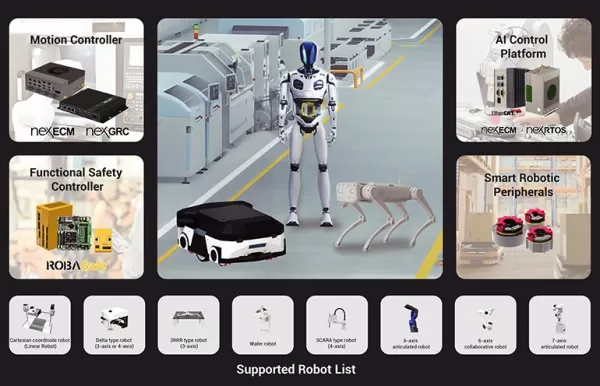
NexCOBOT, showcased at the Robotics Summit & Expo, offers a diverse range of controllers. Source: NexCOBOT
Humanoid robotics and physical AI firms are not only securing billions in funding; they are also being acquired by major technology corporations. This trend significantly impacts industrial adoption, according to Jenny Shern, general manager at NexCOBOT.
For example, Mobileye acquired Mentee Robotics for $900 million in January, Amazon purchased Fauna Robotics in March, and Meta acquired Assured Robot Intelligence in May.
“Starting last year, our team received numerous requests from companies developing legged robots, including quadrupeds and humanoids, as well as mobile manipulators,” Shern told The Robot Report. “Our controllers are compatible with both traditional robots and these emerging system types.”
NexCOBOT was spun out from NEXCOM Group’s IoT Automation Solutions business unit in 2018. Based in New Taipei City, Taiwan, the company provides motion controllers, functional safety controllers, peripheral components, and design verification consulting services to robotics developers and manufacturers.
Shern outlined her views on the evolving physical AI market.
Big Tech views acquisitions as a rapid route to innovation
Do you anticipate more acquisitions in the future?
Shern: Acquisitions will likely persist as robotics becomes increasingly critical to major tech companies. Smaller robotics firms and startups often possess deep expertise in areas like robot learning, perception, or autonomous control, whereas larger corporations have the computing infrastructure, data resources, and capital required to scale these innovations.
As AI models continue to advance, acquiring these companies provides a quicker route for “Big Tech” firms to streamline development and establish a foothold in what many consider the next phase of intelligent systems.
How is NexCOBOT performing regarding its own funding?
Shern: In line with company policy, we do not disclose details regarding specific internal finances or independent funding. However, we can confirm that NexCOBOT maintains a highly stable financial position.
Our priorities are entirely focused on scaling our open, functional safety robotic controllers and fulfilling our substantial backlog of global orders as we move toward mass production.
AI-native robots must still demonstrate reliability and safety
While U.S. funding for physical AI and large rounds has increased, overall VC investment in early-stage companies has reportedly declined. What does this mean for robotics developers and innovation?
Shern: This creates a more selective funding landscape for robotics developers. Capital remains available for companies that demonstrate strong technical differentiation and a clear path to commercialization, but early-stage startups may face greater pressure to validate their business models sooner. While this could slow the number of new entrants, it may also encourage more focused robotics innovation aimed at solving real operational challenges.
Additionally, the industry may see increased collaboration between startups, industrial companies, and larger technology firms as developers seek alternative paths to scale development and bring new technologies to market.
You’ve referred to “AI-native robots.” What do you mean by that term, and how quickly are they maturing?
Shern: AI-native robots are systems originally designed to incorporate AI as a core component of how they perceive, make decisions, and interact with their environment. Traditional robots typically follow predefined instructions in structured settings, while AI-native robots are built to adapt to changing conditions and learn from new inputs.
We are witnessing rapid progress, particularly in perception, motion planning, and human-robot interaction. However, for industrial applications, reliability and safety remain critical requirements, so adoption will continue to advance in stages as the technology proves itself in real-world environments.
Software can enable physical AI to scale, says NexCOBOT
Since software and AI development typically move faster than robotics hardware, how can Big Tech combine the strengths of each?
Shern: Big Tech can help bridge this speed disparity while leveraging the strengths of both industries by separating software innovation from hardware development wherever possible.
AI models and software can be updated and improved continuously, while robotics hardware typically requires longer design, testing, and deployment cycles to meet reliability and safety standards.
By building on modular platforms and standardized interfaces, new AI capabilities can be deployed onto existing robotic systems without waiting for entirely new hardware generations. This allows robotics developers to take advantage of the pace of AI advancement while maintaining the stability and durability that industrial applications demand.
Can you give an example of where open ecosystems have benefitted both the tech suppliers and the users?
Shern: One recent example is the growing adoption of open robot control platforms, which allows manufacturers to integrate components from different vendors rather than relying on a single proprietary ecosystem. This gives users greater flexibility to choose the technologies that best fit their applications while reducing integration complexity.
Consider a recent client case: By deploying our certified functional safety controller based on an open system, we helped the client shorten its development cycle from an estimated three to five years down to just two years.
For suppliers, open ecosystems expand market opportunities because their products can work across a wider range of platforms and industries. We are also seeing them drive increased collaboration around AI frameworks and software tools, which helps accelerate development while lowering barriers to adoption.
NexCOBOT sees physical AI expanding
Are there particular segments where you see big tech companies moving into with physical AI – will it be in established industries or new applications for robots and automation?
Shern: I expect activity in both segments. Established industries like manufacturing, logistics, and warehousing already have clear business use cases for automation, which makes them attractive opportunities for scaling physical AI.
At the same time, advances in AI are opening possibilities in less structured environments where robotics traditionally struggle, including service applications and healthcare support. The most immediate adoption will likely happen where there is already strong demand, but the long-term impact could extend far beyond traditional industrial settings.
Are there certain types of robots that are more likely to get picked up by Big Tech – or not?
Shern: Robots that generate large amounts of operational data and can benefit directly from advances in AI are likely to attract the most attention from Big Tech. Humanoid robots, mobile robots, and systems designed for dynamic environments align closely with large technology companies’ strengths in AI, computing infrastructure, and software development.
Highly specialized robots built for a narrow industrial process may be less attractive unless they provide unique intellectual property or address a particularly large market opportunity. Ultimately, companies will look for robotics technologies that can scale across multiple applications and create long-term business advantages.
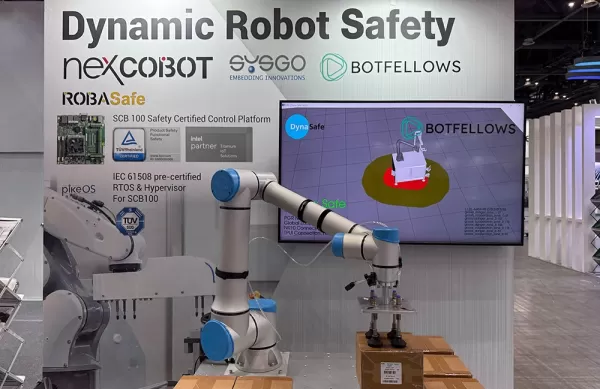
NexCOBOT’s Functional Safety system, ROBASafe, shortens the overall development life cycle for customers and provides faster time-to-market solution. | Source: NexCOBOT
Related article
 RoboStore Unveils New Company Robo Inc. to Accelerate Robot Adoption by U.S. Businesses
RoboStore has supplied Unitree robots to over 4,000 customers across the United States. Source: RoboStore
As labor shortages and increasing competitive pressures take hold, more companies are seeking to bring robotics production and adoption in-hous
Amazon CEO Touts Robotics as Key to Faster Delivery and Lower Costs
On the left is the RIVR TWO robot, and on the right is Fauna Robotics' Sprout. | Sources: RIVR, Fauna RoboticsIn his 2026 letter to shareholders, Amazon.com Inc. CEO Andy Jassy outlined the company's strategic focus on robotics. He emphasized that Am
Queue secures funding to develop fully autonomous pharmacy
Queue leverages automation to streamline prescription processing. Source: QueueQueue has officially launched from stealth, unveiling an autonomous pharmacy system alongside a $12.6 million seed funding round. The company states its technology is engi
Related Special Topic Recommendations
Animation Creation
RoboStore Unveils New Company Robo Inc. to Accelerate Robot Adoption by U.S. Businesses
RoboStore has supplied Unitree robots to over 4,000 customers across the United States. Source: RoboStore
As labor shortages and increasing competitive pressures take hold, more companies are seeking to bring robotics production and adoption in-hous
Amazon CEO Touts Robotics as Key to Faster Delivery and Lower Costs
On the left is the RIVR TWO robot, and on the right is Fauna Robotics' Sprout. | Sources: RIVR, Fauna RoboticsIn his 2026 letter to shareholders, Amazon.com Inc. CEO Andy Jassy outlined the company's strategic focus on robotics. He emphasized that Am
Queue secures funding to develop fully autonomous pharmacy
Queue leverages automation to streamline prescription processing. Source: QueueQueue has officially launched from stealth, unveiling an autonomous pharmacy system alongside a $12.6 million seed funding round. The company states its technology is engi
Related Special Topic Recommendations
Animation Creation
 Best AI Animation Generators: Turn Ideas into Motion Clips Fast
2026 Latest Best Top-Rated AI Animation Generators! XIX.AI curates a powerful game-changing collection of must-try tools for turning creative ideas into high-quality motion clips swiftly. Each option has undergone rigorous real-world tests, featuring detailed free vs paid comparison and updated weekly rankings to help you find the perfect fit for boosting your animation productivity. Explore now to unlock your AI edge!
 11 tools
 xix.ai
Text-to-speech
Top Multilingual AI Voice Generators: Localize Audio at Scale
xix.ai
Text-to-speech
Top Multilingual AI Voice Generators: Localize Audio at Scale
2026 Latest Top-Rated Best Multilingual AI Voice Generators for Large-Scale Audio Localization. This curated list features powerful, game-changing tools that deliver high-quality localized audio fast. Each option has undergone rigorous real-world tests to ensure reliability. Get a free vs paid comparison and discover the perfect fit for your projects. Explore now at XIX.AI to unlock your AI edge.
18 tools
xix.ai
writing
Best AI Outline Generators for Long-Form SEO Articles, Briefs, and Pillar Pages
2026 Latest Best Top-rated AI Outline Generators for Long-Form SEO Articles, Briefs, and Pillar Pages. XIX.AI curates a powerful game-changing collection that undergoes weekly updated real-world tests to deliver must-try tools perfect for boosting writing efficiency, streamlining content creation, and unlocking your AI edge. Explore now to discover your perfect tool for top SEO results.
11 tools
xix.ai
Meeting Assistant
AI Voice-to-Minutes Assistants: Convert Team Talks into Clean Notes
2026 Latest Best Top-Rated AI Voice-to-Minutes Assistants Guide! XIX.AI has curated a highly powerful, game-changing collection of tools designed to transform every team conversation into flawless, organized notes instantly. Our weekly updated rankings cover free vs paid options, along with real-world tests showing their effectiveness for boosting productivity across all work scenarios. Must-try for anyone looking to unlock their AI edge. Explore now!
9 tools
xix.ai
Animation Creation
Best AI Lip-Sync Generators for Dialogue Scenes
2026 Latest Best Top-Rated AI Lip-Sync Generators for Dialogue Scenes are here on XIX.AI! This curated collection features powerful, game-changing tools that deliver flawless synchronized lip movements for any script, boosting your video editing efficiency significantly. Enjoy a free vs paid comparison along with real-world tests and weekly updated rankings to help you find the must-try perfect fit. Explore now to unlock your AI edge!
8 tools
xix.ai
Prompt
AI Prompt Optimizers: Refine Instructions for Better Output Quality
2026 Latest Best Top-Rated AI Prompt Optimizers Curated for Maximum Output Quality! XIX.AI delivers powerful game-changing solutions that help you refine instructions effortlessly, boost writing efficiency, and unlock higher-quality results every time. Get a free vs paid comparison along with real-world tests and weekly updated rankings. Explore now to Discover your perfect tool and Unlock your AI edge!
16 tools
xix.ai

 Comments (0)
0/500
Comments (0)
0/500
NexCOBOT, showcased at the Robotics Summit & Expo, offers a diverse range of controllers. Source: NexCOBOT
Humanoid robotics and physical AI firms are not only securing billions in funding; they are also being acquired by major technology corporations. This trend significantly impacts industrial adoption, according to Jenny Shern, general manager at NexCOBOT.
For example, Mobileye acquired Mentee Robotics for $900 million in January, Amazon purchased Fauna Robotics in March, and Meta acquired Assured Robot Intelligence in May.
“Starting last year, our team received numerous requests from companies developing legged robots, including quadrupeds and humanoids, as well as mobile manipulators,” Shern told The Robot Report. “Our controllers are compatible with both traditional robots and these emerging system types.”
NexCOBOT was spun out from NEXCOM Group’s IoT Automation Solutions business unit in 2018. Based in New Taipei City, Taiwan, the company provides motion controllers, functional safety controllers, peripheral components, and design verification consulting services to robotics developers and manufacturers.
Shern outlined her views on the evolving physical AI market.
Big Tech views acquisitions as a rapid route to innovation
Do you anticipate more acquisitions in the future?
Shern: Acquisitions will likely persist as robotics becomes increasingly critical to major tech companies. Smaller robotics firms and startups often possess deep expertise in areas like robot learning, perception, or autonomous control, whereas larger corporations have the computing infrastructure, data resources, and capital required to scale these innovations.
As AI models continue to advance, acquiring these companies provides a quicker route for “Big Tech” firms to streamline development and establish a foothold in what many consider the next phase of intelligent systems.
How is NexCOBOT performing regarding its own funding?
Shern: In line with company policy, we do not disclose details regarding specific internal finances or independent funding. However, we can confirm that NexCOBOT maintains a highly stable financial position.
Our priorities are entirely focused on scaling our open, functional safety robotic controllers and fulfilling our substantial backlog of global orders as we move toward mass production.
AI-native robots must still demonstrate reliability and safety
While U.S. funding for physical AI and large rounds has increased, overall VC investment in early-stage companies has reportedly declined. What does this mean for robotics developers and innovation?
Shern: This creates a more selective funding landscape for robotics developers. Capital remains available for companies that demonstrate strong technical differentiation and a clear path to commercialization, but early-stage startups may face greater pressure to validate their business models sooner. While this could slow the number of new entrants, it may also encourage more focused robotics innovation aimed at solving real operational challenges.
Additionally, the industry may see increased collaboration between startups, industrial companies, and larger technology firms as developers seek alternative paths to scale development and bring new technologies to market.
You’ve referred to “AI-native robots.” What do you mean by that term, and how quickly are they maturing?
Shern: AI-native robots are systems originally designed to incorporate AI as a core component of how they perceive, make decisions, and interact with their environment. Traditional robots typically follow predefined instructions in structured settings, while AI-native robots are built to adapt to changing conditions and learn from new inputs.
We are witnessing rapid progress, particularly in perception, motion planning, and human-robot interaction. However, for industrial applications, reliability and safety remain critical requirements, so adoption will continue to advance in stages as the technology proves itself in real-world environments.
Software can enable physical AI to scale, says NexCOBOT
Since software and AI development typically move faster than robotics hardware, how can Big Tech combine the strengths of each?
Shern: Big Tech can help bridge this speed disparity while leveraging the strengths of both industries by separating software innovation from hardware development wherever possible.
AI models and software can be updated and improved continuously, while robotics hardware typically requires longer design, testing, and deployment cycles to meet reliability and safety standards.
By building on modular platforms and standardized interfaces, new AI capabilities can be deployed onto existing robotic systems without waiting for entirely new hardware generations. This allows robotics developers to take advantage of the pace of AI advancement while maintaining the stability and durability that industrial applications demand.
Can you give an example of where open ecosystems have benefitted both the tech suppliers and the users?
Shern: One recent example is the growing adoption of open robot control platforms, which allows manufacturers to integrate components from different vendors rather than relying on a single proprietary ecosystem. This gives users greater flexibility to choose the technologies that best fit their applications while reducing integration complexity.
Consider a recent client case: By deploying our certified functional safety controller based on an open system, we helped the client shorten its development cycle from an estimated three to five years down to just two years.
For suppliers, open ecosystems expand market opportunities because their products can work across a wider range of platforms and industries. We are also seeing them drive increased collaboration around AI frameworks and software tools, which helps accelerate development while lowering barriers to adoption.
NexCOBOT sees physical AI expanding
Are there particular segments where you see big tech companies moving into with physical AI – will it be in established industries or new applications for robots and automation?
Shern: I expect activity in both segments. Established industries like manufacturing, logistics, and warehousing already have clear business use cases for automation, which makes them attractive opportunities for scaling physical AI.
At the same time, advances in AI are opening possibilities in less structured environments where robotics traditionally struggle, including service applications and healthcare support. The most immediate adoption will likely happen where there is already strong demand, but the long-term impact could extend far beyond traditional industrial settings.
Are there certain types of robots that are more likely to get picked up by Big Tech – or not?
Shern: Robots that generate large amounts of operational data and can benefit directly from advances in AI are likely to attract the most attention from Big Tech. Humanoid robots, mobile robots, and systems designed for dynamic environments align closely with large technology companies’ strengths in AI, computing infrastructure, and software development.
Highly specialized robots built for a narrow industrial process may be less attractive unless they provide unique intellectual property or address a particularly large market opportunity. Ultimately, companies will look for robotics technologies that can scale across multiple applications and create long-term business advantages.
NexCOBOT’s Functional Safety system, ROBASafe, shortens the overall development life cycle for customers and provides faster time-to-market solution. | Source: NexCOBOT







 RoboStore Unveils New Company Robo Inc. to Accelerate Robot Adoption by U.S. Businesses
RoboStore has supplied Unitree robots to over 4,000 customers across the United States. Source: RoboStore
As labor shortages and increasing competitive pressures take hold, more companies are seeking to bring robotics production and adoption in-hous
Amazon CEO Touts Robotics as Key to Faster Delivery and Lower Costs
On the left is the RIVR TWO robot, and on the right is Fauna Robotics' Sprout. | Sources: RIVR, Fauna RoboticsIn his 2026 letter to shareholders, Amazon.com Inc. CEO Andy Jassy outlined the company's strategic focus on robotics. He emphasized that Am
RoboStore Unveils New Company Robo Inc. to Accelerate Robot Adoption by U.S. Businesses
RoboStore has supplied Unitree robots to over 4,000 customers across the United States. Source: RoboStore
As labor shortages and increasing competitive pressures take hold, more companies are seeking to bring robotics production and adoption in-hous
Amazon CEO Touts Robotics as Key to Faster Delivery and Lower Costs
On the left is the RIVR TWO robot, and on the right is Fauna Robotics' Sprout. | Sources: RIVR, Fauna RoboticsIn his 2026 letter to shareholders, Amazon.com Inc. CEO Andy Jassy outlined the company's strategic focus on robotics. He emphasized that Am
 Queue secures funding to develop fully autonomous pharmacy
Queue leverages automation to streamline prescription processing. Source: QueueQueue has officially launched from stealth, unveiling an autonomous pharmacy system alongside a $12.6 million seed funding round. The company states its technology is engi
Queue secures funding to develop fully autonomous pharmacy
Queue leverages automation to streamline prescription processing. Source: QueueQueue has officially launched from stealth, unveiling an autonomous pharmacy system alongside a $12.6 million seed funding round. The company states its technology is engi

2026 Latest Best Top-Rated AI Animation Generators! XIX.AI curates a powerful game-changing collection of must-try tools for turning creative ideas into high-quality motion clips swiftly. Each option has undergone rigorous real-world tests, featuring detailed free vs paid comparison and updated weekly rankings to help you find the perfect fit for boosting your animation productivity. Explore now to unlock your AI edge!
11 tools
xix.ai

2026 Latest Top-Rated Best Multilingual AI Voice Generators for Large-Scale Audio Localization. This curated list features powerful, game-changing tools that deliver high-quality localized audio fast. Each option has undergone rigorous real-world tests to ensure reliability. Get a free vs paid comparison and discover the perfect fit for your projects. Explore now at XIX.AI to unlock your AI edge.
18 tools
xix.ai

2026 Latest Best Top-rated AI Outline Generators for Long-Form SEO Articles, Briefs, and Pillar Pages. XIX.AI curates a powerful game-changing collection that undergoes weekly updated real-world tests to deliver must-try tools perfect for boosting writing efficiency, streamlining content creation, and unlocking your AI edge. Explore now to discover your perfect tool for top SEO results.
11 tools
xix.ai

2026 Latest Best Top-Rated AI Voice-to-Minutes Assistants Guide! XIX.AI has curated a highly powerful, game-changing collection of tools designed to transform every team conversation into flawless, organized notes instantly. Our weekly updated rankings cover free vs paid options, along with real-world tests showing their effectiveness for boosting productivity across all work scenarios. Must-try for anyone looking to unlock their AI edge. Explore now!
9 tools
xix.ai

2026 Latest Best Top-Rated AI Lip-Sync Generators for Dialogue Scenes are here on XIX.AI! This curated collection features powerful, game-changing tools that deliver flawless synchronized lip movements for any script, boosting your video editing efficiency significantly. Enjoy a free vs paid comparison along with real-world tests and weekly updated rankings to help you find the must-try perfect fit. Explore now to unlock your AI edge!
8 tools
xix.ai

2026 Latest Best Top-Rated AI Prompt Optimizers Curated for Maximum Output Quality! XIX.AI delivers powerful game-changing solutions that help you refine instructions effortlessly, boost writing efficiency, and unlock higher-quality results every time. Get a free vs paid comparison along with real-world tests and weekly updated rankings. Explore now to Discover your perfect tool and Unlock your AI edge!
16 tools
xix.ai












