


 Home
HomeGeneralist Unveils GEN-1 General-Purpose AI Model for Physical Systems
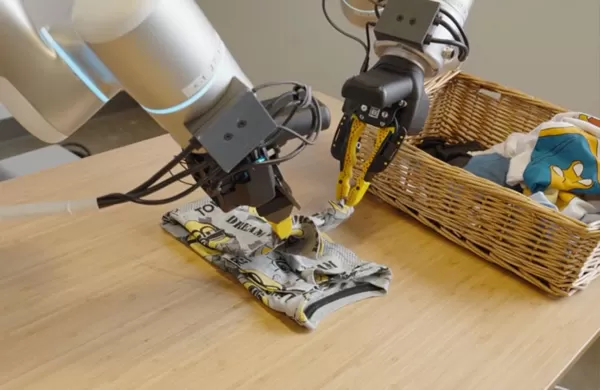
To develop GEN-1, Generalist enhanced training stability, created custom kernels, devised novel paged attention methods for real-time inference, refined post-training techniques, and improved controls for smoother, more precise operation. | Source: Generalist AI
Generalist AI Inc. unveiled its GEN-1 general-purpose AI model for robotics yesterday. The company states the system boosts average task success rates to 99%, up from 64% with prior models. It also completes tasks approximately three times faster than current methods, achieving these results with just one hour of robot data per task, according to Generalist.
Founded in 2024, the company develops embodied foundation models for versatile robots. Based in San Mateo, California, Generalist claims GEN-1 "unlocks commercial viability across a wide spectrum of applications." This release follows just five months after its GEN-0 model, which the company said confirmed the existence of scaling laws in robotics.
While optimistic about the AI model's advancement, Generalist acknowledged that GEN-1 cannot solve every task. The startup added that some real-world applications would require success rates exceeding 99% to be practically useful.
Editor’s note: Sessions on embodied and physical AI development will be featured at the 2026 Robotics Summit & Expo on May 27 and 28 in Boston. Registration is now open.
GEN-1 trains on real-world data, scaling up from GEN-0
GEN-1 builds upon GEN-0's foundation through further scaling and algorithmic improvements to begin mastering basic tasks, Generalist AI explained. The model was trained from the ground up on the company's dataset comprising half a million hours of real-world data.
With GEN-0, Generalist demonstrated that robot learning can be scaled in a generalized manner, similar to the predictable progress seen in language models. The company noted that every zero-shot task it monitored showed simultaneous improvement. However, it admitted the model's performance "was not sufficient for commercial deployment."
GEN-1 is the result of increased data and computational scaling, accelerated by algorithmic breakthroughs, stated Generalist. The company reports that some tasks are now reaching the performance threshold required for economically viable real-world use.
The company pointed out that previous general robotics models achieving over 90% success relied on massive, expensive, and difficult-to-scale teleoperation datasets. In contrast, the base foundation model for both GEN-0 and GEN-1 is trained without any robot-specific data.
Instead, the model utilizes data from low-cost wearable devices worn by humans performing millions of activities. Generalist says it has proven this pretraining approach can lead to high mastery levels without needing large teleoperation or simulation datasets.
Generalist leverages advancements across multiple technologies
According to Generalist AI, GEN-1 incorporates pretraining innovations that enhance computational efficiency. Advances in post-training techniques, learning from experience (reinforcement learning), multimodal human guidance, and new inference-time methods also contributed to higher performance on any given task.
Beyond these improvements, the company stated GEN-1 represents a significant increase in computational scale compared to its predecessor. "It demonstrated the ability to quickly learn new tasks, adapt to new environments, and exhibit moments of physical common sense," Generalist noted.
The company claims GEN-1 is a data-efficient learner. In certain tests, the model achieved performance comparable to GEN-0 using ten times less task-specific data and fewer fine-tuning steps.
Since the pretraining dataset contains no robot data, when GEN-1 adapts to a new task, it is simultaneously learning both the specific robot embodiment and the task itself for the first time, Generalist explained.
GEN-1 enhances reliability and improvisational intelligence
"Embodied foundation models must be reliable, fast, and capable of recovering from unexpected situations," said Generalist. Regarding reliability, the company stated GEN-1 can perform several tasks at high reliability levels over extended periods without human intervention.
The company demonstrated GEN-1 across six tasks: kitting auto parts for over an hour, folding T-shirts 86 consecutive times, servicing robot vacuums more than 200 times in a row, packing blocks over 1,800 times consecutively, folding boxes over 200 times in succession, and packing phones more than 100 times without stopping.
Tasks trained from scratch without pretraining showed poor performance, averaging a 19% success rate. GEN-0 models fine-tuned on these tasks reached 64% success. Generalist says GEN-1 achieves production-level success rates, averaging 99%.
Generalist stated these models can respond creatively to unforeseen scenarios. In the automotive kitting example, if a washer was bumped out of proper alignment, the robot could set it down to regrasp it, partially insert it into a slit for extrinsic dexterity, or even use its other hand for bimanual in-hand regrasping.
If large deformable objects like T-shirts ended up in unexpected configurations, the model could figure out how to recover, said Generalist. "These behaviors fall well outside the training distribution and directly contribute to recovering from rare, unexpected events," the company noted.
Generalist model speeds up task completion
Generalist AI stated that GEN-1 completes tasks roughly three times faster than the current state-of-the-art (SOTA) for demonstrations. The model can dynamically react to new object physics.
For instance, GEN-1 can assemble a box in 12.1 seconds. Generalist says this is 2.8 times faster than the prior SOTA—both GEN-0 and π0 took about 34 seconds on identical boxes. GEN-1 can also pack a phone into a case in 15.5 seconds, operating at 2.8 times the speed of GEN-0.
Several components enabled these speed gains, according to Generalist. The models learn from experience and represent an evolution in inference through Harmonic Reasoning.
The company also credited its data-collection devices for providing models with access to a vast array of pretraining data from completing various other tasks at high speeds, transferring knowledge from general exposure to relevant dynamics. Generalist contrasted this with traditional teleoperation systems, which naturally produce slower, less fluid data due to lack of force feedback, latency, and visibility issues.
"Building GEN-1 was challenging—we redesigned our distributed training infrastructure to natively support petabytes of physical interaction data," said Generalist AI. The company announced that early-access partners can now gain access to the model.
Related article
 HIVE Secures $15M to Develop Physical AI for Industrial Machines
HIVE upgrades existing customer machinery with sensors and a silicon-based control system. | Source: HIVEHIVE announced today the closing of a $15 million pre-Series A funding round. The London-headquartered physical AI startup stated its mission is
MoveIt Pro 9.0 Upgrades with Enhanced Perception and Teleoperation
According to PickNik, MoveIt Pro 9.0 allows robots to work efficiently in settings with shifting geometry and diverse surfaces. | Source: PickNik RoboticsPickNik Inc. has launched MoveIt Pro 9.0, the newest iteration of its platform for building robo
SS Innovations Develops Surgical Robot for Drone Delivery
The SSi Vimana Aero Drone System aims to deliver critical medical care directly to soldiers wounded on the battlefield. | Source: SS Innovations InternationalSS Innovations International Inc. recently showcased four surgical robotic systems currently
Related Special Topic Recommendations
Design & Art
HIVE Secures $15M to Develop Physical AI for Industrial Machines
HIVE upgrades existing customer machinery with sensors and a silicon-based control system. | Source: HIVEHIVE announced today the closing of a $15 million pre-Series A funding round. The London-headquartered physical AI startup stated its mission is
MoveIt Pro 9.0 Upgrades with Enhanced Perception and Teleoperation
According to PickNik, MoveIt Pro 9.0 allows robots to work efficiently in settings with shifting geometry and diverse surfaces. | Source: PickNik RoboticsPickNik Inc. has launched MoveIt Pro 9.0, the newest iteration of its platform for building robo
SS Innovations Develops Surgical Robot for Drone Delivery
The SSi Vimana Aero Drone System aims to deliver critical medical care directly to soldiers wounded on the battlefield. | Source: SS Innovations InternationalSS Innovations International Inc. recently showcased four surgical robotic systems currently
Related Special Topic Recommendations
Design & Art
 Top AI Illustration Tools: Create Editorial Scenes and Cover Art Faster
2026 Latest Top-rated AI Illustration Tools: Our curated list features the best powerfully designed tools for creating stunning editorial scenes and eye-catching cover art quickly. Each option has gone through rigorous real-world tests, offering a free vs paid comparison to help you find the perfect match for your workflow. Try these must-try solutions today to unlock your AI edge and boost your creative productivity. Explore now at XIX.AI.
 10 tools
 xix.ai
Education and Learning
Top AI Tutors for Exam Prep: Practice Math, Science, and English
xix.ai
Education and Learning
Top AI Tutors for Exam Prep: Practice Math, Science, and English
2026 Latest Top-Rated Best AI Tutors for Exam Prep are here on XIX.AI! Our curated list features powerful game-changing tools that offer free vs paid comparison, real-world tests, and weekly updated rankings. They help boost your writing efficiency, simplify complex topic learning, and unlock your academic potential. Explore now to Discover your perfect exam prep tool and Start creating today to Unlock your AI edge!
10 tools
xix.ai
Finance
AI Budget Planning Tools for Personal Money Management
2026 Latest Best Top-Rated AI Budget Planning Tools for Personal Money Management are here on XIX.AI! This curated collection features powerful, game-changing solutions that help you conduct real-world tests, understand spending habits, and create personalized plans to boost productivity. Enjoy a free vs paid comparison along with detailed rankings. Must-try tools designed to simplify money management and unlock your AI edge. Explore now!
11 tools
xix.ai
Health & Wellness
AI Sleep Tracking Assistants: Improve Recovery with Better Bedtime Habits
2026 Latest Best Top-Rated AI Sleep Tracking Assistants curated for ultimate recovery. This fully updated weekly guide features powerful tools that deliver real-world tests, free vs paid comparison, and detailed rankings to help you find the must-try solution that boosts sleep quality and supports better bedtime habits. Explore now at XIX.AI to Unlock your AI edge.
10 tools
xix.ai
Data Analysis
AI SQL Copilots for Product and Revenue Analytics
2026 Latest Best Top-Rated AI SQL Copilots for Product and Revenue Analytics! XIX.AI has curated a powerful, game-changing collection of must-try tools that undergo real-world tests through weekly updated rankings. These tools help users boost productivity significantly by accelerating data analysis, streamlining complex queries, and generating accurate insights to drive smarter business decisions. Explore now to Discover your perfect tool for unlocking your AI edge!
14 tools
xix.ai
Education and Learning
Best AI Homework Helpers That Teach: Learn Concepts, Not Just Answers
2026 Latest Best Top-Rated AI Homework Helpers That Teach Core Concepts Not Just Answers Powerful Tools for Students Must-Try Curated List Weekly Updated Free vs Paid Comparison Real-World Tests Accurate Rankings to Help You Unlock Your Full Learning Potential Explore now to Discover your perfect tool for smarter studying.
10 tools
xix.ai

 Comments (1)
0/500
Comments (1)
0/500
![CarlLopez]()
This GEN-1 model sounds like a game-changer for robotics and industrial control. But I wonder how they handle real-time constraints in complex environments? The custom kernels and paged attention are intriguing, but will it scale well? 🤔
To develop GEN-1, Generalist enhanced training stability, created custom kernels, devised novel paged attention methods for real-time inference, refined post-training techniques, and improved controls for smoother, more precise operation. | Source: Generalist AI
Generalist AI Inc. unveiled its GEN-1 general-purpose AI model for robotics yesterday. The company states the system boosts average task success rates to 99%, up from 64% with prior models. It also completes tasks approximately three times faster than current methods, achieving these results with just one hour of robot data per task, according to Generalist.
Founded in 2024, the company develops embodied foundation models for versatile robots. Based in San Mateo, California, Generalist claims GEN-1 "unlocks commercial viability across a wide spectrum of applications." This release follows just five months after its GEN-0 model, which the company said confirmed the existence of scaling laws in robotics.
While optimistic about the AI model's advancement, Generalist acknowledged that GEN-1 cannot solve every task. The startup added that some real-world applications would require success rates exceeding 99% to be practically useful.
Editor’s note: Sessions on embodied and physical AI development will be featured at the 2026 Robotics Summit & Expo on May 27 and 28 in Boston. Registration is now open.
GEN-1 trains on real-world data, scaling up from GEN-0
GEN-1 builds upon GEN-0's foundation through further scaling and algorithmic improvements to begin mastering basic tasks, Generalist AI explained. The model was trained from the ground up on the company's dataset comprising half a million hours of real-world data.
With GEN-0, Generalist demonstrated that robot learning can be scaled in a generalized manner, similar to the predictable progress seen in language models. The company noted that every zero-shot task it monitored showed simultaneous improvement. However, it admitted the model's performance "was not sufficient for commercial deployment."
GEN-1 is the result of increased data and computational scaling, accelerated by algorithmic breakthroughs, stated Generalist. The company reports that some tasks are now reaching the performance threshold required for economically viable real-world use.
The company pointed out that previous general robotics models achieving over 90% success relied on massive, expensive, and difficult-to-scale teleoperation datasets. In contrast, the base foundation model for both GEN-0 and GEN-1 is trained without any robot-specific data.
Instead, the model utilizes data from low-cost wearable devices worn by humans performing millions of activities. Generalist says it has proven this pretraining approach can lead to high mastery levels without needing large teleoperation or simulation datasets.
Generalist leverages advancements across multiple technologies
According to Generalist AI, GEN-1 incorporates pretraining innovations that enhance computational efficiency. Advances in post-training techniques, learning from experience (reinforcement learning), multimodal human guidance, and new inference-time methods also contributed to higher performance on any given task.
Beyond these improvements, the company stated GEN-1 represents a significant increase in computational scale compared to its predecessor. "It demonstrated the ability to quickly learn new tasks, adapt to new environments, and exhibit moments of physical common sense," Generalist noted.
The company claims GEN-1 is a data-efficient learner. In certain tests, the model achieved performance comparable to GEN-0 using ten times less task-specific data and fewer fine-tuning steps.
Since the pretraining dataset contains no robot data, when GEN-1 adapts to a new task, it is simultaneously learning both the specific robot embodiment and the task itself for the first time, Generalist explained.
GEN-1 enhances reliability and improvisational intelligence
"Embodied foundation models must be reliable, fast, and capable of recovering from unexpected situations," said Generalist. Regarding reliability, the company stated GEN-1 can perform several tasks at high reliability levels over extended periods without human intervention.
The company demonstrated GEN-1 across six tasks: kitting auto parts for over an hour, folding T-shirts 86 consecutive times, servicing robot vacuums more than 200 times in a row, packing blocks over 1,800 times consecutively, folding boxes over 200 times in succession, and packing phones more than 100 times without stopping.
Tasks trained from scratch without pretraining showed poor performance, averaging a 19% success rate. GEN-0 models fine-tuned on these tasks reached 64% success. Generalist says GEN-1 achieves production-level success rates, averaging 99%.
Generalist stated these models can respond creatively to unforeseen scenarios. In the automotive kitting example, if a washer was bumped out of proper alignment, the robot could set it down to regrasp it, partially insert it into a slit for extrinsic dexterity, or even use its other hand for bimanual in-hand regrasping.
If large deformable objects like T-shirts ended up in unexpected configurations, the model could figure out how to recover, said Generalist. "These behaviors fall well outside the training distribution and directly contribute to recovering from rare, unexpected events," the company noted.
Generalist model speeds up task completion
Generalist AI stated that GEN-1 completes tasks roughly three times faster than the current state-of-the-art (SOTA) for demonstrations. The model can dynamically react to new object physics.
For instance, GEN-1 can assemble a box in 12.1 seconds. Generalist says this is 2.8 times faster than the prior SOTA—both GEN-0 and π0 took about 34 seconds on identical boxes. GEN-1 can also pack a phone into a case in 15.5 seconds, operating at 2.8 times the speed of GEN-0.
Several components enabled these speed gains, according to Generalist. The models learn from experience and represent an evolution in inference through Harmonic Reasoning.
The company also credited its data-collection devices for providing models with access to a vast array of pretraining data from completing various other tasks at high speeds, transferring knowledge from general exposure to relevant dynamics. Generalist contrasted this with traditional teleoperation systems, which naturally produce slower, less fluid data due to lack of force feedback, latency, and visibility issues.
"Building GEN-1 was challenging—we redesigned our distributed training infrastructure to natively support petabytes of physical interaction data," said Generalist AI. The company announced that early-access partners can now gain access to the model.







 HIVE Secures $15M to Develop Physical AI for Industrial Machines
HIVE upgrades existing customer machinery with sensors and a silicon-based control system. | Source: HIVEHIVE announced today the closing of a $15 million pre-Series A funding round. The London-headquartered physical AI startup stated its mission is
MoveIt Pro 9.0 Upgrades with Enhanced Perception and Teleoperation
According to PickNik, MoveIt Pro 9.0 allows robots to work efficiently in settings with shifting geometry and diverse surfaces. | Source: PickNik RoboticsPickNik Inc. has launched MoveIt Pro 9.0, the newest iteration of its platform for building robo
HIVE Secures $15M to Develop Physical AI for Industrial Machines
HIVE upgrades existing customer machinery with sensors and a silicon-based control system. | Source: HIVEHIVE announced today the closing of a $15 million pre-Series A funding round. The London-headquartered physical AI startup stated its mission is
MoveIt Pro 9.0 Upgrades with Enhanced Perception and Teleoperation
According to PickNik, MoveIt Pro 9.0 allows robots to work efficiently in settings with shifting geometry and diverse surfaces. | Source: PickNik RoboticsPickNik Inc. has launched MoveIt Pro 9.0, the newest iteration of its platform for building robo
 SS Innovations Develops Surgical Robot for Drone Delivery
The SSi Vimana Aero Drone System aims to deliver critical medical care directly to soldiers wounded on the battlefield. | Source: SS Innovations InternationalSS Innovations International Inc. recently showcased four surgical robotic systems currently
SS Innovations Develops Surgical Robot for Drone Delivery
The SSi Vimana Aero Drone System aims to deliver critical medical care directly to soldiers wounded on the battlefield. | Source: SS Innovations InternationalSS Innovations International Inc. recently showcased four surgical robotic systems currently

2026 Latest Top-rated AI Illustration Tools: Our curated list features the best powerfully designed tools for creating stunning editorial scenes and eye-catching cover art quickly. Each option has gone through rigorous real-world tests, offering a free vs paid comparison to help you find the perfect match for your workflow. Try these must-try solutions today to unlock your AI edge and boost your creative productivity. Explore now at XIX.AI.
10 tools
xix.ai

2026 Latest Top-Rated Best AI Tutors for Exam Prep are here on XIX.AI! Our curated list features powerful game-changing tools that offer free vs paid comparison, real-world tests, and weekly updated rankings. They help boost your writing efficiency, simplify complex topic learning, and unlock your academic potential. Explore now to Discover your perfect exam prep tool and Start creating today to Unlock your AI edge!
10 tools
xix.ai

2026 Latest Best Top-Rated AI Budget Planning Tools for Personal Money Management are here on XIX.AI! This curated collection features powerful, game-changing solutions that help you conduct real-world tests, understand spending habits, and create personalized plans to boost productivity. Enjoy a free vs paid comparison along with detailed rankings. Must-try tools designed to simplify money management and unlock your AI edge. Explore now!
11 tools
xix.ai

2026 Latest Best Top-Rated AI Sleep Tracking Assistants curated for ultimate recovery. This fully updated weekly guide features powerful tools that deliver real-world tests, free vs paid comparison, and detailed rankings to help you find the must-try solution that boosts sleep quality and supports better bedtime habits. Explore now at XIX.AI to Unlock your AI edge.
10 tools
xix.ai

2026 Latest Best Top-Rated AI SQL Copilots for Product and Revenue Analytics! XIX.AI has curated a powerful, game-changing collection of must-try tools that undergo real-world tests through weekly updated rankings. These tools help users boost productivity significantly by accelerating data analysis, streamlining complex queries, and generating accurate insights to drive smarter business decisions. Explore now to Discover your perfect tool for unlocking your AI edge!
14 tools
xix.ai

2026 Latest Best Top-Rated AI Homework Helpers That Teach Core Concepts Not Just Answers Powerful Tools for Students Must-Try Curated List Weekly Updated Free vs Paid Comparison Real-World Tests Accurate Rankings to Help You Unlock Your Full Learning Potential Explore now to Discover your perfect tool for smarter studying.
10 tools
xix.ai

This GEN-1 model sounds like a game-changer for robotics and industrial control. But I wonder how they handle real-time constraints in complex environments? The custom kernels and paged attention are intriguing, but will it scale well? 🤔












