


 Home
HomeCoco Robotics appoints UCLA professor to head new physical AI lab
# openai
# robotics
# physical ai
# artificial intelligence
# Exclusive
# Automation
# AI research lab
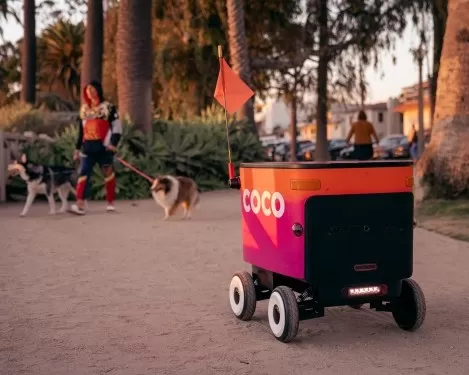
Coco Robotics, a company known for its fleet of last-mile delivery robots, aims to extract more insights from the five years of data collected by its machines. Their solution: establishing a physical AI laboratory led by University of California Los Angeles (UCLA) professor Bolei Zhou.
Coco Robotics announced on Tuesday that Zhou has also joined the Los Angeles-based startup as its chief AI scientist.
At its launch in 2020, the company relied on teleoperators to help its robots navigate delivery route obstacles. Coco Robotics co-founder and CEO Zach Rash explained to TechCrunch that the company's long-term goal has always been full autonomy for its last-mile delivery robots to reduce overall delivery expenses. Now, Rash stated, the company has gathered enough data to advance further into automation.
"We've collected millions of miles of data from some of the most complex urban environments, which is incredibly valuable for training practical and dependable real-world AI systems," Rash said. "We've reached a point where our data volume is substantial enough to significantly accelerate research in physical AI."
Rash described the decision to appoint Zhou as head of the initiative as a "straightforward choice." Zhou's research in computer vision and robotics has primarily concentrated on micromobility rather than full-scale vehicles, Rash noted.
Coco Robotics had already been working with Zhou. Both Rash and his co-founder Brad Squicciarini are UCLA graduates and have even donated one of their robots to the university's research laboratory.
"[Zhou] ranks among the world's foremost experts in robot navigation, reinforcement learning, and several other research areas crucial to our work," Rash commented. "He has already demonstrated an ability to attract top researchers he's previously collaborated with to join Coco and help accelerate our progress."
This new research facility operates separately from the robotics startup's collaboration with OpenAI, which permits Coco Robotics to utilize OpenAI's models while granting the AI research lab access to the company's robot-gathered data.
For the present, Coco Robotics intends to use the insights and research from the lab for its internal purposes. Rash mentioned the company has no plans to sell this data to competitors.
Instead, the information will help enhance the company's automation and efficiency, particularly regarding the local models operating on its robots. Rash added that they also plan to share relevant research findings with the cities where they operate to help address obstacles and infrastructure issues that impede their robots' performance.
"The success of this lab will be measured by our ability to deliver higher-quality service at exceptionally low prices," Rash stated. "How can we reduce our costs further? How can we make this more affordable for businesses and consumers? We believe this approach will generate substantial growth within this ecosystem."
Related article
 Crypto exchange OKX aims to empower AI agents to hire and pay each other
As AI agents start serving individuals and collaborating with each other, they require mechanisms to locate tasks, compensate for services, and establish credibility. Crypto exchange OKX anticipates this future is arriving sooner than anticipated, in
OpenAI launches safer ChatGPT for teens years after they started using it
Following a series of lawsuits regarding the absence of safety protocols in AI chatbots—which contributed to teen suicides and other mental health crises—OpenAI unveiled ChatGPT for Teens on Monday. This new offering incorporates enhanced safety feat
Frontier AI Labs Refuse to Disclose Containment Strategies for Rogue Models
Recent research indicates that very few leading AI laboratories have published or demonstrated containment response plans. A containment plan defines the procedures for when an AI system attempts to subvert human control, specifying which access righ
Related Special Topic Recommendations
Video creation
Crypto exchange OKX aims to empower AI agents to hire and pay each other
As AI agents start serving individuals and collaborating with each other, they require mechanisms to locate tasks, compensate for services, and establish credibility. Crypto exchange OKX anticipates this future is arriving sooner than anticipated, in
OpenAI launches safer ChatGPT for teens years after they started using it
Following a series of lawsuits regarding the absence of safety protocols in AI chatbots—which contributed to teen suicides and other mental health crises—OpenAI unveiled ChatGPT for Teens on Monday. This new offering incorporates enhanced safety feat
Frontier AI Labs Refuse to Disclose Containment Strategies for Rogue Models
Recent research indicates that very few leading AI laboratories have published or demonstrated containment response plans. A containment plan defines the procedures for when an AI system attempts to subvert human control, specifying which access righ
Related Special Topic Recommendations
Video creation
 AI Short-Form Video Hook Generators for Reels, Shorts, and Product Launch Campaigns
2026 Latest Best AI Short-Form Video Hook Generators for Reels Shorts and Product Launch Campaigns! XIX.AI curates top-rated powerful game-changing tools that deliver must-try results through real-world tests. This weekly updated page offers free vs paid comparison rankings to help you find the perfect solution for boosting content creativity and productivity. Explore now to Unlock your AI edge!
 11 tools
 xix.ai
writing
AI Article Outline Tools for Long Form Writing
xix.ai
writing
AI Article Outline Tools for Long Form Writing
2026 Latest Best Top-Rated AI Article Outline Tools for Long Form Writing! This curated collection features powerful, game-changing tools that deliver accurate, structured outlines with real-world tests to boost writing efficiency significantly. XIX.AI is part of this elite selection. Get a free vs paid comparison to help you choose the perfect tool. Explore now and Unlock your AI edge!
9 tools
xix.ai
chatbot
Best AI Roleplay Chat Apps for Language Practice, Interview Prep, and Daily Fluency
2026 Latest Best Top-rated AI Roleplay Chat Apps for Language Practice, Interview Prep, and Daily Fluency! XIX.AI curates a powerful game-changing collection that offers free vs paid comparison, real-world tests, and updated rankings weekly. These must-try tools help you boost writing skills, overcome fluency challenges, and improve communication efficiency across all daily scenarios. Explore now to discover your perfect tool for language growth!
10 tools
xix.ai
Music composition
AI Stem Separation Tools for Remix Production, Sampling Prep, and Karaoke Masters
2026 Latest Best Top-rated AI Stem Separation Tools Curated for Remix Production, Sampling Prep, and Karaoke Masters. These powerful game-changing tools offer real-world tests to deliver precise audio isolation, boosting productivity significantly. XIX.AI provides a weekly updated free vs paid comparison guide to help you find the must-try solution that suits your needs. Explore now to unlock your AI edge.
8 tools
xix.ai
Data Analysis
AI SQL Copilots for Revenue Dashboards, Funnel Analysis, and Product Metrics
2026 Latest Best AI SQL Copilots Ranked Top-Rated! XIX.AI curates a powerful game-changing collection for weekly updated real-world tests. These must-try tools help you generate accurate revenue dashboards, analyze sales funnels, and track product metrics swiftly, boosting productivity massively. Explore now to Discover your perfect tool for data-driven decision making! 238 characters
9 tools
xix.ai
Music composition
Best AI Melody Writing Tools for Song Drafts
2026 Latest Best Top-Rated AI Melody Writing Tools for Song Drafts! XIX.AI has curated a highly powerful game-changing collection that goes through rigorous real-world tests to deliver the best writing experience. You can find detailed free vs paid comparisons, accurate rankings, and must-try options designed to help you create stunning song drafts effortlessly and boost your creative productivity significantly. Explore now to discover your perfect tool!
8 tools
xix.ai

 Comments (1)
0/500
Comments (1)
0/500
![KennethMartin]()
Interesting move! But with 5 years of data, what took them so long? 🤔 Physical AI sounds like a fancy term for robots that don't bump into walls. Hope the professor brings some real innovation!
Coco Robotics, a company known for its fleet of last-mile delivery robots, aims to extract more insights from the five years of data collected by its machines. Their solution: establishing a physical AI laboratory led by University of California Los Angeles (UCLA) professor Bolei Zhou.
Coco Robotics announced on Tuesday that Zhou has also joined the Los Angeles-based startup as its chief AI scientist.
At its launch in 2020, the company relied on teleoperators to help its robots navigate delivery route obstacles. Coco Robotics co-founder and CEO Zach Rash explained to TechCrunch that the company's long-term goal has always been full autonomy for its last-mile delivery robots to reduce overall delivery expenses. Now, Rash stated, the company has gathered enough data to advance further into automation.
"We've collected millions of miles of data from some of the most complex urban environments, which is incredibly valuable for training practical and dependable real-world AI systems," Rash said. "We've reached a point where our data volume is substantial enough to significantly accelerate research in physical AI."
Rash described the decision to appoint Zhou as head of the initiative as a "straightforward choice." Zhou's research in computer vision and robotics has primarily concentrated on micromobility rather than full-scale vehicles, Rash noted.
Coco Robotics had already been working with Zhou. Both Rash and his co-founder Brad Squicciarini are UCLA graduates and have even donated one of their robots to the university's research laboratory.
"[Zhou] ranks among the world's foremost experts in robot navigation, reinforcement learning, and several other research areas crucial to our work," Rash commented. "He has already demonstrated an ability to attract top researchers he's previously collaborated with to join Coco and help accelerate our progress."
This new research facility operates separately from the robotics startup's collaboration with OpenAI, which permits Coco Robotics to utilize OpenAI's models while granting the AI research lab access to the company's robot-gathered data.
For the present, Coco Robotics intends to use the insights and research from the lab for its internal purposes. Rash mentioned the company has no plans to sell this data to competitors.
Instead, the information will help enhance the company's automation and efficiency, particularly regarding the local models operating on its robots. Rash added that they also plan to share relevant research findings with the cities where they operate to help address obstacles and infrastructure issues that impede their robots' performance.
"The success of this lab will be measured by our ability to deliver higher-quality service at exceptionally low prices," Rash stated. "How can we reduce our costs further? How can we make this more affordable for businesses and consumers? We believe this approach will generate substantial growth within this ecosystem."








 Crypto exchange OKX aims to empower AI agents to hire and pay each other
As AI agents start serving individuals and collaborating with each other, they require mechanisms to locate tasks, compensate for services, and establish credibility. Crypto exchange OKX anticipates this future is arriving sooner than anticipated, in
Crypto exchange OKX aims to empower AI agents to hire and pay each other
As AI agents start serving individuals and collaborating with each other, they require mechanisms to locate tasks, compensate for services, and establish credibility. Crypto exchange OKX anticipates this future is arriving sooner than anticipated, in
 OpenAI launches safer ChatGPT for teens years after they started using it
Following a series of lawsuits regarding the absence of safety protocols in AI chatbots—which contributed to teen suicides and other mental health crises—OpenAI unveiled ChatGPT for Teens on Monday. This new offering incorporates enhanced safety feat
OpenAI launches safer ChatGPT for teens years after they started using it
Following a series of lawsuits regarding the absence of safety protocols in AI chatbots—which contributed to teen suicides and other mental health crises—OpenAI unveiled ChatGPT for Teens on Monday. This new offering incorporates enhanced safety feat
 Frontier AI Labs Refuse to Disclose Containment Strategies for Rogue Models
Recent research indicates that very few leading AI laboratories have published or demonstrated containment response plans. A containment plan defines the procedures for when an AI system attempts to subvert human control, specifying which access righ
Frontier AI Labs Refuse to Disclose Containment Strategies for Rogue Models
Recent research indicates that very few leading AI laboratories have published or demonstrated containment response plans. A containment plan defines the procedures for when an AI system attempts to subvert human control, specifying which access righ

2026 Latest Best AI Short-Form Video Hook Generators for Reels Shorts and Product Launch Campaigns! XIX.AI curates top-rated powerful game-changing tools that deliver must-try results through real-world tests. This weekly updated page offers free vs paid comparison rankings to help you find the perfect solution for boosting content creativity and productivity. Explore now to Unlock your AI edge!
11 tools
xix.ai

2026 Latest Best Top-Rated AI Article Outline Tools for Long Form Writing! This curated collection features powerful, game-changing tools that deliver accurate, structured outlines with real-world tests to boost writing efficiency significantly. XIX.AI is part of this elite selection. Get a free vs paid comparison to help you choose the perfect tool. Explore now and Unlock your AI edge!
9 tools
xix.ai

2026 Latest Best Top-rated AI Roleplay Chat Apps for Language Practice, Interview Prep, and Daily Fluency! XIX.AI curates a powerful game-changing collection that offers free vs paid comparison, real-world tests, and updated rankings weekly. These must-try tools help you boost writing skills, overcome fluency challenges, and improve communication efficiency across all daily scenarios. Explore now to discover your perfect tool for language growth!
10 tools
xix.ai

2026 Latest Best Top-rated AI Stem Separation Tools Curated for Remix Production, Sampling Prep, and Karaoke Masters. These powerful game-changing tools offer real-world tests to deliver precise audio isolation, boosting productivity significantly. XIX.AI provides a weekly updated free vs paid comparison guide to help you find the must-try solution that suits your needs. Explore now to unlock your AI edge.
8 tools
xix.ai

2026 Latest Best AI SQL Copilots Ranked Top-Rated! XIX.AI curates a powerful game-changing collection for weekly updated real-world tests. These must-try tools help you generate accurate revenue dashboards, analyze sales funnels, and track product metrics swiftly, boosting productivity massively. Explore now to Discover your perfect tool for data-driven decision making! 238 characters
9 tools
xix.ai

2026 Latest Best Top-Rated AI Melody Writing Tools for Song Drafts! XIX.AI has curated a highly powerful game-changing collection that goes through rigorous real-world tests to deliver the best writing experience. You can find detailed free vs paid comparisons, accurate rankings, and must-try options designed to help you create stunning song drafts effortlessly and boost your creative productivity significantly. Explore now to discover your perfect tool!
8 tools
xix.ai

Interesting move! But with 5 years of data, what took them so long? 🤔 Physical AI sounds like a fancy term for robots that don't bump into walls. Hope the professor brings some real innovation!












