


 Home
HomeCalifornia AV Compliance: A New Era of Tickets, Geofences, and 1M Miles
# government
# california
# autonomous trucking
# robotaxis
# Guident
# robotaxi
# state governments
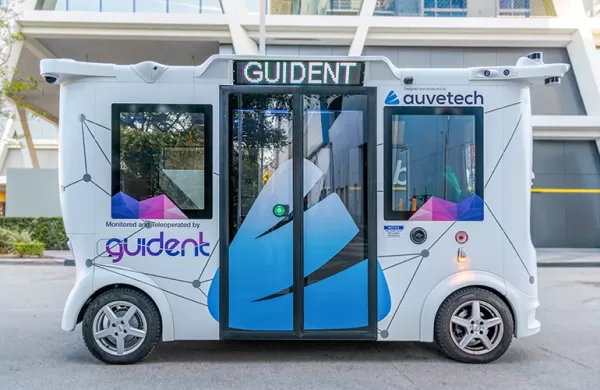
Guident operates an AuveTech shuttle in South Florida, managing a four-mile route in West Palm Beach and a one-mile route in Boca Raton using its remote monitoring technology. | Credit: Guident
California is redefining the regulatory landscape for driverless vehicles, moving away from the tech industry’s “move fast and break things” mentality toward strict accountability and rigorous mileage requirements.
Harold Braun, executive chairman and CEO of Guident, discussed The Robot Report on the state’s significant regulatory shift, its expansion into autonomous heavy freight, and how advanced remote monitoring and control systems are becoming critical for compliance.
“California’s actions clearly demonstrate its continued leadership in autonomous vehicle technology deployment,” he said. “This development is a game changer because it opens the pathway not only for testing in geofenced areas but also for operation on public roads, which has significant implications for developers.”
Braun emphasized that autonomous vehicles (AVs) must adhere to clear regulatory requirements, with public safety being the top priority in every region where AVs are deployed.
He acknowledged that self-driving cars and trucks pose significant risks to unsuspecting drivers, cyclists, and pedestrians. Consequently, government regulations dictate when and where AVs can operate on public roads. New regulations are emerging to guide AV developers while providing a legal framework for continued innovation.
Federal oversight of AVs is divided among three distinct vehicle classes, each governed by specific regulatory frameworks:
Purpose-built AVs: These “pure” autonomous vehicles are engineered from the ground up without steering wheels, pedals, or onboard human driver controls. This class is regulated directly by the National Highway Traffic Safety Administration (NHTSA).Consumer passenger vehicles: Ranging from everyday Subarus to luxury Jaguars, these vehicles feature traditional driver seats and manual controls. They may be equipped with drive-by-wire systems—either factory-installed or as aftermarket modifications—and must comply with the Federal Motor Vehicle Safety Standards (FMVSS), maintained by NHTSA.Commercial vehicles: This sector includes light and heavy trucks, such as tractor-trailers, often retrofitted with aftermarket autonomous driving technology. Due to their commercial application, these vehicles fall under the jurisdiction of the Federal Motor Carrier Safety Administration (FMCSA).California leads with state AV regulations
California and Florida are collaborating with the autonomous vehicle industry to create regulations that protect the public while enabling technology companies to safely test, validate, and improve their solutions.
Recent regulations in California now provide a framework for deploying AVs, including heavy trucks, outside of geofenced areas and onto public roads, allowing them to interact with the public.
According to Braun, “public deployment comes with specific accountabilities and regulations, clearly outlined in the new law. These include safety, oversight, emergency response, remote operation, and accountability requirements, which Guident was built to address.”
Details of the new California regulations
Braun elaborated on the specific requirements in the new California regulations, such as logging mechanisms, video recording, and data reporting. Here are 10 key aspects of the regulations:
Issuance of “notices of noncompliance:” Police officers can formally cite driverless vehicles for traffic violations. Instead of issuing a traditional ticket to a person, officers document the moving violation and send a “notice of AV noncompliance” directly to the vehicle manufacturer and the state Department of Motor Vehicles (DMV).The 72-hour/24-hour reporting window: Upon receiving a noncompliance notice, manufacturers are legally required to submit all relevant vehicle data, telemetry, and an explanation to the DMV within 72 hours. If a police officer marks the violation as a “priority review” due to public danger, this response window shrinks to 24 hours.Strict two-minute emergency geofencing: Local emergency officials can transmit a digital “emergency geofencing message” during a crisis, such as a fire or an active crime scene. Once transmitted, the AV manufacturer must command its fleet to entirely detour or leave the geofenced zone within two minutes.30-second first responder response time: Every driverless vehicle must be equipped with a built-in, two-way voice communication system accessible from the exterior or interior. If a first responder uses it or calls the mandatory 24/7 priority line, a remote human operator with full situational awareness must answer within 30 seconds.30-second pre-collision data capture: Vehicles must feature a dedicated, isolated data-recording mechanism (similar to a flight’s “black box”). It must continuously capture and store at least 30 seconds of read-only sensor data preceding any collision, ensuring data cannot be overwritten or wiped before state investigators download it.Mandated “stepped” testing mileage (light-duty): To earn a commercial deployment permit for robotaxis, companies face strict mileage audits. They must log 50,000 autonomous miles (80,467.2 km) with a safety driver to get a driverless testing permit, and another 50,000 miles under that permit before transitioning to commercial, fare-charging deployment.1 million-mile hurdle for heavy freight: For heavy-duty autonomous trucks (over 10,001 lb. or 4,536.3 kg), the testing threshold is significantly elevated. Heavy trucks must log a total of 1 million autonomous miles (1.6 million km) across authorization tiers — including at least 200,000 mi. (321,868.8 km) specifically on California public roads — before they can deploy commercially.Commercial weigh-station compliance: Autonomous semi-trucks can no longer bypass state freight rules. They are legally required to pull over and pass through all California Highway Patrol (CHP) weigh stations, adhering to the exact same commercial safety and weight audits as human-driven trucks.Domestic location and permit rules for remote drivers: Remote drivers (those who can actively execute dynamic driving tasks from afar) must be physically located within the U.S. and hold a valid California driver’s license. Furthermore, remote drivers must obtain their own individual state-issued AV operating permits.Direct permit revocation for system failures: The DMV’s regulatory authority is explicitly broadened to trigger immediate permit suspensions, operational boundary rollbacks, or total revocations if a fleet demonstrates repeated hardware/software failures, blocks emergency responses, or fails to address underlying technology issues.How Guident supports the new regulations
The Guident Remote Monitor & Control Center (RMCC) includes a suite of capabilities with features such as remote monitoring, assistance, control, teleoperation, and analytics.
The company stated that these features enable an autonomous vehicle developer to meet the demands of the new regulations. For example, the RMCC enables remote operators to monitor and interact with the vehicle efficiently.
It includes capabilities to interact with first responders and enable the quick triage of any emergency. Embedded in the RMCC is a personal communication module to facilitate two-way communication between remote operators and vehicle passengers.
Related article
 FCC Robot Ruling Highlights U.S. Policy; Next-Gen AI Boosts Warehousing
Derik Pridmore serves as the CEO of OSARO.Pridmore explains the evolution of warehouse robotics from basic perception systems to adaptable, AI-driven automation. He emphasizes that hardware-agnostic design, continuous learning, and real-world monitor
HowToRobot, Robotics Australia Group Partner to Boost Robot Adoption
Robotics Australia Group and HowToRobot leverage AI to assist businesses in implementing automation. Source: HowToRobotAccording to the International Federation of Robotics (IFR), Australia’s robot density stands at 134 robots per 10,000 manufacturin
Agentic AI in government faces tough question: What should machines be allowed to decide?
The United Arab Emirates has been an early adopter of artificial intelligence for nine years. It launched a national AI strategy in October 2017 and, shortly thereafter, established a ministerial role to oversee it, appointing Omar Sultan Al Olama as
Related Special Topic Recommendations
Video creation
FCC Robot Ruling Highlights U.S. Policy; Next-Gen AI Boosts Warehousing
Derik Pridmore serves as the CEO of OSARO.Pridmore explains the evolution of warehouse robotics from basic perception systems to adaptable, AI-driven automation. He emphasizes that hardware-agnostic design, continuous learning, and real-world monitor
HowToRobot, Robotics Australia Group Partner to Boost Robot Adoption
Robotics Australia Group and HowToRobot leverage AI to assist businesses in implementing automation. Source: HowToRobotAccording to the International Federation of Robotics (IFR), Australia’s robot density stands at 134 robots per 10,000 manufacturin
Agentic AI in government faces tough question: What should machines be allowed to decide?
The United Arab Emirates has been an early adopter of artificial intelligence for nine years. It launched a national AI strategy in October 2017 and, shortly thereafter, established a ministerial role to oversee it, appointing Omar Sultan Al Olama as
Related Special Topic Recommendations
Video creation
 AI Short-Form Video Hook Generators for Reels, Shorts, and Product Launch Campaigns
2026 Latest Best AI Short-Form Video Hook Generators for Reels Shorts and Product Launch Campaigns! XIX.AI curates top-rated powerful game-changing tools that deliver must-try results through real-world tests. This weekly updated page offers free vs paid comparison rankings to help you find the perfect solution for boosting content creativity and productivity. Explore now to Unlock your AI edge!
 11 tools
 xix.ai
writing
AI Article Outline Tools for Long Form Writing
xix.ai
writing
AI Article Outline Tools for Long Form Writing
2026 Latest Best Top-Rated AI Article Outline Tools for Long Form Writing! This curated collection features powerful, game-changing tools that deliver accurate, structured outlines with real-world tests to boost writing efficiency significantly. XIX.AI is part of this elite selection. Get a free vs paid comparison to help you choose the perfect tool. Explore now and Unlock your AI edge!
9 tools
xix.ai
chatbot
Best AI Roleplay Chat Apps for Language Practice, Interview Prep, and Daily Fluency
2026 Latest Best Top-rated AI Roleplay Chat Apps for Language Practice, Interview Prep, and Daily Fluency! XIX.AI curates a powerful game-changing collection that offers free vs paid comparison, real-world tests, and updated rankings weekly. These must-try tools help you boost writing skills, overcome fluency challenges, and improve communication efficiency across all daily scenarios. Explore now to discover your perfect tool for language growth!
10 tools
xix.ai
Music composition
AI Stem Separation Tools for Remix Production, Sampling Prep, and Karaoke Masters
2026 Latest Best Top-rated AI Stem Separation Tools Curated for Remix Production, Sampling Prep, and Karaoke Masters. These powerful game-changing tools offer real-world tests to deliver precise audio isolation, boosting productivity significantly. XIX.AI provides a weekly updated free vs paid comparison guide to help you find the must-try solution that suits your needs. Explore now to unlock your AI edge.
8 tools
xix.ai
Data Analysis
AI SQL Copilots for Revenue Dashboards, Funnel Analysis, and Product Metrics
2026 Latest Best AI SQL Copilots Ranked Top-Rated! XIX.AI curates a powerful game-changing collection for weekly updated real-world tests. These must-try tools help you generate accurate revenue dashboards, analyze sales funnels, and track product metrics swiftly, boosting productivity massively. Explore now to Discover your perfect tool for data-driven decision making! 238 characters
9 tools
xix.ai
Music composition
Best AI Melody Writing Tools for Song Drafts
2026 Latest Best Top-Rated AI Melody Writing Tools for Song Drafts! XIX.AI has curated a highly powerful game-changing collection that goes through rigorous real-world tests to deliver the best writing experience. You can find detailed free vs paid comparisons, accurate rankings, and must-try options designed to help you create stunning song drafts effortlessly and boost your creative productivity significantly. Explore now to discover your perfect tool!
8 tools
xix.ai

 Comments (0)
0/500
Comments (0)
0/500
Guident operates an AuveTech shuttle in South Florida, managing a four-mile route in West Palm Beach and a one-mile route in Boca Raton using its remote monitoring technology. | Credit: Guident
California is redefining the regulatory landscape for driverless vehicles, moving away from the tech industry’s “move fast and break things” mentality toward strict accountability and rigorous mileage requirements.
Harold Braun, executive chairman and CEO of Guident, discussed The Robot Report on the state’s significant regulatory shift, its expansion into autonomous heavy freight, and how advanced remote monitoring and control systems are becoming critical for compliance.
“California’s actions clearly demonstrate its continued leadership in autonomous vehicle technology deployment,” he said. “This development is a game changer because it opens the pathway not only for testing in geofenced areas but also for operation on public roads, which has significant implications for developers.”
Braun emphasized that autonomous vehicles (AVs) must adhere to clear regulatory requirements, with public safety being the top priority in every region where AVs are deployed.
He acknowledged that self-driving cars and trucks pose significant risks to unsuspecting drivers, cyclists, and pedestrians. Consequently, government regulations dictate when and where AVs can operate on public roads. New regulations are emerging to guide AV developers while providing a legal framework for continued innovation.
Federal oversight of AVs is divided among three distinct vehicle classes, each governed by specific regulatory frameworks:
Purpose-built AVs: These “pure” autonomous vehicles are engineered from the ground up without steering wheels, pedals, or onboard human driver controls. This class is regulated directly by the National Highway Traffic Safety Administration (NHTSA).Consumer passenger vehicles: Ranging from everyday Subarus to luxury Jaguars, these vehicles feature traditional driver seats and manual controls. They may be equipped with drive-by-wire systems—either factory-installed or as aftermarket modifications—and must comply with the Federal Motor Vehicle Safety Standards (FMVSS), maintained by NHTSA.Commercial vehicles: This sector includes light and heavy trucks, such as tractor-trailers, often retrofitted with aftermarket autonomous driving technology. Due to their commercial application, these vehicles fall under the jurisdiction of the Federal Motor Carrier Safety Administration (FMCSA).California leads with state AV regulations
California and Florida are collaborating with the autonomous vehicle industry to create regulations that protect the public while enabling technology companies to safely test, validate, and improve their solutions.
Recent regulations in California now provide a framework for deploying AVs, including heavy trucks, outside of geofenced areas and onto public roads, allowing them to interact with the public.
According to Braun, “public deployment comes with specific accountabilities and regulations, clearly outlined in the new law. These include safety, oversight, emergency response, remote operation, and accountability requirements, which Guident was built to address.”
Details of the new California regulations
Braun elaborated on the specific requirements in the new California regulations, such as logging mechanisms, video recording, and data reporting. Here are 10 key aspects of the regulations:
Issuance of “notices of noncompliance:” Police officers can formally cite driverless vehicles for traffic violations. Instead of issuing a traditional ticket to a person, officers document the moving violation and send a “notice of AV noncompliance” directly to the vehicle manufacturer and the state Department of Motor Vehicles (DMV).The 72-hour/24-hour reporting window: Upon receiving a noncompliance notice, manufacturers are legally required to submit all relevant vehicle data, telemetry, and an explanation to the DMV within 72 hours. If a police officer marks the violation as a “priority review” due to public danger, this response window shrinks to 24 hours.Strict two-minute emergency geofencing: Local emergency officials can transmit a digital “emergency geofencing message” during a crisis, such as a fire or an active crime scene. Once transmitted, the AV manufacturer must command its fleet to entirely detour or leave the geofenced zone within two minutes.30-second first responder response time: Every driverless vehicle must be equipped with a built-in, two-way voice communication system accessible from the exterior or interior. If a first responder uses it or calls the mandatory 24/7 priority line, a remote human operator with full situational awareness must answer within 30 seconds.30-second pre-collision data capture: Vehicles must feature a dedicated, isolated data-recording mechanism (similar to a flight’s “black box”). It must continuously capture and store at least 30 seconds of read-only sensor data preceding any collision, ensuring data cannot be overwritten or wiped before state investigators download it.Mandated “stepped” testing mileage (light-duty): To earn a commercial deployment permit for robotaxis, companies face strict mileage audits. They must log 50,000 autonomous miles (80,467.2 km) with a safety driver to get a driverless testing permit, and another 50,000 miles under that permit before transitioning to commercial, fare-charging deployment.1 million-mile hurdle for heavy freight: For heavy-duty autonomous trucks (over 10,001 lb. or 4,536.3 kg), the testing threshold is significantly elevated. Heavy trucks must log a total of 1 million autonomous miles (1.6 million km) across authorization tiers — including at least 200,000 mi. (321,868.8 km) specifically on California public roads — before they can deploy commercially.Commercial weigh-station compliance: Autonomous semi-trucks can no longer bypass state freight rules. They are legally required to pull over and pass through all California Highway Patrol (CHP) weigh stations, adhering to the exact same commercial safety and weight audits as human-driven trucks.Domestic location and permit rules for remote drivers: Remote drivers (those who can actively execute dynamic driving tasks from afar) must be physically located within the U.S. and hold a valid California driver’s license. Furthermore, remote drivers must obtain their own individual state-issued AV operating permits.Direct permit revocation for system failures: The DMV’s regulatory authority is explicitly broadened to trigger immediate permit suspensions, operational boundary rollbacks, or total revocations if a fleet demonstrates repeated hardware/software failures, blocks emergency responses, or fails to address underlying technology issues.How Guident supports the new regulations
The Guident Remote Monitor & Control Center (RMCC) includes a suite of capabilities with features such as remote monitoring, assistance, control, teleoperation, and analytics.
The company stated that these features enable an autonomous vehicle developer to meet the demands of the new regulations. For example, the RMCC enables remote operators to monitor and interact with the vehicle efficiently.
It includes capabilities to interact with first responders and enable the quick triage of any emergency. Embedded in the RMCC is a personal communication module to facilitate two-way communication between remote operators and vehicle passengers.







 FCC Robot Ruling Highlights U.S. Policy; Next-Gen AI Boosts Warehousing
Derik Pridmore serves as the CEO of OSARO.Pridmore explains the evolution of warehouse robotics from basic perception systems to adaptable, AI-driven automation. He emphasizes that hardware-agnostic design, continuous learning, and real-world monitor
FCC Robot Ruling Highlights U.S. Policy; Next-Gen AI Boosts Warehousing
Derik Pridmore serves as the CEO of OSARO.Pridmore explains the evolution of warehouse robotics from basic perception systems to adaptable, AI-driven automation. He emphasizes that hardware-agnostic design, continuous learning, and real-world monitor
 HowToRobot, Robotics Australia Group Partner to Boost Robot Adoption
Robotics Australia Group and HowToRobot leverage AI to assist businesses in implementing automation. Source: HowToRobotAccording to the International Federation of Robotics (IFR), Australia’s robot density stands at 134 robots per 10,000 manufacturin
HowToRobot, Robotics Australia Group Partner to Boost Robot Adoption
Robotics Australia Group and HowToRobot leverage AI to assist businesses in implementing automation. Source: HowToRobotAccording to the International Federation of Robotics (IFR), Australia’s robot density stands at 134 robots per 10,000 manufacturin
 Agentic AI in government faces tough question: What should machines be allowed to decide?
The United Arab Emirates has been an early adopter of artificial intelligence for nine years. It launched a national AI strategy in October 2017 and, shortly thereafter, established a ministerial role to oversee it, appointing Omar Sultan Al Olama as
Agentic AI in government faces tough question: What should machines be allowed to decide?
The United Arab Emirates has been an early adopter of artificial intelligence for nine years. It launched a national AI strategy in October 2017 and, shortly thereafter, established a ministerial role to oversee it, appointing Omar Sultan Al Olama as

2026 Latest Best AI Short-Form Video Hook Generators for Reels Shorts and Product Launch Campaigns! XIX.AI curates top-rated powerful game-changing tools that deliver must-try results through real-world tests. This weekly updated page offers free vs paid comparison rankings to help you find the perfect solution for boosting content creativity and productivity. Explore now to Unlock your AI edge!
11 tools
xix.ai

2026 Latest Best Top-Rated AI Article Outline Tools for Long Form Writing! This curated collection features powerful, game-changing tools that deliver accurate, structured outlines with real-world tests to boost writing efficiency significantly. XIX.AI is part of this elite selection. Get a free vs paid comparison to help you choose the perfect tool. Explore now and Unlock your AI edge!
9 tools
xix.ai

2026 Latest Best Top-rated AI Roleplay Chat Apps for Language Practice, Interview Prep, and Daily Fluency! XIX.AI curates a powerful game-changing collection that offers free vs paid comparison, real-world tests, and updated rankings weekly. These must-try tools help you boost writing skills, overcome fluency challenges, and improve communication efficiency across all daily scenarios. Explore now to discover your perfect tool for language growth!
10 tools
xix.ai

2026 Latest Best Top-rated AI Stem Separation Tools Curated for Remix Production, Sampling Prep, and Karaoke Masters. These powerful game-changing tools offer real-world tests to deliver precise audio isolation, boosting productivity significantly. XIX.AI provides a weekly updated free vs paid comparison guide to help you find the must-try solution that suits your needs. Explore now to unlock your AI edge.
8 tools
xix.ai

2026 Latest Best AI SQL Copilots Ranked Top-Rated! XIX.AI curates a powerful game-changing collection for weekly updated real-world tests. These must-try tools help you generate accurate revenue dashboards, analyze sales funnels, and track product metrics swiftly, boosting productivity massively. Explore now to Discover your perfect tool for data-driven decision making! 238 characters
9 tools
xix.ai

2026 Latest Best Top-Rated AI Melody Writing Tools for Song Drafts! XIX.AI has curated a highly powerful game-changing collection that goes through rigorous real-world tests to deliver the best writing experience. You can find detailed free vs paid comparisons, accurate rankings, and must-try options designed to help you create stunning song drafts effortlessly and boost your creative productivity significantly. Explore now to discover your perfect tool!
8 tools
xix.ai












