


 Home
HomeABB Robotics Unveils OmniVance Autonomous Surface Finishing Cell
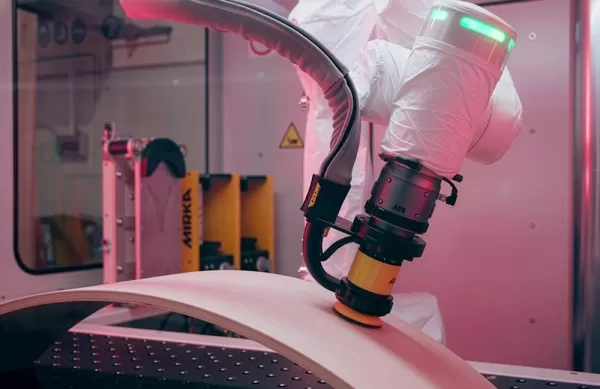
ABB Robotics stated that this finishing cell aims to bridge the gap between custom automation and entry-level toolkits. | Source: ABB Robotics
ABB Robotics recently introduced its first fully automated sanding and polishing cell. The Zurich-based company announced that the OmniVance Collaborative Surface Finishing Cell can automate essential surface finishing operations like sanding and polishing.
Surface finishing is a crucial manufacturing step across nearly all industries. However, companies are grappling with dual challenges: increasingly complex production requirements and a persistent shortage of skilled workers. Deloitte and The Manufacturing Institute forecast that 1.9 million manufacturing positions could remain unfilled by 2033.
“A rising number of firms are seeking to automate processes such as sanding and polishing, yet many smaller businesses lack in-house robotics expertise. While they must ensure flawless quality consistently, until now, a suitable solution for their specific needs has been elusive,” explained Craig McDonnell, Managing Director of Business-Line Industries at ABB Robotics.
“Many companies are hesitant to invest in intricate, custom-built automation, while standard off-the-shelf tools often lack the necessary scalability and capability,” he added. “With our new OmniVance Collaborative Surface Finishing Cell, we are delivering industrial-grade robotics in a simple, cost-effective, and scalable package.”
OmniVance designed to be self-contained, easy to deploy
ABB explained that the OmniVance Collaborative Surface Finishing Cell is a turnkey solution designed to fill the void between customized automation and basic tool kits. It utilizes a GoFa collaborative robot to perform high-quality, precise surface finishing.
The cell is completely self-contained, delivered as a ready-to-use plug-and-play system that includes the GoFa robot and all necessary safety components. ABB noted that the fully CE-certified cell requires no additional engineering to start up and begin production. The company also highlighted that adding new tools and accessories is straightforward, making the system highly flexible for diverse, high-mix production environments.
By automating repetitive sanding and polishing tasks, the cell can boost production throughput and minimize traditional scrap and rework, saving time, labor, and costs, according to ABB. Integrated readiness for dust extraction helps maintain a clean and safe workspace while further improving the quality of finished products. Automation also lessens physical strain on workers and allows skilled personnel to focus on higher-value activities, stated ABB Robotics.
The company developed its software to be intuitive for easy setup and to manage the entire finishing process. ABB stated that a tablet-style interface is user-friendly for operators without robotics experience and requires no custom programming.
Features like lead-through 3D path recording, 2D preset path creation, and intuitive path editing—integrated into Wizard Easy Programming blocks—can cut programming time by up to 90%, the company claimed.
Finishing cell joins growing ABB Robotics portfolio
ABB is a global leader in robot manufacturing. The company's portfolio spans industrial automation, collaborative robots, and autonomous mobile robots (AMRs) for various sectors, including automotive, electronics, and logistics.
In October 2025, ABB Group revealed plans to sell its robotics division to SoftBank Group for $5.3 billion. ABB Robotics employs approximately 7,000 people, with its U.S. headquarters and manufacturing facility located in Auburn Hills, Michigan.
Last month, ABB launched its new PoWa family of force- and power-limited robots. PoWa expands ABB's collaborative robot offerings with industrial-grade performance, featuring six payload categories ranging from 7 to 30 kg (15.4 to 66.1 lb.) and achieving top speeds of up to 5.8 m/s (13 mph).
Related article
 Boosting Complex Assembly by Combining Robot Dexterity with Mechanical Positioning
From left to right: The FANUC LR Mate 200 iD, the KUKA KR QUANTEC, and ABB’s IRB 6700. | Source: FANUC, KUKA, ABB RoboticsIndustry experts anticipate significant growth in robotics, driven by continuous disruptive advancements. While automation remai
ABB Robotics enhances F712 autonomous forklift with vSLAM navigation
The new Flexley Stack F712 autonomous forklift is designed for both storage and retrieval operations. Source: ABB Robotics.ABB Robotics today launched the Flexley Stack F712, an autonomous forklift. The company states that this latest addition to its
Global Robot Installations Top 500,000, Yet Partner Ecosystem Remains Complex
A recent global study has analyzed the dynamics between robot manufacturers and system integrators. Click to enlarge. Source: STIELER Technology & Market Advisors, RSI Market IntelligenceThe true bottleneck: Even the world's most sophisticated AI-pow
Related Special Topic Recommendations
Design & Art
Boosting Complex Assembly by Combining Robot Dexterity with Mechanical Positioning
From left to right: The FANUC LR Mate 200 iD, the KUKA KR QUANTEC, and ABB’s IRB 6700. | Source: FANUC, KUKA, ABB RoboticsIndustry experts anticipate significant growth in robotics, driven by continuous disruptive advancements. While automation remai
ABB Robotics enhances F712 autonomous forklift with vSLAM navigation
The new Flexley Stack F712 autonomous forklift is designed for both storage and retrieval operations. Source: ABB Robotics.ABB Robotics today launched the Flexley Stack F712, an autonomous forklift. The company states that this latest addition to its
Global Robot Installations Top 500,000, Yet Partner Ecosystem Remains Complex
A recent global study has analyzed the dynamics between robot manufacturers and system integrators. Click to enlarge. Source: STIELER Technology & Market Advisors, RSI Market IntelligenceThe true bottleneck: Even the world's most sophisticated AI-pow
Related Special Topic Recommendations
Design & Art
 Top AI Illustration Tools: Create Editorial Scenes and Cover Art Faster
2026 Latest Top-rated AI Illustration Tools: Our curated list features the best powerfully designed tools for creating stunning editorial scenes and eye-catching cover art quickly. Each option has gone through rigorous real-world tests, offering a free vs paid comparison to help you find the perfect match for your workflow. Try these must-try solutions today to unlock your AI edge and boost your creative productivity. Explore now at XIX.AI.
 10 tools
 xix.ai
Education and Learning
Top AI Tutors for Exam Prep: Practice Math, Science, and English
xix.ai
Education and Learning
Top AI Tutors for Exam Prep: Practice Math, Science, and English
2026 Latest Top-Rated Best AI Tutors for Exam Prep are here on XIX.AI! Our curated list features powerful game-changing tools that offer free vs paid comparison, real-world tests, and weekly updated rankings. They help boost your writing efficiency, simplify complex topic learning, and unlock your academic potential. Explore now to Discover your perfect exam prep tool and Start creating today to Unlock your AI edge!
10 tools
xix.ai
Finance
AI Budget Planning Tools for Personal Money Management
2026 Latest Best Top-Rated AI Budget Planning Tools for Personal Money Management are here on XIX.AI! This curated collection features powerful, game-changing solutions that help you conduct real-world tests, understand spending habits, and create personalized plans to boost productivity. Enjoy a free vs paid comparison along with detailed rankings. Must-try tools designed to simplify money management and unlock your AI edge. Explore now!
11 tools
xix.ai
Health & Wellness
AI Sleep Tracking Assistants: Improve Recovery with Better Bedtime Habits
2026 Latest Best Top-Rated AI Sleep Tracking Assistants curated for ultimate recovery. This fully updated weekly guide features powerful tools that deliver real-world tests, free vs paid comparison, and detailed rankings to help you find the must-try solution that boosts sleep quality and supports better bedtime habits. Explore now at XIX.AI to Unlock your AI edge.
10 tools
xix.ai
Data Analysis
AI SQL Copilots for Product and Revenue Analytics
2026 Latest Best Top-Rated AI SQL Copilots for Product and Revenue Analytics! XIX.AI has curated a powerful, game-changing collection of must-try tools that undergo real-world tests through weekly updated rankings. These tools help users boost productivity significantly by accelerating data analysis, streamlining complex queries, and generating accurate insights to drive smarter business decisions. Explore now to Discover your perfect tool for unlocking your AI edge!
14 tools
xix.ai
Education and Learning
Best AI Homework Helpers That Teach: Learn Concepts, Not Just Answers
2026 Latest Best Top-Rated AI Homework Helpers That Teach Core Concepts Not Just Answers Powerful Tools for Students Must-Try Curated List Weekly Updated Free vs Paid Comparison Real-World Tests Accurate Rankings to Help You Unlock Your Full Learning Potential Explore now to Discover your perfect tool for smarter studying.
10 tools
xix.ai

 Comments (1)
0/500
Comments (1)
0/500
![DouglasAnderson]()
Finally, a real solution for polishing complex shapes without hiring a team of artisans! 🤖✨ This OmniVance cell looks promising for bridging that custom automation gap, though I hope the setup isn't too pricey for small shops. Can it handle delicate automotive trim? 🚗
ABB Robotics stated that this finishing cell aims to bridge the gap between custom automation and entry-level toolkits. | Source: ABB Robotics
ABB Robotics recently introduced its first fully automated sanding and polishing cell. The Zurich-based company announced that the OmniVance Collaborative Surface Finishing Cell can automate essential surface finishing operations like sanding and polishing.
Surface finishing is a crucial manufacturing step across nearly all industries. However, companies are grappling with dual challenges: increasingly complex production requirements and a persistent shortage of skilled workers. Deloitte and The Manufacturing Institute forecast that 1.9 million manufacturing positions could remain unfilled by 2033.
“A rising number of firms are seeking to automate processes such as sanding and polishing, yet many smaller businesses lack in-house robotics expertise. While they must ensure flawless quality consistently, until now, a suitable solution for their specific needs has been elusive,” explained Craig McDonnell, Managing Director of Business-Line Industries at ABB Robotics.
“Many companies are hesitant to invest in intricate, custom-built automation, while standard off-the-shelf tools often lack the necessary scalability and capability,” he added. “With our new OmniVance Collaborative Surface Finishing Cell, we are delivering industrial-grade robotics in a simple, cost-effective, and scalable package.”
OmniVance designed to be self-contained, easy to deploy
ABB explained that the OmniVance Collaborative Surface Finishing Cell is a turnkey solution designed to fill the void between customized automation and basic tool kits. It utilizes a GoFa collaborative robot to perform high-quality, precise surface finishing.
The cell is completely self-contained, delivered as a ready-to-use plug-and-play system that includes the GoFa robot and all necessary safety components. ABB noted that the fully CE-certified cell requires no additional engineering to start up and begin production. The company also highlighted that adding new tools and accessories is straightforward, making the system highly flexible for diverse, high-mix production environments.
By automating repetitive sanding and polishing tasks, the cell can boost production throughput and minimize traditional scrap and rework, saving time, labor, and costs, according to ABB. Integrated readiness for dust extraction helps maintain a clean and safe workspace while further improving the quality of finished products. Automation also lessens physical strain on workers and allows skilled personnel to focus on higher-value activities, stated ABB Robotics.
The company developed its software to be intuitive for easy setup and to manage the entire finishing process. ABB stated that a tablet-style interface is user-friendly for operators without robotics experience and requires no custom programming.
Features like lead-through 3D path recording, 2D preset path creation, and intuitive path editing—integrated into Wizard Easy Programming blocks—can cut programming time by up to 90%, the company claimed.
Finishing cell joins growing ABB Robotics portfolio
ABB is a global leader in robot manufacturing. The company's portfolio spans industrial automation, collaborative robots, and autonomous mobile robots (AMRs) for various sectors, including automotive, electronics, and logistics.
In October 2025, ABB Group revealed plans to sell its robotics division to SoftBank Group for $5.3 billion. ABB Robotics employs approximately 7,000 people, with its U.S. headquarters and manufacturing facility located in Auburn Hills, Michigan.
Last month, ABB launched its new PoWa family of force- and power-limited robots. PoWa expands ABB's collaborative robot offerings with industrial-grade performance, featuring six payload categories ranging from 7 to 30 kg (15.4 to 66.1 lb.) and achieving top speeds of up to 5.8 m/s (13 mph).








 Boosting Complex Assembly by Combining Robot Dexterity with Mechanical Positioning
From left to right: The FANUC LR Mate 200 iD, the KUKA KR QUANTEC, and ABB’s IRB 6700. | Source: FANUC, KUKA, ABB RoboticsIndustry experts anticipate significant growth in robotics, driven by continuous disruptive advancements. While automation remai
ABB Robotics enhances F712 autonomous forklift with vSLAM navigation
The new Flexley Stack F712 autonomous forklift is designed for both storage and retrieval operations. Source: ABB Robotics.ABB Robotics today launched the Flexley Stack F712, an autonomous forklift. The company states that this latest addition to its
Boosting Complex Assembly by Combining Robot Dexterity with Mechanical Positioning
From left to right: The FANUC LR Mate 200 iD, the KUKA KR QUANTEC, and ABB’s IRB 6700. | Source: FANUC, KUKA, ABB RoboticsIndustry experts anticipate significant growth in robotics, driven by continuous disruptive advancements. While automation remai
ABB Robotics enhances F712 autonomous forklift with vSLAM navigation
The new Flexley Stack F712 autonomous forklift is designed for both storage and retrieval operations. Source: ABB Robotics.ABB Robotics today launched the Flexley Stack F712, an autonomous forklift. The company states that this latest addition to its
 Global Robot Installations Top 500,000, Yet Partner Ecosystem Remains Complex
A recent global study has analyzed the dynamics between robot manufacturers and system integrators. Click to enlarge. Source: STIELER Technology & Market Advisors, RSI Market IntelligenceThe true bottleneck: Even the world's most sophisticated AI-pow
Global Robot Installations Top 500,000, Yet Partner Ecosystem Remains Complex
A recent global study has analyzed the dynamics between robot manufacturers and system integrators. Click to enlarge. Source: STIELER Technology & Market Advisors, RSI Market IntelligenceThe true bottleneck: Even the world's most sophisticated AI-pow

2026 Latest Top-rated AI Illustration Tools: Our curated list features the best powerfully designed tools for creating stunning editorial scenes and eye-catching cover art quickly. Each option has gone through rigorous real-world tests, offering a free vs paid comparison to help you find the perfect match for your workflow. Try these must-try solutions today to unlock your AI edge and boost your creative productivity. Explore now at XIX.AI.
10 tools
xix.ai

2026 Latest Top-Rated Best AI Tutors for Exam Prep are here on XIX.AI! Our curated list features powerful game-changing tools that offer free vs paid comparison, real-world tests, and weekly updated rankings. They help boost your writing efficiency, simplify complex topic learning, and unlock your academic potential. Explore now to Discover your perfect exam prep tool and Start creating today to Unlock your AI edge!
10 tools
xix.ai

2026 Latest Best Top-Rated AI Budget Planning Tools for Personal Money Management are here on XIX.AI! This curated collection features powerful, game-changing solutions that help you conduct real-world tests, understand spending habits, and create personalized plans to boost productivity. Enjoy a free vs paid comparison along with detailed rankings. Must-try tools designed to simplify money management and unlock your AI edge. Explore now!
11 tools
xix.ai

2026 Latest Best Top-Rated AI Sleep Tracking Assistants curated for ultimate recovery. This fully updated weekly guide features powerful tools that deliver real-world tests, free vs paid comparison, and detailed rankings to help you find the must-try solution that boosts sleep quality and supports better bedtime habits. Explore now at XIX.AI to Unlock your AI edge.
10 tools
xix.ai

2026 Latest Best Top-Rated AI SQL Copilots for Product and Revenue Analytics! XIX.AI has curated a powerful, game-changing collection of must-try tools that undergo real-world tests through weekly updated rankings. These tools help users boost productivity significantly by accelerating data analysis, streamlining complex queries, and generating accurate insights to drive smarter business decisions. Explore now to Discover your perfect tool for unlocking your AI edge!
14 tools
xix.ai

2026 Latest Best Top-Rated AI Homework Helpers That Teach Core Concepts Not Just Answers Powerful Tools for Students Must-Try Curated List Weekly Updated Free vs Paid Comparison Real-World Tests Accurate Rankings to Help You Unlock Your Full Learning Potential Explore now to Discover your perfect tool for smarter studying.
10 tools
xix.ai

Finally, a real solution for polishing complex shapes without hiring a team of artisans! 🤖✨ This OmniVance cell looks promising for bridging that custom automation gap, though I hope the setup isn't too pricey for small shops. Can it handle delicate automotive trim? 🚗












