


 Home
HomeGlobal Robot Installations Top 500,000, Yet Partner Ecosystem Remains Complex
# europe
# asia
# abb robotics
# FANUC News
# Integration
# kuka robotics
# systems integrator
# Universal Robots
# yaskawa
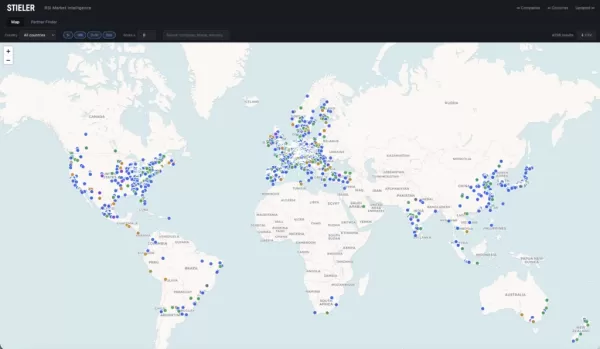
A recent global study has analyzed the dynamics between robot manufacturers and system integrators. Click to enlarge. Source: STIELER Technology & Market Advisors, RSI Market Intelligence
The true bottleneck: Even the world's most sophisticated AI-powered robot cannot deploy itself. The notion that collaborative robots would render system integrators obsolete has been debunked.
Even relatively simple robots demand specialized application knowledge, integration of peripheral equipment, thorough risk assessments, and process-specific expertise. The system integrator is not merely an add-on service but the critical enabler. Without their involvement, even superior technology remains idle on the display floor.
A database reveals the ecosystem
Over half a million industrial robots are installed globally each year. Yet the ecosystem responsible for their deployment—comprising system integrators, machine builders, and distributors that transform hardware into functional applications—remains poorly documented. There is no unified, international overview detailing these companies' identities, specializations, operational regions, or competitive standings.
For the past year, we have worked to create such an overview. The outcome is a structured database containing 4,296 company profiles across 64 countries. Below are some of the key trends identified.
This analysis relies on a structured dataset compiled from OEM partner directories, corporate websites, business registries, industry associations, screenings of major trade-show exhibitors, and analyst reviews. While coverage differs by country and online visibility, the structural trends are evident.
A vast ecosystem led by small enterprises
Among the approximately 3,400 companies with available employee data, 54% have fewer than 50 staff members. Only 5% employ over 1,000 people. The top 5% of firms by headcount represent 84% of total employment in the dataset—a classic long-tail distribution. The robotics ecosystem consists of a handful of large conglomerates and numerous specialized small firms.
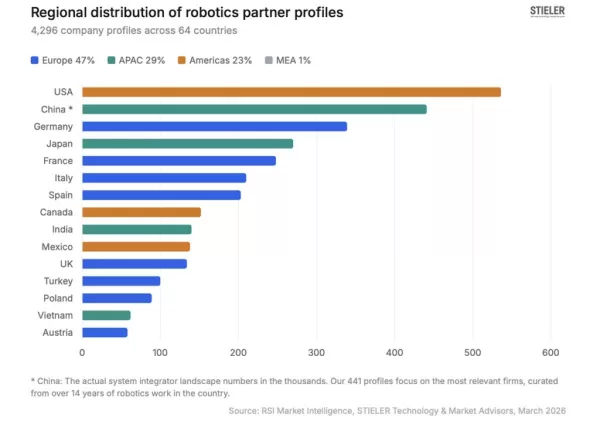
Regionally, Europe accounts for 47% of all profiles, APAC for 29%, and the Americas for 23%. The top five countries—the United States (536), China (441), Germany (339), Japan (270), and France (248)—comprise 43% of the total.
China presents a unique scenario. The actual number of system integrators likely reaches into the thousands, but many smaller entities lack a web presence, and the market is rapidly consolidating. Our 441 Chinese profiles are drawn from over 14 years of project work in the country—the actual ecosystem is far more extensive than any structured database can fully represent.
A significant portion of the channel operates independently
Related article
 Cloudera partners with Mistral to deliver enterprise data solutions and sovereign AI
Cloudera and Mistral are merging Cloudera’s hybrid data and AI platform with Mistral’s sovereign AI models. Credit: ClouderaCloudera and Mistral AI have formed a partnership to deliver customizable, sovereign AI directly to enterprise data, ensuring
Cradle and Lundbeck Forge Biotherapeutics and AI Partnership
Lundbeck is leveraging Cradle’s AI-driven protein design platform to create advanced candidates, aiming to accelerate breakthroughs in neurological treatments. Credit: CradleEuropean startup Cradle teams up with biopharma Lundbeck to optimize biother
Asian AI startups unveil Mythos-like models as Anthropic export ban continues
On Wednesday, Chinese cybersecurity firm 360 reportedly unveiled Tulongfeng, an AI tool it says can compete directly with Anthropic’s Mythos. That’s the cybersecurity-focused AI model that is reportedly so powerful, the Trump Administration has curre
Related Special Topic Recommendations
Design & Art
Cloudera partners with Mistral to deliver enterprise data solutions and sovereign AI
Cloudera and Mistral are merging Cloudera’s hybrid data and AI platform with Mistral’s sovereign AI models. Credit: ClouderaCloudera and Mistral AI have formed a partnership to deliver customizable, sovereign AI directly to enterprise data, ensuring
Cradle and Lundbeck Forge Biotherapeutics and AI Partnership
Lundbeck is leveraging Cradle’s AI-driven protein design platform to create advanced candidates, aiming to accelerate breakthroughs in neurological treatments. Credit: CradleEuropean startup Cradle teams up with biopharma Lundbeck to optimize biother
Asian AI startups unveil Mythos-like models as Anthropic export ban continues
On Wednesday, Chinese cybersecurity firm 360 reportedly unveiled Tulongfeng, an AI tool it says can compete directly with Anthropic’s Mythos. That’s the cybersecurity-focused AI model that is reportedly so powerful, the Trump Administration has curre
Related Special Topic Recommendations
Design & Art
 Top AI Illustration Tools: Create Editorial Scenes and Cover Art Faster
2026 Latest Top-rated AI Illustration Tools: Our curated list features the best powerfully designed tools for creating stunning editorial scenes and eye-catching cover art quickly. Each option has gone through rigorous real-world tests, offering a free vs paid comparison to help you find the perfect match for your workflow. Try these must-try solutions today to unlock your AI edge and boost your creative productivity. Explore now at XIX.AI.
 10 tools
 xix.ai
Education and Learning
Top AI Tutors for Exam Prep: Practice Math, Science, and English
xix.ai
Education and Learning
Top AI Tutors for Exam Prep: Practice Math, Science, and English
2026 Latest Top-Rated Best AI Tutors for Exam Prep are here on XIX.AI! Our curated list features powerful game-changing tools that offer free vs paid comparison, real-world tests, and weekly updated rankings. They help boost your writing efficiency, simplify complex topic learning, and unlock your academic potential. Explore now to Discover your perfect exam prep tool and Start creating today to Unlock your AI edge!
10 tools
xix.ai
Finance
AI Budget Planning Tools for Personal Money Management
2026 Latest Best Top-Rated AI Budget Planning Tools for Personal Money Management are here on XIX.AI! This curated collection features powerful, game-changing solutions that help you conduct real-world tests, understand spending habits, and create personalized plans to boost productivity. Enjoy a free vs paid comparison along with detailed rankings. Must-try tools designed to simplify money management and unlock your AI edge. Explore now!
11 tools
xix.ai
Health & Wellness
AI Sleep Tracking Assistants: Improve Recovery with Better Bedtime Habits
2026 Latest Best Top-Rated AI Sleep Tracking Assistants curated for ultimate recovery. This fully updated weekly guide features powerful tools that deliver real-world tests, free vs paid comparison, and detailed rankings to help you find the must-try solution that boosts sleep quality and supports better bedtime habits. Explore now at XIX.AI to Unlock your AI edge.
10 tools
xix.ai
Data Analysis
AI SQL Copilots for Product and Revenue Analytics
2026 Latest Best Top-Rated AI SQL Copilots for Product and Revenue Analytics! XIX.AI has curated a powerful, game-changing collection of must-try tools that undergo real-world tests through weekly updated rankings. These tools help users boost productivity significantly by accelerating data analysis, streamlining complex queries, and generating accurate insights to drive smarter business decisions. Explore now to Discover your perfect tool for unlocking your AI edge!
14 tools
xix.ai
Education and Learning
Best AI Homework Helpers That Teach: Learn Concepts, Not Just Answers
2026 Latest Best Top-Rated AI Homework Helpers That Teach Core Concepts Not Just Answers Powerful Tools for Students Must-Try Curated List Weekly Updated Free vs Paid Comparison Real-World Tests Accurate Rankings to Help You Unlock Your Full Learning Potential Explore now to Discover your perfect tool for smarter studying.
10 tools
xix.ai

 Comments (1)
0/500
Comments (1)
0/500
![PaulHarris]()
Half a million robots installed and the ecosystem is still a mess? Sounds like my kitchen after I try to cook a new recipe — lots of shiny gadgets but zero coordination. 😅 Maybe the real challenge isn't the hardware but getting all these partners to stop pointing fingers at each other.
A recent global study has analyzed the dynamics between robot manufacturers and system integrators. Click to enlarge. Source: STIELER Technology & Market Advisors, RSI Market Intelligence
The true bottleneck: Even the world's most sophisticated AI-powered robot cannot deploy itself. The notion that collaborative robots would render system integrators obsolete has been debunked.
Even relatively simple robots demand specialized application knowledge, integration of peripheral equipment, thorough risk assessments, and process-specific expertise. The system integrator is not merely an add-on service but the critical enabler. Without their involvement, even superior technology remains idle on the display floor.
A database reveals the ecosystem
Over half a million industrial robots are installed globally each year. Yet the ecosystem responsible for their deployment—comprising system integrators, machine builders, and distributors that transform hardware into functional applications—remains poorly documented. There is no unified, international overview detailing these companies' identities, specializations, operational regions, or competitive standings.
For the past year, we have worked to create such an overview. The outcome is a structured database containing 4,296 company profiles across 64 countries. Below are some of the key trends identified.
This analysis relies on a structured dataset compiled from OEM partner directories, corporate websites, business registries, industry associations, screenings of major trade-show exhibitors, and analyst reviews. While coverage differs by country and online visibility, the structural trends are evident.
A vast ecosystem led by small enterprises
Among the approximately 3,400 companies with available employee data, 54% have fewer than 50 staff members. Only 5% employ over 1,000 people. The top 5% of firms by headcount represent 84% of total employment in the dataset—a classic long-tail distribution. The robotics ecosystem consists of a handful of large conglomerates and numerous specialized small firms.
Regionally, Europe accounts for 47% of all profiles, APAC for 29%, and the Americas for 23%. The top five countries—the United States (536), China (441), Germany (339), Japan (270), and France (248)—comprise 43% of the total.
China presents a unique scenario. The actual number of system integrators likely reaches into the thousands, but many smaller entities lack a web presence, and the market is rapidly consolidating. Our 441 Chinese profiles are drawn from over 14 years of project work in the country—the actual ecosystem is far more extensive than any structured database can fully represent.
A significant portion of the channel operates independently








 Cloudera partners with Mistral to deliver enterprise data solutions and sovereign AI
Cloudera and Mistral are merging Cloudera’s hybrid data and AI platform with Mistral’s sovereign AI models. Credit: ClouderaCloudera and Mistral AI have formed a partnership to deliver customizable, sovereign AI directly to enterprise data, ensuring
Cloudera partners with Mistral to deliver enterprise data solutions and sovereign AI
Cloudera and Mistral are merging Cloudera’s hybrid data and AI platform with Mistral’s sovereign AI models. Credit: ClouderaCloudera and Mistral AI have formed a partnership to deliver customizable, sovereign AI directly to enterprise data, ensuring
 Cradle and Lundbeck Forge Biotherapeutics and AI Partnership
Lundbeck is leveraging Cradle’s AI-driven protein design platform to create advanced candidates, aiming to accelerate breakthroughs in neurological treatments. Credit: CradleEuropean startup Cradle teams up with biopharma Lundbeck to optimize biother
Cradle and Lundbeck Forge Biotherapeutics and AI Partnership
Lundbeck is leveraging Cradle’s AI-driven protein design platform to create advanced candidates, aiming to accelerate breakthroughs in neurological treatments. Credit: CradleEuropean startup Cradle teams up with biopharma Lundbeck to optimize biother
 Asian AI startups unveil Mythos-like models as Anthropic export ban continues
On Wednesday, Chinese cybersecurity firm 360 reportedly unveiled Tulongfeng, an AI tool it says can compete directly with Anthropic’s Mythos. That’s the cybersecurity-focused AI model that is reportedly so powerful, the Trump Administration has curre
Asian AI startups unveil Mythos-like models as Anthropic export ban continues
On Wednesday, Chinese cybersecurity firm 360 reportedly unveiled Tulongfeng, an AI tool it says can compete directly with Anthropic’s Mythos. That’s the cybersecurity-focused AI model that is reportedly so powerful, the Trump Administration has curre

2026 Latest Top-rated AI Illustration Tools: Our curated list features the best powerfully designed tools for creating stunning editorial scenes and eye-catching cover art quickly. Each option has gone through rigorous real-world tests, offering a free vs paid comparison to help you find the perfect match for your workflow. Try these must-try solutions today to unlock your AI edge and boost your creative productivity. Explore now at XIX.AI.
10 tools
xix.ai

2026 Latest Top-Rated Best AI Tutors for Exam Prep are here on XIX.AI! Our curated list features powerful game-changing tools that offer free vs paid comparison, real-world tests, and weekly updated rankings. They help boost your writing efficiency, simplify complex topic learning, and unlock your academic potential. Explore now to Discover your perfect exam prep tool and Start creating today to Unlock your AI edge!
10 tools
xix.ai

2026 Latest Best Top-Rated AI Budget Planning Tools for Personal Money Management are here on XIX.AI! This curated collection features powerful, game-changing solutions that help you conduct real-world tests, understand spending habits, and create personalized plans to boost productivity. Enjoy a free vs paid comparison along with detailed rankings. Must-try tools designed to simplify money management and unlock your AI edge. Explore now!
11 tools
xix.ai

2026 Latest Best Top-Rated AI Sleep Tracking Assistants curated for ultimate recovery. This fully updated weekly guide features powerful tools that deliver real-world tests, free vs paid comparison, and detailed rankings to help you find the must-try solution that boosts sleep quality and supports better bedtime habits. Explore now at XIX.AI to Unlock your AI edge.
10 tools
xix.ai

2026 Latest Best Top-Rated AI SQL Copilots for Product and Revenue Analytics! XIX.AI has curated a powerful, game-changing collection of must-try tools that undergo real-world tests through weekly updated rankings. These tools help users boost productivity significantly by accelerating data analysis, streamlining complex queries, and generating accurate insights to drive smarter business decisions. Explore now to Discover your perfect tool for unlocking your AI edge!
14 tools
xix.ai

2026 Latest Best Top-Rated AI Homework Helpers That Teach Core Concepts Not Just Answers Powerful Tools for Students Must-Try Curated List Weekly Updated Free vs Paid Comparison Real-World Tests Accurate Rankings to Help You Unlock Your Full Learning Potential Explore now to Discover your perfect tool for smarter studying.
10 tools
xix.ai

Half a million robots installed and the ecosystem is still a mess? Sounds like my kitchen after I try to cook a new recipe — lots of shiny gadgets but zero coordination. 😅 Maybe the real challenge isn't the hardware but getting all these partners to stop pointing fingers at each other.












