


 Home
HomeIntel RealSense Debuts Self-Guiding Humanoid Robot Navigation at GTC
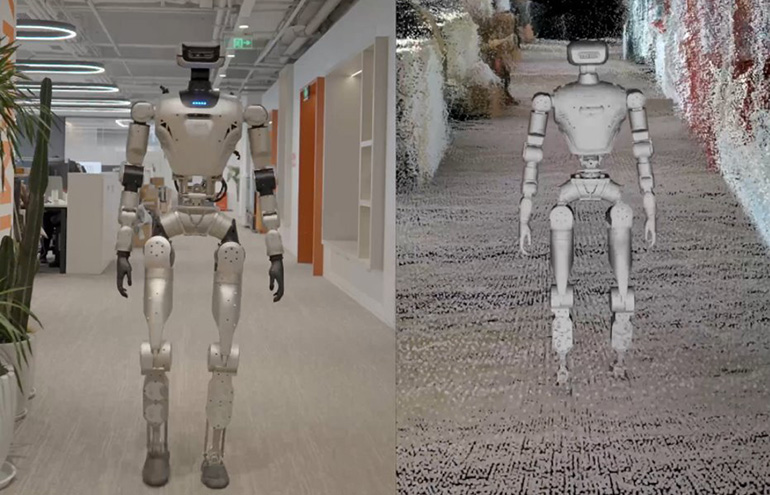
LimX demonstrates safe navigation with RealSense cameras and NVDIA CuVSLAM. Source: RealSense
As humanoid robots transition from prototypes to practical applications, reliable perception becomes critical for safety, not just performance. RealSense emphasized this point at NVIDIA GTC this week, showcasing advanced navigation capabilities developed with LimX Dynamics.
“Humanoids operate in complex, three-dimensional spaces alongside people, within environments that are constantly changing,” said Nadav Orbach, CEO of RealSense. “For robots to work safely with humans, their perception systems must do more than process raw sensor data. They need to function as a visual cortex, enabling precise localization, obstacle avoidance, terrain understanding, and stable, predictable movement in unstructured settings.”
Spun out from Intel Corp. last year, RealSense provides depth cameras and vision systems for autonomous mobile robots (AMRs), humanoids, and various applications in industrial automation, healthcare, and access control. The Cupertino, Calif.-based company stated that its perception technology allows machines and physical AI to navigate and interact with the human world reliably and intelligently.
RealSense offers ‘visual cortex’ for humanoid robots
“The cameras, advanced perception, and reasoning software that give robots sight are more than just navigation or task execution tools,” RealSense explained. “They serve as the visual cortex for humanoids, enabling them to move, work, and operate effectively in human environments.”
The company claims its demonstration of autonomous humanoid navigation at GTC in San Jose, Calif., is a industry first. LimX Dynamics plans to show how dense 3D depth perception allows legged robots to localize, map, and navigate autonomously with safety and predictability.
Their system utilizes RealSense depth cameras with vSLAM (visual simultaneous localization and mapping), integrated with odometry from NVIDIA CuVSLAM. NVIDIA Isaac Lab accelerated the development of this technology stack, providing a high-fidelity digital environment for reinforcement learning and policy training.
Shenzhen, China-based LimX Dynamics said this simulation-first approach helped bridge the “simulation-to-reality” gap, allowing its humanoid to master complex 3D maneuvers with verified safety before its physical debut at NVIDIA GTC.
Humanoids need navigation for 3D spaces
Wheeled robots typically move on a predictable, flat plane, prioritizing speed and efficiency—robotic vacuums are a prime example, according to RealSense.
However, humanoids and quadrupeds present a far greater challenge, the company noted. They navigate full 3D spaces, which involves shifting contact points and non-linear motion. This demands stable foot placement and constant environmental awareness.
“Encoder-only odometry and 2D lidar, commonly used for wheeled robots, lack the comprehensive 3D awareness required for stable and safe motion,” RealSense asserted. “Until now, this limitation has constrained deployment, forcing many legged robots to rely on teleoperation, close supervision, or tightly controlled environments.”
Editor’s note: Mike Nielsen, CMO at RealSense, will participate in a keynote panel on “The State of Humanoids” at the 2026 Robotics Summit & Expo.
LimX Dynamics to demonstrate a safer path for robotics
The partners stated they will demonstrate how RealSense’s dense depth perception, combined with NVIDIA visual odometry and cuVSLAM, provides scene understanding, localization, mapping, and navigation. This enables LimX’s humanoid to operate safely in 3D space.
In practical terms, they outlined that safer robotics involves:
Accurate localization and mapping, ensuring the robot always knows its position and surroundings.Collision avoidance with people and moving objects.Fall prevention and stable locomotion through 3D awareness of terrain, edges, and height changes.Predictable, human-readable motion, minimizing sudden stops or erratic corrections.“Dense 3D perception also unlocks new behaviors that have historically been difficult to execute safely,” RealSense explained. “These include stair navigation, curb and elevation detection, traversal of uneven terrain, and dynamic obstacle avoidance in shared spaces. Advanced path planning allows robots to adapt to changing conditions, such as moving carts, shifting pallets, or people entering their path.”
RealSense said the LimX Dynamics demonstration highlights its expanding role in the broader robotics ecosystem. The company pointed to a decade of innovation in depth sensing, including active stereo technology optimized for close- and mid-range sensing, and a mature software developer kit (SDK) ecosystem.
Furthermore, RealSense stated it has assisted robotics teams in prototyping and scaling more efficiently and is accelerating the development of safe autonomy for humanoid systems.
Related article
 Nvidia H200 China deal survives Trump-Xi summit, but not as expected
President Trump traveled to Beijing with Jensen Huang joining the delegation at the eleventh hour, departing two days later with vague remarks about potential chip export developments. No deal materialized. Since Trump first authorized sales in Decem
Nvidia to Derive 25% of Next Year’s Revenue from Funded Labs
Nvidia has deployed nearly US$50 billion into AI labs purchasing its chips, securing commitments for over $500 billion in total.On August 26, CFO Colette Kress informed analysts that these labs, backed by Nvidia’s balance sheet, will account for roug
ElevenLabs brings on BlackRock, Jamie Foxx and Longoria as new investors
ElevenLabs, a leader in Voice AI, has announced new participants in its $500 million Series D funding round, initially revealed in February. The investor roster now features major institutions like BlackRock, Wellington, D.E. Shaw, and Schroders, alo
Related Special Topic Recommendations
Design & Art
Nvidia H200 China deal survives Trump-Xi summit, but not as expected
President Trump traveled to Beijing with Jensen Huang joining the delegation at the eleventh hour, departing two days later with vague remarks about potential chip export developments. No deal materialized. Since Trump first authorized sales in Decem
Nvidia to Derive 25% of Next Year’s Revenue from Funded Labs
Nvidia has deployed nearly US$50 billion into AI labs purchasing its chips, securing commitments for over $500 billion in total.On August 26, CFO Colette Kress informed analysts that these labs, backed by Nvidia’s balance sheet, will account for roug
ElevenLabs brings on BlackRock, Jamie Foxx and Longoria as new investors
ElevenLabs, a leader in Voice AI, has announced new participants in its $500 million Series D funding round, initially revealed in February. The investor roster now features major institutions like BlackRock, Wellington, D.E. Shaw, and Schroders, alo
Related Special Topic Recommendations
Design & Art
 Top AI Illustration Tools: Create Editorial Scenes and Cover Art Faster
2026 Latest Top-rated AI Illustration Tools: Our curated list features the best powerfully designed tools for creating stunning editorial scenes and eye-catching cover art quickly. Each option has gone through rigorous real-world tests, offering a free vs paid comparison to help you find the perfect match for your workflow. Try these must-try solutions today to unlock your AI edge and boost your creative productivity. Explore now at XIX.AI.
 10 tools
 xix.ai
Education and Learning
Top AI Tutors for Exam Prep: Practice Math, Science, and English
xix.ai
Education and Learning
Top AI Tutors for Exam Prep: Practice Math, Science, and English
2026 Latest Top-Rated Best AI Tutors for Exam Prep are here on XIX.AI! Our curated list features powerful game-changing tools that offer free vs paid comparison, real-world tests, and weekly updated rankings. They help boost your writing efficiency, simplify complex topic learning, and unlock your academic potential. Explore now to Discover your perfect exam prep tool and Start creating today to Unlock your AI edge!
10 tools
xix.ai
Finance
AI Budget Planning Tools for Personal Money Management
2026 Latest Best Top-Rated AI Budget Planning Tools for Personal Money Management are here on XIX.AI! This curated collection features powerful, game-changing solutions that help you conduct real-world tests, understand spending habits, and create personalized plans to boost productivity. Enjoy a free vs paid comparison along with detailed rankings. Must-try tools designed to simplify money management and unlock your AI edge. Explore now!
11 tools
xix.ai
Health & Wellness
AI Sleep Tracking Assistants: Improve Recovery with Better Bedtime Habits
2026 Latest Best Top-Rated AI Sleep Tracking Assistants curated for ultimate recovery. This fully updated weekly guide features powerful tools that deliver real-world tests, free vs paid comparison, and detailed rankings to help you find the must-try solution that boosts sleep quality and supports better bedtime habits. Explore now at XIX.AI to Unlock your AI edge.
10 tools
xix.ai
Data Analysis
AI SQL Copilots for Product and Revenue Analytics
2026 Latest Best Top-Rated AI SQL Copilots for Product and Revenue Analytics! XIX.AI has curated a powerful, game-changing collection of must-try tools that undergo real-world tests through weekly updated rankings. These tools help users boost productivity significantly by accelerating data analysis, streamlining complex queries, and generating accurate insights to drive smarter business decisions. Explore now to Discover your perfect tool for unlocking your AI edge!
14 tools
xix.ai
Education and Learning
Best AI Homework Helpers That Teach: Learn Concepts, Not Just Answers
2026 Latest Best Top-Rated AI Homework Helpers That Teach Core Concepts Not Just Answers Powerful Tools for Students Must-Try Curated List Weekly Updated Free vs Paid Comparison Real-World Tests Accurate Rankings to Help You Unlock Your Full Learning Potential Explore now to Discover your perfect tool for smarter studying.
10 tools
xix.ai

 Comments (0)
0/500
Comments (0)
0/500
LimX demonstrates safe navigation with RealSense cameras and NVDIA CuVSLAM. Source: RealSense
As humanoid robots transition from prototypes to practical applications, reliable perception becomes critical for safety, not just performance. RealSense emphasized this point at NVIDIA GTC this week, showcasing advanced navigation capabilities developed with LimX Dynamics.
“Humanoids operate in complex, three-dimensional spaces alongside people, within environments that are constantly changing,” said Nadav Orbach, CEO of RealSense. “For robots to work safely with humans, their perception systems must do more than process raw sensor data. They need to function as a visual cortex, enabling precise localization, obstacle avoidance, terrain understanding, and stable, predictable movement in unstructured settings.”
Spun out from Intel Corp. last year, RealSense provides depth cameras and vision systems for autonomous mobile robots (AMRs), humanoids, and various applications in industrial automation, healthcare, and access control. The Cupertino, Calif.-based company stated that its perception technology allows machines and physical AI to navigate and interact with the human world reliably and intelligently.
RealSense offers ‘visual cortex’ for humanoid robots
“The cameras, advanced perception, and reasoning software that give robots sight are more than just navigation or task execution tools,” RealSense explained. “They serve as the visual cortex for humanoids, enabling them to move, work, and operate effectively in human environments.”
The company claims its demonstration of autonomous humanoid navigation at GTC in San Jose, Calif., is a industry first. LimX Dynamics plans to show how dense 3D depth perception allows legged robots to localize, map, and navigate autonomously with safety and predictability.
Their system utilizes RealSense depth cameras with vSLAM (visual simultaneous localization and mapping), integrated with odometry from NVIDIA CuVSLAM. NVIDIA Isaac Lab accelerated the development of this technology stack, providing a high-fidelity digital environment for reinforcement learning and policy training.
Shenzhen, China-based LimX Dynamics said this simulation-first approach helped bridge the “simulation-to-reality” gap, allowing its humanoid to master complex 3D maneuvers with verified safety before its physical debut at NVIDIA GTC.
Humanoids need navigation for 3D spaces
Wheeled robots typically move on a predictable, flat plane, prioritizing speed and efficiency—robotic vacuums are a prime example, according to RealSense.
However, humanoids and quadrupeds present a far greater challenge, the company noted. They navigate full 3D spaces, which involves shifting contact points and non-linear motion. This demands stable foot placement and constant environmental awareness.
“Encoder-only odometry and 2D lidar, commonly used for wheeled robots, lack the comprehensive 3D awareness required for stable and safe motion,” RealSense asserted. “Until now, this limitation has constrained deployment, forcing many legged robots to rely on teleoperation, close supervision, or tightly controlled environments.”
Editor’s note: Mike Nielsen, CMO at RealSense, will participate in a keynote panel on “The State of Humanoids” at the 2026 Robotics Summit & Expo.
LimX Dynamics to demonstrate a safer path for robotics
The partners stated they will demonstrate how RealSense’s dense depth perception, combined with NVIDIA visual odometry and cuVSLAM, provides scene understanding, localization, mapping, and navigation. This enables LimX’s humanoid to operate safely in 3D space.
In practical terms, they outlined that safer robotics involves:
Accurate localization and mapping, ensuring the robot always knows its position and surroundings.Collision avoidance with people and moving objects.Fall prevention and stable locomotion through 3D awareness of terrain, edges, and height changes.Predictable, human-readable motion, minimizing sudden stops or erratic corrections.“Dense 3D perception also unlocks new behaviors that have historically been difficult to execute safely,” RealSense explained. “These include stair navigation, curb and elevation detection, traversal of uneven terrain, and dynamic obstacle avoidance in shared spaces. Advanced path planning allows robots to adapt to changing conditions, such as moving carts, shifting pallets, or people entering their path.”
RealSense said the LimX Dynamics demonstration highlights its expanding role in the broader robotics ecosystem. The company pointed to a decade of innovation in depth sensing, including active stereo technology optimized for close- and mid-range sensing, and a mature software developer kit (SDK) ecosystem.
Furthermore, RealSense stated it has assisted robotics teams in prototyping and scaling more efficiently and is accelerating the development of safe autonomy for humanoid systems.








 Nvidia H200 China deal survives Trump-Xi summit, but not as expected
President Trump traveled to Beijing with Jensen Huang joining the delegation at the eleventh hour, departing two days later with vague remarks about potential chip export developments. No deal materialized. Since Trump first authorized sales in Decem
Nvidia H200 China deal survives Trump-Xi summit, but not as expected
President Trump traveled to Beijing with Jensen Huang joining the delegation at the eleventh hour, departing two days later with vague remarks about potential chip export developments. No deal materialized. Since Trump first authorized sales in Decem
 Nvidia to Derive 25% of Next Year’s Revenue from Funded Labs
Nvidia has deployed nearly US$50 billion into AI labs purchasing its chips, securing commitments for over $500 billion in total.On August 26, CFO Colette Kress informed analysts that these labs, backed by Nvidia’s balance sheet, will account for roug
Nvidia to Derive 25% of Next Year’s Revenue from Funded Labs
Nvidia has deployed nearly US$50 billion into AI labs purchasing its chips, securing commitments for over $500 billion in total.On August 26, CFO Colette Kress informed analysts that these labs, backed by Nvidia’s balance sheet, will account for roug
 ElevenLabs brings on BlackRock, Jamie Foxx and Longoria as new investors
ElevenLabs, a leader in Voice AI, has announced new participants in its $500 million Series D funding round, initially revealed in February. The investor roster now features major institutions like BlackRock, Wellington, D.E. Shaw, and Schroders, alo
ElevenLabs brings on BlackRock, Jamie Foxx and Longoria as new investors
ElevenLabs, a leader in Voice AI, has announced new participants in its $500 million Series D funding round, initially revealed in February. The investor roster now features major institutions like BlackRock, Wellington, D.E. Shaw, and Schroders, alo

2026 Latest Top-rated AI Illustration Tools: Our curated list features the best powerfully designed tools for creating stunning editorial scenes and eye-catching cover art quickly. Each option has gone through rigorous real-world tests, offering a free vs paid comparison to help you find the perfect match for your workflow. Try these must-try solutions today to unlock your AI edge and boost your creative productivity. Explore now at XIX.AI.
10 tools
xix.ai

2026 Latest Top-Rated Best AI Tutors for Exam Prep are here on XIX.AI! Our curated list features powerful game-changing tools that offer free vs paid comparison, real-world tests, and weekly updated rankings. They help boost your writing efficiency, simplify complex topic learning, and unlock your academic potential. Explore now to Discover your perfect exam prep tool and Start creating today to Unlock your AI edge!
10 tools
xix.ai

2026 Latest Best Top-Rated AI Budget Planning Tools for Personal Money Management are here on XIX.AI! This curated collection features powerful, game-changing solutions that help you conduct real-world tests, understand spending habits, and create personalized plans to boost productivity. Enjoy a free vs paid comparison along with detailed rankings. Must-try tools designed to simplify money management and unlock your AI edge. Explore now!
11 tools
xix.ai

2026 Latest Best Top-Rated AI Sleep Tracking Assistants curated for ultimate recovery. This fully updated weekly guide features powerful tools that deliver real-world tests, free vs paid comparison, and detailed rankings to help you find the must-try solution that boosts sleep quality and supports better bedtime habits. Explore now at XIX.AI to Unlock your AI edge.
10 tools
xix.ai

2026 Latest Best Top-Rated AI SQL Copilots for Product and Revenue Analytics! XIX.AI has curated a powerful, game-changing collection of must-try tools that undergo real-world tests through weekly updated rankings. These tools help users boost productivity significantly by accelerating data analysis, streamlining complex queries, and generating accurate insights to drive smarter business decisions. Explore now to Discover your perfect tool for unlocking your AI edge!
14 tools
xix.ai

2026 Latest Best Top-Rated AI Homework Helpers That Teach Core Concepts Not Just Answers Powerful Tools for Students Must-Try Curated List Weekly Updated Free vs Paid Comparison Real-World Tests Accurate Rankings to Help You Unlock Your Full Learning Potential Explore now to Discover your perfect tool for smarter studying.
10 tools
xix.ai












