


 Home
HomeHello Robot Readies Home Robots for Silicon Valley
Martinez, California, sits on the far northeastern edge of the San Francisco Bay Area, a world away from Silicon Valley’s tech hub. Here lives Hello Robot, a startup deliberately distancing itself from the grandiose claims of its southern rivals, operating just 45 miles south.
Last month, Hello Robot launched the fourth version of its home assistance robot, Stretch. Calling it humanoid is a stretch. Though it features a vaguely human-like torso and a sensor-equipped head, its telescoping arm ends in pinchers, and it moves on a heavy, omnidirectional wheeled base.
When Stretch’s battery dies, lights around its “eyes” illuminate — “it looks angry,” jokes Blaine Matulevich, an engineer at the company.
Founded in 2017 by CEO Aaron Edsinger, a former robotics director at Google, and CTO Charlie Kemp, a Georgia Tech professor, Hello Robot isn’t building foundation models or promising to replace every human job. Instead, it designed Stretch for real homes with real people, a stark contrast to most robots confined behind laboratory glass.
This focus is crucial. Despite AI advancements offering greater robotic capabilities, there is a severe lack of useful training data. As simulations improve, investors are increasingly prioritizing real-world deployment.
“Companies that deploy first accumulate site-specific recovery loops and workflow tolerances that no competitor can buy or synthesize,” Bullhound Capital wrote in a recent sector report. “In robotics, the moat isn’t just IP, but accumulated operating hours under real-world liability.”
A different kind of embodiment
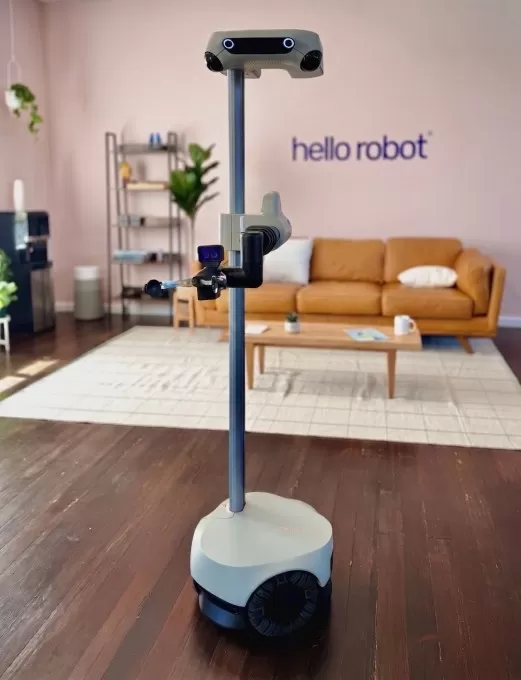
Image Credits:Hello Robot / Hello Robot
Keith Platt, a Georgia-based investor now on Hello Robot’s board, backed the company after experiencing Stretch as a housemate. Platt became quadriplegic in 2021, retaining control only over parts of his shoulders, neck, and head. He began exploring adaptive technology, partnering with Hello Robot in 2024, which includes an occupational therapist to support Platt and others with similar conditions.
Platt controls Stretch via a voice-operated iPhone app, instructing it to move autonomously through his house before taking direct control to manipulate objects and perform tasks. One deceptively simple goal was teaching Stretch to serve him a protein shake for breakfast, a task usually requiring human assistance.
“When we first started out with that activity, it took me independently — no one there — took almost two hours,” Platt told TechCrunch. “But I was gonna stick with it. It got down to where, within a few minutes, I could drink the whole shake and put it back on the counter.”
Dependence on others poses physical and emotional challenges, Platt says. Regaining independence — such as putting on or taking off reading glasses, or brushing his teeth — “is huge.” This matters not just for him, but for his caregivers.
He predicts it would be “life-changing” for families if robotic assistants enabled people with mobility challenges to safely spend a day at home, allowing family members to work or leave without hiring professional caregivers.
Stretch leaves the factory with limited autonomy; keeping a human in the loop is intentional. “Being in control is a feature — it’s desired to be embodied in the robot,” Matulevitch said.
Platt also notes he doesn’t worry about Stretch falling over if it encounters an error.
Hardware is hard
Despite massive funding for robotic “brains,” their “bodies” remain problematic. While components are getting cheaper, current technology still produces heavy limbs requiring high-energy active balancing. A robotic hand and arm weigh significantly more than a human’s, and physics is unforgiving.
When robots err, they cause damage. The Bot Company is currently being sued by a San Francisco Airbnb owner who claims the company rented his apartment to test its robot, resulting in scratched furniture, broken appliances, and chipped bathroom tiles.
“The state of hardware today is actually abysmal from the perspective of, ‘I want to have robots in my parents’ place,’” Mahi Shafiullah, a postdoc working on robotic hands at UC Berkeley, told TechCrunch. He recalled industrial robots in his lab accidentally punching through a plastic kitchen play set they were meant to handle carefully.
Shafiullah eventually used the third generation of Hello Robot’s Stretch for his PhD research at New York University. Models he helped develop with Stretch won the best demonstration prize at last year’s Computer Vision And Pattern Recognition (CVPR) conference.
Hello Robot doesn’t promise the complexity or capability of Valley-favorite humanoids, but its simpler design may prove more effective. Edsinger compares his company to Waymo, which became a leader in self-driving cars by prioritizing safety (though funding helped).
One field leader, 1X, gained significant attention last year when it unveiled Neo, a humanoid robot for home chores. The company claims to have sold out of its 10,000 planned units for this year, yet none have been delivered so far.
“Hello Robot has been really cautious and really caring about this problem, because I think they’re designing it to be around people first,” Shafiullah said. “And then they’re thinking about, where are the capabilities that they can fit in within those limitations?”
Hello Robot’s manufacturing floor.Image Credits:Tim Fernholz / Tim Fernholz
Homeward bound
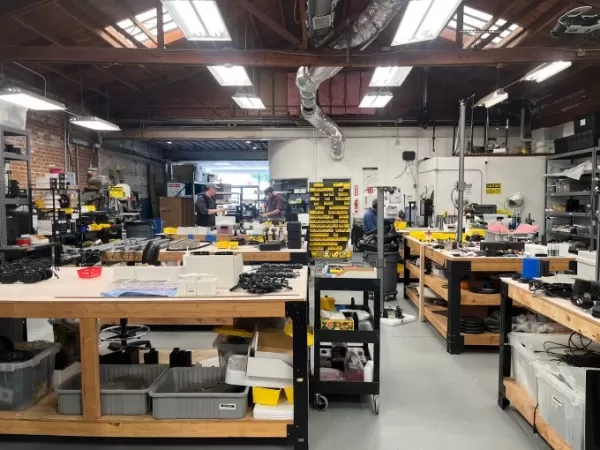
Stretch 4 is priced at an affordable-for-a-robot $30,000, slightly more than Chinese alternatives, though Edsinger notes those often exclude sensors or software, which ultimately increase costs. He expects to manufacture between 200 and 300 units at the Martinez headquarters, with the first batch already sold out.
Edsinger aims to keep the robot accessible to hackers and researchers on tight budgets. A key design criterion is that Stretch must ship in a cardboard box via UPS or DHL; requiring wooden crates and installation teams drives up costs and reduces accessibility.
Hello Robot’s customers include researchers testing sophisticated AI brains, enterprises evaluating Stretch in settings like data centers, and developers creating in-home aides for people with disabilities.
The robot’s comprehensive sensor suite, physical capabilities, and safe operations make it a strong candidate for realizing the hopes of physical AI advocates.
“The algorithms may be there, but the data is not, and data is actually really like 80% ingredient that matters,” Shafiullah said.
Having a robot that can safely collect this data is a significant step forward. Hello Robot plans to keep iterating, using lessons from the Stretch 4 rollout to inform its next bot, potentially lowering prices and boosting capabilities to achieve a vision of robot-human collaboration at home.
Related article
 Former Infosys Chief’s AI Startup Secures Another $53M
Hang Ten Systems, an AI startup established by former Infosys CEO Vishal Sikka just four months ago, has secured an additional $53 million in seed funding. This latest investment round was finalized merely five weeks after the initial $32 million see
Crypto exchange OKX aims to empower AI agents to hire and pay each other
As AI agents start serving individuals and collaborating with each other, they require mechanisms to locate tasks, compensate for services, and establish credibility. Crypto exchange OKX anticipates this future is arriving sooner than anticipated, in
Thiel-backed startup claims AI can judge journalism, despite risks to whistleblowers
Following his role in the lawsuit that led to Gawker’s bankruptcy, Aron D’Souza identified a critical flaw in the American media landscape: individuals harmed by coverage lacked effective means to respond.His answer is technology. D’Souza’s new ventu
Related Special Topic Recommendations
Academic Research
Former Infosys Chief’s AI Startup Secures Another $53M
Hang Ten Systems, an AI startup established by former Infosys CEO Vishal Sikka just four months ago, has secured an additional $53 million in seed funding. This latest investment round was finalized merely five weeks after the initial $32 million see
Crypto exchange OKX aims to empower AI agents to hire and pay each other
As AI agents start serving individuals and collaborating with each other, they require mechanisms to locate tasks, compensate for services, and establish credibility. Crypto exchange OKX anticipates this future is arriving sooner than anticipated, in
Thiel-backed startup claims AI can judge journalism, despite risks to whistleblowers
Following his role in the lawsuit that led to Gawker’s bankruptcy, Aron D’Souza identified a critical flaw in the American media landscape: individuals harmed by coverage lacked effective means to respond.His answer is technology. D’Souza’s new ventu
Related Special Topic Recommendations
Academic Research
 AI Dataset Discovery Tools for Academic Projects
2026 Latest Best Top-Rated AI Dataset Discovery Tools for Academic Projects! XIX.AI has curated a powerful, game-changing collection of highly reliable options, all going through strict real-world tests and updated weekly. You can find detailed free vs paid comparison info to help you pick the perfect tool that boosts your research efficiency and delivers top-quality results. Explore now to unlock your AI edge!
 16 tools
 xix.ai
Social Media
Best AI Caption Generators: Write Platform-Specific Social Posts Fast
xix.ai
Social Media
Best AI Caption Generators: Write Platform-Specific Social Posts Fast
2026 Latest Best AI Caption Generators page! XIX.AI curated a top-rated list of must-try powerful tools for writing platform-specific social posts quickly. These tools go through rigorous real-world tests, offering free vs paid comparison and clear rankings to help you find the best option that boosts your productivity and unlocks your AI edge. Explore now!
11 tools
xix.ai
Health & Wellness
Best AI Sleep Coaching Tools for Shift Workers, Jet Lag Recovery, and Better Routines
2026 Latest Best AI Sleep Coaching Tools for Shift Workers, Jet Lag Recovery, and Better Routines! XIX.AI has curated a top-rated list of powerful game-changing tools that go through real-world tests to deliver accurate guidance. You can find detailed free vs paid comparison info and see how these must-try solutions help boost sleep quality, speed up jet lag recovery, and build healthier routines. Explore now to discover your perfect tool!
7 tools
xix.ai
code
ChatGPT Debugging Tools for Python Errors, API Logs, and Stack Trace Triage
2026 Latest Best ChatGPT debugging tools for Python errors, API logs, and stack trace triage are here on XIX.AI. This curated list of top-rated solutions offers a free vs paid comparison, real-world tests, and detailed rankings to help you find the most powerful tool that can significantly boost your productivity and help you solve complex technical issues faster. Explore now to discover your perfect solution!
9 tools
xix.ai
Text-to-speech
AI Voiceover Tools for Product Demo Videos
2026 Latest Best Top-Rated AI Voiceover Tools for Product Demo Videos are here on XIX.AI! This curated list features powerful, game-changing options that help you create professional-quality audio content fast, boosting your demo efficiency significantly. We conduct real-world tests and provide a free vs paid comparison along with weekly updated rankings to help you find the perfect fit. Explore now to Unlock your AI edge!
10 tools
xix.ai
Business
AI Business Plan Tools for Startup Validation
2026 Latest Best AI Business Plan Tools for Startup Validation! XIX.AI has curated a top-rated list of powerful game-changing tools that go through real-world tests to deliver accurate results. You’ll find a free vs paid comparison, detailed rankings, and easy-to-understand insights to help you choose the perfect solution and boost your startup’s success rate. Explore now to Unlock your AI edge!
9 tools
xix.ai

 Comments (0)
0/500
Comments (0)
0/500
Martinez, California, sits on the far northeastern edge of the San Francisco Bay Area, a world away from Silicon Valley’s tech hub. Here lives Hello Robot, a startup deliberately distancing itself from the grandiose claims of its southern rivals, operating just 45 miles south.
Last month, Hello Robot launched the fourth version of its home assistance robot, Stretch. Calling it humanoid is a stretch. Though it features a vaguely human-like torso and a sensor-equipped head, its telescoping arm ends in pinchers, and it moves on a heavy, omnidirectional wheeled base.
When Stretch’s battery dies, lights around its “eyes” illuminate — “it looks angry,” jokes Blaine Matulevich, an engineer at the company.
Founded in 2017 by CEO Aaron Edsinger, a former robotics director at Google, and CTO Charlie Kemp, a Georgia Tech professor, Hello Robot isn’t building foundation models or promising to replace every human job. Instead, it designed Stretch for real homes with real people, a stark contrast to most robots confined behind laboratory glass.
This focus is crucial. Despite AI advancements offering greater robotic capabilities, there is a severe lack of useful training data. As simulations improve, investors are increasingly prioritizing real-world deployment.
“Companies that deploy first accumulate site-specific recovery loops and workflow tolerances that no competitor can buy or synthesize,” Bullhound Capital wrote in a recent sector report. “In robotics, the moat isn’t just IP, but accumulated operating hours under real-world liability.”
A different kind of embodiment
Image Credits:Hello Robot / Hello Robot
Keith Platt, a Georgia-based investor now on Hello Robot’s board, backed the company after experiencing Stretch as a housemate. Platt became quadriplegic in 2021, retaining control only over parts of his shoulders, neck, and head. He began exploring adaptive technology, partnering with Hello Robot in 2024, which includes an occupational therapist to support Platt and others with similar conditions.
Platt controls Stretch via a voice-operated iPhone app, instructing it to move autonomously through his house before taking direct control to manipulate objects and perform tasks. One deceptively simple goal was teaching Stretch to serve him a protein shake for breakfast, a task usually requiring human assistance.
“When we first started out with that activity, it took me independently — no one there — took almost two hours,” Platt told TechCrunch. “But I was gonna stick with it. It got down to where, within a few minutes, I could drink the whole shake and put it back on the counter.”
Dependence on others poses physical and emotional challenges, Platt says. Regaining independence — such as putting on or taking off reading glasses, or brushing his teeth — “is huge.” This matters not just for him, but for his caregivers.
He predicts it would be “life-changing” for families if robotic assistants enabled people with mobility challenges to safely spend a day at home, allowing family members to work or leave without hiring professional caregivers.
Stretch leaves the factory with limited autonomy; keeping a human in the loop is intentional. “Being in control is a feature — it’s desired to be embodied in the robot,” Matulevitch said.
Platt also notes he doesn’t worry about Stretch falling over if it encounters an error.
Hardware is hard
Despite massive funding for robotic “brains,” their “bodies” remain problematic. While components are getting cheaper, current technology still produces heavy limbs requiring high-energy active balancing. A robotic hand and arm weigh significantly more than a human’s, and physics is unforgiving.
When robots err, they cause damage. The Bot Company is currently being sued by a San Francisco Airbnb owner who claims the company rented his apartment to test its robot, resulting in scratched furniture, broken appliances, and chipped bathroom tiles.
“The state of hardware today is actually abysmal from the perspective of, ‘I want to have robots in my parents’ place,’” Mahi Shafiullah, a postdoc working on robotic hands at UC Berkeley, told TechCrunch. He recalled industrial robots in his lab accidentally punching through a plastic kitchen play set they were meant to handle carefully.
Shafiullah eventually used the third generation of Hello Robot’s Stretch for his PhD research at New York University. Models he helped develop with Stretch won the best demonstration prize at last year’s Computer Vision And Pattern Recognition (CVPR) conference.
Hello Robot doesn’t promise the complexity or capability of Valley-favorite humanoids, but its simpler design may prove more effective. Edsinger compares his company to Waymo, which became a leader in self-driving cars by prioritizing safety (though funding helped).
One field leader, 1X, gained significant attention last year when it unveiled Neo, a humanoid robot for home chores. The company claims to have sold out of its 10,000 planned units for this year, yet none have been delivered so far.
“Hello Robot has been really cautious and really caring about this problem, because I think they’re designing it to be around people first,” Shafiullah said. “And then they’re thinking about, where are the capabilities that they can fit in within those limitations?”
Hello Robot’s manufacturing floor.Image Credits:Tim Fernholz / Tim Fernholz
Homeward bound
Stretch 4 is priced at an affordable-for-a-robot $30,000, slightly more than Chinese alternatives, though Edsinger notes those often exclude sensors or software, which ultimately increase costs. He expects to manufacture between 200 and 300 units at the Martinez headquarters, with the first batch already sold out.
Edsinger aims to keep the robot accessible to hackers and researchers on tight budgets. A key design criterion is that Stretch must ship in a cardboard box via UPS or DHL; requiring wooden crates and installation teams drives up costs and reduces accessibility.
Hello Robot’s customers include researchers testing sophisticated AI brains, enterprises evaluating Stretch in settings like data centers, and developers creating in-home aides for people with disabilities.
The robot’s comprehensive sensor suite, physical capabilities, and safe operations make it a strong candidate for realizing the hopes of physical AI advocates.
“The algorithms may be there, but the data is not, and data is actually really like 80% ingredient that matters,” Shafiullah said.
Having a robot that can safely collect this data is a significant step forward. Hello Robot plans to keep iterating, using lessons from the Stretch 4 rollout to inform its next bot, potentially lowering prices and boosting capabilities to achieve a vision of robot-human collaboration at home.








 Former Infosys Chief’s AI Startup Secures Another $53M
Hang Ten Systems, an AI startup established by former Infosys CEO Vishal Sikka just four months ago, has secured an additional $53 million in seed funding. This latest investment round was finalized merely five weeks after the initial $32 million see
Former Infosys Chief’s AI Startup Secures Another $53M
Hang Ten Systems, an AI startup established by former Infosys CEO Vishal Sikka just four months ago, has secured an additional $53 million in seed funding. This latest investment round was finalized merely five weeks after the initial $32 million see
 Crypto exchange OKX aims to empower AI agents to hire and pay each other
As AI agents start serving individuals and collaborating with each other, they require mechanisms to locate tasks, compensate for services, and establish credibility. Crypto exchange OKX anticipates this future is arriving sooner than anticipated, in
Crypto exchange OKX aims to empower AI agents to hire and pay each other
As AI agents start serving individuals and collaborating with each other, they require mechanisms to locate tasks, compensate for services, and establish credibility. Crypto exchange OKX anticipates this future is arriving sooner than anticipated, in
 Thiel-backed startup claims AI can judge journalism, despite risks to whistleblowers
Following his role in the lawsuit that led to Gawker’s bankruptcy, Aron D’Souza identified a critical flaw in the American media landscape: individuals harmed by coverage lacked effective means to respond.His answer is technology. D’Souza’s new ventu
Thiel-backed startup claims AI can judge journalism, despite risks to whistleblowers
Following his role in the lawsuit that led to Gawker’s bankruptcy, Aron D’Souza identified a critical flaw in the American media landscape: individuals harmed by coverage lacked effective means to respond.His answer is technology. D’Souza’s new ventu

2026 Latest Best Top-Rated AI Dataset Discovery Tools for Academic Projects! XIX.AI has curated a powerful, game-changing collection of highly reliable options, all going through strict real-world tests and updated weekly. You can find detailed free vs paid comparison info to help you pick the perfect tool that boosts your research efficiency and delivers top-quality results. Explore now to unlock your AI edge!
16 tools
xix.ai

2026 Latest Best AI Caption Generators page! XIX.AI curated a top-rated list of must-try powerful tools for writing platform-specific social posts quickly. These tools go through rigorous real-world tests, offering free vs paid comparison and clear rankings to help you find the best option that boosts your productivity and unlocks your AI edge. Explore now!
11 tools
xix.ai

2026 Latest Best AI Sleep Coaching Tools for Shift Workers, Jet Lag Recovery, and Better Routines! XIX.AI has curated a top-rated list of powerful game-changing tools that go through real-world tests to deliver accurate guidance. You can find detailed free vs paid comparison info and see how these must-try solutions help boost sleep quality, speed up jet lag recovery, and build healthier routines. Explore now to discover your perfect tool!
7 tools
xix.ai

2026 Latest Best ChatGPT debugging tools for Python errors, API logs, and stack trace triage are here on XIX.AI. This curated list of top-rated solutions offers a free vs paid comparison, real-world tests, and detailed rankings to help you find the most powerful tool that can significantly boost your productivity and help you solve complex technical issues faster. Explore now to discover your perfect solution!
9 tools
xix.ai

2026 Latest Best Top-Rated AI Voiceover Tools for Product Demo Videos are here on XIX.AI! This curated list features powerful, game-changing options that help you create professional-quality audio content fast, boosting your demo efficiency significantly. We conduct real-world tests and provide a free vs paid comparison along with weekly updated rankings to help you find the perfect fit. Explore now to Unlock your AI edge!
10 tools
xix.ai

2026 Latest Best AI Business Plan Tools for Startup Validation! XIX.AI has curated a top-rated list of powerful game-changing tools that go through real-world tests to deliver accurate results. You’ll find a free vs paid comparison, detailed rankings, and easy-to-understand insights to help you choose the perfect solution and boost your startup’s success rate. Explore now to Unlock your AI edge!
9 tools
xix.ai












