


 Home
HomeTruecaller lets you hang up on scammers for your family
Truecaller, the caller identity platform, recently introduced a feature that allows one person to act as an admin for a family group. The admin receives alerts about fraud calls received by other members and can even remotely end a call if they suspect a family member is being scammed.
With over 450 million users, Truecaller initially launched this feature in December in a few countries, including Sweden, Chile, Malaysia, and Kenya. After seeing encouraging results, the company rolled it out globally, including in India, its largest market. The feature is free and available to all users, even those without a paid Truecaller plan.
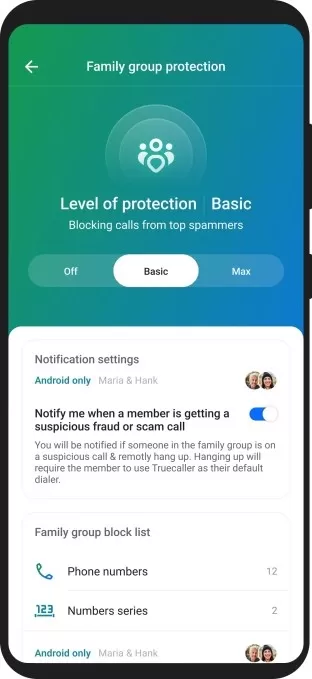
Image credit: Truecaller
With this feature, a tech‑savvy member of a family or friend group can become the admin of a group of up to five members. Once other members join, the admin receives alerts about potentially fraudulent calls those members receive. If the admin believes a call could be harmful, they can also end the call remotely. The admin can get alerts for fraud calls on both iOS and Android, but can only end calls for Android users.
On Android, members can grant the admin permission to access real‑time activity data, such as walking or driving status, battery level, and phone sound settings (to check if the phone is in silent mode). Truecaller says this helps admins monitor elderly members and only contact them when they are not walking or driving.
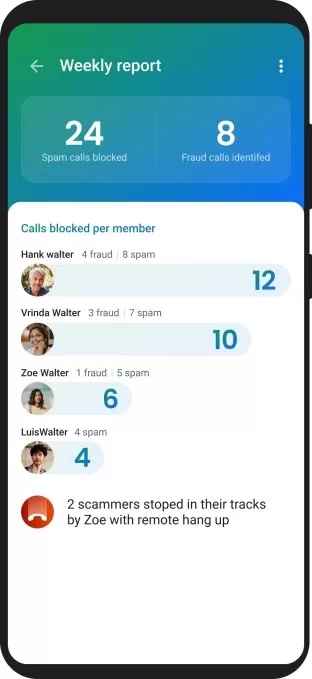
Image credit: Truecaller
The admin can also block specific numbers and international calling codes, and share a blocklist with group members.
Truecaller notes that the admin cannot view the non‑spam call history or SMS history of group members.
“Unfortunately, I think we all know someone in our family or among friends who has been affected by fraud,” said Kunal Dua, Chief Product Officer at Truecaller, in a call with TechCrunch. “In that sense, this represents a fundamental shift in what Truecaller has been focusing on as a problem,” he added.
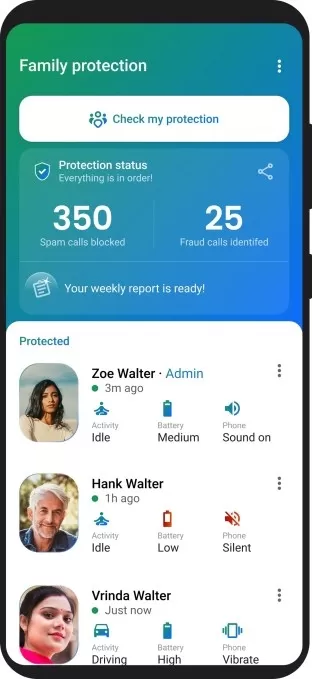
Image credit: Truecaller
Last year, Truecaller introduced a voicemail feature for Indian users that includes an AI assistant. The assistant listens for calls when a user is unavailable and provides a transcript summary. The company is now exploring a similar AI approach for family protection, aiming to potentially alert the admin about the type of fraud call a group member is receiving.
The company is also exploring the use of AI to screen calls and automatically disconnect them when scam‑related keywords are detected, such as “digital arrest” — a tactic where impersonators pose as law enforcement to extract information or money from call recipients.
In India, scam calls have been increasing, causing widespread financial losses. Truecaller reports identifying over 7.7 billion fraud calls last year. Indian authorities have launched several initiatives, including a controversial policy known as SIM binding, which could affect the functioning of apps like WhatsApp and Telegram.
Truecaller is facing headwinds. Its stock has dropped more than 80% over the past 12 months. In its Q4 2025 report, the company said its EBITDA — a measure of operating profitability — fell 49% year‑over‑year, with ad revenue declining 31%. The company is also contending with India’s Caller Name Presentation (CNAP) system, which shows the caller’s name as registered with their phone carrier. Truecaller maintains that simply displaying a caller’s name will not reduce spam calls, arguing that its platform goes further by offering community‑based reports.
“In India, there has been a lot of discussion about the imminent rollout of CNAP,” said Truecaller CEO Rishit Jhunjhunwala during the Q4 2025 earnings call. “CNAP has been partially rolled out, and so far the impact on our user growth is limited. As we have said before, we expect that CNAP might have some impact on user growth, but that remains to be seen as CNAP reaches full rollout.”
Jhunjhunwala continued, “Our focus remains on delivering a superior product. As you know, consumers can choose to use CNAP and Truecaller simultaneously, where we provide much more information, context, and various other solutions.”
Related article
 Avataar’s Video AI Tackles India’s Scale With Speed, Savings, and Cultural Nuance
India’s AI model output has been slow compared to the U.S., Europe, and China. Only a few startups are releasing models, and most of them are large language models or voice models. To encourage more development, the government launched the India AI M
India's AI boom prompts firms to sacrifice revenue for users
Tech giants’ efforts to accelerate AI adoption in India may be nearing a turning point, as companies end free trials and aim to turn the world’s fourth-largest economy into a source of paid subscribers.India became the largest market for generative A
Google rolls out Gemini in Chrome to India
On Wednesday, Google announced it is expanding Gemini integration for Chrome to new regions, including India, Canada, and New Zealand. This rollout allows desktop users to access Gemini via a sidebar, where they can ask Google’s AI chatbot about on-s
Related Special Topic Recommendations
chatbot
Avataar’s Video AI Tackles India’s Scale With Speed, Savings, and Cultural Nuance
India’s AI model output has been slow compared to the U.S., Europe, and China. Only a few startups are releasing models, and most of them are large language models or voice models. To encourage more development, the government launched the India AI M
India's AI boom prompts firms to sacrifice revenue for users
Tech giants’ efforts to accelerate AI adoption in India may be nearing a turning point, as companies end free trials and aim to turn the world’s fourth-largest economy into a source of paid subscribers.India became the largest market for generative A
Google rolls out Gemini in Chrome to India
On Wednesday, Google announced it is expanding Gemini integration for Chrome to new regions, including India, Canada, and New Zealand. This rollout allows desktop users to access Gemini via a sidebar, where they can ask Google’s AI chatbot about on-s
Related Special Topic Recommendations
chatbot
 Best AI Roleplay Chat Apps for Language Practice, Interview Prep, and Daily Fluency
2026 Latest Best Top-rated AI Roleplay Chat Apps for Language Practice, Interview Prep, and Daily Fluency! XIX.AI curates a powerful game-changing collection that offers free vs paid comparison, real-world tests, and updated rankings weekly. These must-try tools help you boost writing skills, overcome fluency challenges, and improve communication efficiency across all daily scenarios. Explore now to discover your perfect tool for language growth!
 10 tools
 xix.ai
Music composition
AI Stem Separation Tools for Remix Production, Sampling Prep, and Karaoke Masters
xix.ai
Music composition
AI Stem Separation Tools for Remix Production, Sampling Prep, and Karaoke Masters
2026 Latest Best Top-rated AI Stem Separation Tools Curated for Remix Production, Sampling Prep, and Karaoke Masters. These powerful game-changing tools offer real-world tests to deliver precise audio isolation, boosting productivity significantly. XIX.AI provides a weekly updated free vs paid comparison guide to help you find the must-try solution that suits your needs. Explore now to unlock your AI edge.
8 tools
xix.ai
Data Analysis
AI SQL Copilots for Revenue Dashboards, Funnel Analysis, and Product Metrics
2026 Latest Best AI SQL Copilots Ranked Top-Rated! XIX.AI curates a powerful game-changing collection for weekly updated real-world tests. These must-try tools help you generate accurate revenue dashboards, analyze sales funnels, and track product metrics swiftly, boosting productivity massively. Explore now to Discover your perfect tool for data-driven decision making! 238 characters
9 tools
xix.ai
Music composition
Best AI Melody Writing Tools for Song Drafts
2026 Latest Best Top-Rated AI Melody Writing Tools for Song Drafts! XIX.AI has curated a highly powerful game-changing collection that goes through rigorous real-world tests to deliver the best writing experience. You can find detailed free vs paid comparisons, accurate rankings, and must-try options designed to help you create stunning song drafts effortlessly and boost your creative productivity significantly. Explore now to discover your perfect tool!
8 tools
xix.ai
chatbot
Best AI Conversation Trainer Tools for Interview Practice
2026 Latest Best Top-rated AI Conversation Trainer Tools for Interview Practice are here on XIX.AI! This curated collection features powerful, game-changing tools that go through rigorous real-world tests to deliver accurate feedback. You’ll find a free vs paid comparison and detailed rankings to help you choose the must-try option that boosts your confidence and skills. Explore now to Discover your perfect tool for interview success!
12 tools
xix.ai
Design & Art
Best AI Style Transfer Tools for Creative Experiments
2026 Latest Best Top-rated AI Style Transfer Tools for Creative Experiments! XIX.AI has curated a powerful, game-changing collection of must-try tools that deliver exceptional results through real-world tests and rigorous rankings. These top solutions help creatives boost productivity significantly by accelerating content creation and unlocking endless creative possibilities. Explore now to discover your perfect tool and start creating today!
9 tools
xix.ai

 Comments (1)
0/500
Comments (1)
0/500
![StephenGreen]()
家族の詐欺電話をブロックできるのは嬉しいけど、管理者が遠隔で通話を切断する権限を持つのはちょっと怖い。誤操作で大切な電話が切れたらどうするの?セキュリティと利便性のバランスが難しいね。😅
Truecaller, the caller identity platform, recently introduced a feature that allows one person to act as an admin for a family group. The admin receives alerts about fraud calls received by other members and can even remotely end a call if they suspect a family member is being scammed.
With over 450 million users, Truecaller initially launched this feature in December in a few countries, including Sweden, Chile, Malaysia, and Kenya. After seeing encouraging results, the company rolled it out globally, including in India, its largest market. The feature is free and available to all users, even those without a paid Truecaller plan.
Image credit: Truecaller
With this feature, a tech‑savvy member of a family or friend group can become the admin of a group of up to five members. Once other members join, the admin receives alerts about potentially fraudulent calls those members receive. If the admin believes a call could be harmful, they can also end the call remotely. The admin can get alerts for fraud calls on both iOS and Android, but can only end calls for Android users.
On Android, members can grant the admin permission to access real‑time activity data, such as walking or driving status, battery level, and phone sound settings (to check if the phone is in silent mode). Truecaller says this helps admins monitor elderly members and only contact them when they are not walking or driving.
Image credit: Truecaller
The admin can also block specific numbers and international calling codes, and share a blocklist with group members.
Truecaller notes that the admin cannot view the non‑spam call history or SMS history of group members.
“Unfortunately, I think we all know someone in our family or among friends who has been affected by fraud,” said Kunal Dua, Chief Product Officer at Truecaller, in a call with TechCrunch. “In that sense, this represents a fundamental shift in what Truecaller has been focusing on as a problem,” he added.
Image credit: Truecaller
Last year, Truecaller introduced a voicemail feature for Indian users that includes an AI assistant. The assistant listens for calls when a user is unavailable and provides a transcript summary. The company is now exploring a similar AI approach for family protection, aiming to potentially alert the admin about the type of fraud call a group member is receiving.
The company is also exploring the use of AI to screen calls and automatically disconnect them when scam‑related keywords are detected, such as “digital arrest” — a tactic where impersonators pose as law enforcement to extract information or money from call recipients.
In India, scam calls have been increasing, causing widespread financial losses. Truecaller reports identifying over 7.7 billion fraud calls last year. Indian authorities have launched several initiatives, including a controversial policy known as SIM binding, which could affect the functioning of apps like WhatsApp and Telegram.
Truecaller is facing headwinds. Its stock has dropped more than 80% over the past 12 months. In its Q4 2025 report, the company said its EBITDA — a measure of operating profitability — fell 49% year‑over‑year, with ad revenue declining 31%. The company is also contending with India’s Caller Name Presentation (CNAP) system, which shows the caller’s name as registered with their phone carrier. Truecaller maintains that simply displaying a caller’s name will not reduce spam calls, arguing that its platform goes further by offering community‑based reports.
“In India, there has been a lot of discussion about the imminent rollout of CNAP,” said Truecaller CEO Rishit Jhunjhunwala during the Q4 2025 earnings call. “CNAP has been partially rolled out, and so far the impact on our user growth is limited. As we have said before, we expect that CNAP might have some impact on user growth, but that remains to be seen as CNAP reaches full rollout.”
Jhunjhunwala continued, “Our focus remains on delivering a superior product. As you know, consumers can choose to use CNAP and Truecaller simultaneously, where we provide much more information, context, and various other solutions.”








 Avataar’s Video AI Tackles India’s Scale With Speed, Savings, and Cultural Nuance
India’s AI model output has been slow compared to the U.S., Europe, and China. Only a few startups are releasing models, and most of them are large language models or voice models. To encourage more development, the government launched the India AI M
Avataar’s Video AI Tackles India’s Scale With Speed, Savings, and Cultural Nuance
India’s AI model output has been slow compared to the U.S., Europe, and China. Only a few startups are releasing models, and most of them are large language models or voice models. To encourage more development, the government launched the India AI M
 India's AI boom prompts firms to sacrifice revenue for users
Tech giants’ efforts to accelerate AI adoption in India may be nearing a turning point, as companies end free trials and aim to turn the world’s fourth-largest economy into a source of paid subscribers.India became the largest market for generative A
India's AI boom prompts firms to sacrifice revenue for users
Tech giants’ efforts to accelerate AI adoption in India may be nearing a turning point, as companies end free trials and aim to turn the world’s fourth-largest economy into a source of paid subscribers.India became the largest market for generative A
 Google rolls out Gemini in Chrome to India
On Wednesday, Google announced it is expanding Gemini integration for Chrome to new regions, including India, Canada, and New Zealand. This rollout allows desktop users to access Gemini via a sidebar, where they can ask Google’s AI chatbot about on-s
Google rolls out Gemini in Chrome to India
On Wednesday, Google announced it is expanding Gemini integration for Chrome to new regions, including India, Canada, and New Zealand. This rollout allows desktop users to access Gemini via a sidebar, where they can ask Google’s AI chatbot about on-s

2026 Latest Best Top-rated AI Roleplay Chat Apps for Language Practice, Interview Prep, and Daily Fluency! XIX.AI curates a powerful game-changing collection that offers free vs paid comparison, real-world tests, and updated rankings weekly. These must-try tools help you boost writing skills, overcome fluency challenges, and improve communication efficiency across all daily scenarios. Explore now to discover your perfect tool for language growth!
10 tools
xix.ai

2026 Latest Best Top-rated AI Stem Separation Tools Curated for Remix Production, Sampling Prep, and Karaoke Masters. These powerful game-changing tools offer real-world tests to deliver precise audio isolation, boosting productivity significantly. XIX.AI provides a weekly updated free vs paid comparison guide to help you find the must-try solution that suits your needs. Explore now to unlock your AI edge.
8 tools
xix.ai

2026 Latest Best AI SQL Copilots Ranked Top-Rated! XIX.AI curates a powerful game-changing collection for weekly updated real-world tests. These must-try tools help you generate accurate revenue dashboards, analyze sales funnels, and track product metrics swiftly, boosting productivity massively. Explore now to Discover your perfect tool for data-driven decision making! 238 characters
9 tools
xix.ai

2026 Latest Best Top-Rated AI Melody Writing Tools for Song Drafts! XIX.AI has curated a highly powerful game-changing collection that goes through rigorous real-world tests to deliver the best writing experience. You can find detailed free vs paid comparisons, accurate rankings, and must-try options designed to help you create stunning song drafts effortlessly and boost your creative productivity significantly. Explore now to discover your perfect tool!
8 tools
xix.ai

2026 Latest Best Top-rated AI Conversation Trainer Tools for Interview Practice are here on XIX.AI! This curated collection features powerful, game-changing tools that go through rigorous real-world tests to deliver accurate feedback. You’ll find a free vs paid comparison and detailed rankings to help you choose the must-try option that boosts your confidence and skills. Explore now to Discover your perfect tool for interview success!
12 tools
xix.ai

2026 Latest Best Top-rated AI Style Transfer Tools for Creative Experiments! XIX.AI has curated a powerful, game-changing collection of must-try tools that deliver exceptional results through real-world tests and rigorous rankings. These top solutions help creatives boost productivity significantly by accelerating content creation and unlocking endless creative possibilities. Explore now to discover your perfect tool and start creating today!
9 tools
xix.ai

家族の詐欺電話をブロックできるのは嬉しいけど、管理者が遠隔で通話を切断する権限を持つのはちょっと怖い。誤操作で大切な電話が切れたらどうするの?セキュリティと利便性のバランスが難しいね。😅












