


 Home
HomeHII Forges Robotics Partnerships to Advance Shipbuilding
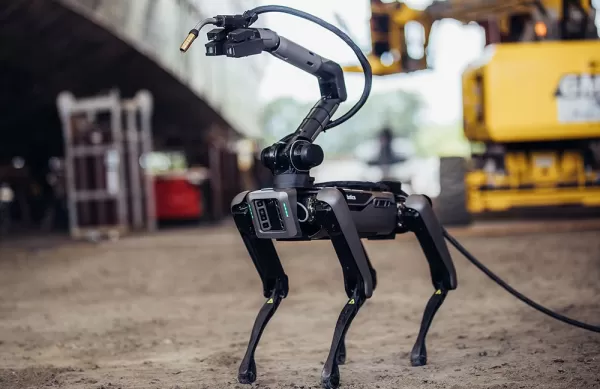
Path Robotics' latest offering is the Rove mobile robotic welding system. | Source: Path Robotics
HII, Path Robotics, and GrayMatter Robotics have launched the High-Yield Production Robotics (HYPR) program this week. The initiative aims to deploy a network of cutting-edge physical AI technologies from both robotics firms to significantly speed up the adoption of advanced, adaptive automation in fabricating both crewed and uncrewed naval vessels.
"By unifying our partnerships into a single HYPR team, we can combine our respective best-in-class capabilities to boost shipbuilding output, reinforce the maritime industrial base, and enhance our shipbuilding operations," stated Eric Chewning, HII's executive vice president of maritime systems and corporate strategy. "This HYPR program will allow us to deploy next-generation robotics for complex, variable shipbuilding tasks that have historically resisted full automation."
Developed with support from Huntington Ingalls Industries' (HII) Dark Sea Labs Advanced Technology Group, HYPR will integrate robotic welding, automated material handling, autonomous surface treatment, and autonomous quality inspection into a streamlined assembly line. This integrated approach is designed to dramatically improve the speed and efficiency of constructing ships and submarines.
"[Welding] is the most critical task. It's the most expensive, and it's the most unforgiving," Andy Lonsberry, CEO and co-founder of Path Robotics, explained to The Robot Report. "In general assembly, dropping a part is usually fine—you just pick it up. But with welding, a missed weld or a burn-through ruins the component entirely."
HII plans to conduct proof-of-concept demonstrations with its partners in 2026. The Newport News, Virginia-based company aims to launch the full-scale pilot program in 2027.
HII strengthens collaborations with Path Robotics and GrayMatter
Rather than deploying isolated automation tools, HYPR fuses multiple systems into one synchronized production line. The pilot program incorporates technologies from two key automation specialists:
Path Robotics: Physical AI for manufacturingGrayMatter Robotics: Factory SuperIntelligence (FSI) for surface preparation, finishing, coating, and inspectionHII initially partnered with Path Robotics in February. The companies signed a memorandum of understanding to explore integrating Path's physical AI welding technology into shipbuilding processes. Earlier this month, Path also unveiled Rove, a mobile robotic welding system that combines its Obsidian physical AI with a quadruped robot.
GrayMatter Robotics entered a partnership with HII earlier this month with analogous goals to embed its physical AI into shipbuilding operations.
Collectively, these systems will address the highly specialized and interconnected stages of structural fabrication and assembly. These steps significantly impact cost, timelines, and reliance on external suppliers for major maritime projects.
"[HII] requires millions of welding hours annually," noted Lonsberry. "They face a massive, multi-billion-dollar backlog that demands an aggressive approach. The timing is critical, and they need solutions to augment their workforce effectively."
HII will contribute its shipbuilding expertise, production requirements, and certification pathways. In exchange, the partners will provide engineering investment and deliver cost-competitive materials, alongside scalable automation systems applicable across various programs.
U.S. drive for accelerated shipbuilding
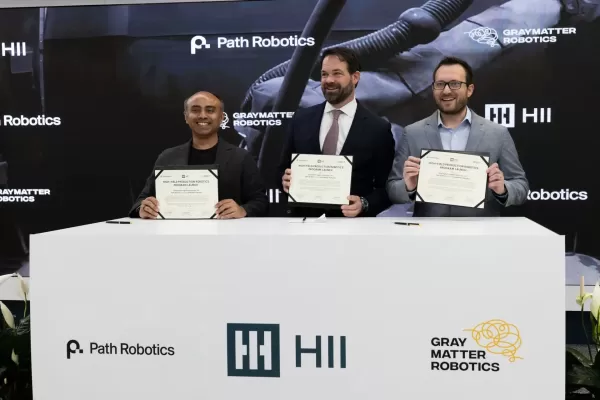
From left to right: Ariyan Kabir, CEO of GrayMatter Robotics; Eric Chewning, executive vice president of maritime systems and corporate strategy at HII; and Andy Lonsberry, CEO of Path Robotics. | Source: HII
The program aligns with a wider U.S. defense effort to expand naval capacity, modernize shipbuilding, and introduce more scalable manufacturing techniques to support the construction of the nation's future "golden fleet."
"This partnership is a move toward bolstering industrial capacity in a sector vital to national security," said Ariyan Kabir, co-founder and CEO of Carson, California-based GrayMatter Robotics. "We have already deployed our systems in demanding production environments across multiple industries. This collaboration lets us apply and scale that proven capability within shipbuilding, alongside Path and HII."
Path Robotics acknowledged that producing critical materials for integration into U.S. Navy platforms remains a primary bottleneck in ship and submarine construction. The company highlighted that complex assemblies, in particular, demand flawless coordination of numerous specialized skills and tasks to shorten production cycles.
HYPR is engineered for adaptive automation throughout the entire structural process—from cutting and fitting parts to surface preparation, welding, inspection, blasting, and coating.
"We see this urgency resonating across the entire shipbuilding sector," Lonsberry observed. "There is an unprecedented demand for production. The industry widely calls this the shipbuilding renaissance, and everyone needs to ramp up productivity."
Editor’s note: Path Robotics co-founder and CEO Andy Lonsberry will be a panelist for "Productizing AI in Robotic Systems" at next month's Robotics Summit & Expo in Boston. Register now to attend.
Related article
 AI Robotics Transitions from Lab to Factory Floor
From left: Andy Lonsberry of Path Robotics; Anders Beck of Universal Robots; and Dave Coleman of PickNik Robotics.Artificial intelligence is now a fundamental part of every robotic system. It transforms how robots interpret sensor data, make decision
Dextall's Robotic Welding Triples Speed for Industrial Facade Production
Precision robotic welding triples production speed for Dextall’s high-rise facade components. | Credit: DextallDextall, a facade manufacturer with a $210 million project portfolio, has introduced a proprietary robotic welding system that triples the
Anthropic Expands Claude AI Coding Tools to Japan in Push for Overseas Growth
Anthropic, a prominent U.S. artificial intelligence firm, is intensifying its global outreach. On Wednesday, the company hosted a major developer gathering, "Code with Claude," in Tokyo, drawing close to 500 software engineers. This initiative seeks
Related Special Topic Recommendations
Design & Art
AI Robotics Transitions from Lab to Factory Floor
From left: Andy Lonsberry of Path Robotics; Anders Beck of Universal Robots; and Dave Coleman of PickNik Robotics.Artificial intelligence is now a fundamental part of every robotic system. It transforms how robots interpret sensor data, make decision
Dextall's Robotic Welding Triples Speed for Industrial Facade Production
Precision robotic welding triples production speed for Dextall’s high-rise facade components. | Credit: DextallDextall, a facade manufacturer with a $210 million project portfolio, has introduced a proprietary robotic welding system that triples the
Anthropic Expands Claude AI Coding Tools to Japan in Push for Overseas Growth
Anthropic, a prominent U.S. artificial intelligence firm, is intensifying its global outreach. On Wednesday, the company hosted a major developer gathering, "Code with Claude," in Tokyo, drawing close to 500 software engineers. This initiative seeks
Related Special Topic Recommendations
Design & Art
 Best AI Style Transfer Tools for Creative Experiments
2026 Latest Best Top-rated AI Style Transfer Tools for Creative Experiments! XIX.AI has curated a powerful, game-changing collection of must-try tools that deliver exceptional results through real-world tests and rigorous rankings. These top solutions help creatives boost productivity significantly by accelerating content creation and unlocking endless creative possibilities. Explore now to discover your perfect tool and start creating today!
 9 tools
 xix.ai
Comic Creation
Best AI Dialogue Bubble Tools for Visual Storytelling
xix.ai
Comic Creation
Best AI Dialogue Bubble Tools for Visual Storytelling
2026 Latest Best Top-Rated AI Dialogue Bubble Tools for Visual Storytelling are here on XIX.AI! This curated collection features powerful, game-changing tools that help creators boost productivity and overcome creative bottlenecks. Get a free vs paid comparison, see real-world tests, and check the latest rankings to find the must-try solutions perfect for crafting engaging visual narratives. Explore now to discover your ideal tool!
10 tools
xix.ai
Meeting Assistant
Top AI Meeting Summary Tools: Track Decisions and Follow-Ups Clearly
2026 Latest Top-Rated Best AI Meeting Summary Tools for Clear Decision Tracking and Effortless Follow-Ups. This curated list showcases powerful, game-changing solutions that boost productivity dramatically by automating meeting notes, identifying key action items, and streamlining team coordination across all projects. Get a free vs paid comparison along with real-world tests and weekly updated rankings to help you find the perfect tool. Explore now to unlock your AI edge!
9 tools
xix.ai
Data Analysis
Best AI Data Cleaning Tools: Fix Missing Values and Duplicates Fast
2026 Latest Best Top-rated AI Data Cleaning Tools for quick fixing of missing values and duplicates. This curated list showcases powerful, game-changing solutions that boost productivity significantly. Each option has undergone rigorous real-world tests to ensure reliability. Get a free vs paid comparison and discover the must-try tool that fits your needs best. Explore now at XIX.AI to Unlock your AI edge.
11 tools
xix.ai
Design & Art
Best AI Creative Ideation Tools for Artists: Break Through Visual Blocks
2026 Latest Best Top-Rated AI Creative Ideation Tools for Artists are curated by XIX.AI to help creators break through visual blocks and boost creativity instantly. These powerful game-changing tools offer real-world tests, detailed free vs paid comparison, and weekly updated rankings. Discover your perfect tool to accelerate content creation and unlock your AI edge today. Explore now!
14 tools
xix.ai
Music composition
AI Beat Makers for TikTok Background Tracks, Reels Audio, and Creator Promo Music
2026 Latest Best AI Beat Makers for TikTok Background Tracks, Reels Audio, and Creator Promo Music! XIX.AI has curated a top-rated list of powerful game-changing tools that go through real-world tests to deliver flawless music for every content need. You’ll find detailed free vs paid comparison data, weekly updated rankings, and must-try options to help you boost creativity and productivity. Explore now to discover your perfect tool!
11 tools
xix.ai

 Comments (0)
0/500
Comments (0)
0/500
Path Robotics' latest offering is the Rove mobile robotic welding system. | Source: Path Robotics
HII, Path Robotics, and GrayMatter Robotics have launched the High-Yield Production Robotics (HYPR) program this week. The initiative aims to deploy a network of cutting-edge physical AI technologies from both robotics firms to significantly speed up the adoption of advanced, adaptive automation in fabricating both crewed and uncrewed naval vessels.
"By unifying our partnerships into a single HYPR team, we can combine our respective best-in-class capabilities to boost shipbuilding output, reinforce the maritime industrial base, and enhance our shipbuilding operations," stated Eric Chewning, HII's executive vice president of maritime systems and corporate strategy. "This HYPR program will allow us to deploy next-generation robotics for complex, variable shipbuilding tasks that have historically resisted full automation."
Developed with support from Huntington Ingalls Industries' (HII) Dark Sea Labs Advanced Technology Group, HYPR will integrate robotic welding, automated material handling, autonomous surface treatment, and autonomous quality inspection into a streamlined assembly line. This integrated approach is designed to dramatically improve the speed and efficiency of constructing ships and submarines.
"[Welding] is the most critical task. It's the most expensive, and it's the most unforgiving," Andy Lonsberry, CEO and co-founder of Path Robotics, explained to The Robot Report. "In general assembly, dropping a part is usually fine—you just pick it up. But with welding, a missed weld or a burn-through ruins the component entirely."
HII plans to conduct proof-of-concept demonstrations with its partners in 2026. The Newport News, Virginia-based company aims to launch the full-scale pilot program in 2027.
HII strengthens collaborations with Path Robotics and GrayMatter
Rather than deploying isolated automation tools, HYPR fuses multiple systems into one synchronized production line. The pilot program incorporates technologies from two key automation specialists:
Path Robotics: Physical AI for manufacturingGrayMatter Robotics: Factory SuperIntelligence (FSI) for surface preparation, finishing, coating, and inspectionHII initially partnered with Path Robotics in February. The companies signed a memorandum of understanding to explore integrating Path's physical AI welding technology into shipbuilding processes. Earlier this month, Path also unveiled Rove, a mobile robotic welding system that combines its Obsidian physical AI with a quadruped robot.
GrayMatter Robotics entered a partnership with HII earlier this month with analogous goals to embed its physical AI into shipbuilding operations.
Collectively, these systems will address the highly specialized and interconnected stages of structural fabrication and assembly. These steps significantly impact cost, timelines, and reliance on external suppliers for major maritime projects.
"[HII] requires millions of welding hours annually," noted Lonsberry. "They face a massive, multi-billion-dollar backlog that demands an aggressive approach. The timing is critical, and they need solutions to augment their workforce effectively."
HII will contribute its shipbuilding expertise, production requirements, and certification pathways. In exchange, the partners will provide engineering investment and deliver cost-competitive materials, alongside scalable automation systems applicable across various programs.
U.S. drive for accelerated shipbuilding
From left to right: Ariyan Kabir, CEO of GrayMatter Robotics; Eric Chewning, executive vice president of maritime systems and corporate strategy at HII; and Andy Lonsberry, CEO of Path Robotics. | Source: HII
The program aligns with a wider U.S. defense effort to expand naval capacity, modernize shipbuilding, and introduce more scalable manufacturing techniques to support the construction of the nation's future "golden fleet."
"This partnership is a move toward bolstering industrial capacity in a sector vital to national security," said Ariyan Kabir, co-founder and CEO of Carson, California-based GrayMatter Robotics. "We have already deployed our systems in demanding production environments across multiple industries. This collaboration lets us apply and scale that proven capability within shipbuilding, alongside Path and HII."
Path Robotics acknowledged that producing critical materials for integration into U.S. Navy platforms remains a primary bottleneck in ship and submarine construction. The company highlighted that complex assemblies, in particular, demand flawless coordination of numerous specialized skills and tasks to shorten production cycles.
HYPR is engineered for adaptive automation throughout the entire structural process—from cutting and fitting parts to surface preparation, welding, inspection, blasting, and coating.
"We see this urgency resonating across the entire shipbuilding sector," Lonsberry observed. "There is an unprecedented demand for production. The industry widely calls this the shipbuilding renaissance, and everyone needs to ramp up productivity."
Editor’s note: Path Robotics co-founder and CEO Andy Lonsberry will be a panelist for "Productizing AI in Robotic Systems" at next month's Robotics Summit & Expo in Boston. Register now to attend.








 AI Robotics Transitions from Lab to Factory Floor
From left: Andy Lonsberry of Path Robotics; Anders Beck of Universal Robots; and Dave Coleman of PickNik Robotics.Artificial intelligence is now a fundamental part of every robotic system. It transforms how robots interpret sensor data, make decision
AI Robotics Transitions from Lab to Factory Floor
From left: Andy Lonsberry of Path Robotics; Anders Beck of Universal Robots; and Dave Coleman of PickNik Robotics.Artificial intelligence is now a fundamental part of every robotic system. It transforms how robots interpret sensor data, make decision
 Dextall's Robotic Welding Triples Speed for Industrial Facade Production
Precision robotic welding triples production speed for Dextall’s high-rise facade components. | Credit: DextallDextall, a facade manufacturer with a $210 million project portfolio, has introduced a proprietary robotic welding system that triples the
Dextall's Robotic Welding Triples Speed for Industrial Facade Production
Precision robotic welding triples production speed for Dextall’s high-rise facade components. | Credit: DextallDextall, a facade manufacturer with a $210 million project portfolio, has introduced a proprietary robotic welding system that triples the
 Anthropic Expands Claude AI Coding Tools to Japan in Push for Overseas Growth
Anthropic, a prominent U.S. artificial intelligence firm, is intensifying its global outreach. On Wednesday, the company hosted a major developer gathering, "Code with Claude," in Tokyo, drawing close to 500 software engineers. This initiative seeks
Anthropic Expands Claude AI Coding Tools to Japan in Push for Overseas Growth
Anthropic, a prominent U.S. artificial intelligence firm, is intensifying its global outreach. On Wednesday, the company hosted a major developer gathering, "Code with Claude," in Tokyo, drawing close to 500 software engineers. This initiative seeks

2026 Latest Best Top-rated AI Style Transfer Tools for Creative Experiments! XIX.AI has curated a powerful, game-changing collection of must-try tools that deliver exceptional results through real-world tests and rigorous rankings. These top solutions help creatives boost productivity significantly by accelerating content creation and unlocking endless creative possibilities. Explore now to discover your perfect tool and start creating today!
9 tools
xix.ai

2026 Latest Best Top-Rated AI Dialogue Bubble Tools for Visual Storytelling are here on XIX.AI! This curated collection features powerful, game-changing tools that help creators boost productivity and overcome creative bottlenecks. Get a free vs paid comparison, see real-world tests, and check the latest rankings to find the must-try solutions perfect for crafting engaging visual narratives. Explore now to discover your ideal tool!
10 tools
xix.ai

2026 Latest Top-Rated Best AI Meeting Summary Tools for Clear Decision Tracking and Effortless Follow-Ups. This curated list showcases powerful, game-changing solutions that boost productivity dramatically by automating meeting notes, identifying key action items, and streamlining team coordination across all projects. Get a free vs paid comparison along with real-world tests and weekly updated rankings to help you find the perfect tool. Explore now to unlock your AI edge!
9 tools
xix.ai

2026 Latest Best Top-rated AI Data Cleaning Tools for quick fixing of missing values and duplicates. This curated list showcases powerful, game-changing solutions that boost productivity significantly. Each option has undergone rigorous real-world tests to ensure reliability. Get a free vs paid comparison and discover the must-try tool that fits your needs best. Explore now at XIX.AI to Unlock your AI edge.
11 tools
xix.ai

2026 Latest Best Top-Rated AI Creative Ideation Tools for Artists are curated by XIX.AI to help creators break through visual blocks and boost creativity instantly. These powerful game-changing tools offer real-world tests, detailed free vs paid comparison, and weekly updated rankings. Discover your perfect tool to accelerate content creation and unlock your AI edge today. Explore now!
14 tools
xix.ai

2026 Latest Best AI Beat Makers for TikTok Background Tracks, Reels Audio, and Creator Promo Music! XIX.AI has curated a top-rated list of powerful game-changing tools that go through real-world tests to deliver flawless music for every content need. You’ll find detailed free vs paid comparison data, weekly updated rankings, and must-try options to help you boost creativity and productivity. Explore now to discover your perfect tool!
11 tools
xix.ai












