


 Home
HomeEnCharge Secures Over $100M for AI Acceleration with Analog Chips
EnCharge AI, a semiconductor startup spun out from Princeton University, has successfully raised over $100 million in a Series B funding round. This round, led by Tiger Global, aims to fuel the company's next growth phase. The excitement around AI is at an all-time high, yet the steep costs of building and running AI services remain a concern. EnCharge believes its innovative analog memory chips, designed for integration into devices like laptops, desktops, handsets, and wearables, will not only accelerate AI processing but also reduce costs.
Based in Santa Clara, EnCharge claims its AI accelerators consume 20 times less energy than other market-available chips. They anticipate launching their first chips later this year. This funding round is particularly noteworthy as it aligns with the U.S. government's push to enhance domestic innovation in hardware and infrastructure, including chips. Should EnCharge succeed, it could play a pivotal role in this national strategy.
This Series B is a new funding round, distinct from a tranche reported in December 2023. Bloomberg hinted at this Series B last May, noting EnCharge's intention to raise at least $70 million to expand its business. In a conversation with TechCrunch, EnCharge's CEO and co-founder, Naveen Verma, did not disclose the company's valuation, correcting PitchBook data that suggested a $438 million post-money valuation in October as inaccurate.
Verma also kept the identities of EnCharge's customers under wraps, but the diverse group of investors in this round hints at potential partnerships. Alongside Tiger Global, investors include Maverick Silicon, Capital TEN from Taiwan, SIP Global Partners, Zero Infinity Partners, CTBC VC, Vanderbilt University, and Morgan Creek Digital, as well as returning investors like RTX Ventures, Anzu Partners, Scout Ventures, AlleyCorp, ACVC, and S5V.
Corporate investors in the round include Samsung Ventures and HH-CTBC, a collaboration between Hon Hai Technology Group (Foxconn) and CTBC VC. EnCharge has previously received support from the VentureTech Alliance, In-Q-Tel, and Constellation Technology, along with grants from U.S. organizations such as DARPA and the Department of Defense.
Verma mentioned a close collaboration with TSMC, which he said has been following his research for years and provided access to advanced silicon—a rare opportunity. This partnership dates back to the early stages of EnCharge's R&D.
EnCharge's focus on analog technology sets it apart from competitors who primarily target processing chips for AI training and inference at the server level, boosting business for GPU makers like Nvidia and AMD. EnCharge's approach, as detailed in a recent IBM research paper, integrates compute and memory, making these processors more cost-effective than traditional designs. While these chips are suitable for inference at the edge, EnCharge and others like IBM are exploring new algorithms to broaden their applications.
EnCharge isn't alone in pursuing analog technology, but Verma highlights a significant breakthrough in their chip design, making them resilient to noise. This innovation involves using a precise device available in the standard supply chain—geometry-dependent metal wires that can be finely controlled. EnCharge also offers a full-stack solution, including software tailored to its hardware.
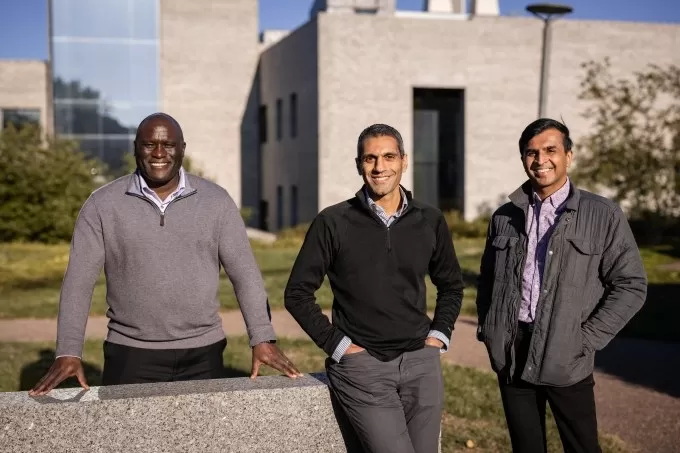
Image Credits:EnCharge AI (opens in a new window) under alicense. The expertise of EnCharge's leadership, including CEO Naveen Verma, COO Echere Iroaga, and CTO Kailash Gopalakrishnan, adds strength to their endeavor. However, the competitive landscape remains challenging, with other startups like Mythic and Sagence also in the analog chip race.
Jimmy Kan, an investment partner at Anzu Partners with a focus on semiconductors, noted the crowded field, having reviewed over 50 companies in this space since 2017. He emphasized the search for truly differentiated AI compute technology, expressing excitement about EnCharge's progress.
EnCharge's journey contrasts with many deep tech startups that have emerged over the past few years, often backed by ample venture funding. These startups often focus on ideas that are not yet market-ready but hold significant potential. EnCharge, however, took a more measured approach, emerging from stealth in 2022 after nearly a decade of research at Princeton. This strategy allowed them to de-risk their technology and focus on securing commercial partners while continuing development.
Verma explained that for fundamentally new technologies, understanding and de-risking the technology is crucial before shifting focus to customer needs upon receiving venture funding.
Related article
 How Recursive Intelligence Raised $335M at $4B Valuation in 4 Months
The co-founders of startup Ricursive Intelligence seemed destined to be co-founders.Anna Goldie, CEO, and Azalia Mirhoseini, CTO, are so well-known in the AI community that they were among those AI engineers who “got those weird emails from Zuckerber
Nvidia H200 China deal survives Trump-Xi summit, but not as expected
President Trump traveled to Beijing with Jensen Huang joining the delegation at the eleventh hour, departing two days later with vague remarks about potential chip export developments. No deal materialized. Since Trump first authorized sales in Decem
Huawei to launch new AI chip in Q1 2027, challenging Nvidia
Huawei has accelerated the release of its next-generation Ascend 960DT AI processor to Q1 2027, aiming to compete directly with Nvidia, the company revealed at its Huawei Connect event on Thursday.Previously, the Chinese technology leader targeted a
Related Special Topic Recommendations
Design & Art
How Recursive Intelligence Raised $335M at $4B Valuation in 4 Months
The co-founders of startup Ricursive Intelligence seemed destined to be co-founders.Anna Goldie, CEO, and Azalia Mirhoseini, CTO, are so well-known in the AI community that they were among those AI engineers who “got those weird emails from Zuckerber
Nvidia H200 China deal survives Trump-Xi summit, but not as expected
President Trump traveled to Beijing with Jensen Huang joining the delegation at the eleventh hour, departing two days later with vague remarks about potential chip export developments. No deal materialized. Since Trump first authorized sales in Decem
Huawei to launch new AI chip in Q1 2027, challenging Nvidia
Huawei has accelerated the release of its next-generation Ascend 960DT AI processor to Q1 2027, aiming to compete directly with Nvidia, the company revealed at its Huawei Connect event on Thursday.Previously, the Chinese technology leader targeted a
Related Special Topic Recommendations
Design & Art
 Top AI Illustration Tools: Create Editorial Scenes and Cover Art Faster
2026 Latest Top-rated AI Illustration Tools: Our curated list features the best powerfully designed tools for creating stunning editorial scenes and eye-catching cover art quickly. Each option has gone through rigorous real-world tests, offering a free vs paid comparison to help you find the perfect match for your workflow. Try these must-try solutions today to unlock your AI edge and boost your creative productivity. Explore now at XIX.AI.
 10 tools
 xix.ai
Education and Learning
Top AI Tutors for Exam Prep: Practice Math, Science, and English
xix.ai
Education and Learning
Top AI Tutors for Exam Prep: Practice Math, Science, and English
2026 Latest Top-Rated Best AI Tutors for Exam Prep are here on XIX.AI! Our curated list features powerful game-changing tools that offer free vs paid comparison, real-world tests, and weekly updated rankings. They help boost your writing efficiency, simplify complex topic learning, and unlock your academic potential. Explore now to Discover your perfect exam prep tool and Start creating today to Unlock your AI edge!
10 tools
xix.ai
Finance
AI Budget Planning Tools for Personal Money Management
2026 Latest Best Top-Rated AI Budget Planning Tools for Personal Money Management are here on XIX.AI! This curated collection features powerful, game-changing solutions that help you conduct real-world tests, understand spending habits, and create personalized plans to boost productivity. Enjoy a free vs paid comparison along with detailed rankings. Must-try tools designed to simplify money management and unlock your AI edge. Explore now!
11 tools
xix.ai
Health & Wellness
AI Sleep Tracking Assistants: Improve Recovery with Better Bedtime Habits
2026 Latest Best Top-Rated AI Sleep Tracking Assistants curated for ultimate recovery. This fully updated weekly guide features powerful tools that deliver real-world tests, free vs paid comparison, and detailed rankings to help you find the must-try solution that boosts sleep quality and supports better bedtime habits. Explore now at XIX.AI to Unlock your AI edge.
10 tools
xix.ai
Data Analysis
AI SQL Copilots for Product and Revenue Analytics
2026 Latest Best Top-Rated AI SQL Copilots for Product and Revenue Analytics! XIX.AI has curated a powerful, game-changing collection of must-try tools that undergo real-world tests through weekly updated rankings. These tools help users boost productivity significantly by accelerating data analysis, streamlining complex queries, and generating accurate insights to drive smarter business decisions. Explore now to Discover your perfect tool for unlocking your AI edge!
14 tools
xix.ai
Education and Learning
Best AI Homework Helpers That Teach: Learn Concepts, Not Just Answers
2026 Latest Best Top-Rated AI Homework Helpers That Teach Core Concepts Not Just Answers Powerful Tools for Students Must-Try Curated List Weekly Updated Free vs Paid Comparison Real-World Tests Accurate Rankings to Help You Unlock Your Full Learning Potential Explore now to Discover your perfect tool for smarter studying.
10 tools
xix.ai

 Comments (20)
0/500
Comments (20)
0/500
![MichaelMartinez]()
Interesting move by EnCharge! Analog chips for AI acceleration could really change the game, especially if they can bring down costs. But I wonder how they'll compete with digital giants like Nvidia. $100M is a lot, but AI hardware is a tough market. 🤔
![TimothyAllen]()
Raising over $100M with analog chips for AI? Not gonna lie, that’s wild! Feels like a clever hack to cut costs while everyone’s stuck on expensive digital hardware. Wonder if this changes the game or just stays niche. 🤔 Cool to see Princeton spin-outs getting this kind of backing!
![AveryThomas]()
看完这篇报道只能说AI芯片赛道太疯狂了!用模拟电路做AI加速听起来很前卫,但作为普通用户更在意的是这玩意儿用在我的手机里会不会发热降频?🤔 毕竟现在旗舰机动不动就烫手可不是什么好体验...
![TimothyDavis]()
Wow, $100M for analog AI chips? EnCharge is betting big on a unique approach! Curious how their tech stacks up against digital giants like NVIDIA. 🤔
![RobertSanchez]()
Wow, $100M for analog chips to boost AI? That’s wild! EnCharge is cooking something big, but I wonder if analog tech can really outpace GPUs in the AI race. Curious to see where this goes! 🚀
![WilliamMiller]()
A notícia de financiamento da EnCharge é empolgante, mas o aplicativo em si? Meh. É legal que eles estejam trabalhando na aceleração de IA com chips analógicos, mas a interface parece desajeitada. Precisa de uma experiência de usuário mais suave. Ainda assim, é ótimo ver inovação no hardware de IA! 🚀
EnCharge AI, a semiconductor startup spun out from Princeton University, has successfully raised over $100 million in a Series B funding round. This round, led by Tiger Global, aims to fuel the company's next growth phase. The excitement around AI is at an all-time high, yet the steep costs of building and running AI services remain a concern. EnCharge believes its innovative analog memory chips, designed for integration into devices like laptops, desktops, handsets, and wearables, will not only accelerate AI processing but also reduce costs.
Based in Santa Clara, EnCharge claims its AI accelerators consume 20 times less energy than other market-available chips. They anticipate launching their first chips later this year. This funding round is particularly noteworthy as it aligns with the U.S. government's push to enhance domestic innovation in hardware and infrastructure, including chips. Should EnCharge succeed, it could play a pivotal role in this national strategy.
This Series B is a new funding round, distinct from a tranche reported in December 2023. Bloomberg hinted at this Series B last May, noting EnCharge's intention to raise at least $70 million to expand its business. In a conversation with TechCrunch, EnCharge's CEO and co-founder, Naveen Verma, did not disclose the company's valuation, correcting PitchBook data that suggested a $438 million post-money valuation in October as inaccurate.
Verma also kept the identities of EnCharge's customers under wraps, but the diverse group of investors in this round hints at potential partnerships. Alongside Tiger Global, investors include Maverick Silicon, Capital TEN from Taiwan, SIP Global Partners, Zero Infinity Partners, CTBC VC, Vanderbilt University, and Morgan Creek Digital, as well as returning investors like RTX Ventures, Anzu Partners, Scout Ventures, AlleyCorp, ACVC, and S5V.
Corporate investors in the round include Samsung Ventures and HH-CTBC, a collaboration between Hon Hai Technology Group (Foxconn) and CTBC VC. EnCharge has previously received support from the VentureTech Alliance, In-Q-Tel, and Constellation Technology, along with grants from U.S. organizations such as DARPA and the Department of Defense.
Verma mentioned a close collaboration with TSMC, which he said has been following his research for years and provided access to advanced silicon—a rare opportunity. This partnership dates back to the early stages of EnCharge's R&D.
EnCharge's focus on analog technology sets it apart from competitors who primarily target processing chips for AI training and inference at the server level, boosting business for GPU makers like Nvidia and AMD. EnCharge's approach, as detailed in a recent IBM research paper, integrates compute and memory, making these processors more cost-effective than traditional designs. While these chips are suitable for inference at the edge, EnCharge and others like IBM are exploring new algorithms to broaden their applications.
EnCharge isn't alone in pursuing analog technology, but Verma highlights a significant breakthrough in their chip design, making them resilient to noise. This innovation involves using a precise device available in the standard supply chain—geometry-dependent metal wires that can be finely controlled. EnCharge also offers a full-stack solution, including software tailored to its hardware.
Jimmy Kan, an investment partner at Anzu Partners with a focus on semiconductors, noted the crowded field, having reviewed over 50 companies in this space since 2017. He emphasized the search for truly differentiated AI compute technology, expressing excitement about EnCharge's progress.
EnCharge's journey contrasts with many deep tech startups that have emerged over the past few years, often backed by ample venture funding. These startups often focus on ideas that are not yet market-ready but hold significant potential. EnCharge, however, took a more measured approach, emerging from stealth in 2022 after nearly a decade of research at Princeton. This strategy allowed them to de-risk their technology and focus on securing commercial partners while continuing development.
Verma explained that for fundamentally new technologies, understanding and de-risking the technology is crucial before shifting focus to customer needs upon receiving venture funding.








 How Recursive Intelligence Raised $335M at $4B Valuation in 4 Months
The co-founders of startup Ricursive Intelligence seemed destined to be co-founders.Anna Goldie, CEO, and Azalia Mirhoseini, CTO, are so well-known in the AI community that they were among those AI engineers who “got those weird emails from Zuckerber
How Recursive Intelligence Raised $335M at $4B Valuation in 4 Months
The co-founders of startup Ricursive Intelligence seemed destined to be co-founders.Anna Goldie, CEO, and Azalia Mirhoseini, CTO, are so well-known in the AI community that they were among those AI engineers who “got those weird emails from Zuckerber
 Nvidia H200 China deal survives Trump-Xi summit, but not as expected
President Trump traveled to Beijing with Jensen Huang joining the delegation at the eleventh hour, departing two days later with vague remarks about potential chip export developments. No deal materialized. Since Trump first authorized sales in Decem
Nvidia H200 China deal survives Trump-Xi summit, but not as expected
President Trump traveled to Beijing with Jensen Huang joining the delegation at the eleventh hour, departing two days later with vague remarks about potential chip export developments. No deal materialized. Since Trump first authorized sales in Decem
 Huawei to launch new AI chip in Q1 2027, challenging Nvidia
Huawei has accelerated the release of its next-generation Ascend 960DT AI processor to Q1 2027, aiming to compete directly with Nvidia, the company revealed at its Huawei Connect event on Thursday.Previously, the Chinese technology leader targeted a
Huawei to launch new AI chip in Q1 2027, challenging Nvidia
Huawei has accelerated the release of its next-generation Ascend 960DT AI processor to Q1 2027, aiming to compete directly with Nvidia, the company revealed at its Huawei Connect event on Thursday.Previously, the Chinese technology leader targeted a

2026 Latest Top-rated AI Illustration Tools: Our curated list features the best powerfully designed tools for creating stunning editorial scenes and eye-catching cover art quickly. Each option has gone through rigorous real-world tests, offering a free vs paid comparison to help you find the perfect match for your workflow. Try these must-try solutions today to unlock your AI edge and boost your creative productivity. Explore now at XIX.AI.
10 tools
xix.ai

2026 Latest Top-Rated Best AI Tutors for Exam Prep are here on XIX.AI! Our curated list features powerful game-changing tools that offer free vs paid comparison, real-world tests, and weekly updated rankings. They help boost your writing efficiency, simplify complex topic learning, and unlock your academic potential. Explore now to Discover your perfect exam prep tool and Start creating today to Unlock your AI edge!
10 tools
xix.ai

2026 Latest Best Top-Rated AI Budget Planning Tools for Personal Money Management are here on XIX.AI! This curated collection features powerful, game-changing solutions that help you conduct real-world tests, understand spending habits, and create personalized plans to boost productivity. Enjoy a free vs paid comparison along with detailed rankings. Must-try tools designed to simplify money management and unlock your AI edge. Explore now!
11 tools
xix.ai

2026 Latest Best Top-Rated AI Sleep Tracking Assistants curated for ultimate recovery. This fully updated weekly guide features powerful tools that deliver real-world tests, free vs paid comparison, and detailed rankings to help you find the must-try solution that boosts sleep quality and supports better bedtime habits. Explore now at XIX.AI to Unlock your AI edge.
10 tools
xix.ai

2026 Latest Best Top-Rated AI SQL Copilots for Product and Revenue Analytics! XIX.AI has curated a powerful, game-changing collection of must-try tools that undergo real-world tests through weekly updated rankings. These tools help users boost productivity significantly by accelerating data analysis, streamlining complex queries, and generating accurate insights to drive smarter business decisions. Explore now to Discover your perfect tool for unlocking your AI edge!
14 tools
xix.ai

2026 Latest Best Top-Rated AI Homework Helpers That Teach Core Concepts Not Just Answers Powerful Tools for Students Must-Try Curated List Weekly Updated Free vs Paid Comparison Real-World Tests Accurate Rankings to Help You Unlock Your Full Learning Potential Explore now to Discover your perfect tool for smarter studying.
10 tools
xix.ai

Interesting move by EnCharge! Analog chips for AI acceleration could really change the game, especially if they can bring down costs. But I wonder how they'll compete with digital giants like Nvidia. $100M is a lot, but AI hardware is a tough market. 🤔
Raising over $100M with analog chips for AI? Not gonna lie, that’s wild! Feels like a clever hack to cut costs while everyone’s stuck on expensive digital hardware. Wonder if this changes the game or just stays niche. 🤔 Cool to see Princeton spin-outs getting this kind of backing!
看完这篇报道只能说AI芯片赛道太疯狂了!用模拟电路做AI加速听起来很前卫,但作为普通用户更在意的是这玩意儿用在我的手机里会不会发热降频?🤔 毕竟现在旗舰机动不动就烫手可不是什么好体验...
Wow, $100M for analog AI chips? EnCharge is betting big on a unique approach! Curious how their tech stacks up against digital giants like NVIDIA. 🤔
Wow, $100M for analog chips to boost AI? That’s wild! EnCharge is cooking something big, but I wonder if analog tech can really outpace GPUs in the AI race. Curious to see where this goes! 🚀
A notícia de financiamento da EnCharge é empolgante, mas o aplicativo em si? Meh. É legal que eles estejam trabalhando na aceleração de IA com chips analógicos, mas a interface parece desajeitada. Precisa de uma experiência de usuário mais suave. Ainda assim, é ótimo ver inovação no hardware de IA! 🚀












