


 Home
HomeAlibaba DAMO Academy Unveils DAMO EAGLE AI for Non-Invasive Esophageal Cancer Detection
Alibaba has unveiled its latest cancer screening AI tool, DAMO EAGLE. Developed jointly by Alibaba DAMO Academy, Sichuan Cancer Hospital, and Sun Yat-sen University Cancer Center, this model detects esophageal cancer—including early-stage and precancerous lesions—using standard CT scans, eliminating the need for endoscopy or contrast agents. Validated across 80,000 cases in three countries, the research was published on September 22 in Nature Medicine, a leading international journal.
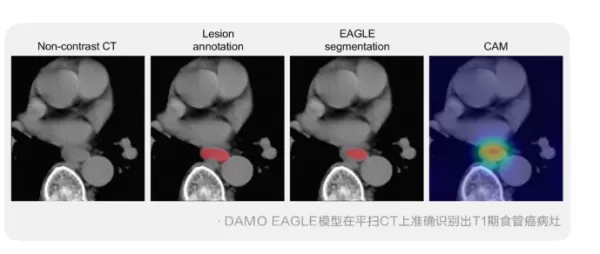
Achieving 90% Sensitivity and 99.2% Specificity in a Challenging Field
China accounts for nearly half of global esophageal cancer cases, with most diagnoses occurring at late stages, often missing the window for curative treatment. Early detection through minimally invasive endoscopic surgery offers a five-year survival rate above 95%. While upper gastrointestinal endoscopy is the current standard, its invasive nature and complexity hinder widespread adoption. Plain chest CT scans, however, are cost-effective and widely accepted, naturally covering the esophagus. If AI can identify esophageal risks during lung cancer screening, it would significantly boost efficiency. The difficulty lies in the esophagus’s structure as a collapsible hollow organ, with early lesions hidden in mucosal layers and obscured by heart and blood vessel movements, making identification on plain CT scans exceptionally hard for radiologists.
Yao Jiawen, an algorithm expert at DAMO Academy, explained that the team innovatively correlated endoscopic reports with precise lesion locations on enhanced CT images to train the AI on plain CT data. This approach enables the detection of subtle early lesions invisible to the human eye. According to the study, DAMO EAGLE achieves 90% sensitivity for esophageal cancer in opportunistic screening scenarios and 52.5% sensitivity for weak signals in precancerous lesions. In real-world applications, it maintains a specificity of 99.2%, performing consistently on low-dose CT scans. This allows seamless integration into existing lung cancer screening workflows without adding burden to patients.
Advancing the 'Plain CT + AI' Multi-Cancer Screening Strategy
Wang Qifeng, Chief Physician of Radiotherapy at Sichuan Cancer Hospital, noted that dietary habits like consuming hot and salty foods contribute to high esophageal cancer rates in western China, particularly Sichuan. Limited medical resources and low patient compliance create significant gaps in endoscopic screening. "AI does not replace endoscopy; it identifies high-risk individuals who then undergo targeted endoscopy, improving accuracy and detection rates," he stated. Crucially, this approach shifts prevention efforts earlier, offering more opportunities for early intervention.
With the recent release of AI models for pancreatic, gastric, colorectal, esophageal cancers, and aortic dissection, DAMO Academy has successfully established the "plain CT + AI" multi-screening technical route. Having published five papers in Nature Medicine, this technology holds the potential to screen for China’s top seven deadliest cancers using a single plain CT scan.
Related article
 Tencent WorkBuddy Launches on HarmonyOS PC App Market
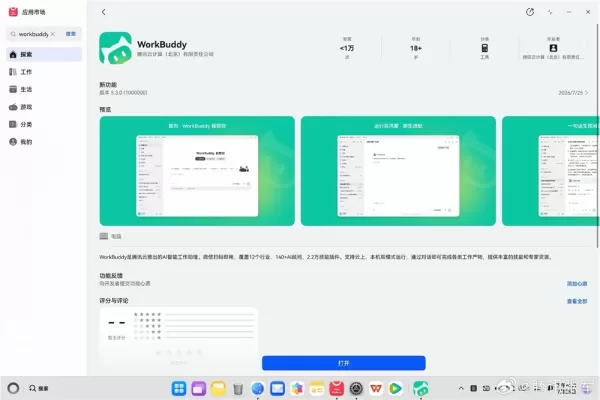
On July 27, Zhang Jun, Tencent’s public relations director, announced the official launch of the company’s AI office assistant, WorkBuddy, on the HarmonyOS PC app market. This marks the debut of the first desktop AI agent within the HarmonyOS ecosyst
ByteDance’s 50,000 AI Chip Buy Signals New Era for Domestic GPU Industry
As the user base of AI large models continues to expand, the self-reliance and controllability of computing infrastructure has become a strategic focus for major technology companies. On June 15, it was reported that ByteDance is currently in deep di
Denmark Fights AI Cheating With Oral Defenses and Live Screen Monitoring
Danish high schools have witnessed a sharp rise in AI-assisted cheating during this summer’s exam period. As generative AI becomes integrated into classrooms, students increasingly rely on it for homework and exams, creating significant challenges fo
Related Special Topic Recommendations
code
Tencent WorkBuddy Launches on HarmonyOS PC App Market
On July 27, Zhang Jun, Tencent’s public relations director, announced the official launch of the company’s AI office assistant, WorkBuddy, on the HarmonyOS PC app market. This marks the debut of the first desktop AI agent within the HarmonyOS ecosyst
ByteDance’s 50,000 AI Chip Buy Signals New Era for Domestic GPU Industry
As the user base of AI large models continues to expand, the self-reliance and controllability of computing infrastructure has become a strategic focus for major technology companies. On June 15, it was reported that ByteDance is currently in deep di
Denmark Fights AI Cheating With Oral Defenses and Live Screen Monitoring
Danish high schools have witnessed a sharp rise in AI-assisted cheating during this summer’s exam period. As generative AI becomes integrated into classrooms, students increasingly rely on it for homework and exams, creating significant challenges fo
Related Special Topic Recommendations
code
 Best AI Coding Tools for Python and JavaScript
2026 Latest Best Top-Rated AI Coding Tools for Python and JavaScript are here on XIX.AI’s curated list. These powerful game-changing tools have undergone rigorous real-world tests to deliver exceptional results for writing efficient code, fixing bugs, and boosting productivity. Get a free vs paid comparison and see which options suit your needs. Explore now to Discover your perfect coding tool and Unlock your AI edge.
 10 tools
 xix.ai
Academic Research
Best AI Citation Mapping Tools for Research Discovery
xix.ai
Academic Research
Best AI Citation Mapping Tools for Research Discovery
2026 Latest Best Top-Rated AI Citation Mapping Tools for Research Discovery! XIX.AI has curated a powerful, game-changing collection of must-try tools that go through rigorous real-world tests to deliver accurate results. You’ll find detailed free vs paid comparisons, weekly updated rankings, and insights to help you boost your research efficiency and uncover valuable data faster. Explore now to discover your perfect tool for academic work! 238 characters
11 tools
xix.ai
SEO
AI Meta Tag Tools for Faster On Page SEO
2026 Latest Best Top-rated AI Meta Tag Tools for Faster On Page SEO! XIX.AI has curated a powerful, game-changing collection of highly reliable tools that undergo rigorous real-world tests. You’ll find a free vs paid comparison along with detailed rankings to help you choose the perfect option for boosting your content’s search visibility and improving writing efficiency. Explore now to Unlock your AI edge!
9 tools
xix.ai
Health & Wellness
AI Habit Tracking Tools for Personal Health Goals
2026 Latest Best AI Habit Tracking Tools for Personal Health Goals are here on XIX.AI! Our curated top-rated list includes powerful, game-changing solutions that help you stay consistent with your goals through real-world tests and strict rankings. We also offer a free vs paid comparison to help you choose the perfect fit. Explore now to Unlock your AI edge in achieving better health outcomes.
10 tools
xix.ai
Data Analysis
Best AI Anomaly Detection Tools for Dashboard Monitoring
2026 Latest Best Top-rated AI Anomaly Detection Tools for Dashboard Monitoring are here on XIX.AI! This curated list features powerful, game-changing solutions that deliver accurate real-world tests through weekly updated rankings. You’ll find a free vs paid comparison and insights into how these tools boost productivity by helping users spot issues fast, streamlining workflow efficiency. Discover your perfect tool to unlock your AI edge today. Explore now!
9 tools
xix.ai
Animation Creation
AI Lip-Sync Generators for Dialogue-Driven Character Animation and Motion Scenes
2026 Latest Best AI Lip-Sync Generators for Dialogue-Driven Character Animation and Motion Scenes! XIX.AI has curated a top-rated list of powerful, game-changing tools that deliver flawless synchronized lip movements for animated characters. Each option undergoes rigorous real-world tests to ensure reliability, and our weekly updated rankings help you find the must-try solution that boosts your animation workflow efficiency. Explore now to discover your perfect tool!
9 tools
xix.ai

 Comments (0)
0/500
Comments (0)
0/500
Alibaba has unveiled its latest cancer screening AI tool, DAMO EAGLE. Developed jointly by Alibaba DAMO Academy, Sichuan Cancer Hospital, and Sun Yat-sen University Cancer Center, this model detects esophageal cancer—including early-stage and precancerous lesions—using standard CT scans, eliminating the need for endoscopy or contrast agents. Validated across 80,000 cases in three countries, the research was published on September 22 in Nature Medicine, a leading international journal.
Achieving 90% Sensitivity and 99.2% Specificity in a Challenging Field
China accounts for nearly half of global esophageal cancer cases, with most diagnoses occurring at late stages, often missing the window for curative treatment. Early detection through minimally invasive endoscopic surgery offers a five-year survival rate above 95%. While upper gastrointestinal endoscopy is the current standard, its invasive nature and complexity hinder widespread adoption. Plain chest CT scans, however, are cost-effective and widely accepted, naturally covering the esophagus. If AI can identify esophageal risks during lung cancer screening, it would significantly boost efficiency. The difficulty lies in the esophagus’s structure as a collapsible hollow organ, with early lesions hidden in mucosal layers and obscured by heart and blood vessel movements, making identification on plain CT scans exceptionally hard for radiologists.
Yao Jiawen, an algorithm expert at DAMO Academy, explained that the team innovatively correlated endoscopic reports with precise lesion locations on enhanced CT images to train the AI on plain CT data. This approach enables the detection of subtle early lesions invisible to the human eye. According to the study, DAMO EAGLE achieves 90% sensitivity for esophageal cancer in opportunistic screening scenarios and 52.5% sensitivity for weak signals in precancerous lesions. In real-world applications, it maintains a specificity of 99.2%, performing consistently on low-dose CT scans. This allows seamless integration into existing lung cancer screening workflows without adding burden to patients.
Advancing the 'Plain CT + AI' Multi-Cancer Screening Strategy
Wang Qifeng, Chief Physician of Radiotherapy at Sichuan Cancer Hospital, noted that dietary habits like consuming hot and salty foods contribute to high esophageal cancer rates in western China, particularly Sichuan. Limited medical resources and low patient compliance create significant gaps in endoscopic screening. "AI does not replace endoscopy; it identifies high-risk individuals who then undergo targeted endoscopy, improving accuracy and detection rates," he stated. Crucially, this approach shifts prevention efforts earlier, offering more opportunities for early intervention.
With the recent release of AI models for pancreatic, gastric, colorectal, esophageal cancers, and aortic dissection, DAMO Academy has successfully established the "plain CT + AI" multi-screening technical route. Having published five papers in Nature Medicine, this technology holds the potential to screen for China’s top seven deadliest cancers using a single plain CT scan.








 Tencent WorkBuddy Launches on HarmonyOS PC App Market
On July 27, Zhang Jun, Tencent’s public relations director, announced the official launch of the company’s AI office assistant, WorkBuddy, on the HarmonyOS PC app market. This marks the debut of the first desktop AI agent within the HarmonyOS ecosyst
Tencent WorkBuddy Launches on HarmonyOS PC App Market
On July 27, Zhang Jun, Tencent’s public relations director, announced the official launch of the company’s AI office assistant, WorkBuddy, on the HarmonyOS PC app market. This marks the debut of the first desktop AI agent within the HarmonyOS ecosyst
 ByteDance’s 50,000 AI Chip Buy Signals New Era for Domestic GPU Industry
As the user base of AI large models continues to expand, the self-reliance and controllability of computing infrastructure has become a strategic focus for major technology companies. On June 15, it was reported that ByteDance is currently in deep di
ByteDance’s 50,000 AI Chip Buy Signals New Era for Domestic GPU Industry
As the user base of AI large models continues to expand, the self-reliance and controllability of computing infrastructure has become a strategic focus for major technology companies. On June 15, it was reported that ByteDance is currently in deep di
 Denmark Fights AI Cheating With Oral Defenses and Live Screen Monitoring
Danish high schools have witnessed a sharp rise in AI-assisted cheating during this summer’s exam period. As generative AI becomes integrated into classrooms, students increasingly rely on it for homework and exams, creating significant challenges fo
Denmark Fights AI Cheating With Oral Defenses and Live Screen Monitoring
Danish high schools have witnessed a sharp rise in AI-assisted cheating during this summer’s exam period. As generative AI becomes integrated into classrooms, students increasingly rely on it for homework and exams, creating significant challenges fo

2026 Latest Best Top-Rated AI Coding Tools for Python and JavaScript are here on XIX.AI’s curated list. These powerful game-changing tools have undergone rigorous real-world tests to deliver exceptional results for writing efficient code, fixing bugs, and boosting productivity. Get a free vs paid comparison and see which options suit your needs. Explore now to Discover your perfect coding tool and Unlock your AI edge.
10 tools
xix.ai

2026 Latest Best Top-Rated AI Citation Mapping Tools for Research Discovery! XIX.AI has curated a powerful, game-changing collection of must-try tools that go through rigorous real-world tests to deliver accurate results. You’ll find detailed free vs paid comparisons, weekly updated rankings, and insights to help you boost your research efficiency and uncover valuable data faster. Explore now to discover your perfect tool for academic work! 238 characters
11 tools
xix.ai

2026 Latest Best Top-rated AI Meta Tag Tools for Faster On Page SEO! XIX.AI has curated a powerful, game-changing collection of highly reliable tools that undergo rigorous real-world tests. You’ll find a free vs paid comparison along with detailed rankings to help you choose the perfect option for boosting your content’s search visibility and improving writing efficiency. Explore now to Unlock your AI edge!
9 tools
xix.ai

2026 Latest Best AI Habit Tracking Tools for Personal Health Goals are here on XIX.AI! Our curated top-rated list includes powerful, game-changing solutions that help you stay consistent with your goals through real-world tests and strict rankings. We also offer a free vs paid comparison to help you choose the perfect fit. Explore now to Unlock your AI edge in achieving better health outcomes.
10 tools
xix.ai

2026 Latest Best Top-rated AI Anomaly Detection Tools for Dashboard Monitoring are here on XIX.AI! This curated list features powerful, game-changing solutions that deliver accurate real-world tests through weekly updated rankings. You’ll find a free vs paid comparison and insights into how these tools boost productivity by helping users spot issues fast, streamlining workflow efficiency. Discover your perfect tool to unlock your AI edge today. Explore now!
9 tools
xix.ai

2026 Latest Best AI Lip-Sync Generators for Dialogue-Driven Character Animation and Motion Scenes! XIX.AI has curated a top-rated list of powerful, game-changing tools that deliver flawless synchronized lip movements for animated characters. Each option undergoes rigorous real-world tests to ensure reliability, and our weekly updated rankings help you find the must-try solution that boosts your animation workflow efficiency. Explore now to discover your perfect tool!
9 tools
xix.ai












