


 Home
HomeOptimizing AI Model Selection for Real-World Performance
Businesses must ensure their application-driving AI models perform effectively in real-world scenarios. Predicting these scenarios can be challenging, complicating evaluations. The updated RewardBench 2 benchmark offers organizations clearer insights into a model’s practical performance.
The Allen Institute for AI (Ai2) introduced RewardBench 2, an enhanced version of its RewardBench benchmark, designed to provide a comprehensive assessment of model performance and alignment with enterprise objectives.
Ai2 developed RewardBench with classification tasks that evaluate correlations via inference-time compute and downstream training. RewardBench focuses on reward models (RMs), which judge large language model outputs by assigning scores or “rewards” to guide reinforcement learning with human feedback (RHLF).
RewardBench 2 is here! We took a long time to learn from our first reward model evaluation tool to make one that is substantially harder and more correlated with both downstream RLHF and inference-time scaling. pic.twitter.com/NGetvNrOQV
— Ai2 (@allen_ai) June 2, 2025
Nathan Lambert, a senior research scientist at Ai2, told VentureBeat that the original RewardBench functioned well initially, but evolving model environments demanded updated benchmarks.
“As reward models grew more sophisticated and use cases more complex, we saw, alongside the community, that the first version didn’t fully address real-world human preference complexities,” he explained.
Lambert noted that RewardBench 2 improves evaluation scope and depth, incorporating diverse, challenging prompts and refined methods to better reflect human judgment of AI outputs. It features new human prompts, a tougher scoring system, and additional domains.
Leveraging Evaluations for Model Assessment
Reward models evaluate model performance, but alignment with company values is critical. Misaligned RMs can amplify issues like hallucinations, reduce generalization, or overly favor harmful responses during fine-tuning and reinforcement learning.
RewardBench 2 spans six domains: factuality, precise instruction adherence, math, safety, focus, and ties.
“Enterprises can use RewardBench 2 in two ways based on their needs. For RLHF, they should integrate best practices and datasets from top models into their pipelines, as reward models require on-policy training. For inference-time scaling or data filtering, RewardBench 2 helps select the best model for their domain with correlated performance,” Lambert said.
Lambert emphasized that benchmarks like RewardBench allow users to assess models based on priorities most relevant to them, rather than a generic score. He noted that performance is subjective, heavily tied to user context and goals, with human preferences often highly nuanced.
Ai2 launched the original RewardBench in March 2024, calling it the first reward model benchmark and leaderboard. Since then, new methods like Meta’s FAIR reWordBench and DeepSeek’s Self-Principled Critique Tuning have emerged for smarter, scalable RMs.
Super excited that our second reward model evaluation is out. It's substantially harder, much cleaner, and well correlated with downstream PPO/BoN sampling.
Happy hillclimbing!
Huge congrats to @saumyamalik44 who lead the project with a total commitment to excellence. https://t.co/c0b6rHTXY5
— Nathan Lambert (@natolambert) June 2, 2025
Model Performance Insights
With RewardBench 2, Ai2 tested both existing and newly trained models, including variants of Gemini, Claude, GPT-4.1, and Llama-3.1, alongside datasets and models like Qwen, Skywork, and Tulu.
Findings showed larger reward models excel due to stronger base models. Llama-3.1 Instruct variants topped the benchmark, with Skywork data aiding focus and safety, and Tulu performing well in factuality.
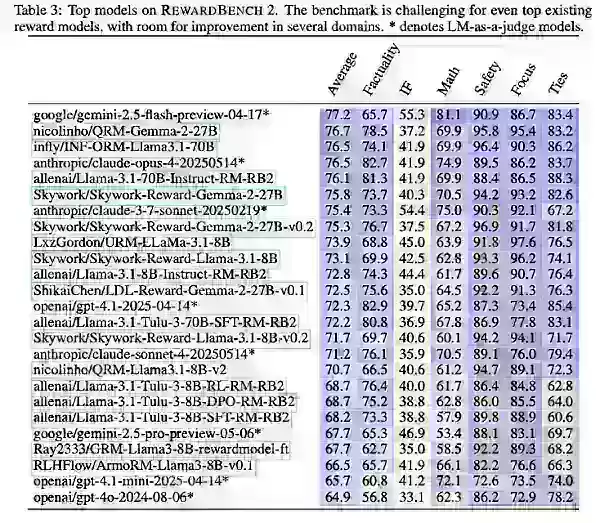
Ai2 noted that while RewardBench 2 advances multi-domain, accuracy-focused evaluation for reward models, it should primarily guide enterprises in selecting models best suited to their specific needs.
Related article
 Stripe to Acquire OpenRouter as AI Model Routing Gains Momentum
Stripe has agreed to acquire OpenRouter, an AI model-routing platform that gives developers access to hundreds of models through a single interface. The deal adds model selection and routing to Stripe’s existing work around AI usage and token-based b
Former OpenAI Researcher Barrett Zoph Returns to Google to Support Gemini Development
Barret Zoph, who previously abruptly left and joined OpenAI due to a disagreement with Thinking Machines Lab CEO Miriam Mularati, has once again changed employers. Alphabet's Google announced that Zoph will return as Vice President of Research, bring
How Recursive Intelligence Raised $335M at $4B Valuation in 4 Months
The co-founders of startup Ricursive Intelligence seemed destined to be co-founders.Anna Goldie, CEO, and Azalia Mirhoseini, CTO, are so well-known in the AI community that they were among those AI engineers who “got those weird emails from Zuckerber
Related Special Topic Recommendations
Design & Art
Stripe to Acquire OpenRouter as AI Model Routing Gains Momentum
Stripe has agreed to acquire OpenRouter, an AI model-routing platform that gives developers access to hundreds of models through a single interface. The deal adds model selection and routing to Stripe’s existing work around AI usage and token-based b
Former OpenAI Researcher Barrett Zoph Returns to Google to Support Gemini Development
Barret Zoph, who previously abruptly left and joined OpenAI due to a disagreement with Thinking Machines Lab CEO Miriam Mularati, has once again changed employers. Alphabet's Google announced that Zoph will return as Vice President of Research, bring
How Recursive Intelligence Raised $335M at $4B Valuation in 4 Months
The co-founders of startup Ricursive Intelligence seemed destined to be co-founders.Anna Goldie, CEO, and Azalia Mirhoseini, CTO, are so well-known in the AI community that they were among those AI engineers who “got those weird emails from Zuckerber
Related Special Topic Recommendations
Design & Art
 Top AI Illustration Tools: Create Editorial Scenes and Cover Art Faster
2026 Latest Top-rated AI Illustration Tools: Our curated list features the best powerfully designed tools for creating stunning editorial scenes and eye-catching cover art quickly. Each option has gone through rigorous real-world tests, offering a free vs paid comparison to help you find the perfect match for your workflow. Try these must-try solutions today to unlock your AI edge and boost your creative productivity. Explore now at XIX.AI.
 10 tools
 xix.ai
Education and Learning
Top AI Tutors for Exam Prep: Practice Math, Science, and English
xix.ai
Education and Learning
Top AI Tutors for Exam Prep: Practice Math, Science, and English
2026 Latest Top-Rated Best AI Tutors for Exam Prep are here on XIX.AI! Our curated list features powerful game-changing tools that offer free vs paid comparison, real-world tests, and weekly updated rankings. They help boost your writing efficiency, simplify complex topic learning, and unlock your academic potential. Explore now to Discover your perfect exam prep tool and Start creating today to Unlock your AI edge!
10 tools
xix.ai
Finance
AI Budget Planning Tools for Personal Money Management
2026 Latest Best Top-Rated AI Budget Planning Tools for Personal Money Management are here on XIX.AI! This curated collection features powerful, game-changing solutions that help you conduct real-world tests, understand spending habits, and create personalized plans to boost productivity. Enjoy a free vs paid comparison along with detailed rankings. Must-try tools designed to simplify money management and unlock your AI edge. Explore now!
11 tools
xix.ai
Health & Wellness
AI Sleep Tracking Assistants: Improve Recovery with Better Bedtime Habits
2026 Latest Best Top-Rated AI Sleep Tracking Assistants curated for ultimate recovery. This fully updated weekly guide features powerful tools that deliver real-world tests, free vs paid comparison, and detailed rankings to help you find the must-try solution that boosts sleep quality and supports better bedtime habits. Explore now at XIX.AI to Unlock your AI edge.
10 tools
xix.ai
Data Analysis
AI SQL Copilots for Product and Revenue Analytics
2026 Latest Best Top-Rated AI SQL Copilots for Product and Revenue Analytics! XIX.AI has curated a powerful, game-changing collection of must-try tools that undergo real-world tests through weekly updated rankings. These tools help users boost productivity significantly by accelerating data analysis, streamlining complex queries, and generating accurate insights to drive smarter business decisions. Explore now to Discover your perfect tool for unlocking your AI edge!
14 tools
xix.ai
Education and Learning
Best AI Homework Helpers That Teach: Learn Concepts, Not Just Answers
2026 Latest Best Top-Rated AI Homework Helpers That Teach Core Concepts Not Just Answers Powerful Tools for Students Must-Try Curated List Weekly Updated Free vs Paid Comparison Real-World Tests Accurate Rankings to Help You Unlock Your Full Learning Potential Explore now to Discover your perfect tool for smarter studying.
10 tools
xix.ai

 Comments (3)
0/500
Comments (3)
0/500
![JeffreyThomas]()
Como usuario que solo tiene conocimientos básicos, elegir el modelo adecuado es un dolor de cabeza. Este artículo menciona problemas prácticos que son ciertos; a veces, el modelo parece brillar en la prueba, pero en la práctica simplemente falla. Me pregunto si el RewardBench actualizado ayuda a predecir cuándo un modelo se 'descompone' de manera realista. Si las empresas confían demasiado en las métricas, podrían terminar con un fiasco en producción 😅. ¿Habrá herramientas más accesibles para los equipos pequeños?
![DonaldGonzález]()
この記事、実運用でのAIモデルの難しさをしっかり分析してますね。特にリアルワールドでの性能評価の課題は興味深い。AI導入が進む中で、本当に役立つモデル選びができる企業が勝ち残るのかも。ユーザー体験を考えると、ベンチマークだけで選ぶのは危険かもしれない... 😅
![CarlMartin]()
C'est intéressant, mais j'aimerais voir plus d'exemples concrets sur comment évaluer la performance des modèles en situation réelle. Parfois les benchmarks ne reflètent pas la complexité du terrain 😅
Businesses must ensure their application-driving AI models perform effectively in real-world scenarios. Predicting these scenarios can be challenging, complicating evaluations. The updated RewardBench 2 benchmark offers organizations clearer insights into a model’s practical performance.
The Allen Institute for AI (Ai2) introduced RewardBench 2, an enhanced version of its RewardBench benchmark, designed to provide a comprehensive assessment of model performance and alignment with enterprise objectives.
Ai2 developed RewardBench with classification tasks that evaluate correlations via inference-time compute and downstream training. RewardBench focuses on reward models (RMs), which judge large language model outputs by assigning scores or “rewards” to guide reinforcement learning with human feedback (RHLF).
RewardBench 2 is here! We took a long time to learn from our first reward model evaluation tool to make one that is substantially harder and more correlated with both downstream RLHF and inference-time scaling. pic.twitter.com/NGetvNrOQV
— Ai2 (@allen_ai) June 2, 2025
Nathan Lambert, a senior research scientist at Ai2, told VentureBeat that the original RewardBench functioned well initially, but evolving model environments demanded updated benchmarks.
“As reward models grew more sophisticated and use cases more complex, we saw, alongside the community, that the first version didn’t fully address real-world human preference complexities,” he explained.
Lambert noted that RewardBench 2 improves evaluation scope and depth, incorporating diverse, challenging prompts and refined methods to better reflect human judgment of AI outputs. It features new human prompts, a tougher scoring system, and additional domains.
Leveraging Evaluations for Model Assessment
Reward models evaluate model performance, but alignment with company values is critical. Misaligned RMs can amplify issues like hallucinations, reduce generalization, or overly favor harmful responses during fine-tuning and reinforcement learning.
RewardBench 2 spans six domains: factuality, precise instruction adherence, math, safety, focus, and ties.
“Enterprises can use RewardBench 2 in two ways based on their needs. For RLHF, they should integrate best practices and datasets from top models into their pipelines, as reward models require on-policy training. For inference-time scaling or data filtering, RewardBench 2 helps select the best model for their domain with correlated performance,” Lambert said.
Lambert emphasized that benchmarks like RewardBench allow users to assess models based on priorities most relevant to them, rather than a generic score. He noted that performance is subjective, heavily tied to user context and goals, with human preferences often highly nuanced.
Ai2 launched the original RewardBench in March 2024, calling it the first reward model benchmark and leaderboard. Since then, new methods like Meta’s FAIR reWordBench and DeepSeek’s Self-Principled Critique Tuning have emerged for smarter, scalable RMs.
Super excited that our second reward model evaluation is out. It's substantially harder, much cleaner, and well correlated with downstream PPO/BoN sampling.
— Nathan Lambert (@natolambert) June 2, 2025
Happy hillclimbing!
Huge congrats to @saumyamalik44 who lead the project with a total commitment to excellence. https://t.co/c0b6rHTXY5
Model Performance Insights
With RewardBench 2, Ai2 tested both existing and newly trained models, including variants of Gemini, Claude, GPT-4.1, and Llama-3.1, alongside datasets and models like Qwen, Skywork, and Tulu.
Findings showed larger reward models excel due to stronger base models. Llama-3.1 Instruct variants topped the benchmark, with Skywork data aiding focus and safety, and Tulu performing well in factuality.
Ai2 noted that while RewardBench 2 advances multi-domain, accuracy-focused evaluation for reward models, it should primarily guide enterprises in selecting models best suited to their specific needs.








 Stripe to Acquire OpenRouter as AI Model Routing Gains Momentum
Stripe has agreed to acquire OpenRouter, an AI model-routing platform that gives developers access to hundreds of models through a single interface. The deal adds model selection and routing to Stripe’s existing work around AI usage and token-based b
Stripe to Acquire OpenRouter as AI Model Routing Gains Momentum
Stripe has agreed to acquire OpenRouter, an AI model-routing platform that gives developers access to hundreds of models through a single interface. The deal adds model selection and routing to Stripe’s existing work around AI usage and token-based b
 Former OpenAI Researcher Barrett Zoph Returns to Google to Support Gemini Development
Barret Zoph, who previously abruptly left and joined OpenAI due to a disagreement with Thinking Machines Lab CEO Miriam Mularati, has once again changed employers. Alphabet's Google announced that Zoph will return as Vice President of Research, bring
Former OpenAI Researcher Barrett Zoph Returns to Google to Support Gemini Development
Barret Zoph, who previously abruptly left and joined OpenAI due to a disagreement with Thinking Machines Lab CEO Miriam Mularati, has once again changed employers. Alphabet's Google announced that Zoph will return as Vice President of Research, bring
 How Recursive Intelligence Raised $335M at $4B Valuation in 4 Months
The co-founders of startup Ricursive Intelligence seemed destined to be co-founders.Anna Goldie, CEO, and Azalia Mirhoseini, CTO, are so well-known in the AI community that they were among those AI engineers who “got those weird emails from Zuckerber
How Recursive Intelligence Raised $335M at $4B Valuation in 4 Months
The co-founders of startup Ricursive Intelligence seemed destined to be co-founders.Anna Goldie, CEO, and Azalia Mirhoseini, CTO, are so well-known in the AI community that they were among those AI engineers who “got those weird emails from Zuckerber

2026 Latest Top-rated AI Illustration Tools: Our curated list features the best powerfully designed tools for creating stunning editorial scenes and eye-catching cover art quickly. Each option has gone through rigorous real-world tests, offering a free vs paid comparison to help you find the perfect match for your workflow. Try these must-try solutions today to unlock your AI edge and boost your creative productivity. Explore now at XIX.AI.
10 tools
xix.ai

2026 Latest Top-Rated Best AI Tutors for Exam Prep are here on XIX.AI! Our curated list features powerful game-changing tools that offer free vs paid comparison, real-world tests, and weekly updated rankings. They help boost your writing efficiency, simplify complex topic learning, and unlock your academic potential. Explore now to Discover your perfect exam prep tool and Start creating today to Unlock your AI edge!
10 tools
xix.ai

2026 Latest Best Top-Rated AI Budget Planning Tools for Personal Money Management are here on XIX.AI! This curated collection features powerful, game-changing solutions that help you conduct real-world tests, understand spending habits, and create personalized plans to boost productivity. Enjoy a free vs paid comparison along with detailed rankings. Must-try tools designed to simplify money management and unlock your AI edge. Explore now!
11 tools
xix.ai

2026 Latest Best Top-Rated AI Sleep Tracking Assistants curated for ultimate recovery. This fully updated weekly guide features powerful tools that deliver real-world tests, free vs paid comparison, and detailed rankings to help you find the must-try solution that boosts sleep quality and supports better bedtime habits. Explore now at XIX.AI to Unlock your AI edge.
10 tools
xix.ai

2026 Latest Best Top-Rated AI SQL Copilots for Product and Revenue Analytics! XIX.AI has curated a powerful, game-changing collection of must-try tools that undergo real-world tests through weekly updated rankings. These tools help users boost productivity significantly by accelerating data analysis, streamlining complex queries, and generating accurate insights to drive smarter business decisions. Explore now to Discover your perfect tool for unlocking your AI edge!
14 tools
xix.ai

2026 Latest Best Top-Rated AI Homework Helpers That Teach Core Concepts Not Just Answers Powerful Tools for Students Must-Try Curated List Weekly Updated Free vs Paid Comparison Real-World Tests Accurate Rankings to Help You Unlock Your Full Learning Potential Explore now to Discover your perfect tool for smarter studying.
10 tools
xix.ai

Como usuario que solo tiene conocimientos básicos, elegir el modelo adecuado es un dolor de cabeza. Este artículo menciona problemas prácticos que son ciertos; a veces, el modelo parece brillar en la prueba, pero en la práctica simplemente falla. Me pregunto si el RewardBench actualizado ayuda a predecir cuándo un modelo se 'descompone' de manera realista. Si las empresas confían demasiado en las métricas, podrían terminar con un fiasco en producción 😅. ¿Habrá herramientas más accesibles para los equipos pequeños?
この記事、実運用でのAIモデルの難しさをしっかり分析してますね。特にリアルワールドでの性能評価の課題は興味深い。AI導入が進む中で、本当に役立つモデル選びができる企業が勝ち残るのかも。ユーザー体験を考えると、ベンチマークだけで選ぶのは危険かもしれない... 😅
C'est intéressant, mais j'aimerais voir plus d'exemples concrets sur comment évaluer la performance des modèles en situation réelle. Parfois les benchmarks ne reflètent pas la complexité du terrain 😅












