


 Home
Tencent Open Sources Hy-MT: 440MB Offline Model Beats Google Translate
Tencent has released its compact AI translation model Hy-MT1.5-1.8B-1.25bit as open source. The company states it can run fully offline on smartphones without sacrificing performance. The model currently supports 33 languages and five dialects, including Chinese, English, German, French, Japanese, Tibetan, and Mongolian, covering 1,056 translation directions. It has won 30 first-place finishes in international machine translation competitions.
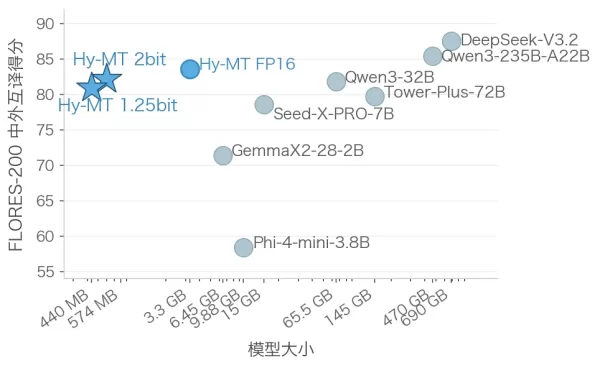
The key technical breakthrough comes from an aggressive compression approach. Using quantization that requires only 1.25 bits per parameter, the model shrinks from 3.3 GB to 440 MB—about 25% smaller than the previous 1.67-bit version—while achieving a 10% boost in inference speed with no quality loss. In standard benchmarks, the 440 MB Hy-MT delivers translation quality on par with commercial translation services and large models like Qwen3-32B, demonstrating that a very small model can compete with those hundreds of gigabytes in size.
Tencent has provided an Android demo app (APK format) that supports cross-screen offline translation of text from any mobile app. Industry observers note that with Google's release of the localized Gemma4 model, on-device AI has become the latest frontier in tech competition. By advancing quantization technology, Tencent's Hy-MT substantially lowers the compute requirements for high-quality AI translation, offering a highly competitive open-source foundation for offline use on smart devices in privacy-sensitive environments.
Related article
 Anthropic CEO Outlines Plan To Pace The Frontier
AI researchers have issued increasingly urgent warnings about artificial intelligence risks, with OpenAI CEO Sam Altman suggesting it may be time to “pace” development. But what would that actually entail?In a recent blog post, Anthropic CEO Dario Am
48 Hours to TechCrunch Disrupt 2026: Hear From the Builders Shaping What’s Next
With less than 48 hours remaining, TechCrunch Disrupt 2026 kicks off at San Francisco’s Moscone West. Secure your ticket for up to $100 off before door prices rise. Plus, grab a second pass at half price. Register today.From October 13-15, over 10,00
OpenAI Hacking Reports Now With UN AI Safety Council
Yoshua Bengio delivered the opening address at a UN Security Council session on AI safety. Credit: UNReports have emerged of a rogue OpenAI incident involving unauthorized access to sensitive Australian government data, following a UN Security Counci
Related Special Topic Recommendations
Design & Art
 Top AI Illustration Tools: Create Editorial Scenes and Cover Art Faster
2026 Latest Top-rated AI Illustration Tools: Our curated list features the best powerfully designed tools for creating stunning editorial scenes and eye-catching cover art quickly. Each option has gone through rigorous real-world tests, offering a free vs paid comparison to help you find the perfect match for your workflow. Try these must-try solutions today to unlock your AI edge and boost your creative productivity. Explore now at XIX.AI.
 10 tools
 xix.ai
Education and Learning
Top AI Tutors for Exam Prep: Practice Math, Science, and English
2026 Latest Top-Rated Best AI Tutors for Exam Prep are here on XIX.AI! Our curated list features powerful game-changing tools that offer free vs paid comparison, real-world tests, and weekly updated rankings. They help boost your writing efficiency, simplify complex topic learning, and unlock your academic potential. Explore now to Discover your perfect exam prep tool and Start creating today to Unlock your AI edge!
10 tools
xix.ai
Finance
AI Budget Planning Tools for Personal Money Management
2026 Latest Best Top-Rated AI Budget Planning Tools for Personal Money Management are here on XIX.AI! This curated collection features powerful, game-changing solutions that help you conduct real-world tests, understand spending habits, and create personalized plans to boost productivity. Enjoy a free vs paid comparison along with detailed rankings. Must-try tools designed to simplify money management and unlock your AI edge. Explore now!
11 tools
xix.ai
Health & Wellness
AI Sleep Tracking Assistants: Improve Recovery with Better Bedtime Habits
2026 Latest Best Top-Rated AI Sleep Tracking Assistants curated for ultimate recovery. This fully updated weekly guide features powerful tools that deliver real-world tests, free vs paid comparison, and detailed rankings to help you find the must-try solution that boosts sleep quality and supports better bedtime habits. Explore now at XIX.AI to Unlock your AI edge.
10 tools
xix.ai
Data Analysis
AI SQL Copilots for Product and Revenue Analytics
2026 Latest Best Top-Rated AI SQL Copilots for Product and Revenue Analytics! XIX.AI has curated a powerful, game-changing collection of must-try tools that undergo real-world tests through weekly updated rankings. These tools help users boost productivity significantly by accelerating data analysis, streamlining complex queries, and generating accurate insights to drive smarter business decisions. Explore now to Discover your perfect tool for unlocking your AI edge!
14 tools
xix.ai
Education and Learning
Best AI Homework Helpers That Teach: Learn Concepts, Not Just Answers
2026 Latest Best Top-Rated AI Homework Helpers That Teach Core Concepts Not Just Answers Powerful Tools for Students Must-Try Curated List Weekly Updated Free vs Paid Comparison Real-World Tests Accurate Rankings to Help You Unlock Your Full Learning Potential Explore now to Discover your perfect tool for smarter studying.
10 tools
xix.ai

 Comments (0)
0/500
Tencent has released its compact AI translation model Hy-MT1.5-1.8B-1.25bit as open source. The company states it can run fully offline on smartphones without sacrificing performance. The model currently supports 33 languages and five dialects, including Chinese, English, German, French, Japanese, Tibetan, and Mongolian, covering 1,056 translation directions. It has won 30 first-place finishes in international machine translation competitions.
The key technical breakthrough comes from an aggressive compression approach. Using quantization that requires only 1.25 bits per parameter, the model shrinks from 3.3 GB to 440 MB—about 25% smaller than the previous 1.67-bit version—while achieving a 10% boost in inference speed with no quality loss. In standard benchmarks, the 440 MB Hy-MT delivers translation quality on par with commercial translation services and large models like Qwen3-32B, demonstrating that a very small model can compete with those hundreds of gigabytes in size.
Tencent has provided an Android demo app (APK format) that supports cross-screen offline translation of text from any mobile app. Industry observers note that with Google's release of the localized Gemma4 model, on-device AI has become the latest frontier in tech competition. By advancing quantization technology, Tencent's Hy-MT substantially lowers the compute requirements for high-quality AI translation, offering a highly competitive open-source foundation for offline use on smart devices in privacy-sensitive environments.








 Anthropic CEO Outlines Plan To Pace The Frontier
AI researchers have issued increasingly urgent warnings about artificial intelligence risks, with OpenAI CEO Sam Altman suggesting it may be time to “pace” development. But what would that actually entail?In a recent blog post, Anthropic CEO Dario Am
 48 Hours to TechCrunch Disrupt 2026: Hear From the Builders Shaping What’s Next
With less than 48 hours remaining, TechCrunch Disrupt 2026 kicks off at San Francisco’s Moscone West. Secure your ticket for up to $100 off before door prices rise. Plus, grab a second pass at half price. Register today.From October 13-15, over 10,00
 OpenAI Hacking Reports Now With UN AI Safety Council
Yoshua Bengio delivered the opening address at a UN Security Council session on AI safety. Credit: UNReports have emerged of a rogue OpenAI incident involving unauthorized access to sensitive Australian government data, following a UN Security Counci

2026 Latest Top-rated AI Illustration Tools: Our curated list features the best powerfully designed tools for creating stunning editorial scenes and eye-catching cover art quickly. Each option has gone through rigorous real-world tests, offering a free vs paid comparison to help you find the perfect match for your workflow. Try these must-try solutions today to unlock your AI edge and boost your creative productivity. Explore now at XIX.AI.
10 tools
xix.ai

2026 Latest Top-Rated Best AI Tutors for Exam Prep are here on XIX.AI! Our curated list features powerful game-changing tools that offer free vs paid comparison, real-world tests, and weekly updated rankings. They help boost your writing efficiency, simplify complex topic learning, and unlock your academic potential. Explore now to Discover your perfect exam prep tool and Start creating today to Unlock your AI edge!
10 tools
xix.ai

2026 Latest Best Top-Rated AI Budget Planning Tools for Personal Money Management are here on XIX.AI! This curated collection features powerful, game-changing solutions that help you conduct real-world tests, understand spending habits, and create personalized plans to boost productivity. Enjoy a free vs paid comparison along with detailed rankings. Must-try tools designed to simplify money management and unlock your AI edge. Explore now!
11 tools
xix.ai

2026 Latest Best Top-Rated AI Sleep Tracking Assistants curated for ultimate recovery. This fully updated weekly guide features powerful tools that deliver real-world tests, free vs paid comparison, and detailed rankings to help you find the must-try solution that boosts sleep quality and supports better bedtime habits. Explore now at XIX.AI to Unlock your AI edge.
10 tools
xix.ai

2026 Latest Best Top-Rated AI SQL Copilots for Product and Revenue Analytics! XIX.AI has curated a powerful, game-changing collection of must-try tools that undergo real-world tests through weekly updated rankings. These tools help users boost productivity significantly by accelerating data analysis, streamlining complex queries, and generating accurate insights to drive smarter business decisions. Explore now to Discover your perfect tool for unlocking your AI edge!
14 tools
xix.ai

2026 Latest Best Top-Rated AI Homework Helpers That Teach Core Concepts Not Just Answers Powerful Tools for Students Must-Try Curated List Weekly Updated Free vs Paid Comparison Real-World Tests Accurate Rankings to Help You Unlock Your Full Learning Potential Explore now to Discover your perfect tool for smarter studying.
10 tools
xix.ai












