


 Home
HomeMetaverse Vision Falters as Momentum Shifts
Meta's massive investment in virtual reality came to an abrupt halt last week, as the company reportedly laid off approximately 1,500 employees from its Reality Labs division—around 10% of the unit's workforce—and closed several VR game studios, according to The Wall Street Journal. This marks a dramatic shift for a company that, just four years ago, built its entire identity around this concept.
Few will mourn its passing.
As industry observers may recall, Facebook rebranded itself as Meta in 2021, pledging to lead a new technological era powered by VR devices.
The move was partly a bet on Generation Z’s growing preference for socializing in online games like Fortnite and Roblox over traditional social media apps. It also allowed Meta to distance itself from the negative reputation of the Facebook brand, which had been tarnished by data privacy scandals such as Cambridge Analytica, whistleblower Frances Haugen’s revelations about the platform's harmful effects on young users, congressional hearings on digital surveillance, its role in spreading misinformation, antitrust concerns, and more.
At the time, Meta envisioned the metaverse as the next major social platform—a virtual world where users could connect through Horizon Worlds and enjoy games on VR headsets.
Today, the metaverse has been largely abandoned in favor of artificial intelligence.
As reported by CNBC, affected studios include Armature Studio ("Resident Evil 4 VR"), Twisted Pixel ("Marvel’s Deadpool VR"), and Sanzaru ("Asgard’s Wrath"). Meanwhile, Supernatural, the VR fitness app Meta acquired in 2023 for $400 million, will stop producing new content and shift into "maintenance mode." GeekWire also reported layoffs at Camouflaj, the studio behind "Batman: Arkham Shadow."
Additionally, The Verge noted last week that Meta is shutting down Workrooms, its program for bringing VR into the workplace.
This follows a Bloomberg report from December indicating that Meta was cutting the VR department’s budget by up to 30%. Around the same time, Meta paused its program to share its Meta Horizon OS—the operating system for Quest VR headsets—with third-party device makers.
Unlike the surprise of Meta’s rebranding, the scaling back of its metaverse ambitions comes as no shock. The division consistently lost substantial amounts of money, alarming investors, and never turned a profit.
In total, the company invested approximately $73 billion into Reality Labs. To put that figure in perspective, you would need to spend $1 million every day for 200 years to match that level of investment.
The Failure of "Building in the Open"
Beyond being overhyped by investors and analysts, early versions of the metaverse were simply poor products. The awkward, lifeless avatars lacked legs, and a metaverse selfie of CEO Mark Zuckerberg became a viral meme due to its poor quality. In short, Meta was promoting a futuristic vision while its product fell short—a failure of the "build in the open" approach, where early-stage tech is released to gather user feedback for iteration.

Image Credits: Facebook This model works when customers are genuinely excited about a technology. However, consumer interest in the metaverse remained lukewarm. Although Meta quickly captured most of the VR market with its Oculus headsets, sales began to decline. Last spring, Counterpoint Research reported that global VR headset shipments dropped by 12% year-over-year in 2024—the third consecutive annual decline—with Meta accounting for 77% of those shipments.

Image Credits: Meta Meta’s Premature Bet on an App Store Model
Relying on a "if you build it, they will come" strategy, Meta focused more on profiting from its own platform for apps and games than on whether consumers actually wanted these VR devices.
Specifically, Zuckerberg sought to bypass Apple and Google’s ability to take a cut of Meta’s revenue through their app stores.
"This period has been humbling. Despite our size, we’ve experienced what it’s like to build for other platforms—and living under their rules has shaped my perspective on the tech industry," Zuckerberg stated during his keynote at Facebook Connect 2021, referring to the Apple-Google duopoly. "I believe the lack of choice and high fees stifle innovation, hold back new creations, and slow the entire internet economy."
He projected that the metaverse could reach a billion users within a decade, facilitating "hundreds of billions" in digital commerce. Analysts like McKinsey & Co. and Citi supported this optimistic outlook, estimating the metaverse could become a multi-trillion-dollar market by 2030.

Meta quest app store Only a Fraction of Meta’s Users Embraced VR
While Meta saw dollar signs, adoption of metaverse apps remained low—especially for a company of its scale.
Although Meta’s VR app store data isn’t public, we can look at mobile versions of its apps as a proxy. According to estimates from app intelligence firm Apptopia, the Meta Horizon app has been downloaded 60.4 million times globally and 39.8 million times in the U.S. since May 2018. A better measure of engagement, however, is user activity.
Apptopia’s U.S. panel data shows the average number of sessions per daily active user grew from 3.49 in January 2023 to 4.93 in January 2026. While this represents a peak for the app, it may not have met Meta’s expectations.
For comparison, outside of VR, Meta’s social apps—Facebook, Instagram, WhatsApp, and Messenger—now boast over 3.5 billion daily active users combined.
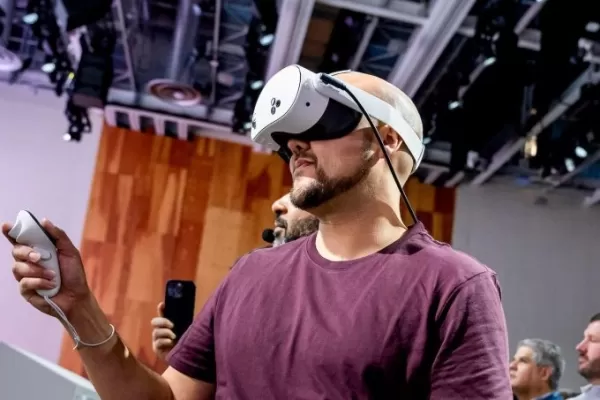
An attendee wears a Quest 3s virtual reality headset during the Meta Connect event in Menlo Park, California, US, on Wednesday, Sept. 25, 2024. Image Credits: David Paul Morris/Bloomberg / Getty Images Had it succeeded, Meta could have built a new social empire rooted in VR gaming—similar to Facebook’s early days when partners like Zynga (creator of FarmVille and Words with Friends) drove significant revenue. (Ultimately, Facebook’s 30% cut of virtual goods sales and restrictive policies pushed Zynga to launch its own portal and shift to mobile.)
This time, however, Zuckerberg signaled his intent to tap into developer revenue too early. Meta might have attracted more developers by offering lower fees than Apple or Google’s standard 30%. Instead, it went in the opposite direction—charging more.
Even before VR became a viable platform, Meta announced it would take 47.5% of digital asset sales in Horizon Worlds—a 30% hardware platform fee plus a 17.5% Horizon Worlds fee. Unsurprisingly, creators were displeased.

Image Credits: Meta Virtual Assault and Harassment in the Metaverse
Compounding its problems, Meta did not prioritize user safety in the metaverse. As with its social network, the company often reacted to issues rather than preventing them. For example, it only introduced the "Personal Boundary" feature—creating space between avatars—after reports of sexual harassment, including virtual rape and gang rape, in Horizon Worlds. Meta later adjusted the feature so it defaults to "on" only with non-friends and allows users to disable it entirely.
In May 2022, TechCrunch asked Meta to detail its support measures for Horizon Worlds. The company listed several tools, including blocking and reporting functions, a "safe zone" button to quickly mute and block others, and a feature to temporarily remove disruptive users. However, Meta declined to specify what actions it would take against offenders.

Image Credits: Meta At the time, users told TechCrunch that those who experienced abuse often responded by removing their headset and taking a break. By the time they returned, it was too late to report the incident with supporting video or audio evidence.
These scenarios were not adequately planned for, and detailed abuse policies were lacking. Even when a code of conduct was later published, it did not specify consequences beyond saying Meta would "take action on users."
Around the same time, Meta declined to share the composition of its metaverse development team with TechCrunch. (If we had to guess, the team likely had fewer women than men—reflecting the company’s overall gender imbalance.)
AR, Mixed Reality, and AI Gained More Traction
Another blow to the metaverse was the success of Meta’s Ray-Ban AR glasses, which have gained popularity in recent months. With features like hands-free recording, music streaming, and Meta AI integration, the glasses began outselling traditional Ray-Bans in some stores in 2024. Bloomberg recently reported that Meta is considering doubling production to meet demand.

Meta Ray-Ban displayImage Credits: Meta / Meta With a growing focus on AI, the company introduced Ray-Ban Display last year—similar smart glasses with a display on the right lens for apps, alerts, and directions. Meta has since paused international rollout due to "unprecedented demand" (or possibly due to conservative inventory planning).
As other companies, including OpenAI, Amazon, and various startups, explore AI hardware as the next computing platform, VR appears increasingly outdated—a vision of the web that never materialized.
Together, these factors—especially the rise of AI as a potential app platform—make it difficult for Meta to continue justifying VR investments. Instead, Meta will focus on promising products like its Ray-Ban and AI glasses, growth in AI applications, and large language models.
Related article
 Stripe to Acquire OpenRouter as AI Model Routing Gains Momentum
Stripe has agreed to acquire OpenRouter, an AI model-routing platform that gives developers access to hundreds of models through a single interface. The deal adds model selection and routing to Stripe’s existing work around AI usage and token-based b
Former OpenAI Researcher Barrett Zoph Returns to Google to Support Gemini Development
Barret Zoph, who previously abruptly left and joined OpenAI due to a disagreement with Thinking Machines Lab CEO Miriam Mularati, has once again changed employers. Alphabet's Google announced that Zoph will return as Vice President of Research, bring
How Recursive Intelligence Raised $335M at $4B Valuation in 4 Months
The co-founders of startup Ricursive Intelligence seemed destined to be co-founders.Anna Goldie, CEO, and Azalia Mirhoseini, CTO, are so well-known in the AI community that they were among those AI engineers who “got those weird emails from Zuckerber
Related Special Topic Recommendations
Design & Art
Stripe to Acquire OpenRouter as AI Model Routing Gains Momentum
Stripe has agreed to acquire OpenRouter, an AI model-routing platform that gives developers access to hundreds of models through a single interface. The deal adds model selection and routing to Stripe’s existing work around AI usage and token-based b
Former OpenAI Researcher Barrett Zoph Returns to Google to Support Gemini Development
Barret Zoph, who previously abruptly left and joined OpenAI due to a disagreement with Thinking Machines Lab CEO Miriam Mularati, has once again changed employers. Alphabet's Google announced that Zoph will return as Vice President of Research, bring
How Recursive Intelligence Raised $335M at $4B Valuation in 4 Months
The co-founders of startup Ricursive Intelligence seemed destined to be co-founders.Anna Goldie, CEO, and Azalia Mirhoseini, CTO, are so well-known in the AI community that they were among those AI engineers who “got those weird emails from Zuckerber
Related Special Topic Recommendations
Design & Art
 Top AI Illustration Tools: Create Editorial Scenes and Cover Art Faster
2026 Latest Top-rated AI Illustration Tools: Our curated list features the best powerfully designed tools for creating stunning editorial scenes and eye-catching cover art quickly. Each option has gone through rigorous real-world tests, offering a free vs paid comparison to help you find the perfect match for your workflow. Try these must-try solutions today to unlock your AI edge and boost your creative productivity. Explore now at XIX.AI.
 10 tools
 xix.ai
Education and Learning
Top AI Tutors for Exam Prep: Practice Math, Science, and English
xix.ai
Education and Learning
Top AI Tutors for Exam Prep: Practice Math, Science, and English
2026 Latest Top-Rated Best AI Tutors for Exam Prep are here on XIX.AI! Our curated list features powerful game-changing tools that offer free vs paid comparison, real-world tests, and weekly updated rankings. They help boost your writing efficiency, simplify complex topic learning, and unlock your academic potential. Explore now to Discover your perfect exam prep tool and Start creating today to Unlock your AI edge!
10 tools
xix.ai
Finance
AI Budget Planning Tools for Personal Money Management
2026 Latest Best Top-Rated AI Budget Planning Tools for Personal Money Management are here on XIX.AI! This curated collection features powerful, game-changing solutions that help you conduct real-world tests, understand spending habits, and create personalized plans to boost productivity. Enjoy a free vs paid comparison along with detailed rankings. Must-try tools designed to simplify money management and unlock your AI edge. Explore now!
11 tools
xix.ai
Health & Wellness
AI Sleep Tracking Assistants: Improve Recovery with Better Bedtime Habits
2026 Latest Best Top-Rated AI Sleep Tracking Assistants curated for ultimate recovery. This fully updated weekly guide features powerful tools that deliver real-world tests, free vs paid comparison, and detailed rankings to help you find the must-try solution that boosts sleep quality and supports better bedtime habits. Explore now at XIX.AI to Unlock your AI edge.
10 tools
xix.ai
Data Analysis
AI SQL Copilots for Product and Revenue Analytics
2026 Latest Best Top-Rated AI SQL Copilots for Product and Revenue Analytics! XIX.AI has curated a powerful, game-changing collection of must-try tools that undergo real-world tests through weekly updated rankings. These tools help users boost productivity significantly by accelerating data analysis, streamlining complex queries, and generating accurate insights to drive smarter business decisions. Explore now to Discover your perfect tool for unlocking your AI edge!
14 tools
xix.ai
Education and Learning
Best AI Homework Helpers That Teach: Learn Concepts, Not Just Answers
2026 Latest Best Top-Rated AI Homework Helpers That Teach Core Concepts Not Just Answers Powerful Tools for Students Must-Try Curated List Weekly Updated Free vs Paid Comparison Real-World Tests Accurate Rankings to Help You Unlock Your Full Learning Potential Explore now to Discover your perfect tool for smarter studying.
10 tools
xix.ai

 Comments (0)
0/500
Comments (0)
0/500
Meta's massive investment in virtual reality came to an abrupt halt last week, as the company reportedly laid off approximately 1,500 employees from its Reality Labs division—around 10% of the unit's workforce—and closed several VR game studios, according to The Wall Street Journal. This marks a dramatic shift for a company that, just four years ago, built its entire identity around this concept.
Few will mourn its passing.
As industry observers may recall, Facebook rebranded itself as Meta in 2021, pledging to lead a new technological era powered by VR devices.
The move was partly a bet on Generation Z’s growing preference for socializing in online games like Fortnite and Roblox over traditional social media apps. It also allowed Meta to distance itself from the negative reputation of the Facebook brand, which had been tarnished by data privacy scandals such as Cambridge Analytica, whistleblower Frances Haugen’s revelations about the platform's harmful effects on young users, congressional hearings on digital surveillance, its role in spreading misinformation, antitrust concerns, and more.
At the time, Meta envisioned the metaverse as the next major social platform—a virtual world where users could connect through Horizon Worlds and enjoy games on VR headsets.
Today, the metaverse has been largely abandoned in favor of artificial intelligence.
As reported by CNBC, affected studios include Armature Studio ("Resident Evil 4 VR"), Twisted Pixel ("Marvel’s Deadpool VR"), and Sanzaru ("Asgard’s Wrath"). Meanwhile, Supernatural, the VR fitness app Meta acquired in 2023 for $400 million, will stop producing new content and shift into "maintenance mode." GeekWire also reported layoffs at Camouflaj, the studio behind "Batman: Arkham Shadow."
Additionally, The Verge noted last week that Meta is shutting down Workrooms, its program for bringing VR into the workplace.
This follows a Bloomberg report from December indicating that Meta was cutting the VR department’s budget by up to 30%. Around the same time, Meta paused its program to share its Meta Horizon OS—the operating system for Quest VR headsets—with third-party device makers.
Unlike the surprise of Meta’s rebranding, the scaling back of its metaverse ambitions comes as no shock. The division consistently lost substantial amounts of money, alarming investors, and never turned a profit.
In total, the company invested approximately $73 billion into Reality Labs. To put that figure in perspective, you would need to spend $1 million every day for 200 years to match that level of investment.
The Failure of "Building in the Open"
Beyond being overhyped by investors and analysts, early versions of the metaverse were simply poor products. The awkward, lifeless avatars lacked legs, and a metaverse selfie of CEO Mark Zuckerberg became a viral meme due to its poor quality. In short, Meta was promoting a futuristic vision while its product fell short—a failure of the "build in the open" approach, where early-stage tech is released to gather user feedback for iteration.
This model works when customers are genuinely excited about a technology. However, consumer interest in the metaverse remained lukewarm. Although Meta quickly captured most of the VR market with its Oculus headsets, sales began to decline. Last spring, Counterpoint Research reported that global VR headset shipments dropped by 12% year-over-year in 2024—the third consecutive annual decline—with Meta accounting for 77% of those shipments.
Meta’s Premature Bet on an App Store Model
Relying on a "if you build it, they will come" strategy, Meta focused more on profiting from its own platform for apps and games than on whether consumers actually wanted these VR devices.
Specifically, Zuckerberg sought to bypass Apple and Google’s ability to take a cut of Meta’s revenue through their app stores.
"This period has been humbling. Despite our size, we’ve experienced what it’s like to build for other platforms—and living under their rules has shaped my perspective on the tech industry," Zuckerberg stated during his keynote at Facebook Connect 2021, referring to the Apple-Google duopoly. "I believe the lack of choice and high fees stifle innovation, hold back new creations, and slow the entire internet economy."
He projected that the metaverse could reach a billion users within a decade, facilitating "hundreds of billions" in digital commerce. Analysts like McKinsey & Co. and Citi supported this optimistic outlook, estimating the metaverse could become a multi-trillion-dollar market by 2030.
Only a Fraction of Meta’s Users Embraced VR
While Meta saw dollar signs, adoption of metaverse apps remained low—especially for a company of its scale.
Although Meta’s VR app store data isn’t public, we can look at mobile versions of its apps as a proxy. According to estimates from app intelligence firm Apptopia, the Meta Horizon app has been downloaded 60.4 million times globally and 39.8 million times in the U.S. since May 2018. A better measure of engagement, however, is user activity.
Apptopia’s U.S. panel data shows the average number of sessions per daily active user grew from 3.49 in January 2023 to 4.93 in January 2026. While this represents a peak for the app, it may not have met Meta’s expectations.
For comparison, outside of VR, Meta’s social apps—Facebook, Instagram, WhatsApp, and Messenger—now boast over 3.5 billion daily active users combined.
Had it succeeded, Meta could have built a new social empire rooted in VR gaming—similar to Facebook’s early days when partners like Zynga (creator of FarmVille and Words with Friends) drove significant revenue. (Ultimately, Facebook’s 30% cut of virtual goods sales and restrictive policies pushed Zynga to launch its own portal and shift to mobile.)
This time, however, Zuckerberg signaled his intent to tap into developer revenue too early. Meta might have attracted more developers by offering lower fees than Apple or Google’s standard 30%. Instead, it went in the opposite direction—charging more.
Even before VR became a viable platform, Meta announced it would take 47.5% of digital asset sales in Horizon Worlds—a 30% hardware platform fee plus a 17.5% Horizon Worlds fee. Unsurprisingly, creators were displeased.
Virtual Assault and Harassment in the Metaverse
Compounding its problems, Meta did not prioritize user safety in the metaverse. As with its social network, the company often reacted to issues rather than preventing them. For example, it only introduced the "Personal Boundary" feature—creating space between avatars—after reports of sexual harassment, including virtual rape and gang rape, in Horizon Worlds. Meta later adjusted the feature so it defaults to "on" only with non-friends and allows users to disable it entirely.
In May 2022, TechCrunch asked Meta to detail its support measures for Horizon Worlds. The company listed several tools, including blocking and reporting functions, a "safe zone" button to quickly mute and block others, and a feature to temporarily remove disruptive users. However, Meta declined to specify what actions it would take against offenders.
At the time, users told TechCrunch that those who experienced abuse often responded by removing their headset and taking a break. By the time they returned, it was too late to report the incident with supporting video or audio evidence.
These scenarios were not adequately planned for, and detailed abuse policies were lacking. Even when a code of conduct was later published, it did not specify consequences beyond saying Meta would "take action on users."
Around the same time, Meta declined to share the composition of its metaverse development team with TechCrunch. (If we had to guess, the team likely had fewer women than men—reflecting the company’s overall gender imbalance.)
AR, Mixed Reality, and AI Gained More Traction
Another blow to the metaverse was the success of Meta’s Ray-Ban AR glasses, which have gained popularity in recent months. With features like hands-free recording, music streaming, and Meta AI integration, the glasses began outselling traditional Ray-Bans in some stores in 2024. Bloomberg recently reported that Meta is considering doubling production to meet demand.
With a growing focus on AI, the company introduced Ray-Ban Display last year—similar smart glasses with a display on the right lens for apps, alerts, and directions. Meta has since paused international rollout due to "unprecedented demand" (or possibly due to conservative inventory planning).
As other companies, including OpenAI, Amazon, and various startups, explore AI hardware as the next computing platform, VR appears increasingly outdated—a vision of the web that never materialized.
Together, these factors—especially the rise of AI as a potential app platform—make it difficult for Meta to continue justifying VR investments. Instead, Meta will focus on promising products like its Ray-Ban and AI glasses, growth in AI applications, and large language models.








 Stripe to Acquire OpenRouter as AI Model Routing Gains Momentum
Stripe has agreed to acquire OpenRouter, an AI model-routing platform that gives developers access to hundreds of models through a single interface. The deal adds model selection and routing to Stripe’s existing work around AI usage and token-based b
Stripe to Acquire OpenRouter as AI Model Routing Gains Momentum
Stripe has agreed to acquire OpenRouter, an AI model-routing platform that gives developers access to hundreds of models through a single interface. The deal adds model selection and routing to Stripe’s existing work around AI usage and token-based b
 Former OpenAI Researcher Barrett Zoph Returns to Google to Support Gemini Development
Barret Zoph, who previously abruptly left and joined OpenAI due to a disagreement with Thinking Machines Lab CEO Miriam Mularati, has once again changed employers. Alphabet's Google announced that Zoph will return as Vice President of Research, bring
Former OpenAI Researcher Barrett Zoph Returns to Google to Support Gemini Development
Barret Zoph, who previously abruptly left and joined OpenAI due to a disagreement with Thinking Machines Lab CEO Miriam Mularati, has once again changed employers. Alphabet's Google announced that Zoph will return as Vice President of Research, bring
 How Recursive Intelligence Raised $335M at $4B Valuation in 4 Months
The co-founders of startup Ricursive Intelligence seemed destined to be co-founders.Anna Goldie, CEO, and Azalia Mirhoseini, CTO, are so well-known in the AI community that they were among those AI engineers who “got those weird emails from Zuckerber
How Recursive Intelligence Raised $335M at $4B Valuation in 4 Months
The co-founders of startup Ricursive Intelligence seemed destined to be co-founders.Anna Goldie, CEO, and Azalia Mirhoseini, CTO, are so well-known in the AI community that they were among those AI engineers who “got those weird emails from Zuckerber

2026 Latest Top-rated AI Illustration Tools: Our curated list features the best powerfully designed tools for creating stunning editorial scenes and eye-catching cover art quickly. Each option has gone through rigorous real-world tests, offering a free vs paid comparison to help you find the perfect match for your workflow. Try these must-try solutions today to unlock your AI edge and boost your creative productivity. Explore now at XIX.AI.
10 tools
xix.ai

2026 Latest Top-Rated Best AI Tutors for Exam Prep are here on XIX.AI! Our curated list features powerful game-changing tools that offer free vs paid comparison, real-world tests, and weekly updated rankings. They help boost your writing efficiency, simplify complex topic learning, and unlock your academic potential. Explore now to Discover your perfect exam prep tool and Start creating today to Unlock your AI edge!
10 tools
xix.ai

2026 Latest Best Top-Rated AI Budget Planning Tools for Personal Money Management are here on XIX.AI! This curated collection features powerful, game-changing solutions that help you conduct real-world tests, understand spending habits, and create personalized plans to boost productivity. Enjoy a free vs paid comparison along with detailed rankings. Must-try tools designed to simplify money management and unlock your AI edge. Explore now!
11 tools
xix.ai

2026 Latest Best Top-Rated AI Sleep Tracking Assistants curated for ultimate recovery. This fully updated weekly guide features powerful tools that deliver real-world tests, free vs paid comparison, and detailed rankings to help you find the must-try solution that boosts sleep quality and supports better bedtime habits. Explore now at XIX.AI to Unlock your AI edge.
10 tools
xix.ai

2026 Latest Best Top-Rated AI SQL Copilots for Product and Revenue Analytics! XIX.AI has curated a powerful, game-changing collection of must-try tools that undergo real-world tests through weekly updated rankings. These tools help users boost productivity significantly by accelerating data analysis, streamlining complex queries, and generating accurate insights to drive smarter business decisions. Explore now to Discover your perfect tool for unlocking your AI edge!
14 tools
xix.ai

2026 Latest Best Top-Rated AI Homework Helpers That Teach Core Concepts Not Just Answers Powerful Tools for Students Must-Try Curated List Weekly Updated Free vs Paid Comparison Real-World Tests Accurate Rankings to Help You Unlock Your Full Learning Potential Explore now to Discover your perfect tool for smarter studying.
10 tools
xix.ai












