


 Home
HomeMeta Faces Lawsuit Over AI Glasses Privacy as Staff Reportedly Viewed Explicit Content
Meta is confronting a new lawsuit regarding privacy issues with its AI smart glasses. According to an investigation by Swedish newspapers, workers at a Kenya-based subcontractor have been reviewing customer footage. This footage reportedly included sensitive content such as nudity, sexual activity, and people using the toilet.
Meta stated that it blurs faces in images, but news reports cited sources claiming this measure does not always work effectively. The findings prompted the UK's Information Commissioner's Office to launch an inquiry.
The tech giant now faces legal action in the United States as well. In the newly filed complaint, plaintiffs Gina Bartone of New Jersey and Mateo Canu of California, represented by the public interest firm Clarkson Law, allege that Meta violated privacy laws and engaged in deceptive advertising.
The lawsuit contends that Meta's AI smart glasses are marketed with claims like "designed for privacy, controlled by you" and "built for your privacy." These statements, the complaint argues, could lead customers to believe their intimate moments captured on the glasses were not being viewed by overseas contractors. The plaintiffs say they relied on this marketing and saw no disclaimers contradicting the promised privacy protections.
The suit accuses Meta and its manufacturing partner, Luxottica of America, of violating consumer protection laws. Meta has declined to comment on the ongoing litigation.
Clarkson Law Firm, known for previous major lawsuits against Apple, Google, and OpenAI, highlights the scale of the issue. With over seven million units sold in 2025, a vast amount of user footage enters a data pipeline for review without an opt-out option for customers.
In a statement to the BBC, Meta explained that when users share content with Meta AI, contractors may review the data to improve the product experience, a practice outlined in its privacy policy. The company referenced its Supplemental Terms of Service, though the specific location of this detail was not clarified. The BBC noted that mention of human review appears in Meta's UK AI terms of service.
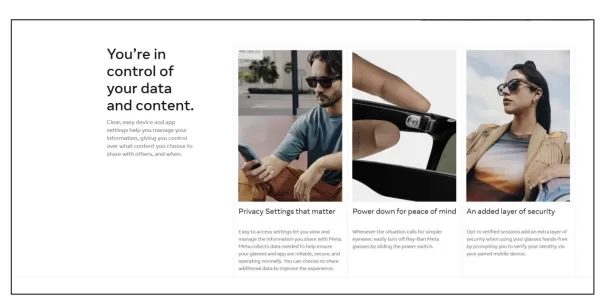
Screenshot from the complaint
The legal filing focuses heavily on Meta's advertising, citing examples that promoted privacy benefits, detailed privacy settings, and touted an "added layer of security."
One advertisement read, "You're in control of your data and content," explaining that owners decide what to share with others.
The growing popularity of smart glasses and other "luxury surveillance" devices, such as always-listening AI pendants, has sparked significant public concern. In response, one developer released an app designed to detect nearby smart glasses.
Meta did not comment on the newly filed lawsuit itself.
However, spokesperson Christopher Sgro provided a general statement on the issue: "Ray-Ban Meta glasses help you use AI, hands-free, to answer questions about the world around you. Unless users choose to share media they’ve captured with Meta or others, that media stays on the user’s device. When people share content with Meta AI, we sometimes use contractors to review this data for the purpose of improving people’s experience, as many other companies do. We take steps to filter this data to protect people’s privacy and to help prevent identifying information from being reviewed."
Updated after publication with Meta’s statement.
Related article
 Meta's Muse outpaces ChatGPT in early mobile launch
New data suggests Meta’s latest AI app, Muse, could become the social giant’s next major success. According to recent estimates from Appfigures, Muse has been downloaded on mobile devices more times in its first twelve days than ChatGPT did in the tw
Meta’s Muse arrives on Mac, enabling AI to perform actions on your computer
Meta’s latest AI assistant, Muse, is now live on Mac.On macOS, Muse integrates with your files, messages, calendar, notes, and mail, operating directly within their native apps.This desktop release follows Muse’s mobile and web debut earlier this mon
Zuckerberg expands Meta’s enterprise AI vision beyond agents
In June, Meta launched a new AI agent for enterprises, designed to assist with customer service, support, and daily operations. However, CEO Mark Zuckerberg revealed to investors on Wednesday’s second-quarter earnings call that the company’s enterpri
Related Special Topic Recommendations
Design & Art
Meta's Muse outpaces ChatGPT in early mobile launch
New data suggests Meta’s latest AI app, Muse, could become the social giant’s next major success. According to recent estimates from Appfigures, Muse has been downloaded on mobile devices more times in its first twelve days than ChatGPT did in the tw
Meta’s Muse arrives on Mac, enabling AI to perform actions on your computer
Meta’s latest AI assistant, Muse, is now live on Mac.On macOS, Muse integrates with your files, messages, calendar, notes, and mail, operating directly within their native apps.This desktop release follows Muse’s mobile and web debut earlier this mon
Zuckerberg expands Meta’s enterprise AI vision beyond agents
In June, Meta launched a new AI agent for enterprises, designed to assist with customer service, support, and daily operations. However, CEO Mark Zuckerberg revealed to investors on Wednesday’s second-quarter earnings call that the company’s enterpri
Related Special Topic Recommendations
Design & Art
 Top AI Illustration Tools: Create Editorial Scenes and Cover Art Faster
2026 Latest Top-rated AI Illustration Tools: Our curated list features the best powerfully designed tools for creating stunning editorial scenes and eye-catching cover art quickly. Each option has gone through rigorous real-world tests, offering a free vs paid comparison to help you find the perfect match for your workflow. Try these must-try solutions today to unlock your AI edge and boost your creative productivity. Explore now at XIX.AI.
 10 tools
 xix.ai
Education and Learning
Top AI Tutors for Exam Prep: Practice Math, Science, and English
xix.ai
Education and Learning
Top AI Tutors for Exam Prep: Practice Math, Science, and English
2026 Latest Top-Rated Best AI Tutors for Exam Prep are here on XIX.AI! Our curated list features powerful game-changing tools that offer free vs paid comparison, real-world tests, and weekly updated rankings. They help boost your writing efficiency, simplify complex topic learning, and unlock your academic potential. Explore now to Discover your perfect exam prep tool and Start creating today to Unlock your AI edge!
10 tools
xix.ai
Finance
AI Budget Planning Tools for Personal Money Management
2026 Latest Best Top-Rated AI Budget Planning Tools for Personal Money Management are here on XIX.AI! This curated collection features powerful, game-changing solutions that help you conduct real-world tests, understand spending habits, and create personalized plans to boost productivity. Enjoy a free vs paid comparison along with detailed rankings. Must-try tools designed to simplify money management and unlock your AI edge. Explore now!
11 tools
xix.ai
Health & Wellness
AI Sleep Tracking Assistants: Improve Recovery with Better Bedtime Habits
2026 Latest Best Top-Rated AI Sleep Tracking Assistants curated for ultimate recovery. This fully updated weekly guide features powerful tools that deliver real-world tests, free vs paid comparison, and detailed rankings to help you find the must-try solution that boosts sleep quality and supports better bedtime habits. Explore now at XIX.AI to Unlock your AI edge.
10 tools
xix.ai
Data Analysis
AI SQL Copilots for Product and Revenue Analytics
2026 Latest Best Top-Rated AI SQL Copilots for Product and Revenue Analytics! XIX.AI has curated a powerful, game-changing collection of must-try tools that undergo real-world tests through weekly updated rankings. These tools help users boost productivity significantly by accelerating data analysis, streamlining complex queries, and generating accurate insights to drive smarter business decisions. Explore now to Discover your perfect tool for unlocking your AI edge!
14 tools
xix.ai
Education and Learning
Best AI Homework Helpers That Teach: Learn Concepts, Not Just Answers
2026 Latest Best Top-Rated AI Homework Helpers That Teach Core Concepts Not Just Answers Powerful Tools for Students Must-Try Curated List Weekly Updated Free vs Paid Comparison Real-World Tests Accurate Rankings to Help You Unlock Your Full Learning Potential Explore now to Discover your perfect tool for smarter studying.
10 tools
xix.ai

 Comments (1)
0/500
Comments (1)
0/500
![JosephGreen]()
Wait, so my AI glasses might be secretly reviewed by random contractors? That's beyond creepy. I get that data annotation is part of the process, but explicit content? There needs to be way stricter oversight and transparency. Makes me rethink buying any device with a camera now. 😬
Meta is confronting a new lawsuit regarding privacy issues with its AI smart glasses. According to an investigation by Swedish newspapers, workers at a Kenya-based subcontractor have been reviewing customer footage. This footage reportedly included sensitive content such as nudity, sexual activity, and people using the toilet.
Meta stated that it blurs faces in images, but news reports cited sources claiming this measure does not always work effectively. The findings prompted the UK's Information Commissioner's Office to launch an inquiry.
The tech giant now faces legal action in the United States as well. In the newly filed complaint, plaintiffs Gina Bartone of New Jersey and Mateo Canu of California, represented by the public interest firm Clarkson Law, allege that Meta violated privacy laws and engaged in deceptive advertising.
The lawsuit contends that Meta's AI smart glasses are marketed with claims like "designed for privacy, controlled by you" and "built for your privacy." These statements, the complaint argues, could lead customers to believe their intimate moments captured on the glasses were not being viewed by overseas contractors. The plaintiffs say they relied on this marketing and saw no disclaimers contradicting the promised privacy protections.
The suit accuses Meta and its manufacturing partner, Luxottica of America, of violating consumer protection laws. Meta has declined to comment on the ongoing litigation.
Clarkson Law Firm, known for previous major lawsuits against Apple, Google, and OpenAI, highlights the scale of the issue. With over seven million units sold in 2025, a vast amount of user footage enters a data pipeline for review without an opt-out option for customers.
In a statement to the BBC, Meta explained that when users share content with Meta AI, contractors may review the data to improve the product experience, a practice outlined in its privacy policy. The company referenced its Supplemental Terms of Service, though the specific location of this detail was not clarified. The BBC noted that mention of human review appears in Meta's UK AI terms of service.
Screenshot from the complaint
The legal filing focuses heavily on Meta's advertising, citing examples that promoted privacy benefits, detailed privacy settings, and touted an "added layer of security."
One advertisement read, "You're in control of your data and content," explaining that owners decide what to share with others.
The growing popularity of smart glasses and other "luxury surveillance" devices, such as always-listening AI pendants, has sparked significant public concern. In response, one developer released an app designed to detect nearby smart glasses.
Meta did not comment on the newly filed lawsuit itself.
However, spokesperson Christopher Sgro provided a general statement on the issue: "Ray-Ban Meta glasses help you use AI, hands-free, to answer questions about the world around you. Unless users choose to share media they’ve captured with Meta or others, that media stays on the user’s device. When people share content with Meta AI, we sometimes use contractors to review this data for the purpose of improving people’s experience, as many other companies do. We take steps to filter this data to protect people’s privacy and to help prevent identifying information from being reviewed."
Updated after publication with Meta’s statement.








 Meta's Muse outpaces ChatGPT in early mobile launch
New data suggests Meta’s latest AI app, Muse, could become the social giant’s next major success. According to recent estimates from Appfigures, Muse has been downloaded on mobile devices more times in its first twelve days than ChatGPT did in the tw
Meta's Muse outpaces ChatGPT in early mobile launch
New data suggests Meta’s latest AI app, Muse, could become the social giant’s next major success. According to recent estimates from Appfigures, Muse has been downloaded on mobile devices more times in its first twelve days than ChatGPT did in the tw
 Meta’s Muse arrives on Mac, enabling AI to perform actions on your computer
Meta’s latest AI assistant, Muse, is now live on Mac.On macOS, Muse integrates with your files, messages, calendar, notes, and mail, operating directly within their native apps.This desktop release follows Muse’s mobile and web debut earlier this mon
Meta’s Muse arrives on Mac, enabling AI to perform actions on your computer
Meta’s latest AI assistant, Muse, is now live on Mac.On macOS, Muse integrates with your files, messages, calendar, notes, and mail, operating directly within their native apps.This desktop release follows Muse’s mobile and web debut earlier this mon
 Zuckerberg expands Meta’s enterprise AI vision beyond agents
In June, Meta launched a new AI agent for enterprises, designed to assist with customer service, support, and daily operations. However, CEO Mark Zuckerberg revealed to investors on Wednesday’s second-quarter earnings call that the company’s enterpri
Zuckerberg expands Meta’s enterprise AI vision beyond agents
In June, Meta launched a new AI agent for enterprises, designed to assist with customer service, support, and daily operations. However, CEO Mark Zuckerberg revealed to investors on Wednesday’s second-quarter earnings call that the company’s enterpri

2026 Latest Top-rated AI Illustration Tools: Our curated list features the best powerfully designed tools for creating stunning editorial scenes and eye-catching cover art quickly. Each option has gone through rigorous real-world tests, offering a free vs paid comparison to help you find the perfect match for your workflow. Try these must-try solutions today to unlock your AI edge and boost your creative productivity. Explore now at XIX.AI.
10 tools
xix.ai

2026 Latest Top-Rated Best AI Tutors for Exam Prep are here on XIX.AI! Our curated list features powerful game-changing tools that offer free vs paid comparison, real-world tests, and weekly updated rankings. They help boost your writing efficiency, simplify complex topic learning, and unlock your academic potential. Explore now to Discover your perfect exam prep tool and Start creating today to Unlock your AI edge!
10 tools
xix.ai

2026 Latest Best Top-Rated AI Budget Planning Tools for Personal Money Management are here on XIX.AI! This curated collection features powerful, game-changing solutions that help you conduct real-world tests, understand spending habits, and create personalized plans to boost productivity. Enjoy a free vs paid comparison along with detailed rankings. Must-try tools designed to simplify money management and unlock your AI edge. Explore now!
11 tools
xix.ai

2026 Latest Best Top-Rated AI Sleep Tracking Assistants curated for ultimate recovery. This fully updated weekly guide features powerful tools that deliver real-world tests, free vs paid comparison, and detailed rankings to help you find the must-try solution that boosts sleep quality and supports better bedtime habits. Explore now at XIX.AI to Unlock your AI edge.
10 tools
xix.ai

2026 Latest Best Top-Rated AI SQL Copilots for Product and Revenue Analytics! XIX.AI has curated a powerful, game-changing collection of must-try tools that undergo real-world tests through weekly updated rankings. These tools help users boost productivity significantly by accelerating data analysis, streamlining complex queries, and generating accurate insights to drive smarter business decisions. Explore now to Discover your perfect tool for unlocking your AI edge!
14 tools
xix.ai

2026 Latest Best Top-Rated AI Homework Helpers That Teach Core Concepts Not Just Answers Powerful Tools for Students Must-Try Curated List Weekly Updated Free vs Paid Comparison Real-World Tests Accurate Rankings to Help You Unlock Your Full Learning Potential Explore now to Discover your perfect tool for smarter studying.
10 tools
xix.ai

Wait, so my AI glasses might be secretly reviewed by random contractors? That's beyond creepy. I get that data annotation is part of the process, but explicit content? There needs to be way stricter oversight and transparency. Makes me rethink buying any device with a camera now. 😬












