


 Home
HomeLiu Zhenyun, Ma Yi on AI Era: Machines Handle Commonalities, Humans Guard Individuality
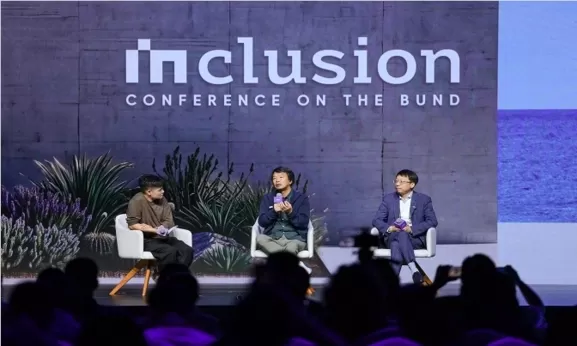
As AI grows increasingly sophisticated, what role remains for humanity? On the morning of September 10, the 2026 Inclusion · Bund Conference kicked off in Shanghai with its opening ceremony and main forum. During a roundtable discussion, acclaimed author Liu Zhenyun and Professor Ma Yi, Dean of the School of Computing and Data Science at the University of Hong Kong, explored how AI is reshaping creativity, education, employment, and human connections, offering distinct perspectives from literature and technology.
Neither speaker adopted a pessimistic stance. Liu Zhenyun described AI as "not a monster," while Ma Yi emphasized that the core issue isn't whether we should use AI, but how we must redefine learning and our own worth in this new landscape.
AI Standardizes Output; Humans Preserve Individuality
How advanced has AI become? Liu Zhenyun shares a personal encounter: a vast number of online videos featuring his likeness and voice are "95% fake." These AI-generated clips mimic his speech patterns and lip movements, using excerpts from works like "One Heap of Chickens" and "One Sentence Worth Ten Thousand" to perpetuate his "opinions."
He likens this phenomenon to the legend of Sun Wukong and the Six-Eared Macaque — "Even the Buddha struggled to distinguish the real from the fake." Confronted by this "AI Liu Zhenyun," his reaction is not fear, but amusement.
However, Liu argues that similarity does not equate to genuine creation. While AI excels at processing existing knowledge, it struggles to generate novel perspectives. "It can mimic 'One Heap of Chickens' to write 'One Heap of Geese,' but I haven't conceived or written a work that AI couldn't replicate."
From Ma Yi's perspective, this highlights a fundamental limit of large language models. AI can currently master knowledge in literature, history, and science to a professional level, but these are largely "commonalities" accumulated by humanity. "Everyone possesses unique individuality; our joys, sorrows, and values differ significantly," Ma noted. AI can explain general concepts well, but it struggles to grasp what an individual values most.
This leads to a crucial question: where does human value lie amidst technological disruption? "This is a question everyone must confront today," Ma stated. "A thriving AI era will be one where each person finds a new equilibrium between societal common values and personal uniqueness."
"AI Is Not a Monster"
Anxiety regarding AI has spilled over into education and employment. Ma Yi observes that many students and parents are worried: Which majors should they choose to avoid being replaced by AI? Yet, he argues that seeking a skill immune to automation reflects outdated thinking.
Shifts are already underway. Ma believes that in clearly defined tasks like programming and mathematical reasoning, AI can now automate significant portions of work, potentially displacing some jobs. However, this does not diminish the value of computer science or mathematics. Instead, the future importance lies in using these disciplines as tools to solve scientific, engineering, and social challenges.
Consequently, in the University of Hong Kong's general AI education courses, he encourages students to fully integrate AI. Rather than searching for skills AI can never learn, it is more effective to learn how to leverage AI to amplify existing capabilities.
Liu Zhenyun addresses unemployment concerns by citing the mechanization of agriculture. Historically, farming relied on human and animal labor, but tractors and harvesters eventually took over. While traditional labor decreased, livelihoods were not lost. "Now, farmers in my village manage hundreds of acres, yet others haven't become unemployed," he observed.
Liu argues that productivity shifts create new production relations, and technological benefits outweigh costs. "AI is definitely not a monster."
AI Can Suggest Restaurants, But Won't Host Dinners
A deeper transformation than work involves human relationships. Increasingly, people seek emotional support from AI. Can technology ultimately resolve human loneliness?
Liu Zhenyun draws a clear line between knowledge acquisition and emotional connection. AI can answer life's questions, but a conversation between friends under a lamp differs fundamentally from chatting with AI — "AI represents the common; you are unique."
He shared an anecdote that drew laughter from the audience: When visiting Hong Kong, he might ask AI for restaurant recommendations; but he would directly ask Ma Yi: "When will you treat me to dinner?" Liu continued, "AI will only suggest a good restaurant, but it won't invite you to dinner. Professor Ma, however, will treat me."
Ma Yi also highlighted the flip side: AI can help students who are hesitant to ask questions in public settings learn more freely. However, if knowledge acquisition shifts entirely to AI, students may become increasingly isolated.
"Ultimately, people must engage with society and interact with real humans," Ma concluded. A new balance is needed between the convenience of AI and the development of human social skills.
Related article
 WeChat Pay launches Smart Glasses SDK; Rokid becomes first compatible brand
WeChat has officially launched the WeChat Pay smart glasses SDK, making it fully accessible. This solution integrates WeChat’s core “scan to pay” functionality into a standard SDK, available to smart glasses manufacturers meeting specific standards.
OpenAI Enhances Codex Security with Dangerous Operation Blocking and Permission Controls
OpenAI has bolstered the security framework for its AI coding agent, Codex, by introducing multiple safeguards designed to mitigate risks associated with destructive actions, such as accidental file deletion or data overwriting during code execution.
Uber Engineer Creates AI Clone of CEO to Dodge Direct Questions
While most staff dread reporting to the CEO, engineers at global travel leader Uber have discovered a strategic advantage: letting an AI replica of their boss provide feedback beforehand."Dara AI": The Executive Coach Before Boardroom MeetingsUber CE
Related Special Topic Recommendations
Social Media
WeChat Pay launches Smart Glasses SDK; Rokid becomes first compatible brand
WeChat has officially launched the WeChat Pay smart glasses SDK, making it fully accessible. This solution integrates WeChat’s core “scan to pay” functionality into a standard SDK, available to smart glasses manufacturers meeting specific standards.
OpenAI Enhances Codex Security with Dangerous Operation Blocking and Permission Controls
OpenAI has bolstered the security framework for its AI coding agent, Codex, by introducing multiple safeguards designed to mitigate risks associated with destructive actions, such as accidental file deletion or data overwriting during code execution.
Uber Engineer Creates AI Clone of CEO to Dodge Direct Questions
While most staff dread reporting to the CEO, engineers at global travel leader Uber have discovered a strategic advantage: letting an AI replica of their boss provide feedback beforehand."Dara AI": The Executive Coach Before Boardroom MeetingsUber CE
Related Special Topic Recommendations
Social Media
 Best AI Caption Generators: Write Platform-Specific Social Posts Fast
2026 Latest Best AI Caption Generators page! XIX.AI curated a top-rated list of must-try powerful tools for writing platform-specific social posts quickly. These tools go through rigorous real-world tests, offering free vs paid comparison and clear rankings to help you find the best option that boosts your productivity and unlocks your AI edge. Explore now!
 11 tools
 xix.ai
Health & Wellness
Best AI Sleep Coaching Tools for Shift Workers, Jet Lag Recovery, and Better Routines
xix.ai
Health & Wellness
Best AI Sleep Coaching Tools for Shift Workers, Jet Lag Recovery, and Better Routines
2026 Latest Best AI Sleep Coaching Tools for Shift Workers, Jet Lag Recovery, and Better Routines! XIX.AI has curated a top-rated list of powerful game-changing tools that go through real-world tests to deliver accurate guidance. You can find detailed free vs paid comparison info and see how these must-try solutions help boost sleep quality, speed up jet lag recovery, and build healthier routines. Explore now to discover your perfect tool!
7 tools
xix.ai
code
ChatGPT Debugging Tools for Python Errors, API Logs, and Stack Trace Triage
2026 Latest Best ChatGPT debugging tools for Python errors, API logs, and stack trace triage are here on XIX.AI. This curated list of top-rated solutions offers a free vs paid comparison, real-world tests, and detailed rankings to help you find the most powerful tool that can significantly boost your productivity and help you solve complex technical issues faster. Explore now to discover your perfect solution!
9 tools
xix.ai
Text-to-speech
AI Voiceover Tools for Product Demo Videos
2026 Latest Best Top-Rated AI Voiceover Tools for Product Demo Videos are here on XIX.AI! This curated list features powerful, game-changing options that help you create professional-quality audio content fast, boosting your demo efficiency significantly. We conduct real-world tests and provide a free vs paid comparison along with weekly updated rankings to help you find the perfect fit. Explore now to Unlock your AI edge!
10 tools
xix.ai
Business
AI Business Plan Tools for Startup Validation
2026 Latest Best AI Business Plan Tools for Startup Validation! XIX.AI has curated a top-rated list of powerful game-changing tools that go through real-world tests to deliver accurate results. You’ll find a free vs paid comparison, detailed rankings, and easy-to-understand insights to help you choose the perfect solution and boost your startup’s success rate. Explore now to Unlock your AI edge!
9 tools
xix.ai
chatbot
AI Chat Apps for Roleplay and Conversation Practice
2026 Latest Best AI Chat Apps for Roleplay and Conversation Practice! XIX.AI curates a top-rated list of powerful must-try tools that go through rigorous real-world tests to deliver exceptional results. You’ll find detailed free vs paid comparison, comprehensive rankings, and insights into how these apps can boost your language skills and communication confidence effectively. Explore now to discover your perfect tool for practice!
10 tools
xix.ai

 Comments (0)
0/500
Comments (0)
0/500
As AI grows increasingly sophisticated, what role remains for humanity? On the morning of September 10, the 2026 Inclusion · Bund Conference kicked off in Shanghai with its opening ceremony and main forum. During a roundtable discussion, acclaimed author Liu Zhenyun and Professor Ma Yi, Dean of the School of Computing and Data Science at the University of Hong Kong, explored how AI is reshaping creativity, education, employment, and human connections, offering distinct perspectives from literature and technology.
Neither speaker adopted a pessimistic stance. Liu Zhenyun described AI as "not a monster," while Ma Yi emphasized that the core issue isn't whether we should use AI, but how we must redefine learning and our own worth in this new landscape.
AI Standardizes Output; Humans Preserve Individuality
How advanced has AI become? Liu Zhenyun shares a personal encounter: a vast number of online videos featuring his likeness and voice are "95% fake." These AI-generated clips mimic his speech patterns and lip movements, using excerpts from works like "One Heap of Chickens" and "One Sentence Worth Ten Thousand" to perpetuate his "opinions."
He likens this phenomenon to the legend of Sun Wukong and the Six-Eared Macaque — "Even the Buddha struggled to distinguish the real from the fake." Confronted by this "AI Liu Zhenyun," his reaction is not fear, but amusement.
However, Liu argues that similarity does not equate to genuine creation. While AI excels at processing existing knowledge, it struggles to generate novel perspectives. "It can mimic 'One Heap of Chickens' to write 'One Heap of Geese,' but I haven't conceived or written a work that AI couldn't replicate."
From Ma Yi's perspective, this highlights a fundamental limit of large language models. AI can currently master knowledge in literature, history, and science to a professional level, but these are largely "commonalities" accumulated by humanity. "Everyone possesses unique individuality; our joys, sorrows, and values differ significantly," Ma noted. AI can explain general concepts well, but it struggles to grasp what an individual values most.
This leads to a crucial question: where does human value lie amidst technological disruption? "This is a question everyone must confront today," Ma stated. "A thriving AI era will be one where each person finds a new equilibrium between societal common values and personal uniqueness."
"AI Is Not a Monster"
Anxiety regarding AI has spilled over into education and employment. Ma Yi observes that many students and parents are worried: Which majors should they choose to avoid being replaced by AI? Yet, he argues that seeking a skill immune to automation reflects outdated thinking.
Shifts are already underway. Ma believes that in clearly defined tasks like programming and mathematical reasoning, AI can now automate significant portions of work, potentially displacing some jobs. However, this does not diminish the value of computer science or mathematics. Instead, the future importance lies in using these disciplines as tools to solve scientific, engineering, and social challenges.
Consequently, in the University of Hong Kong's general AI education courses, he encourages students to fully integrate AI. Rather than searching for skills AI can never learn, it is more effective to learn how to leverage AI to amplify existing capabilities.
Liu Zhenyun addresses unemployment concerns by citing the mechanization of agriculture. Historically, farming relied on human and animal labor, but tractors and harvesters eventually took over. While traditional labor decreased, livelihoods were not lost. "Now, farmers in my village manage hundreds of acres, yet others haven't become unemployed," he observed.
Liu argues that productivity shifts create new production relations, and technological benefits outweigh costs. "AI is definitely not a monster."
AI Can Suggest Restaurants, But Won't Host Dinners
A deeper transformation than work involves human relationships. Increasingly, people seek emotional support from AI. Can technology ultimately resolve human loneliness?
Liu Zhenyun draws a clear line between knowledge acquisition and emotional connection. AI can answer life's questions, but a conversation between friends under a lamp differs fundamentally from chatting with AI — "AI represents the common; you are unique."
He shared an anecdote that drew laughter from the audience: When visiting Hong Kong, he might ask AI for restaurant recommendations; but he would directly ask Ma Yi: "When will you treat me to dinner?" Liu continued, "AI will only suggest a good restaurant, but it won't invite you to dinner. Professor Ma, however, will treat me."
Ma Yi also highlighted the flip side: AI can help students who are hesitant to ask questions in public settings learn more freely. However, if knowledge acquisition shifts entirely to AI, students may become increasingly isolated.
"Ultimately, people must engage with society and interact with real humans," Ma concluded. A new balance is needed between the convenience of AI and the development of human social skills.








 WeChat Pay launches Smart Glasses SDK; Rokid becomes first compatible brand
WeChat has officially launched the WeChat Pay smart glasses SDK, making it fully accessible. This solution integrates WeChat’s core “scan to pay” functionality into a standard SDK, available to smart glasses manufacturers meeting specific standards.
WeChat Pay launches Smart Glasses SDK; Rokid becomes first compatible brand
WeChat has officially launched the WeChat Pay smart glasses SDK, making it fully accessible. This solution integrates WeChat’s core “scan to pay” functionality into a standard SDK, available to smart glasses manufacturers meeting specific standards.
 OpenAI Enhances Codex Security with Dangerous Operation Blocking and Permission Controls
OpenAI has bolstered the security framework for its AI coding agent, Codex, by introducing multiple safeguards designed to mitigate risks associated with destructive actions, such as accidental file deletion or data overwriting during code execution.
OpenAI Enhances Codex Security with Dangerous Operation Blocking and Permission Controls
OpenAI has bolstered the security framework for its AI coding agent, Codex, by introducing multiple safeguards designed to mitigate risks associated with destructive actions, such as accidental file deletion or data overwriting during code execution.
 Uber Engineer Creates AI Clone of CEO to Dodge Direct Questions
While most staff dread reporting to the CEO, engineers at global travel leader Uber have discovered a strategic advantage: letting an AI replica of their boss provide feedback beforehand."Dara AI": The Executive Coach Before Boardroom MeetingsUber CE
Uber Engineer Creates AI Clone of CEO to Dodge Direct Questions
While most staff dread reporting to the CEO, engineers at global travel leader Uber have discovered a strategic advantage: letting an AI replica of their boss provide feedback beforehand."Dara AI": The Executive Coach Before Boardroom MeetingsUber CE
2026 Latest Best AI Caption Generators page! XIX.AI curated a top-rated list of must-try powerful tools for writing platform-specific social posts quickly. These tools go through rigorous real-world tests, offering free vs paid comparison and clear rankings to help you find the best option that boosts your productivity and unlocks your AI edge. Explore now!
11 tools
xix.ai

2026 Latest Best AI Sleep Coaching Tools for Shift Workers, Jet Lag Recovery, and Better Routines! XIX.AI has curated a top-rated list of powerful game-changing tools that go through real-world tests to deliver accurate guidance. You can find detailed free vs paid comparison info and see how these must-try solutions help boost sleep quality, speed up jet lag recovery, and build healthier routines. Explore now to discover your perfect tool!
7 tools
xix.ai

2026 Latest Best ChatGPT debugging tools for Python errors, API logs, and stack trace triage are here on XIX.AI. This curated list of top-rated solutions offers a free vs paid comparison, real-world tests, and detailed rankings to help you find the most powerful tool that can significantly boost your productivity and help you solve complex technical issues faster. Explore now to discover your perfect solution!
9 tools
xix.ai

2026 Latest Best Top-Rated AI Voiceover Tools for Product Demo Videos are here on XIX.AI! This curated list features powerful, game-changing options that help you create professional-quality audio content fast, boosting your demo efficiency significantly. We conduct real-world tests and provide a free vs paid comparison along with weekly updated rankings to help you find the perfect fit. Explore now to Unlock your AI edge!
10 tools
xix.ai

2026 Latest Best AI Business Plan Tools for Startup Validation! XIX.AI has curated a top-rated list of powerful game-changing tools that go through real-world tests to deliver accurate results. You’ll find a free vs paid comparison, detailed rankings, and easy-to-understand insights to help you choose the perfect solution and boost your startup’s success rate. Explore now to Unlock your AI edge!
9 tools
xix.ai

2026 Latest Best AI Chat Apps for Roleplay and Conversation Practice! XIX.AI curates a top-rated list of powerful must-try tools that go through rigorous real-world tests to deliver exceptional results. You’ll find detailed free vs paid comparison, comprehensive rankings, and insights into how these apps can boost your language skills and communication confidence effectively. Explore now to discover your perfect tool for practice!
10 tools
xix.ai












