


 Home
HomeLatent Labs, Founded by DeepMind Alum, Launches with $50M to Program Biology
A new startup, Latent Labs, founded by a former Google DeepMind scientist, has just come out of stealth mode with a hefty $50 million in funding. Their mission? To make biology programmable by building AI foundation models that can generate and optimize proteins. They're planning to team up with biotech and pharmaceutical companies to make this happen.
To get why this is a big deal, you gotta understand proteins. They're the workhorses of our cells, doing everything from acting as enzymes and hormones to serving as antibodies. Made up of about 20 different amino acids, these chains fold into 3D structures that determine how they function. Figuring out these shapes used to be a real slog, but DeepMind's AlphaFold changed the game by using machine learning and real biological data to predict the shapes of around 200 million protein structures.
With this kind of data, scientists can better understand diseases, design new drugs, and even create synthetic proteins for new uses. That's where Latent Labs comes in, aiming to let researchers "computationally create" new therapeutic molecules from scratch.
Latent Potential
Simon Kohl, who used to work at DeepMind on the AlphaFold2 team and led their protein design efforts, saw the potential in going solo. He left DeepMind at the end of 2022 to start Latent Labs, which he officially set up in London in mid-2023. Kohl was inspired by the impact of generative modeling in biology and saw an opportunity to focus specifically on protein design.
To make this happen, Latent Labs has hired around 15 people, including some from DeepMind, a senior engineer from Microsoft, and PhDs from the University of Cambridge. They're split between London, where they're working on cutting-edge models, and San Francisco, where they have a wet lab and a computational protein design team.
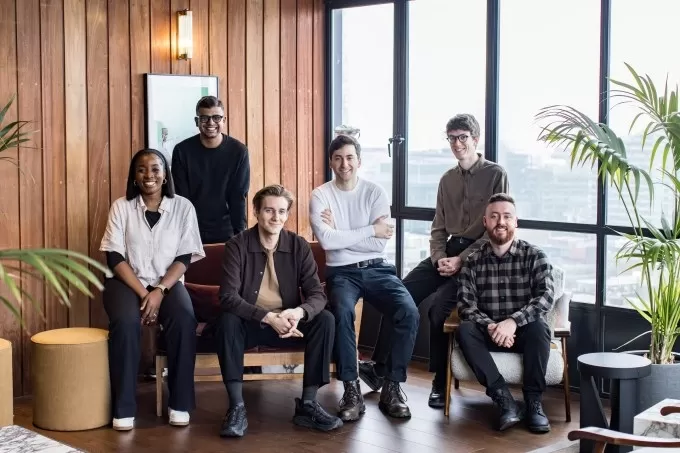
Latent Labs’ London team (L-R): Annette Obika-Mbatha, Krishan Bhatt, Dr. Simon Kohl, Agrin Hilmkil, Alex Bridgland and Henry Kenlay.Image Credits:Latent Labs While wet labs are crucial for now to validate their tech's predictions, the ultimate goal is to make biology so programmable that wet labs become less necessary.
"Our mission is to make biology programmable, really bringing biology into the computational realm, where the reliance on biological, wet lab experiments will be reduced over time," Kohl explained. This could revolutionize drug discovery, which currently involves tons of experiments and can take years.
The Business of Biology
Latent Labs isn't about developing its own drugs. Instead, they want to speed up and de-risk the early R&D stages for other biopharma, biotech, and life science companies through direct model access or project-based partnerships.
Their $50 million funding includes a $10 million seed round and a $40 million Series A round co-led by Radical Ventures and Sofinnova Partners. Other investors include Flying Fish, Isomer, 8VC, Kindred Capital, Pillar VC, and notable angels like Google's Jeff Dean, Cohere's Aidan Gomez, and ElevenLabs' Mati Staniszewski.
A big chunk of this cash will go towards salaries and hiring more machine learning experts, but they'll also need a lot for infrastructure. "Compute is a big cost for us as well — we're building fairly large models, and that requires a lot of GPU compute," Kohl said. This funding will help them scale their models, grow their teams, and build partnerships.
While there are other startups like Cradle and Bioptimus working on similar goals, Kohl believes we're still early enough in the game that the best approach to decoding and designing biological systems isn't clear yet. "There have been some very interesting seeds planted, [for example] with AlphaFold and some other early generative models from other groups," Kohl said. "But this field hasn't converged in terms of what is the best model approach, or in terms of what business model will work here. I think we have the capacity to really innovate."
Related article
 DeepMind’s David Silver Raises $1.1B to Build AI That Learns Without Human Data
Ineffable Intelligence, a UK-based AI startup established just months ago by ex-DeepMind researcher David Silver, has secured $1.1 billion in funding at a $5.1 billion valuation, positioning itself to challenge large language models with novel AI arc
Google Adopts Anthropic Standard for AI Model Data Connectivity
Just weeks after OpenAI announced it would adopt rival Anthropic's protocol for connecting AI models to data systems, Google is doing the same.
In a Wednesday post on X, Google DeepMind CEO Demis Hassabis stated that Google will add support for Anthr
Google DeepMind's Logan Kilpatrick to speak at TechCrunch Sessions: AI
Google DeepMind is leading the charge in AI innovation, and Senior Product Manager Logan Kilpatrick is the perfect person to discuss it. We're thrilled to confirm he'll be joining us on the main stage at TechCrunch Sessions: AI, taking place June 5 a
Related Special Topic Recommendations
Design & Art
DeepMind’s David Silver Raises $1.1B to Build AI That Learns Without Human Data
Ineffable Intelligence, a UK-based AI startup established just months ago by ex-DeepMind researcher David Silver, has secured $1.1 billion in funding at a $5.1 billion valuation, positioning itself to challenge large language models with novel AI arc
Google Adopts Anthropic Standard for AI Model Data Connectivity
Just weeks after OpenAI announced it would adopt rival Anthropic's protocol for connecting AI models to data systems, Google is doing the same.
In a Wednesday post on X, Google DeepMind CEO Demis Hassabis stated that Google will add support for Anthr
Google DeepMind's Logan Kilpatrick to speak at TechCrunch Sessions: AI
Google DeepMind is leading the charge in AI innovation, and Senior Product Manager Logan Kilpatrick is the perfect person to discuss it. We're thrilled to confirm he'll be joining us on the main stage at TechCrunch Sessions: AI, taking place June 5 a
Related Special Topic Recommendations
Design & Art
 Top AI Illustration Tools: Create Editorial Scenes and Cover Art Faster
2026 Latest Top-rated AI Illustration Tools: Our curated list features the best powerfully designed tools for creating stunning editorial scenes and eye-catching cover art quickly. Each option has gone through rigorous real-world tests, offering a free vs paid comparison to help you find the perfect match for your workflow. Try these must-try solutions today to unlock your AI edge and boost your creative productivity. Explore now at XIX.AI.
 10 tools
 xix.ai
Education and Learning
Top AI Tutors for Exam Prep: Practice Math, Science, and English
xix.ai
Education and Learning
Top AI Tutors for Exam Prep: Practice Math, Science, and English
2026 Latest Top-Rated Best AI Tutors for Exam Prep are here on XIX.AI! Our curated list features powerful game-changing tools that offer free vs paid comparison, real-world tests, and weekly updated rankings. They help boost your writing efficiency, simplify complex topic learning, and unlock your academic potential. Explore now to Discover your perfect exam prep tool and Start creating today to Unlock your AI edge!
10 tools
xix.ai
Finance
AI Budget Planning Tools for Personal Money Management
2026 Latest Best Top-Rated AI Budget Planning Tools for Personal Money Management are here on XIX.AI! This curated collection features powerful, game-changing solutions that help you conduct real-world tests, understand spending habits, and create personalized plans to boost productivity. Enjoy a free vs paid comparison along with detailed rankings. Must-try tools designed to simplify money management and unlock your AI edge. Explore now!
11 tools
xix.ai
Health & Wellness
AI Sleep Tracking Assistants: Improve Recovery with Better Bedtime Habits
2026 Latest Best Top-Rated AI Sleep Tracking Assistants curated for ultimate recovery. This fully updated weekly guide features powerful tools that deliver real-world tests, free vs paid comparison, and detailed rankings to help you find the must-try solution that boosts sleep quality and supports better bedtime habits. Explore now at XIX.AI to Unlock your AI edge.
10 tools
xix.ai
Data Analysis
AI SQL Copilots for Product and Revenue Analytics
2026 Latest Best Top-Rated AI SQL Copilots for Product and Revenue Analytics! XIX.AI has curated a powerful, game-changing collection of must-try tools that undergo real-world tests through weekly updated rankings. These tools help users boost productivity significantly by accelerating data analysis, streamlining complex queries, and generating accurate insights to drive smarter business decisions. Explore now to Discover your perfect tool for unlocking your AI edge!
14 tools
xix.ai
Education and Learning
Best AI Homework Helpers That Teach: Learn Concepts, Not Just Answers
2026 Latest Best Top-Rated AI Homework Helpers That Teach Core Concepts Not Just Answers Powerful Tools for Students Must-Try Curated List Weekly Updated Free vs Paid Comparison Real-World Tests Accurate Rankings to Help You Unlock Your Full Learning Potential Explore now to Discover your perfect tool for smarter studying.
10 tools
xix.ai

 Comments (48)
0/500
Comments (48)
0/500
![ThomasRoberts]()
這家公司野心不小啊!用AI設計蛋白質聽起來像科幻片情節,但DeepMind出來的人確實有兩把刷子。不過50M真的夠燒嗎?生物實驗成本超高,而且蛋白質摺疊問題超級複雜,AI模型真的能搞定實際生產中的變數?我保持觀望,但樂見其成!🧬
![JonathanMiller]()
Also, wieder ein Startup, das die Biologie 'programmierbar' machen will. Klingt ambitioniert, aber ich frage mich, wie viele dieser KI-gesteuerten Protein-Design-Firmen es eigentlich schon gibt. Der Markt scheint ja voll davon zu sein. Hoffentlich konzentrieren sie sich auf wirklich nützliche Anwendungen und nicht nur auf das nächste Investment-Round. Die 50 Mio. sind auf jeden Fall ein starkes Signal. Mal sehen, was daraus wird. 🧬
![PeterJohnson]()
Interesting read! Kinda reminds me of the early days of CRISPR hype, but with an AI twist this time. $50M is serious cash though – hope they focus on applications beyond just pharma/biotech, like maybe sustainable materials or energy. The DeepMind connection definitely gives them a head start.
![JackSanchez]()
AI設計蛋白質?這個方向有點酷,不過我更好奇他們說要讓生物學「可編程」,到底要怎麼做?現有的蛋白質設計技術已經很厲害了,他們能突破到什麼程度?而且,這種技術要是真的成了,後續的倫理審核和實際應用會是更大的挑戰吧。先觀望一下。
![NicholasHernández]()
Wow, $50M to program biology? That’s wild! Latent Labs is diving deep into AI-driven protein design—super cool but makes me wonder if we’re playing god a bit too fast. 🧬
![JoseLewis]()
This is wild! $50M to make biology programmable? Latent Labs is basically trying to code life like it’s a video game. Super curious how their AI will shake up drug discovery—hope it’s not just hype! 😎
A new startup, Latent Labs, founded by a former Google DeepMind scientist, has just come out of stealth mode with a hefty $50 million in funding. Their mission? To make biology programmable by building AI foundation models that can generate and optimize proteins. They're planning to team up with biotech and pharmaceutical companies to make this happen.
To get why this is a big deal, you gotta understand proteins. They're the workhorses of our cells, doing everything from acting as enzymes and hormones to serving as antibodies. Made up of about 20 different amino acids, these chains fold into 3D structures that determine how they function. Figuring out these shapes used to be a real slog, but DeepMind's AlphaFold changed the game by using machine learning and real biological data to predict the shapes of around 200 million protein structures.
With this kind of data, scientists can better understand diseases, design new drugs, and even create synthetic proteins for new uses. That's where Latent Labs comes in, aiming to let researchers "computationally create" new therapeutic molecules from scratch.
Latent Potential
Simon Kohl, who used to work at DeepMind on the AlphaFold2 team and led their protein design efforts, saw the potential in going solo. He left DeepMind at the end of 2022 to start Latent Labs, which he officially set up in London in mid-2023. Kohl was inspired by the impact of generative modeling in biology and saw an opportunity to focus specifically on protein design.
To make this happen, Latent Labs has hired around 15 people, including some from DeepMind, a senior engineer from Microsoft, and PhDs from the University of Cambridge. They're split between London, where they're working on cutting-edge models, and San Francisco, where they have a wet lab and a computational protein design team.
"Our mission is to make biology programmable, really bringing biology into the computational realm, where the reliance on biological, wet lab experiments will be reduced over time," Kohl explained. This could revolutionize drug discovery, which currently involves tons of experiments and can take years.
The Business of Biology
Latent Labs isn't about developing its own drugs. Instead, they want to speed up and de-risk the early R&D stages for other biopharma, biotech, and life science companies through direct model access or project-based partnerships.
Their $50 million funding includes a $10 million seed round and a $40 million Series A round co-led by Radical Ventures and Sofinnova Partners. Other investors include Flying Fish, Isomer, 8VC, Kindred Capital, Pillar VC, and notable angels like Google's Jeff Dean, Cohere's Aidan Gomez, and ElevenLabs' Mati Staniszewski.
A big chunk of this cash will go towards salaries and hiring more machine learning experts, but they'll also need a lot for infrastructure. "Compute is a big cost for us as well — we're building fairly large models, and that requires a lot of GPU compute," Kohl said. This funding will help them scale their models, grow their teams, and build partnerships.
While there are other startups like Cradle and Bioptimus working on similar goals, Kohl believes we're still early enough in the game that the best approach to decoding and designing biological systems isn't clear yet. "There have been some very interesting seeds planted, [for example] with AlphaFold and some other early generative models from other groups," Kohl said. "But this field hasn't converged in terms of what is the best model approach, or in terms of what business model will work here. I think we have the capacity to really innovate."








 DeepMind’s David Silver Raises $1.1B to Build AI That Learns Without Human Data
Ineffable Intelligence, a UK-based AI startup established just months ago by ex-DeepMind researcher David Silver, has secured $1.1 billion in funding at a $5.1 billion valuation, positioning itself to challenge large language models with novel AI arc
Google Adopts Anthropic Standard for AI Model Data Connectivity
Just weeks after OpenAI announced it would adopt rival Anthropic's protocol for connecting AI models to data systems, Google is doing the same.
In a Wednesday post on X, Google DeepMind CEO Demis Hassabis stated that Google will add support for Anthr
DeepMind’s David Silver Raises $1.1B to Build AI That Learns Without Human Data
Ineffable Intelligence, a UK-based AI startup established just months ago by ex-DeepMind researcher David Silver, has secured $1.1 billion in funding at a $5.1 billion valuation, positioning itself to challenge large language models with novel AI arc
Google Adopts Anthropic Standard for AI Model Data Connectivity
Just weeks after OpenAI announced it would adopt rival Anthropic's protocol for connecting AI models to data systems, Google is doing the same.
In a Wednesday post on X, Google DeepMind CEO Demis Hassabis stated that Google will add support for Anthr
 Google DeepMind's Logan Kilpatrick to speak at TechCrunch Sessions: AI
Google DeepMind is leading the charge in AI innovation, and Senior Product Manager Logan Kilpatrick is the perfect person to discuss it. We're thrilled to confirm he'll be joining us on the main stage at TechCrunch Sessions: AI, taking place June 5 a
Google DeepMind's Logan Kilpatrick to speak at TechCrunch Sessions: AI
Google DeepMind is leading the charge in AI innovation, and Senior Product Manager Logan Kilpatrick is the perfect person to discuss it. We're thrilled to confirm he'll be joining us on the main stage at TechCrunch Sessions: AI, taking place June 5 a

2026 Latest Top-rated AI Illustration Tools: Our curated list features the best powerfully designed tools for creating stunning editorial scenes and eye-catching cover art quickly. Each option has gone through rigorous real-world tests, offering a free vs paid comparison to help you find the perfect match for your workflow. Try these must-try solutions today to unlock your AI edge and boost your creative productivity. Explore now at XIX.AI.
10 tools
xix.ai

2026 Latest Top-Rated Best AI Tutors for Exam Prep are here on XIX.AI! Our curated list features powerful game-changing tools that offer free vs paid comparison, real-world tests, and weekly updated rankings. They help boost your writing efficiency, simplify complex topic learning, and unlock your academic potential. Explore now to Discover your perfect exam prep tool and Start creating today to Unlock your AI edge!
10 tools
xix.ai

2026 Latest Best Top-Rated AI Budget Planning Tools for Personal Money Management are here on XIX.AI! This curated collection features powerful, game-changing solutions that help you conduct real-world tests, understand spending habits, and create personalized plans to boost productivity. Enjoy a free vs paid comparison along with detailed rankings. Must-try tools designed to simplify money management and unlock your AI edge. Explore now!
11 tools
xix.ai

2026 Latest Best Top-Rated AI Sleep Tracking Assistants curated for ultimate recovery. This fully updated weekly guide features powerful tools that deliver real-world tests, free vs paid comparison, and detailed rankings to help you find the must-try solution that boosts sleep quality and supports better bedtime habits. Explore now at XIX.AI to Unlock your AI edge.
10 tools
xix.ai

2026 Latest Best Top-Rated AI SQL Copilots for Product and Revenue Analytics! XIX.AI has curated a powerful, game-changing collection of must-try tools that undergo real-world tests through weekly updated rankings. These tools help users boost productivity significantly by accelerating data analysis, streamlining complex queries, and generating accurate insights to drive smarter business decisions. Explore now to Discover your perfect tool for unlocking your AI edge!
14 tools
xix.ai

2026 Latest Best Top-Rated AI Homework Helpers That Teach Core Concepts Not Just Answers Powerful Tools for Students Must-Try Curated List Weekly Updated Free vs Paid Comparison Real-World Tests Accurate Rankings to Help You Unlock Your Full Learning Potential Explore now to Discover your perfect tool for smarter studying.
10 tools
xix.ai

這家公司野心不小啊!用AI設計蛋白質聽起來像科幻片情節,但DeepMind出來的人確實有兩把刷子。不過50M真的夠燒嗎?生物實驗成本超高,而且蛋白質摺疊問題超級複雜,AI模型真的能搞定實際生產中的變數?我保持觀望,但樂見其成!🧬
Also, wieder ein Startup, das die Biologie 'programmierbar' machen will. Klingt ambitioniert, aber ich frage mich, wie viele dieser KI-gesteuerten Protein-Design-Firmen es eigentlich schon gibt. Der Markt scheint ja voll davon zu sein. Hoffentlich konzentrieren sie sich auf wirklich nützliche Anwendungen und nicht nur auf das nächste Investment-Round. Die 50 Mio. sind auf jeden Fall ein starkes Signal. Mal sehen, was daraus wird. 🧬
Interesting read! Kinda reminds me of the early days of CRISPR hype, but with an AI twist this time. $50M is serious cash though – hope they focus on applications beyond just pharma/biotech, like maybe sustainable materials or energy. The DeepMind connection definitely gives them a head start.
AI設計蛋白質?這個方向有點酷,不過我更好奇他們說要讓生物學「可編程」,到底要怎麼做?現有的蛋白質設計技術已經很厲害了,他們能突破到什麼程度?而且,這種技術要是真的成了,後續的倫理審核和實際應用會是更大的挑戰吧。先觀望一下。
Wow, $50M to program biology? That’s wild! Latent Labs is diving deep into AI-driven protein design—super cool but makes me wonder if we’re playing god a bit too fast. 🧬
This is wild! $50M to make biology programmable? Latent Labs is basically trying to code life like it’s a video game. Super curious how their AI will shake up drug discovery—hope it’s not just hype! 😎












