


 Home
HomeGoogle Utilizes AI to Suspend Over 39 Million Ad Accounts for Suspected Fraud
Google announced on Wednesday that it had taken a major step in fighting ad fraud by suspending a staggering 39.2 million advertiser accounts on its platform in 2024. This number is more than triple what was reported the previous year, showcasing Google's intensified efforts to clean up its ad ecosystem.
By harnessing the power of large language models (LLMs) and analyzing signals like business impersonation and suspicious payment details, Google claims it can now suspend the "vast majority" of these ad accounts before they even have a chance to display an ad. It's like catching the bad guys before they can even step into the bank!
Last year alone, Google rolled out over 50 LLM enhancements to bolster its safety enforcement across all its platforms. "While these AI models are incredibly important and have led to significant improvements, we still rely on human oversight throughout the process," explained Alex Rodriguez, Google's General Manager for Ads Safety, during a virtual media roundtable.
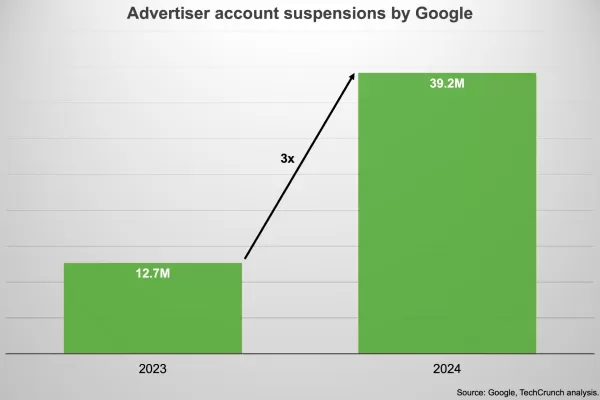
Image Credits: Jagmeet Singh / TechCrunch
Rodriguez shared that Google assembled a team of over 100 experts from various divisions, including Ads Safety, Trust and Safety, and researchers from DeepMind. This team worked tirelessly to analyze deepfake ad scams, especially those involving impersonations of public figures, and developed effective countermeasures.
The company introduced over 30 updates to its ads and publisher policies last year, along with technical countermeasures. These efforts led to the suspension of more than 700,000 offending advertising accounts and a dramatic 90% reduction in reported deepfake ads, according to Google's own claims.
In the U.S., Google suspended 39.2 million advertiser accounts and removed 1.8 billion ads last year. The key violations included ad network abuse, trademark misuse, healthcare claims, personalized ads, and misrepresentation. Meanwhile, in India, which boasts the world's largest population and the second-largest internet market after China, Google suspended 2.9 million accounts and removed 247.4 million ads. The top policy violations in India were related to financial services, trademark misuse, ad network abuse, personalized ads, and gambling and games.
Out of all the suspensions, Google specifically targeted 5 million accounts for scam-related violations, and overall, it removed nearly half a billion scam-related ads.
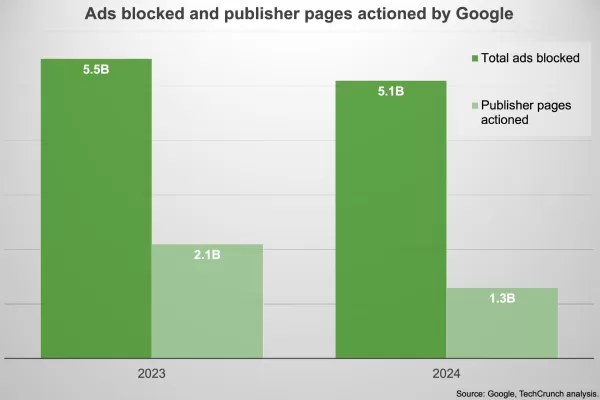
Image Credits: Jagmeet Singh / TechCrunch
In 2024, with half the world's population heading to the polls, Google verified more than 8,900 new election advertisers and removed 10.7 million election ads. However, Rodriguez noted that the volume of election ads is relatively small compared to Google's overall ad numbers, so it won't significantly affect the company's safety metrics this year.
Last year, Google blocked a total of 5.1 billion ads and removed 1.3 billion pages. In 2023, these numbers were even higher, with over 5.5 billion ads blocked and action taken against 2.1 billion publisher pages. Google told TechCrunch that the decline in these numbers reflects improvements in its prevention efforts, as better early detection and suspension of malicious accounts means fewer harmful ads make it to the platform.
Additionally, Google restricted 9.1 billion ads last year. However, large-scale suspensions can raise concerns about fairness in applying rules. To address this, Google offers an appeal process that includes human reviews to ensure appropriate action was taken.
"Sometimes, our messaging wasn't as clear or transparent about the specifics, the rationale, or the reasoning behind our actions, which left advertisers confused. We've updated many of our policies and transparency capabilities to better communicate what and why to help advertisers understand our decisions. This has been a major focus for our team in 2024 and will continue into 2025," Rodriguez concluded.
Related article
 Google AI Overviews Gain Ground in Search Results
According to Similarweb’s 2026 Generative AI Landscape report, Google’s AI-generated summaries appeared in 43% of US searches, a significant rise from 15% recorded a year prior.While AI Overviews present generated summaries within standard search res
Google to Pay SpaceX $920M Monthly for Compute
SpaceX has secured another major compute agreement ahead of its landmark IPO, this time partnering with Google. The company disclosed the arrangement in a regulatory filing on Friday.According to the agreement, Google will pay SpaceX $920 million mon
Google expands AI Mode to track flight prices and book hotels
Google has introduced new capabilities within AI Mode, its conversational search interface, allowing users to plan and book trips more effectively, the company revealed on Thursday. The updated features enable users to inquire about flight price tren
Related Special Topic Recommendations
Design & Art
Google AI Overviews Gain Ground in Search Results
According to Similarweb’s 2026 Generative AI Landscape report, Google’s AI-generated summaries appeared in 43% of US searches, a significant rise from 15% recorded a year prior.While AI Overviews present generated summaries within standard search res
Google to Pay SpaceX $920M Monthly for Compute
SpaceX has secured another major compute agreement ahead of its landmark IPO, this time partnering with Google. The company disclosed the arrangement in a regulatory filing on Friday.According to the agreement, Google will pay SpaceX $920 million mon
Google expands AI Mode to track flight prices and book hotels
Google has introduced new capabilities within AI Mode, its conversational search interface, allowing users to plan and book trips more effectively, the company revealed on Thursday. The updated features enable users to inquire about flight price tren
Related Special Topic Recommendations
Design & Art
 Top AI Illustration Tools: Create Editorial Scenes and Cover Art Faster
2026 Latest Top-rated AI Illustration Tools: Our curated list features the best powerfully designed tools for creating stunning editorial scenes and eye-catching cover art quickly. Each option has gone through rigorous real-world tests, offering a free vs paid comparison to help you find the perfect match for your workflow. Try these must-try solutions today to unlock your AI edge and boost your creative productivity. Explore now at XIX.AI.
 10 tools
 xix.ai
Education and Learning
Top AI Tutors for Exam Prep: Practice Math, Science, and English
xix.ai
Education and Learning
Top AI Tutors for Exam Prep: Practice Math, Science, and English
2026 Latest Top-Rated Best AI Tutors for Exam Prep are here on XIX.AI! Our curated list features powerful game-changing tools that offer free vs paid comparison, real-world tests, and weekly updated rankings. They help boost your writing efficiency, simplify complex topic learning, and unlock your academic potential. Explore now to Discover your perfect exam prep tool and Start creating today to Unlock your AI edge!
10 tools
xix.ai
Finance
AI Budget Planning Tools for Personal Money Management
2026 Latest Best Top-Rated AI Budget Planning Tools for Personal Money Management are here on XIX.AI! This curated collection features powerful, game-changing solutions that help you conduct real-world tests, understand spending habits, and create personalized plans to boost productivity. Enjoy a free vs paid comparison along with detailed rankings. Must-try tools designed to simplify money management and unlock your AI edge. Explore now!
11 tools
xix.ai
Health & Wellness
AI Sleep Tracking Assistants: Improve Recovery with Better Bedtime Habits
2026 Latest Best Top-Rated AI Sleep Tracking Assistants curated for ultimate recovery. This fully updated weekly guide features powerful tools that deliver real-world tests, free vs paid comparison, and detailed rankings to help you find the must-try solution that boosts sleep quality and supports better bedtime habits. Explore now at XIX.AI to Unlock your AI edge.
10 tools
xix.ai
Data Analysis
AI SQL Copilots for Product and Revenue Analytics
2026 Latest Best Top-Rated AI SQL Copilots for Product and Revenue Analytics! XIX.AI has curated a powerful, game-changing collection of must-try tools that undergo real-world tests through weekly updated rankings. These tools help users boost productivity significantly by accelerating data analysis, streamlining complex queries, and generating accurate insights to drive smarter business decisions. Explore now to Discover your perfect tool for unlocking your AI edge!
14 tools
xix.ai
Education and Learning
Best AI Homework Helpers That Teach: Learn Concepts, Not Just Answers
2026 Latest Best Top-Rated AI Homework Helpers That Teach Core Concepts Not Just Answers Powerful Tools for Students Must-Try Curated List Weekly Updated Free vs Paid Comparison Real-World Tests Accurate Rankings to Help You Unlock Your Full Learning Potential Explore now to Discover your perfect tool for smarter studying.
10 tools
xix.ai

 Comments (17)
0/500
Comments (17)
0/500
![PaulGonzalez]()
Obwohl der Kampf gegen Betrug lobenswert ist, frage ich mich, ob diese massenhafte, KI-gesteuerte Aussperrung manchmal auch legitime oder kleine Werbetreibende fälschlicherweise trifft. Die Transparenz bei diesen Entscheidungsprozessen ist entscheidend. Spannend wäre, Statistiken zu 'falsch Positiven' zu sehen. 🤔
![BruceGonzalez]()
Это впечатляющая цифра, но вызывает вопросы: насколько точны алгоритмы ИИ? Случаются ли ложные блокировки? Было бы полезно, если бы Google предоставил больше деталей о процессе проверки. В любом случае, борьба с мошенничеством — это важно для всех пользователей. 🤔
![KevinJohnson]()
Wow, 39.2 million accounts banned? Google's AI is like a digital bouncer kicking out the fraudsters! 🕵️♂️ Makes me wonder how many sneaky ads I’ve clicked on without knowing.
![EdwardEvans]()
Wow, 39 million accounts banned? Google's AI is like a digital bouncer kicking out the fraudsters! But I wonder if legit advertisers are getting caught in the crossfire. 🧐
![StephenScott]()
Wow, 39.2 million accounts banned? Google's AI is like a digital sheriff cleaning up the ad Wild West! 🕵️♂️ Makes me wonder how many legit accounts got caught in the crossfire though.
![StephenLee]()
Wow, 39.2 million accounts banned? Google's AI is like a digital sheriff cleaning up the wild west of ads! 🕵️♂️ Makes me wonder how many sneaky fraudsters are still out there.
Google announced on Wednesday that it had taken a major step in fighting ad fraud by suspending a staggering 39.2 million advertiser accounts on its platform in 2024. This number is more than triple what was reported the previous year, showcasing Google's intensified efforts to clean up its ad ecosystem.
By harnessing the power of large language models (LLMs) and analyzing signals like business impersonation and suspicious payment details, Google claims it can now suspend the "vast majority" of these ad accounts before they even have a chance to display an ad. It's like catching the bad guys before they can even step into the bank!
Last year alone, Google rolled out over 50 LLM enhancements to bolster its safety enforcement across all its platforms. "While these AI models are incredibly important and have led to significant improvements, we still rely on human oversight throughout the process," explained Alex Rodriguez, Google's General Manager for Ads Safety, during a virtual media roundtable.
Rodriguez shared that Google assembled a team of over 100 experts from various divisions, including Ads Safety, Trust and Safety, and researchers from DeepMind. This team worked tirelessly to analyze deepfake ad scams, especially those involving impersonations of public figures, and developed effective countermeasures.
The company introduced over 30 updates to its ads and publisher policies last year, along with technical countermeasures. These efforts led to the suspension of more than 700,000 offending advertising accounts and a dramatic 90% reduction in reported deepfake ads, according to Google's own claims.
In the U.S., Google suspended 39.2 million advertiser accounts and removed 1.8 billion ads last year. The key violations included ad network abuse, trademark misuse, healthcare claims, personalized ads, and misrepresentation. Meanwhile, in India, which boasts the world's largest population and the second-largest internet market after China, Google suspended 2.9 million accounts and removed 247.4 million ads. The top policy violations in India were related to financial services, trademark misuse, ad network abuse, personalized ads, and gambling and games.
Out of all the suspensions, Google specifically targeted 5 million accounts for scam-related violations, and overall, it removed nearly half a billion scam-related ads.
In 2024, with half the world's population heading to the polls, Google verified more than 8,900 new election advertisers and removed 10.7 million election ads. However, Rodriguez noted that the volume of election ads is relatively small compared to Google's overall ad numbers, so it won't significantly affect the company's safety metrics this year.
Last year, Google blocked a total of 5.1 billion ads and removed 1.3 billion pages. In 2023, these numbers were even higher, with over 5.5 billion ads blocked and action taken against 2.1 billion publisher pages. Google told TechCrunch that the decline in these numbers reflects improvements in its prevention efforts, as better early detection and suspension of malicious accounts means fewer harmful ads make it to the platform.
Additionally, Google restricted 9.1 billion ads last year. However, large-scale suspensions can raise concerns about fairness in applying rules. To address this, Google offers an appeal process that includes human reviews to ensure appropriate action was taken.
"Sometimes, our messaging wasn't as clear or transparent about the specifics, the rationale, or the reasoning behind our actions, which left advertisers confused. We've updated many of our policies and transparency capabilities to better communicate what and why to help advertisers understand our decisions. This has been a major focus for our team in 2024 and will continue into 2025," Rodriguez concluded.








 Google AI Overviews Gain Ground in Search Results
According to Similarweb’s 2026 Generative AI Landscape report, Google’s AI-generated summaries appeared in 43% of US searches, a significant rise from 15% recorded a year prior.While AI Overviews present generated summaries within standard search res
Google AI Overviews Gain Ground in Search Results
According to Similarweb’s 2026 Generative AI Landscape report, Google’s AI-generated summaries appeared in 43% of US searches, a significant rise from 15% recorded a year prior.While AI Overviews present generated summaries within standard search res
 Google to Pay SpaceX $920M Monthly for Compute
SpaceX has secured another major compute agreement ahead of its landmark IPO, this time partnering with Google. The company disclosed the arrangement in a regulatory filing on Friday.According to the agreement, Google will pay SpaceX $920 million mon
Google to Pay SpaceX $920M Monthly for Compute
SpaceX has secured another major compute agreement ahead of its landmark IPO, this time partnering with Google. The company disclosed the arrangement in a regulatory filing on Friday.According to the agreement, Google will pay SpaceX $920 million mon
 Google expands AI Mode to track flight prices and book hotels
Google has introduced new capabilities within AI Mode, its conversational search interface, allowing users to plan and book trips more effectively, the company revealed on Thursday. The updated features enable users to inquire about flight price tren
Google expands AI Mode to track flight prices and book hotels
Google has introduced new capabilities within AI Mode, its conversational search interface, allowing users to plan and book trips more effectively, the company revealed on Thursday. The updated features enable users to inquire about flight price tren

2026 Latest Top-rated AI Illustration Tools: Our curated list features the best powerfully designed tools for creating stunning editorial scenes and eye-catching cover art quickly. Each option has gone through rigorous real-world tests, offering a free vs paid comparison to help you find the perfect match for your workflow. Try these must-try solutions today to unlock your AI edge and boost your creative productivity. Explore now at XIX.AI.
10 tools
xix.ai

2026 Latest Top-Rated Best AI Tutors for Exam Prep are here on XIX.AI! Our curated list features powerful game-changing tools that offer free vs paid comparison, real-world tests, and weekly updated rankings. They help boost your writing efficiency, simplify complex topic learning, and unlock your academic potential. Explore now to Discover your perfect exam prep tool and Start creating today to Unlock your AI edge!
10 tools
xix.ai

2026 Latest Best Top-Rated AI Budget Planning Tools for Personal Money Management are here on XIX.AI! This curated collection features powerful, game-changing solutions that help you conduct real-world tests, understand spending habits, and create personalized plans to boost productivity. Enjoy a free vs paid comparison along with detailed rankings. Must-try tools designed to simplify money management and unlock your AI edge. Explore now!
11 tools
xix.ai

2026 Latest Best Top-Rated AI Sleep Tracking Assistants curated for ultimate recovery. This fully updated weekly guide features powerful tools that deliver real-world tests, free vs paid comparison, and detailed rankings to help you find the must-try solution that boosts sleep quality and supports better bedtime habits. Explore now at XIX.AI to Unlock your AI edge.
10 tools
xix.ai

2026 Latest Best Top-Rated AI SQL Copilots for Product and Revenue Analytics! XIX.AI has curated a powerful, game-changing collection of must-try tools that undergo real-world tests through weekly updated rankings. These tools help users boost productivity significantly by accelerating data analysis, streamlining complex queries, and generating accurate insights to drive smarter business decisions. Explore now to Discover your perfect tool for unlocking your AI edge!
14 tools
xix.ai

2026 Latest Best Top-Rated AI Homework Helpers That Teach Core Concepts Not Just Answers Powerful Tools for Students Must-Try Curated List Weekly Updated Free vs Paid Comparison Real-World Tests Accurate Rankings to Help You Unlock Your Full Learning Potential Explore now to Discover your perfect tool for smarter studying.
10 tools
xix.ai

Obwohl der Kampf gegen Betrug lobenswert ist, frage ich mich, ob diese massenhafte, KI-gesteuerte Aussperrung manchmal auch legitime oder kleine Werbetreibende fälschlicherweise trifft. Die Transparenz bei diesen Entscheidungsprozessen ist entscheidend. Spannend wäre, Statistiken zu 'falsch Positiven' zu sehen. 🤔
Это впечатляющая цифра, но вызывает вопросы: насколько точны алгоритмы ИИ? Случаются ли ложные блокировки? Было бы полезно, если бы Google предоставил больше деталей о процессе проверки. В любом случае, борьба с мошенничеством — это важно для всех пользователей. 🤔
Wow, 39.2 million accounts banned? Google's AI is like a digital bouncer kicking out the fraudsters! 🕵️♂️ Makes me wonder how many sneaky ads I’ve clicked on without knowing.
Wow, 39 million accounts banned? Google's AI is like a digital bouncer kicking out the fraudsters! But I wonder if legit advertisers are getting caught in the crossfire. 🧐
Wow, 39.2 million accounts banned? Google's AI is like a digital sheriff cleaning up the ad Wild West! 🕵️♂️ Makes me wonder how many legit accounts got caught in the crossfire though.
Wow, 39.2 million accounts banned? Google's AI is like a digital sheriff cleaning up the wild west of ads! 🕵️♂️ Makes me wonder how many sneaky fraudsters are still out there.












