


 Home
Home
iFlytek Xinghuo Unveils 0.65B Encoder Speech Model with 30B MoE, Built on Fully Domestic Computing Power
iFLYTEK has launched Spark-Audio-1.0-Preview, a speech foundation large model built entirely on domestic computing infrastructure.
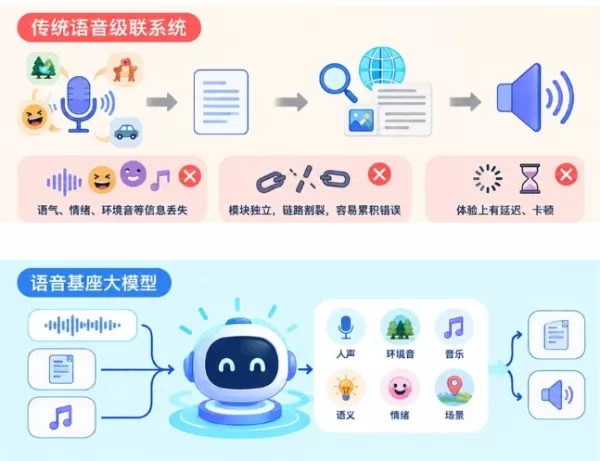
Previously, audio processing with large models relied on a cascading method: converting speech to text first, then passing it to the model for analysis. This approach suffers from two major flaws: information loss, as text fails to capture tone, emotion, and background sounds, leading to incomplete context; and fragmented workflows, where independent modules for transcription, speaker ID, and translation run in series, causing error accumulation, latency, and a poor user experience.
Beyond transcription: Direct speech comprehension
This speech foundation model moves beyond simple transcription to directly interpret audio. It can distinguish human voices, ambient noise, and music, while grasping semantics, emotions, and contextual cues within the sound.
The initial Spark-Audio-1.0-Preview release features a 0.65B audio encoder (Dense structure) and a 30B-A3B large language model (MoE structure). Trained on 13 million hours of audio and extensive text data using a fully domestic computing cluster, the model accepts both text and audio inputs. It supports tasks including speech transcription, multilingual translation, multi-dialect recognition, ambient sound identification, speaker recognition, sentiment analysis, and complex audio Q&A, enabling machines to transition from "hearing clearly" to "understanding." Similar to iFLYTEK's Spark large model "1+N" system, users can fine-tune this speech foundation model to create specialized systems for speech recognition, real-time translation, and interactive speech applications.
Supports 99 languages and 202 dialects, excelling in complex scenarios
According to official data, Spark-Audio-1.0-Preview performs comparably or better than competitors across various speech evaluation tasks, particularly in challenging real-world scenarios like high noise levels and soft speaking. Its performance is also closely aligned with larger, closed-source speech foundation models.
The model supports recognition of 99 languages and 202 dialects. It demonstrates superior average performance in multilingual and multi-dialect speech recognition compared to the similarly sized Qwen3.5-omni-flash (35B-A3B), and matches the performance of the significantly larger Qwen3.5-omni-plus. In evaluations such as Fleurs, Kespeech, and LibriSpeech for Chinese-English, multilingual, and multi-dialect speech recognition, it outperforms Gemini-3.1 Pro and achieves SOTA on the Fleurs Chinese test set.
iFLYTEK acknowledges that while this version maintains strong performance in general knowledge, math, and coding tasks, there is room for improvement in instruction following, dialogue, and audio understanding. Future updates will focus on strengthening these areas. Spark-Audio-1.0-Preview is now available for public experience, with API access to be released on the iFLYTEK Open Platform soon.
Related article
 Zoho Helps Businesses Adopt AI Agents
The market is rapidly evolving toward AI-driven agentsZoho highlights that AI is advancing exponentially, making it crucial for businesses to adapt and rethink their operationsThe excitement surrounding AI shows no signs of slowing down. Keeping up w
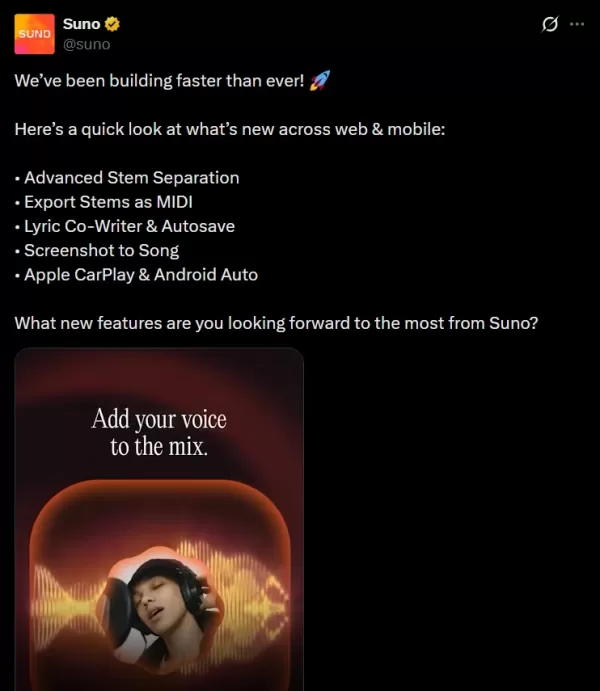
Suno Unveils Major Update With Advanced Track Separation and Car Support
Suno has rolled out significant updates to its AI music generation platform, enhancing both web and mobile experiences to streamline creation and boost usability. The platform is advancing toward a more accessible and efficient stage for AI-driven mu
Cohere’s Joëlle Pineau on Sovereign AI and Enterprise Security
IDC research commissioned by Cohere explores sovereign AI, with Chief AI Officer Joëlle Pineau outlining essential strategies for enterprise cloud security and data governance.According to IDC’s report, The State of Sovereign AI Adoption in 2026, com
Related Special Topic Recommendations
code
Zoho Helps Businesses Adopt AI Agents
The market is rapidly evolving toward AI-driven agentsZoho highlights that AI is advancing exponentially, making it crucial for businesses to adapt and rethink their operationsThe excitement surrounding AI shows no signs of slowing down. Keeping up w
Suno Unveils Major Update With Advanced Track Separation and Car Support
Suno has rolled out significant updates to its AI music generation platform, enhancing both web and mobile experiences to streamline creation and boost usability. The platform is advancing toward a more accessible and efficient stage for AI-driven mu
Cohere’s Joëlle Pineau on Sovereign AI and Enterprise Security
IDC research commissioned by Cohere explores sovereign AI, with Chief AI Officer Joëlle Pineau outlining essential strategies for enterprise cloud security and data governance.According to IDC’s report, The State of Sovereign AI Adoption in 2026, com
Related Special Topic Recommendations
code
 Best AI Test Generators: Create Unit Tests for APIs and Functions
2026 Latest Best Top-Rated AI Test Generators for API and Function Development. XIX.AI has curated a powerful, game-changing collection of must-try tools that go through rigorous real-world tests to deliver accurate results. You’ll find detailed free vs paid comparison insights and updated rankings weekly. Explore now to discover your perfect tool and unlock your AI edge in software testing.
 7 tools
 xix.ai
Business
Best AI Business Plan Generators: Turn Ideas into Investor Deck Drafts
xix.ai
Business
Best AI Business Plan Generators: Turn Ideas into Investor Deck Drafts
2026 Latest Best Top-rated AI Business Plan Generators are here on XIX.AI! This curated collection features powerful game-changing tools that help creators turn innovative ideas into polished investor deck drafts quickly. You’ll find weekly updated rankings, free vs paid comparison insights, and real-world tests to help you choose the must-try solution that boosts productivity and delivers top results. Explore now to discover your perfect tool for securing funding!
11 tools
xix.ai
Finance
AI Invoice OCR Platforms for QuickBooks, Xero, and Multi-Entity Reconciliation
2026 Latest Best AI Invoice OCR Platforms for QuickBooks, Xero, and Multi-Entity Reconciliation! XIX.AI curates a top-rated list of powerful tools that deliver accurate real-world tests and weekly updated rankings. These must-try solutions streamline invoice processing, boost productivity, and save time across complex business setups. Get a free vs paid comparison to find your perfect fit. Explore now to unlock your AI edge!
8 tools
xix.ai
Business
AI RFP Response Software for Enterprise Proposal Workflows
2026 Latest Best AI RFP Response Software for Enterprise Proposal Workflows! XIX.AI curates a top-rated list of powerful tools that pass rigorous real-world tests, offering must-try features to boost productivity and streamline your proposal processes. Get a free vs paid comparison, see detailed rankings, and discover how these game-changing solutions can help you create high-quality responses faster. Explore now to unlock your AI edge!
9 tools
xix.ai
Video creation
AI Subtitle and Dubbing Tools: Localize Video for Global Audiences
2026 Latest Best Top-rated AI Subtitle and Dubbing Tools Curated for Localizing Video for Global Audiences Powerfully boost content reach across language barriers with game-changing accuracy Real-world tests prove these must-try solutions offer free vs paid comparison and reliable rankings to maximize productivity Explore now to Discover your perfect tool for global content delivery
10 tools
xix.ai
automation
AI Invoice Processing Tools for AP Automation, Approval Routing, and ERP Sync Workflows
2026 Latest Best AI Invoice Processing Tools for AP Automation, Approval Routing, and ERP Sync Workflows! XIX.AI curates top-rated, powerful solutions that pass rigorous real-world tests to boost productivity dramatically. Get a free vs paid comparison, see detailed rankings, and discover must-try options to streamline your finance operations. Explore now to unlock your AI edge!
9 tools
xix.ai

 Comments (0)
0/500
Comments (0)
0/500
iFLYTEK has launched Spark-Audio-1.0-Preview, a speech foundation large model built entirely on domestic computing infrastructure.
Previously, audio processing with large models relied on a cascading method: converting speech to text first, then passing it to the model for analysis. This approach suffers from two major flaws: information loss, as text fails to capture tone, emotion, and background sounds, leading to incomplete context; and fragmented workflows, where independent modules for transcription, speaker ID, and translation run in series, causing error accumulation, latency, and a poor user experience.
Beyond transcription: Direct speech comprehension
This speech foundation model moves beyond simple transcription to directly interpret audio. It can distinguish human voices, ambient noise, and music, while grasping semantics, emotions, and contextual cues within the sound.
The initial Spark-Audio-1.0-Preview release features a 0.65B audio encoder (Dense structure) and a 30B-A3B large language model (MoE structure). Trained on 13 million hours of audio and extensive text data using a fully domestic computing cluster, the model accepts both text and audio inputs. It supports tasks including speech transcription, multilingual translation, multi-dialect recognition, ambient sound identification, speaker recognition, sentiment analysis, and complex audio Q&A, enabling machines to transition from "hearing clearly" to "understanding." Similar to iFLYTEK's Spark large model "1+N" system, users can fine-tune this speech foundation model to create specialized systems for speech recognition, real-time translation, and interactive speech applications.
Supports 99 languages and 202 dialects, excelling in complex scenarios
According to official data, Spark-Audio-1.0-Preview performs comparably or better than competitors across various speech evaluation tasks, particularly in challenging real-world scenarios like high noise levels and soft speaking. Its performance is also closely aligned with larger, closed-source speech foundation models.
The model supports recognition of 99 languages and 202 dialects. It demonstrates superior average performance in multilingual and multi-dialect speech recognition compared to the similarly sized Qwen3.5-omni-flash (35B-A3B), and matches the performance of the significantly larger Qwen3.5-omni-plus. In evaluations such as Fleurs, Kespeech, and LibriSpeech for Chinese-English, multilingual, and multi-dialect speech recognition, it outperforms Gemini-3.1 Pro and achieves SOTA on the Fleurs Chinese test set.
iFLYTEK acknowledges that while this version maintains strong performance in general knowledge, math, and coding tasks, there is room for improvement in instruction following, dialogue, and audio understanding. Future updates will focus on strengthening these areas. Spark-Audio-1.0-Preview is now available for public experience, with API access to be released on the iFLYTEK Open Platform soon.








 Zoho Helps Businesses Adopt AI Agents
The market is rapidly evolving toward AI-driven agentsZoho highlights that AI is advancing exponentially, making it crucial for businesses to adapt and rethink their operationsThe excitement surrounding AI shows no signs of slowing down. Keeping up w
Zoho Helps Businesses Adopt AI Agents
The market is rapidly evolving toward AI-driven agentsZoho highlights that AI is advancing exponentially, making it crucial for businesses to adapt and rethink their operationsThe excitement surrounding AI shows no signs of slowing down. Keeping up w
 Suno Unveils Major Update With Advanced Track Separation and Car Support
Suno has rolled out significant updates to its AI music generation platform, enhancing both web and mobile experiences to streamline creation and boost usability. The platform is advancing toward a more accessible and efficient stage for AI-driven mu
Suno Unveils Major Update With Advanced Track Separation and Car Support
Suno has rolled out significant updates to its AI music generation platform, enhancing both web and mobile experiences to streamline creation and boost usability. The platform is advancing toward a more accessible and efficient stage for AI-driven mu
 Cohere’s Joëlle Pineau on Sovereign AI and Enterprise Security
IDC research commissioned by Cohere explores sovereign AI, with Chief AI Officer Joëlle Pineau outlining essential strategies for enterprise cloud security and data governance.According to IDC’s report, The State of Sovereign AI Adoption in 2026, com
Cohere’s Joëlle Pineau on Sovereign AI and Enterprise Security
IDC research commissioned by Cohere explores sovereign AI, with Chief AI Officer Joëlle Pineau outlining essential strategies for enterprise cloud security and data governance.According to IDC’s report, The State of Sovereign AI Adoption in 2026, com

2026 Latest Best Top-Rated AI Test Generators for API and Function Development. XIX.AI has curated a powerful, game-changing collection of must-try tools that go through rigorous real-world tests to deliver accurate results. You’ll find detailed free vs paid comparison insights and updated rankings weekly. Explore now to discover your perfect tool and unlock your AI edge in software testing.
7 tools
xix.ai

2026 Latest Best Top-rated AI Business Plan Generators are here on XIX.AI! This curated collection features powerful game-changing tools that help creators turn innovative ideas into polished investor deck drafts quickly. You’ll find weekly updated rankings, free vs paid comparison insights, and real-world tests to help you choose the must-try solution that boosts productivity and delivers top results. Explore now to discover your perfect tool for securing funding!
11 tools
xix.ai

2026 Latest Best AI Invoice OCR Platforms for QuickBooks, Xero, and Multi-Entity Reconciliation! XIX.AI curates a top-rated list of powerful tools that deliver accurate real-world tests and weekly updated rankings. These must-try solutions streamline invoice processing, boost productivity, and save time across complex business setups. Get a free vs paid comparison to find your perfect fit. Explore now to unlock your AI edge!
8 tools
xix.ai
2026 Latest Best AI RFP Response Software for Enterprise Proposal Workflows! XIX.AI curates a top-rated list of powerful tools that pass rigorous real-world tests, offering must-try features to boost productivity and streamline your proposal processes. Get a free vs paid comparison, see detailed rankings, and discover how these game-changing solutions can help you create high-quality responses faster. Explore now to unlock your AI edge!
9 tools
xix.ai
2026 Latest Best Top-rated AI Subtitle and Dubbing Tools Curated for Localizing Video for Global Audiences Powerfully boost content reach across language barriers with game-changing accuracy Real-world tests prove these must-try solutions offer free vs paid comparison and reliable rankings to maximize productivity Explore now to Discover your perfect tool for global content delivery
10 tools
xix.ai
2026 Latest Best AI Invoice Processing Tools for AP Automation, Approval Routing, and ERP Sync Workflows! XIX.AI curates top-rated, powerful solutions that pass rigorous real-world tests to boost productivity dramatically. Get a free vs paid comparison, see detailed rankings, and discover must-try options to streamline your finance operations. Explore now to unlock your AI edge!
9 tools
xix.ai












