


 Home
HomeGoogle's Universal Cart Aims to Track Online Shopping Across the Web
At its I/O event on Tuesday, Google unveiled Universal Cart, a centralized hub designed to manage all your shopping in one place. The company also shared updates to its Agent Payments Protocol (AP2) and previewed plans to integrate the technology into Google products in the coming months, allowing users to authorize AI agents to handle payments for them.
These announcements highlight Google's ambition to evolve AI assistants from passive tools that offer suggestions into active participants in online commerce. By creating a unified shopping system and the infrastructure for autonomous agent-driven purchases, Google aims to play a larger role in the entire shopping journey, potentially reshaping the dynamic between consumers and competing merchants.
With Universal Cart, users can save products they're interested in from anywhere across Google's ecosystem—whether they're searching the web, chatting with Gemini, watching YouTube, or checking Gmail. Once items are added, the cart tracks deals, monitors price drops, provides price history insights, and sends alerts when out-of-stock items become available again.
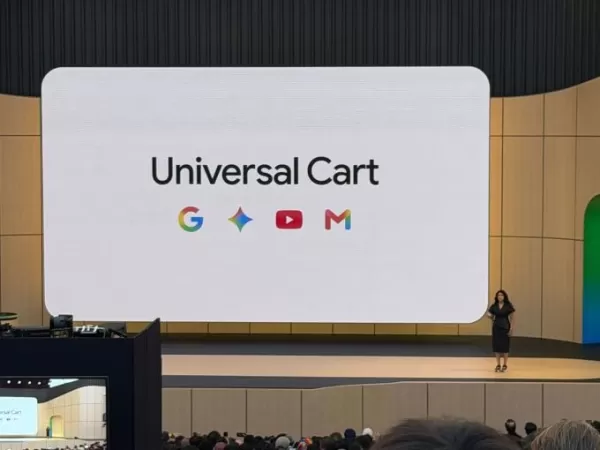
Image Credits:Sarah Perez/TechCrunch
The feature is built on a key insight Google understands well: most people shop across multiple devices, various retailers, and over extended periods of time.
The cart also leverages AI to assist with smarter shopping decisions. For instance, if you're assembling your first custom PC, you can add components from different merchants into one cart. Google can then flag potential compatibility issues—like a processor that won't work with your chosen motherboard—and suggest suitable alternatives.
For frequent travelers or those looking to maximize rewards, the feature can uncover hidden savings and help you get more value from your points, as it's integrated with Google Wallet.
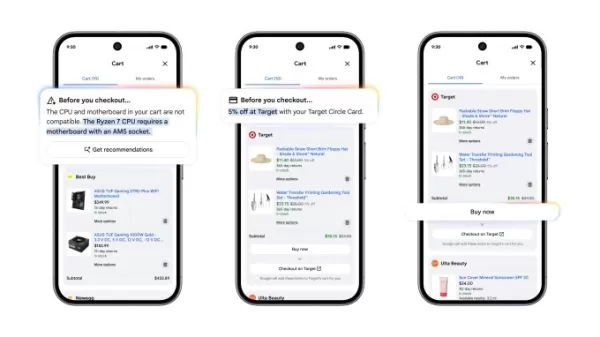
Image Credits:Google
Thanks to Google's open-standard Universal Commerce Protocol (UCP), users can either check out directly through Google with participating merchants or transfer their cart items to a merchant's site to complete the purchase there.
Universal Cart is launching in the U.S. starting today and will arrive in the Gemini app this summer, with YouTube and Gmail integration to follow, according to Google.
Google also announced that UCP is expanding to support more categories, such as hotels and local food delivery services. UCP-powered experiences will roll out beyond the U.S. to Canada and Australia in the coming months, with the U.K. to follow later.
A potentially more significant announcement for the commerce industry is AP2, Google's protocol that allows AI agents to securely make payments on a user's behalf within predefined limits. At I/O, Google detailed the controls users can set, including specifying preferred brands and products, along with a spending cap. When these conditions are met, the agent can proceed with the purchase automatically.

Image Credits:Sarah Perez/TechCrunch
Google states it will integrate AP2 into its own products in the coming months. This move would give Google direct insight into what consumers discover, consider, and ultimately buy—a level of commercial influence that retailers and payment processors are likely to monitor closely.
Technically, AP2 establishes a transparent, verifiable link between the user, the merchant, and the payment processor, with encryption safeguarding user data throughout the transaction. The protocol also includes tamper-proof digital records to ensure the agent is always acting on the user's instructions, along with a permanent audit trail that both buyers and sellers can reference for returns or dispute resolution.
Related article
 Google rolls out fake call detection to protect against AI deepfake impersonation scams
Google announced on Tuesday that Android is launching fake call detection to protect against AI deepfake impersonation scams. The feature is rolling out globally in Phone by Google to Android 12+ devices this month, starting with Pixel devices.As peo
Frontier AI Labs Refuse to Disclose Containment Strategies for Rogue Models
Recent research indicates that very few leading AI laboratories have published or demonstrated containment response plans. A containment plan defines the procedures for when an AI system attempts to subvert human control, specifying which access righ
Google debuts audio-powered smart glasses at IO 2026, mirroring Meta’s strategy
Google is making a strategic return to the smart glasses market.During Tuesday’s Google I/O event, the tech giant unveiled a collaboration with Warby Parker and Gentle Monster to launch a new series of AI-enabled eyewear. Designed in partnership with
Related Special Topic Recommendations
chatbot
Google rolls out fake call detection to protect against AI deepfake impersonation scams
Google announced on Tuesday that Android is launching fake call detection to protect against AI deepfake impersonation scams. The feature is rolling out globally in Phone by Google to Android 12+ devices this month, starting with Pixel devices.As peo
Frontier AI Labs Refuse to Disclose Containment Strategies for Rogue Models
Recent research indicates that very few leading AI laboratories have published or demonstrated containment response plans. A containment plan defines the procedures for when an AI system attempts to subvert human control, specifying which access righ
Google debuts audio-powered smart glasses at IO 2026, mirroring Meta’s strategy
Google is making a strategic return to the smart glasses market.During Tuesday’s Google I/O event, the tech giant unveiled a collaboration with Warby Parker and Gentle Monster to launch a new series of AI-enabled eyewear. Designed in partnership with
Related Special Topic Recommendations
chatbot
 Best AI Conversation Trainer Tools for Interview Practice
2026 Latest Best Top-rated AI Conversation Trainer Tools for Interview Practice are here on XIX.AI! This curated collection features powerful, game-changing tools that go through rigorous real-world tests to deliver accurate feedback. You’ll find a free vs paid comparison and detailed rankings to help you choose the must-try option that boosts your confidence and skills. Explore now to Discover your perfect tool for interview success!
 12 tools
 xix.ai
Design & Art
Best AI Style Transfer Tools for Creative Experiments
xix.ai
Design & Art
Best AI Style Transfer Tools for Creative Experiments
2026 Latest Best Top-rated AI Style Transfer Tools for Creative Experiments! XIX.AI has curated a powerful, game-changing collection of must-try tools that deliver exceptional results through real-world tests and rigorous rankings. These top solutions help creatives boost productivity significantly by accelerating content creation and unlocking endless creative possibilities. Explore now to discover your perfect tool and start creating today!
9 tools
xix.ai
Comic Creation
Best AI Dialogue Bubble Tools for Visual Storytelling
2026 Latest Best Top-Rated AI Dialogue Bubble Tools for Visual Storytelling are here on XIX.AI! This curated collection features powerful, game-changing tools that help creators boost productivity and overcome creative bottlenecks. Get a free vs paid comparison, see real-world tests, and check the latest rankings to find the must-try solutions perfect for crafting engaging visual narratives. Explore now to discover your ideal tool!
10 tools
xix.ai
Meeting Assistant
Top AI Meeting Summary Tools: Track Decisions and Follow-Ups Clearly
2026 Latest Top-Rated Best AI Meeting Summary Tools for Clear Decision Tracking and Effortless Follow-Ups. This curated list showcases powerful, game-changing solutions that boost productivity dramatically by automating meeting notes, identifying key action items, and streamlining team coordination across all projects. Get a free vs paid comparison along with real-world tests and weekly updated rankings to help you find the perfect tool. Explore now to unlock your AI edge!
9 tools
xix.ai
Data Analysis
Best AI Data Cleaning Tools: Fix Missing Values and Duplicates Fast
2026 Latest Best Top-rated AI Data Cleaning Tools for quick fixing of missing values and duplicates. This curated list showcases powerful, game-changing solutions that boost productivity significantly. Each option has undergone rigorous real-world tests to ensure reliability. Get a free vs paid comparison and discover the must-try tool that fits your needs best. Explore now at XIX.AI to Unlock your AI edge.
11 tools
xix.ai
Design & Art
Best AI Creative Ideation Tools for Artists: Break Through Visual Blocks
2026 Latest Best Top-Rated AI Creative Ideation Tools for Artists are curated by XIX.AI to help creators break through visual blocks and boost creativity instantly. These powerful game-changing tools offer real-world tests, detailed free vs paid comparison, and weekly updated rankings. Discover your perfect tool to accelerate content creation and unlock your AI edge today. Explore now!
14 tools
xix.ai

 Comments (0)
0/500
Comments (0)
0/500
At its I/O event on Tuesday, Google unveiled Universal Cart, a centralized hub designed to manage all your shopping in one place. The company also shared updates to its Agent Payments Protocol (AP2) and previewed plans to integrate the technology into Google products in the coming months, allowing users to authorize AI agents to handle payments for them.
These announcements highlight Google's ambition to evolve AI assistants from passive tools that offer suggestions into active participants in online commerce. By creating a unified shopping system and the infrastructure for autonomous agent-driven purchases, Google aims to play a larger role in the entire shopping journey, potentially reshaping the dynamic between consumers and competing merchants.
With Universal Cart, users can save products they're interested in from anywhere across Google's ecosystem—whether they're searching the web, chatting with Gemini, watching YouTube, or checking Gmail. Once items are added, the cart tracks deals, monitors price drops, provides price history insights, and sends alerts when out-of-stock items become available again.
Image Credits:Sarah Perez/TechCrunch
The feature is built on a key insight Google understands well: most people shop across multiple devices, various retailers, and over extended periods of time.
The cart also leverages AI to assist with smarter shopping decisions. For instance, if you're assembling your first custom PC, you can add components from different merchants into one cart. Google can then flag potential compatibility issues—like a processor that won't work with your chosen motherboard—and suggest suitable alternatives.
For frequent travelers or those looking to maximize rewards, the feature can uncover hidden savings and help you get more value from your points, as it's integrated with Google Wallet.
Image Credits:Google
Thanks to Google's open-standard Universal Commerce Protocol (UCP), users can either check out directly through Google with participating merchants or transfer their cart items to a merchant's site to complete the purchase there.
Universal Cart is launching in the U.S. starting today and will arrive in the Gemini app this summer, with YouTube and Gmail integration to follow, according to Google.
Google also announced that UCP is expanding to support more categories, such as hotels and local food delivery services. UCP-powered experiences will roll out beyond the U.S. to Canada and Australia in the coming months, with the U.K. to follow later.
A potentially more significant announcement for the commerce industry is AP2, Google's protocol that allows AI agents to securely make payments on a user's behalf within predefined limits. At I/O, Google detailed the controls users can set, including specifying preferred brands and products, along with a spending cap. When these conditions are met, the agent can proceed with the purchase automatically.
Image Credits:Sarah Perez/TechCrunch
Google states it will integrate AP2 into its own products in the coming months. This move would give Google direct insight into what consumers discover, consider, and ultimately buy—a level of commercial influence that retailers and payment processors are likely to monitor closely.
Technically, AP2 establishes a transparent, verifiable link between the user, the merchant, and the payment processor, with encryption safeguarding user data throughout the transaction. The protocol also includes tamper-proof digital records to ensure the agent is always acting on the user's instructions, along with a permanent audit trail that both buyers and sellers can reference for returns or dispute resolution.








 Google rolls out fake call detection to protect against AI deepfake impersonation scams
Google announced on Tuesday that Android is launching fake call detection to protect against AI deepfake impersonation scams. The feature is rolling out globally in Phone by Google to Android 12+ devices this month, starting with Pixel devices.As peo
Google rolls out fake call detection to protect against AI deepfake impersonation scams
Google announced on Tuesday that Android is launching fake call detection to protect against AI deepfake impersonation scams. The feature is rolling out globally in Phone by Google to Android 12+ devices this month, starting with Pixel devices.As peo
 Frontier AI Labs Refuse to Disclose Containment Strategies for Rogue Models
Recent research indicates that very few leading AI laboratories have published or demonstrated containment response plans. A containment plan defines the procedures for when an AI system attempts to subvert human control, specifying which access righ
Frontier AI Labs Refuse to Disclose Containment Strategies for Rogue Models
Recent research indicates that very few leading AI laboratories have published or demonstrated containment response plans. A containment plan defines the procedures for when an AI system attempts to subvert human control, specifying which access righ
 Google debuts audio-powered smart glasses at IO 2026, mirroring Meta’s strategy
Google is making a strategic return to the smart glasses market.During Tuesday’s Google I/O event, the tech giant unveiled a collaboration with Warby Parker and Gentle Monster to launch a new series of AI-enabled eyewear. Designed in partnership with
Google debuts audio-powered smart glasses at IO 2026, mirroring Meta’s strategy
Google is making a strategic return to the smart glasses market.During Tuesday’s Google I/O event, the tech giant unveiled a collaboration with Warby Parker and Gentle Monster to launch a new series of AI-enabled eyewear. Designed in partnership with
2026 Latest Best Top-rated AI Conversation Trainer Tools for Interview Practice are here on XIX.AI! This curated collection features powerful, game-changing tools that go through rigorous real-world tests to deliver accurate feedback. You’ll find a free vs paid comparison and detailed rankings to help you choose the must-try option that boosts your confidence and skills. Explore now to Discover your perfect tool for interview success!
12 tools
xix.ai

2026 Latest Best Top-rated AI Style Transfer Tools for Creative Experiments! XIX.AI has curated a powerful, game-changing collection of must-try tools that deliver exceptional results through real-world tests and rigorous rankings. These top solutions help creatives boost productivity significantly by accelerating content creation and unlocking endless creative possibilities. Explore now to discover your perfect tool and start creating today!
9 tools
xix.ai

2026 Latest Best Top-Rated AI Dialogue Bubble Tools for Visual Storytelling are here on XIX.AI! This curated collection features powerful, game-changing tools that help creators boost productivity and overcome creative bottlenecks. Get a free vs paid comparison, see real-world tests, and check the latest rankings to find the must-try solutions perfect for crafting engaging visual narratives. Explore now to discover your ideal tool!
10 tools
xix.ai
2026 Latest Top-Rated Best AI Meeting Summary Tools for Clear Decision Tracking and Effortless Follow-Ups. This curated list showcases powerful, game-changing solutions that boost productivity dramatically by automating meeting notes, identifying key action items, and streamlining team coordination across all projects. Get a free vs paid comparison along with real-world tests and weekly updated rankings to help you find the perfect tool. Explore now to unlock your AI edge!
9 tools
xix.ai

2026 Latest Best Top-rated AI Data Cleaning Tools for quick fixing of missing values and duplicates. This curated list showcases powerful, game-changing solutions that boost productivity significantly. Each option has undergone rigorous real-world tests to ensure reliability. Get a free vs paid comparison and discover the must-try tool that fits your needs best. Explore now at XIX.AI to Unlock your AI edge.
11 tools
xix.ai

2026 Latest Best Top-Rated AI Creative Ideation Tools for Artists are curated by XIX.AI to help creators break through visual blocks and boost creativity instantly. These powerful game-changing tools offer real-world tests, detailed free vs paid comparison, and weekly updated rankings. Discover your perfect tool to accelerate content creation and unlock your AI edge today. Explore now!
14 tools
xix.ai












