


 Home
Home
Google TurboQuant Compresses LLM Cache 6x, Boosts Speed 8x, Training-Free with Zero Precision Loss
On March 26, Google Research announced the launch of TurboQuant, a new vector quantization compression algorithm that combines PolarQuant and QJL technologies. This innovation reduces the memory requirements of key-value cache (KV Cache) in large language model (LLM) inference by at least six times. On Nvidia H100 GPUs, it improves attention computation speed by up to eight times while maintaining zero precision loss across multiple long-context benchmarks. This breakthrough is expected to lower AI deployment costs and accelerate the adoption of long-context applications.
KV Cache Pain Points: High-Dimensional Vector Memory Overhead
When processing long sequences, LLMs must maintain a cache of key and value vectors. These high-dimensional vectors enable fast attention mechanism calculations without redundant computations. However, as context length increases, KV Cache memory consumption grows exponentially, becoming a major bottleneck limiting model inference efficiency and deployment scale.
While traditional vector quantization methods can compress data, they require additional storage for quantization constants such as scaling factors and zero points. These constants are typically stored in full precision, adding an extra 1–2 bits per value and partially offsetting compression benefits.
TurboQuant Core Innovation: Dual-Phase Compression with PolarQuant + QJL
TurboQuant adopts a two-phase training-free compression framework that effectively addresses the overhead of traditional quantization:
PolarQuant (Polar Coordinate Compression):
First, vectors are randomly rotated, then Cartesian coordinates (X/Y/Z, etc.) are converted into polar form (angle + radius). Because angles fall within a fixed, predictable range, this method eliminates the storage overhead required for boundary normalization in traditional quantization, enabling more efficient compression.
QJL (1-bit Error Correction, Quantized Johnson-Lindenstrauss):
After PolarQuant compression, residual errors remain. QJL uses the Johnson-Lindenstrauss transform for dimensionality reduction, then quantizes using a minimal 1-bit scheme (+1/-1 sign). By employing a special unbiased estimator, it achieves error correction during attention score calculation without additional memory overhead, ensuring the overall process remains unbiased.
Combined, TurboQuant compresses KV Cache to approximately 3 bits per value while maintaining unbiasedness and high accuracy in inner product estimation.
Benchmark Test Performance: Comprehensive Leadership, Ideal for Long Contexts
The Google team conducted extensive validation on open-source models such as Gemma and Mistral:
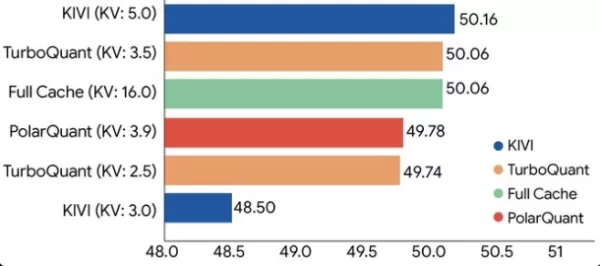
LongBench (covering tasks like long-text QA, code generation, and summarization): TurboQuant matches or surpasses existing baselines such as KIVI, demonstrating comprehensive leadership.Needle In A Haystack and other retrieval tasks: Achieves perfect downstream scores while compressing KV memory by at least six times.Nvidia H100 Test Results: With a 4-bit configuration, attention logits calculation speed improves by up to eight times.Additionally, on vector datasets like GloVe, TurboQuant's recall rate outperforms traditional methods such as PQ and RabbiQ.
AIbase Comment: TurboQuant requires no model retraining or fine-tuning and can be directly applied to existing LLMs. It is suitable for any scenario relying on vector quantization, including database retrieval, recommendation systems, and vector search engines. This not only enables a single consumer-grade GPU to support longer contexts (e.g., tens of thousands of tokens) but also significantly lowers the hardware threshold for enterprise-level AI services.
Industry Significance: A New Benchmark for AI Inference Efficiency
With the explosion of long-context and multimodal applications, KV Cache memory has become a core constraint in AI infrastructure. TurboQuant's "near-optimal, data-independent" quantization framework opens a new path for efficient inference. Google Research stated that this technology has been detailed in papers presented at ICLR 2026 and other conferences, with related code and implementation details expected to be gradually open-sourced.
In the future, TurboQuant is expected to be integrated into mainstream inference frameworks such as vLLM and TensorRT, further promoting the democratization and scalability of AI deployment.
Related article
 DeepMind CEO Hassabis: I sleep six hours a day, usually feel energetic around 1 a.m.
Fortune recently featured an interview with Demis Hassabis, CEO of Google DeepMind, revealing his unconventional approach to rest and productivity. Hassabis disclosed that he sleeps very little, structuring his waking hours into two distinct work blo
OpenAI, Anthropic Vie for Market Share Despite Revenue Shortfalls
Despite recent reports suggesting OpenAI missed revenue targets, creating pressure on tech stocks this Tuesday, private AI lab investors remain resilient. Seasoned backers have confirmed they will not reduce investment despite negative media coverage
California AV Compliance: A New Era of Tickets, Geofences, and 1M Miles
Guident operates an AuveTech shuttle in South Florida, managing a four-mile route in West Palm Beach and a one-mile route in Boca Raton using its remote monitoring technology. | Credit: GuidentCalifornia is redefining the regulatory landscape for dri
Related Special Topic Recommendations
chatbot
DeepMind CEO Hassabis: I sleep six hours a day, usually feel energetic around 1 a.m.
Fortune recently featured an interview with Demis Hassabis, CEO of Google DeepMind, revealing his unconventional approach to rest and productivity. Hassabis disclosed that he sleeps very little, structuring his waking hours into two distinct work blo
OpenAI, Anthropic Vie for Market Share Despite Revenue Shortfalls
Despite recent reports suggesting OpenAI missed revenue targets, creating pressure on tech stocks this Tuesday, private AI lab investors remain resilient. Seasoned backers have confirmed they will not reduce investment despite negative media coverage
California AV Compliance: A New Era of Tickets, Geofences, and 1M Miles
Guident operates an AuveTech shuttle in South Florida, managing a four-mile route in West Palm Beach and a one-mile route in Boca Raton using its remote monitoring technology. | Credit: GuidentCalifornia is redefining the regulatory landscape for dri
Related Special Topic Recommendations
chatbot
 Best AI Roleplay Chat Apps for Language Practice, Interview Prep, and Daily Fluency
2026 Latest Best Top-rated AI Roleplay Chat Apps for Language Practice, Interview Prep, and Daily Fluency! XIX.AI curates a powerful game-changing collection that offers free vs paid comparison, real-world tests, and updated rankings weekly. These must-try tools help you boost writing skills, overcome fluency challenges, and improve communication efficiency across all daily scenarios. Explore now to discover your perfect tool for language growth!
 10 tools
 xix.ai
Music composition
AI Stem Separation Tools for Remix Production, Sampling Prep, and Karaoke Masters
xix.ai
Music composition
AI Stem Separation Tools for Remix Production, Sampling Prep, and Karaoke Masters
2026 Latest Best Top-rated AI Stem Separation Tools Curated for Remix Production, Sampling Prep, and Karaoke Masters. These powerful game-changing tools offer real-world tests to deliver precise audio isolation, boosting productivity significantly. XIX.AI provides a weekly updated free vs paid comparison guide to help you find the must-try solution that suits your needs. Explore now to unlock your AI edge.
8 tools
xix.ai
Data Analysis
AI SQL Copilots for Revenue Dashboards, Funnel Analysis, and Product Metrics
2026 Latest Best AI SQL Copilots Ranked Top-Rated! XIX.AI curates a powerful game-changing collection for weekly updated real-world tests. These must-try tools help you generate accurate revenue dashboards, analyze sales funnels, and track product metrics swiftly, boosting productivity massively. Explore now to Discover your perfect tool for data-driven decision making! 238 characters
9 tools
xix.ai
Music composition
Best AI Melody Writing Tools for Song Drafts
2026 Latest Best Top-Rated AI Melody Writing Tools for Song Drafts! XIX.AI has curated a highly powerful game-changing collection that goes through rigorous real-world tests to deliver the best writing experience. You can find detailed free vs paid comparisons, accurate rankings, and must-try options designed to help you create stunning song drafts effortlessly and boost your creative productivity significantly. Explore now to discover your perfect tool!
8 tools
xix.ai
chatbot
Best AI Conversation Trainer Tools for Interview Practice
2026 Latest Best Top-rated AI Conversation Trainer Tools for Interview Practice are here on XIX.AI! This curated collection features powerful, game-changing tools that go through rigorous real-world tests to deliver accurate feedback. You’ll find a free vs paid comparison and detailed rankings to help you choose the must-try option that boosts your confidence and skills. Explore now to Discover your perfect tool for interview success!
12 tools
xix.ai
Design & Art
Best AI Style Transfer Tools for Creative Experiments
2026 Latest Best Top-rated AI Style Transfer Tools for Creative Experiments! XIX.AI has curated a powerful, game-changing collection of must-try tools that deliver exceptional results through real-world tests and rigorous rankings. These top solutions help creatives boost productivity significantly by accelerating content creation and unlocking endless creative possibilities. Explore now to discover your perfect tool and start creating today!
9 tools
xix.ai

 Comments (0)
0/500
Comments (0)
0/500
On March 26, Google Research announced the launch of TurboQuant, a new vector quantization compression algorithm that combines PolarQuant and QJL technologies. This innovation reduces the memory requirements of key-value cache (KV Cache) in large language model (LLM) inference by at least six times. On Nvidia H100 GPUs, it improves attention computation speed by up to eight times while maintaining zero precision loss across multiple long-context benchmarks. This breakthrough is expected to lower AI deployment costs and accelerate the adoption of long-context applications.
KV Cache Pain Points: High-Dimensional Vector Memory Overhead
When processing long sequences, LLMs must maintain a cache of key and value vectors. These high-dimensional vectors enable fast attention mechanism calculations without redundant computations. However, as context length increases, KV Cache memory consumption grows exponentially, becoming a major bottleneck limiting model inference efficiency and deployment scale.
While traditional vector quantization methods can compress data, they require additional storage for quantization constants such as scaling factors and zero points. These constants are typically stored in full precision, adding an extra 1–2 bits per value and partially offsetting compression benefits.
TurboQuant Core Innovation: Dual-Phase Compression with PolarQuant + QJL
TurboQuant adopts a two-phase training-free compression framework that effectively addresses the overhead of traditional quantization:
PolarQuant (Polar Coordinate Compression):
First, vectors are randomly rotated, then Cartesian coordinates (X/Y/Z, etc.) are converted into polar form (angle + radius). Because angles fall within a fixed, predictable range, this method eliminates the storage overhead required for boundary normalization in traditional quantization, enabling more efficient compression.
QJL (1-bit Error Correction, Quantized Johnson-Lindenstrauss):
After PolarQuant compression, residual errors remain. QJL uses the Johnson-Lindenstrauss transform for dimensionality reduction, then quantizes using a minimal 1-bit scheme (+1/-1 sign). By employing a special unbiased estimator, it achieves error correction during attention score calculation without additional memory overhead, ensuring the overall process remains unbiased.
Combined, TurboQuant compresses KV Cache to approximately 3 bits per value while maintaining unbiasedness and high accuracy in inner product estimation.
Benchmark Test Performance: Comprehensive Leadership, Ideal for Long Contexts
The Google team conducted extensive validation on open-source models such as Gemma and Mistral:
LongBench (covering tasks like long-text QA, code generation, and summarization): TurboQuant matches or surpasses existing baselines such as KIVI, demonstrating comprehensive leadership.Needle In A Haystack and other retrieval tasks: Achieves perfect downstream scores while compressing KV memory by at least six times.Nvidia H100 Test Results: With a 4-bit configuration, attention logits calculation speed improves by up to eight times.Additionally, on vector datasets like GloVe, TurboQuant's recall rate outperforms traditional methods such as PQ and RabbiQ.
AIbase Comment: TurboQuant requires no model retraining or fine-tuning and can be directly applied to existing LLMs. It is suitable for any scenario relying on vector quantization, including database retrieval, recommendation systems, and vector search engines. This not only enables a single consumer-grade GPU to support longer contexts (e.g., tens of thousands of tokens) but also significantly lowers the hardware threshold for enterprise-level AI services.
Industry Significance: A New Benchmark for AI Inference Efficiency
With the explosion of long-context and multimodal applications, KV Cache memory has become a core constraint in AI infrastructure. TurboQuant's "near-optimal, data-independent" quantization framework opens a new path for efficient inference. Google Research stated that this technology has been detailed in papers presented at ICLR 2026 and other conferences, with related code and implementation details expected to be gradually open-sourced.
In the future, TurboQuant is expected to be integrated into mainstream inference frameworks such as vLLM and TensorRT, further promoting the democratization and scalability of AI deployment.








 DeepMind CEO Hassabis: I sleep six hours a day, usually feel energetic around 1 a.m.
Fortune recently featured an interview with Demis Hassabis, CEO of Google DeepMind, revealing his unconventional approach to rest and productivity. Hassabis disclosed that he sleeps very little, structuring his waking hours into two distinct work blo
DeepMind CEO Hassabis: I sleep six hours a day, usually feel energetic around 1 a.m.
Fortune recently featured an interview with Demis Hassabis, CEO of Google DeepMind, revealing his unconventional approach to rest and productivity. Hassabis disclosed that he sleeps very little, structuring his waking hours into two distinct work blo
 OpenAI, Anthropic Vie for Market Share Despite Revenue Shortfalls
Despite recent reports suggesting OpenAI missed revenue targets, creating pressure on tech stocks this Tuesday, private AI lab investors remain resilient. Seasoned backers have confirmed they will not reduce investment despite negative media coverage
California AV Compliance: A New Era of Tickets, Geofences, and 1M Miles
Guident operates an AuveTech shuttle in South Florida, managing a four-mile route in West Palm Beach and a one-mile route in Boca Raton using its remote monitoring technology. | Credit: GuidentCalifornia is redefining the regulatory landscape for dri
OpenAI, Anthropic Vie for Market Share Despite Revenue Shortfalls
Despite recent reports suggesting OpenAI missed revenue targets, creating pressure on tech stocks this Tuesday, private AI lab investors remain resilient. Seasoned backers have confirmed they will not reduce investment despite negative media coverage
California AV Compliance: A New Era of Tickets, Geofences, and 1M Miles
Guident operates an AuveTech shuttle in South Florida, managing a four-mile route in West Palm Beach and a one-mile route in Boca Raton using its remote monitoring technology. | Credit: GuidentCalifornia is redefining the regulatory landscape for dri

2026 Latest Best Top-rated AI Roleplay Chat Apps for Language Practice, Interview Prep, and Daily Fluency! XIX.AI curates a powerful game-changing collection that offers free vs paid comparison, real-world tests, and updated rankings weekly. These must-try tools help you boost writing skills, overcome fluency challenges, and improve communication efficiency across all daily scenarios. Explore now to discover your perfect tool for language growth!
10 tools
xix.ai
2026 Latest Best Top-rated AI Stem Separation Tools Curated for Remix Production, Sampling Prep, and Karaoke Masters. These powerful game-changing tools offer real-world tests to deliver precise audio isolation, boosting productivity significantly. XIX.AI provides a weekly updated free vs paid comparison guide to help you find the must-try solution that suits your needs. Explore now to unlock your AI edge.
8 tools
xix.ai

2026 Latest Best AI SQL Copilots Ranked Top-Rated! XIX.AI curates a powerful game-changing collection for weekly updated real-world tests. These must-try tools help you generate accurate revenue dashboards, analyze sales funnels, and track product metrics swiftly, boosting productivity massively. Explore now to Discover your perfect tool for data-driven decision making! 238 characters
9 tools
xix.ai

2026 Latest Best Top-Rated AI Melody Writing Tools for Song Drafts! XIX.AI has curated a highly powerful game-changing collection that goes through rigorous real-world tests to deliver the best writing experience. You can find detailed free vs paid comparisons, accurate rankings, and must-try options designed to help you create stunning song drafts effortlessly and boost your creative productivity significantly. Explore now to discover your perfect tool!
8 tools
xix.ai

2026 Latest Best Top-rated AI Conversation Trainer Tools for Interview Practice are here on XIX.AI! This curated collection features powerful, game-changing tools that go through rigorous real-world tests to deliver accurate feedback. You’ll find a free vs paid comparison and detailed rankings to help you choose the must-try option that boosts your confidence and skills. Explore now to Discover your perfect tool for interview success!
12 tools
xix.ai

2026 Latest Best Top-rated AI Style Transfer Tools for Creative Experiments! XIX.AI has curated a powerful, game-changing collection of must-try tools that deliver exceptional results through real-world tests and rigorous rankings. These top solutions help creatives boost productivity significantly by accelerating content creation and unlocking endless creative possibilities. Explore now to discover your perfect tool and start creating today!
9 tools
xix.ai












