


 Home
Flock CEO claims mics detect only gunshots despite website claims
Flock CEO Garrett Langley stated that the company’s gunshot-detection microphones capture “only gunshots,” yet Flock’s website presents a much wider scope of the ambient audio it records.
Speaking at TechCrunch Disrupt, the surveillance firm’s co-founder defended its audio-collection tool, Gunshot Detection, which monitors for gunshots and surrounding sounds across neighborhoods to offer “earlier awareness” of potential public safety incidents.
Flock’s website claims its audio systems can locate gunfire instantly, while also “detecting street takeovers early to prevent chaos from escalating” and “identifying severe crashes in real time to speed up help.” It further states they can “expand awareness beyond gunfire with alerts for car crashes, fireworks, and sideshows.”
The Gunshot Detection feature, launched last year, faced immediate backlash. When announcing the feature, Flock said it would listen for “screaming” sounds. Privacy groups condemned the firm for monitoring human voices, prompting Flock to update its website to read “sounds of human distress.” Flock later removed the ability to detect “distress” for customers who had tested it.
During the interview, Langley pushed back against what he called misinformation about his product, arguing that many critics misunderstand how it works. These comments arise as public opinion shifts against Flock and other license plate readers amid growing concerns over mass surveillance—sentiments evident in San Francisco, where protesters gathered outside the venue to voice their opposition as Langley took the stage.
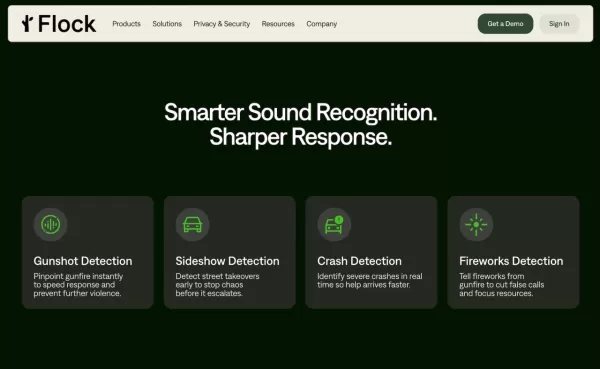
Image Credits:TechCrunch (screenshot)
“Most people don’t call 911 when they hear a gunshot, which is why we built the product,” Langley told TechCrunch editor-in-chief Connie Loizos onstage. “Then some of our customers said, ‘Oh, we have these in parking lots. It would be great if we could get alerted if someone was being abducted or harmed.’”
Langley said the idea seemed logical, so the company prototyped and deployed it to a few customers, but noted that many people raised concerns. Langley admitted making mistakes but said he was listening to customer feedback.
“There are only a couple of customers prototyping it with us, and we said, ‘OK, great, it’s just going to do gunshots, plain and simple.’ If a gun goes off, we’ll notify, and if not, that’s all it’s going to listen to,” Langley said.
When asked about the contradiction between his remarks and marketing materials claiming the audio systems detect more than gunshots, he replied, “It’s just gunshots.”
In a statement to TechCrunch, Flock spokesperson Paris Lewbel said: “Flock’s gunshot detection technology is primarily used to detect gunfire but is also capable of detecting fireworks, sideshows, and potential car crashes. CEO Garrett Langley’s remarks were intended to emphasize that Flock’s Audio Detection technology is not designed to monitor conversations or analyze speech and does not currently detect human screaming or distress.”
An FAQ section on the website notes that “in addition to gunshots, Flock Gunshot and Audio Detection can detect fireworks, sideshows, and other disruptive community events.” It further states that the company’s “detection library is continually expanding to include emerging threats that are relevant” to customers’ specific needs.
Langley stated that Flock’s number of microphones is comparable to ShotSpotter, which had about 25,000 microphones as of 2024, according to Wired.
Langley’s comments come amid increasing scrutiny of Flock from privacy advocates, including the ACLU, and the public, who are concerned about the technology’s misuse, with some even destroying the surveillance cameras. The remarks also coincide with Texas and Florida ending their partnerships with Flock, and Amazon’s Ring terminating its relationship with the company.
Related article
 TechCrunch Disrupt 2026 kicks off tomorrow: Final chance to save up to $100 on tickets
Tomorrow at 8 a.m. PT, the countdown ends. Over 10,000 founders, investors, and tech leaders will converge at San Francisco’s Moscone West for TechCrunch Disrupt 2026, a three-day immersion in the ideas, connections, and startups defining our future.
Nvidia's Les Karpas: Robots Waiting for a ChatGPT Moment at TechCrunch Disrupt 2026
ChatGPT’s November 2022 launch abruptly shifted AI from theoretical hype to everyday utility, fundamentally changing how we interact with large language models.Robotics has long been a subject of discussion and development, yet it lacks that singular
Save up to $200 in 4 Days: The Second Reason to Attend TechCrunch Disrupt 2026
Time is ticking: you have just four days to secure up to $200 in savings on your TechCrunch Disrupt 2026 pass before prices rise on September 25 at 11:59 p.m. PT. Claim your ticket savings and enjoy 50% off a second pass here.This is the second compe
Related Special Topic Recommendations
Design & Art
 Top AI Illustration Tools: Create Editorial Scenes and Cover Art Faster
2026 Latest Top-rated AI Illustration Tools: Our curated list features the best powerfully designed tools for creating stunning editorial scenes and eye-catching cover art quickly. Each option has gone through rigorous real-world tests, offering a free vs paid comparison to help you find the perfect match for your workflow. Try these must-try solutions today to unlock your AI edge and boost your creative productivity. Explore now at XIX.AI.
 10 tools
 xix.ai
Education and Learning
Top AI Tutors for Exam Prep: Practice Math, Science, and English
2026 Latest Top-Rated Best AI Tutors for Exam Prep are here on XIX.AI! Our curated list features powerful game-changing tools that offer free vs paid comparison, real-world tests, and weekly updated rankings. They help boost your writing efficiency, simplify complex topic learning, and unlock your academic potential. Explore now to Discover your perfect exam prep tool and Start creating today to Unlock your AI edge!
10 tools
xix.ai
Finance
AI Budget Planning Tools for Personal Money Management
2026 Latest Best Top-Rated AI Budget Planning Tools for Personal Money Management are here on XIX.AI! This curated collection features powerful, game-changing solutions that help you conduct real-world tests, understand spending habits, and create personalized plans to boost productivity. Enjoy a free vs paid comparison along with detailed rankings. Must-try tools designed to simplify money management and unlock your AI edge. Explore now!
11 tools
xix.ai
Health & Wellness
AI Sleep Tracking Assistants: Improve Recovery with Better Bedtime Habits
2026 Latest Best Top-Rated AI Sleep Tracking Assistants curated for ultimate recovery. This fully updated weekly guide features powerful tools that deliver real-world tests, free vs paid comparison, and detailed rankings to help you find the must-try solution that boosts sleep quality and supports better bedtime habits. Explore now at XIX.AI to Unlock your AI edge.
10 tools
xix.ai
Data Analysis
AI SQL Copilots for Product and Revenue Analytics
2026 Latest Best Top-Rated AI SQL Copilots for Product and Revenue Analytics! XIX.AI has curated a powerful, game-changing collection of must-try tools that undergo real-world tests through weekly updated rankings. These tools help users boost productivity significantly by accelerating data analysis, streamlining complex queries, and generating accurate insights to drive smarter business decisions. Explore now to Discover your perfect tool for unlocking your AI edge!
14 tools
xix.ai
Education and Learning
Best AI Homework Helpers That Teach: Learn Concepts, Not Just Answers
2026 Latest Best Top-Rated AI Homework Helpers That Teach Core Concepts Not Just Answers Powerful Tools for Students Must-Try Curated List Weekly Updated Free vs Paid Comparison Real-World Tests Accurate Rankings to Help You Unlock Your Full Learning Potential Explore now to Discover your perfect tool for smarter studying.
10 tools
xix.ai

 Comments (0)
0/500
Flock CEO Garrett Langley stated that the company’s gunshot-detection microphones capture “only gunshots,” yet Flock’s website presents a much wider scope of the ambient audio it records.
Speaking at TechCrunch Disrupt, the surveillance firm’s co-founder defended its audio-collection tool, Gunshot Detection, which monitors for gunshots and surrounding sounds across neighborhoods to offer “earlier awareness” of potential public safety incidents.
Flock’s website claims its audio systems can locate gunfire instantly, while also “detecting street takeovers early to prevent chaos from escalating” and “identifying severe crashes in real time to speed up help.” It further states they can “expand awareness beyond gunfire with alerts for car crashes, fireworks, and sideshows.”
The Gunshot Detection feature, launched last year, faced immediate backlash. When announcing the feature, Flock said it would listen for “screaming” sounds. Privacy groups condemned the firm for monitoring human voices, prompting Flock to update its website to read “sounds of human distress.” Flock later removed the ability to detect “distress” for customers who had tested it.
During the interview, Langley pushed back against what he called misinformation about his product, arguing that many critics misunderstand how it works. These comments arise as public opinion shifts against Flock and other license plate readers amid growing concerns over mass surveillance—sentiments evident in San Francisco, where protesters gathered outside the venue to voice their opposition as Langley took the stage.
Image Credits:TechCrunch (screenshot)
“Most people don’t call 911 when they hear a gunshot, which is why we built the product,” Langley told TechCrunch editor-in-chief Connie Loizos onstage. “Then some of our customers said, ‘Oh, we have these in parking lots. It would be great if we could get alerted if someone was being abducted or harmed.’”
Langley said the idea seemed logical, so the company prototyped and deployed it to a few customers, but noted that many people raised concerns. Langley admitted making mistakes but said he was listening to customer feedback.
“There are only a couple of customers prototyping it with us, and we said, ‘OK, great, it’s just going to do gunshots, plain and simple.’ If a gun goes off, we’ll notify, and if not, that’s all it’s going to listen to,” Langley said.
When asked about the contradiction between his remarks and marketing materials claiming the audio systems detect more than gunshots, he replied, “It’s just gunshots.”
In a statement to TechCrunch, Flock spokesperson Paris Lewbel said: “Flock’s gunshot detection technology is primarily used to detect gunfire but is also capable of detecting fireworks, sideshows, and potential car crashes. CEO Garrett Langley’s remarks were intended to emphasize that Flock’s Audio Detection technology is not designed to monitor conversations or analyze speech and does not currently detect human screaming or distress.”
An FAQ section on the website notes that “in addition to gunshots, Flock Gunshot and Audio Detection can detect fireworks, sideshows, and other disruptive community events.” It further states that the company’s “detection library is continually expanding to include emerging threats that are relevant” to customers’ specific needs.
Langley stated that Flock’s number of microphones is comparable to ShotSpotter, which had about 25,000 microphones as of 2024, according to Wired.
Langley’s comments come amid increasing scrutiny of Flock from privacy advocates, including the ACLU, and the public, who are concerned about the technology’s misuse, with some even destroying the surveillance cameras. The remarks also coincide with Texas and Florida ending their partnerships with Flock, and Amazon’s Ring terminating its relationship with the company.








 TechCrunch Disrupt 2026 kicks off tomorrow: Final chance to save up to $100 on tickets
Tomorrow at 8 a.m. PT, the countdown ends. Over 10,000 founders, investors, and tech leaders will converge at San Francisco’s Moscone West for TechCrunch Disrupt 2026, a three-day immersion in the ideas, connections, and startups defining our future.
 Nvidia's Les Karpas: Robots Waiting for a ChatGPT Moment at TechCrunch Disrupt 2026
ChatGPT’s November 2022 launch abruptly shifted AI from theoretical hype to everyday utility, fundamentally changing how we interact with large language models.Robotics has long been a subject of discussion and development, yet it lacks that singular
 Save up to $200 in 4 Days: The Second Reason to Attend TechCrunch Disrupt 2026
Time is ticking: you have just four days to secure up to $200 in savings on your TechCrunch Disrupt 2026 pass before prices rise on September 25 at 11:59 p.m. PT. Claim your ticket savings and enjoy 50% off a second pass here.This is the second compe

2026 Latest Top-rated AI Illustration Tools: Our curated list features the best powerfully designed tools for creating stunning editorial scenes and eye-catching cover art quickly. Each option has gone through rigorous real-world tests, offering a free vs paid comparison to help you find the perfect match for your workflow. Try these must-try solutions today to unlock your AI edge and boost your creative productivity. Explore now at XIX.AI.
10 tools
xix.ai

2026 Latest Top-Rated Best AI Tutors for Exam Prep are here on XIX.AI! Our curated list features powerful game-changing tools that offer free vs paid comparison, real-world tests, and weekly updated rankings. They help boost your writing efficiency, simplify complex topic learning, and unlock your academic potential. Explore now to Discover your perfect exam prep tool and Start creating today to Unlock your AI edge!
10 tools
xix.ai

2026 Latest Best Top-Rated AI Budget Planning Tools for Personal Money Management are here on XIX.AI! This curated collection features powerful, game-changing solutions that help you conduct real-world tests, understand spending habits, and create personalized plans to boost productivity. Enjoy a free vs paid comparison along with detailed rankings. Must-try tools designed to simplify money management and unlock your AI edge. Explore now!
11 tools
xix.ai

2026 Latest Best Top-Rated AI Sleep Tracking Assistants curated for ultimate recovery. This fully updated weekly guide features powerful tools that deliver real-world tests, free vs paid comparison, and detailed rankings to help you find the must-try solution that boosts sleep quality and supports better bedtime habits. Explore now at XIX.AI to Unlock your AI edge.
10 tools
xix.ai

2026 Latest Best Top-Rated AI SQL Copilots for Product and Revenue Analytics! XIX.AI has curated a powerful, game-changing collection of must-try tools that undergo real-world tests through weekly updated rankings. These tools help users boost productivity significantly by accelerating data analysis, streamlining complex queries, and generating accurate insights to drive smarter business decisions. Explore now to Discover your perfect tool for unlocking your AI edge!
14 tools
xix.ai

2026 Latest Best Top-Rated AI Homework Helpers That Teach Core Concepts Not Just Answers Powerful Tools for Students Must-Try Curated List Weekly Updated Free vs Paid Comparison Real-World Tests Accurate Rankings to Help You Unlock Your Full Learning Potential Explore now to Discover your perfect tool for smarter studying.
10 tools
xix.ai












