


 Home
HomeEpson Unveils AX6 Cobot Featuring Compact Design and No-Code Programming
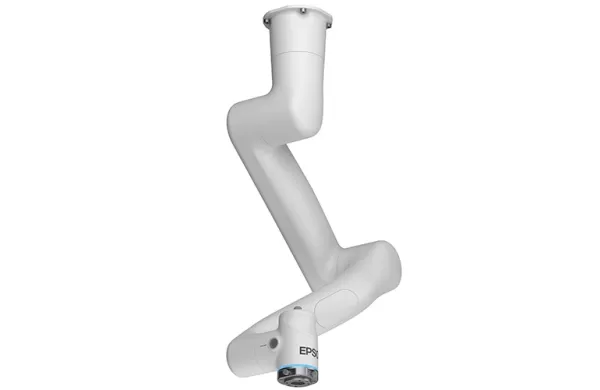
The AX6 force- and power-limited robot arm is designed to be lightweight and easy to use. Source: Epson
Epson Robots this week expanded its six-axis robot line with the AX6 collaborative robot. It said the new cobot is is designed with power- and force-limiting features that, with a proper risk assessment, can allow operation alongside people without traditional safety barriers.
“Collaborative robots have lowered the barriers to entry for many new robot users by simplifying programming and integration, while enabling new applications where space and user interaction are critical,” stated Rick Brookshire, director for product and robot development at Epson. “With the introduction of the AX6, Epson can now address these applications while offering customers a complete range of robotic safety solutions.”
Suwa, Japan-based Epson Robots said it is the global leader in SCARA robots. With four decades of experience, it provides systems based on a common PC platform for precision assembly and material handling to industries including aerospace, automotive, biotechnology, electronics, food processing, medical device, pharmaceuticals, and plastics.
The Epson Group unit, which has U.S. offices in Los Alamitos, Calif., said it has sold more than 250,000 units worldwide as of April 2026.
Key features of the AX6 prioritize user-friendly operation
Epson Robotics claimed that the AX6 gives it “a full portfolio of robot safety tools, including industrial robots that maximize speed and performance, collaborative robots that maximize worker interaction and redeployability, and industrial collaborative tools that balance the two use cases.”
The new robot arm has a 900 mm (35.4 in.) reach, a 6 kg (13.2 lb.) maximum payload, and an RC-A1010 controller.
The AX6 features no-code software and a user interface designed for operators of all skill levels, asserted the company. Combined with AX Portal software, the cobot provides a range of development tools to address diverse automation needs, it said.
The software runs on an Ethernet-enabled controller and can be accessed through a web browser, so most industrial tablets can be used as a teach pendant, James Shimano, product manager at Epson Robots, told The Robot Report.
Epson listed additional AX6 features:
Customizable Python development environment — enables users to easily upload custom libraries and modules to develop more complicated robotic workcellsIndustrial kinematics — users can generate straight-line, curved or joint motions from either a no-code or Python-based environmentEnd-of-arm multifunctional user buttons — these include three customizable and two dedicated buttons; operators can teach positions by manually moving the robot in free space and using the Teach buttonsEnd-of-arm Ethernet port and pneumatic connections — simplifies end-of-arm tooling for grippers, dispensers, and moreCompatible with multiple power sources — supports 100 V to 240 V AC and 48 V DCEnd-of-arm multicolor status LED ring — quickly assess the robot’s status through fixed color status lights at the end of the arm3D simulator — test programs in simulation before running them within the workcell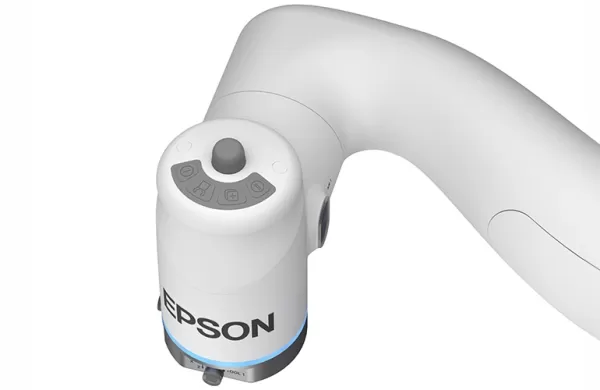
The new AX6 robot includes end-of-arm multifunction buttons, a status display, and ports. Source: Epson
Engineered for tight spaces and mobile manipulation tasks
The AX6 complies with ISO Class 5 (ISO 14644-1) cleanroom standards for controlled environments, said Epson Robots.
“There are life science applications that are interested,” noted Shimano. “These applications are mostly monitoring applications where a sensor needs to be moved around in free space to sample an area. The ISO 5 cleanroom classification has been important in these applications.”
The new robot arm’s compact, lightweight carbon-fiber structure make it suitable for space-constrained applications. Could this also lead to integration with autonomous mobile robots (AMRs) for mobile manipulation?
“Yes, the lightweight and power design was specifically built with AMR integration in mind,” Shimano replied. He added that Epson is working with sensor and end-effector providers, and it expects the new cobot to be used in a range of applications beyond palletizing or machine tending.
“In many applications, industrial robots handle bottleneck processes such as assembly and packaging, while cobots are often used at the end of the line where user interaction is needed,” said Shimano.
The AX6 is now available through Epson Robots’ channel of distributor partners as part of its AX series of six-axis robots.
Related article
 Siemens and Humanoid Test HMND 01 Alpha Humanoid Robot in Logistics
A mobile manipulator from Humanoid retrieves a tote from a conveyor belt. Source: SiemensSiemens AG and Humanoid announced the successful testing of the HMND 01 Alpha wheeled humanoid robot at Siemens' electronics factory in Erlangen, Germany. Levera
OpenAI overtakes Anthropic in enterprise market share as AI spending grows
Recent figures from Ramp, a corporate credit card and expense management platform, reveal that OpenAI has reclaimed over 40% of the U.S. enterprise AI market, overtaking Anthropic. In May, Anthropic held a 41% share against OpenAI’s 39%; by July, Ant
Altman warns AI could be dominated by a few powerful players, sidelining the public
Sam Altman, OpenAI’s CEO, expressed concerns during an August 23 podcast that AI governance could become concentrated among a few corporations, models, or individuals, effectively silencing the majority of consumers regarding how technology impacts t
Related Special Topic Recommendations
Business
Siemens and Humanoid Test HMND 01 Alpha Humanoid Robot in Logistics
A mobile manipulator from Humanoid retrieves a tote from a conveyor belt. Source: SiemensSiemens AG and Humanoid announced the successful testing of the HMND 01 Alpha wheeled humanoid robot at Siemens' electronics factory in Erlangen, Germany. Levera
OpenAI overtakes Anthropic in enterprise market share as AI spending grows
Recent figures from Ramp, a corporate credit card and expense management platform, reveal that OpenAI has reclaimed over 40% of the U.S. enterprise AI market, overtaking Anthropic. In May, Anthropic held a 41% share against OpenAI’s 39%; by July, Ant
Altman warns AI could be dominated by a few powerful players, sidelining the public
Sam Altman, OpenAI’s CEO, expressed concerns during an August 23 podcast that AI governance could become concentrated among a few corporations, models, or individuals, effectively silencing the majority of consumers regarding how technology impacts t
Related Special Topic Recommendations
Business
 AI Customer Insight Tools for Product Positioning
2026 Latest Best Top-rated AI Customer Insight Tools for Product Positioning! XIX.AI has curated a powerful, game-changing collection that goes through real-world tests and weekly updated rankings. It helps you uncover customer needs quickly to boost writing efficiency, create optimal SEO content, and craft perfect social media messages without wasting time. Explore now to Discover your perfect tool and Unlock your AI edge.
 10 tools
 xix.ai
Meeting Assistant
Zoom AI Note Takers for Client Calls, Internal Syncs, and Decision Tracking
xix.ai
Meeting Assistant
Zoom AI Note Takers for Client Calls, Internal Syncs, and Decision Tracking
2026 Latest Best Zoom AI note takers ranked by performance and usability. XIX.AI has curated a top-rated list of powerful tools that help you take accurate notes during client calls, streamline internal team syncs, and keep track of key decisions effortlessly. Get a free vs paid comparison along with real-world tests to find the must-try solution that boosts your productivity significantly. Explore now!
12 tools
xix.ai
Data Analysis
AI Spreadsheet Analysis Tools: Ask Questions and Get Charts Instantly
2026 Latest Best Top-rated AI Spreadsheet Analysis Tools are here on XIX.AI! This curated list features powerful, game-changing solutions that allow you to ask questions directly in spreadsheets and get accurate charts instantly, boosting your productivity significantly. We conduct real-world tests and provide a free vs paid comparison along with weekly updated rankings to help you find the perfect tool for streamlining data tasks. Explore now to Unlock your AI edge!
19 tools
xix.ai
design
AI Wireframe Tools for Product Designers
2026 Latest Best Top-Rated AI Wireframe Tools for Product Designers! XIX.AI has curated a powerful, game-changing collection of must-try tools that go through rigorous real-world tests. You’ll find detailed weekly updated rankings, free vs paid comparison insights, and all the key info you need to choose the perfect tool to boost your design efficiency and unlock your AI edge. Explore now!
8 tools
xix.ai
SEO
Best AI SEO Tools for Keyword Research
2026 Latest Best Top-Rated AI SEO Tools for Keyword Research are here on XIX.AI! This curated list features powerful, game-changing tools that go through rigorous real-world tests to deliver accurate data. Get a free vs paid comparison, see detailed rankings, and discover must-try options to boost your content strategy and improve search visibility. Explore now to find your perfect tool!
8 tools
xix.ai
Education and Learning
Best AI Quiz Builders for Course Creators and Tutors
2026 Latest Best Top-rated AI Quiz Builders for Course Creators and Tutors! XIX.AI has curated a powerful, game-changing collection of must-try tools that go through real-world tests for unmatched accuracy. You’ll find detailed free vs paid comparison insights, updated weekly rankings, and practical tips to boost content creation efficiency and deliver engaging learning experiences. Explore now to Discover your perfect tool and Unlock your AI edge!
9 tools
xix.ai

 Comments (0)
0/500
Comments (0)
0/500
The AX6 force- and power-limited robot arm is designed to be lightweight and easy to use. Source: Epson
Epson Robots this week expanded its six-axis robot line with the AX6 collaborative robot. It said the new cobot is is designed with power- and force-limiting features that, with a proper risk assessment, can allow operation alongside people without traditional safety barriers.
“Collaborative robots have lowered the barriers to entry for many new robot users by simplifying programming and integration, while enabling new applications where space and user interaction are critical,” stated Rick Brookshire, director for product and robot development at Epson. “With the introduction of the AX6, Epson can now address these applications while offering customers a complete range of robotic safety solutions.”
Suwa, Japan-based Epson Robots said it is the global leader in SCARA robots. With four decades of experience, it provides systems based on a common PC platform for precision assembly and material handling to industries including aerospace, automotive, biotechnology, electronics, food processing, medical device, pharmaceuticals, and plastics.
The Epson Group unit, which has U.S. offices in Los Alamitos, Calif., said it has sold more than 250,000 units worldwide as of April 2026.
Key features of the AX6 prioritize user-friendly operation
Epson Robotics claimed that the AX6 gives it “a full portfolio of robot safety tools, including industrial robots that maximize speed and performance, collaborative robots that maximize worker interaction and redeployability, and industrial collaborative tools that balance the two use cases.”
The new robot arm has a 900 mm (35.4 in.) reach, a 6 kg (13.2 lb.) maximum payload, and an RC-A1010 controller.
The AX6 features no-code software and a user interface designed for operators of all skill levels, asserted the company. Combined with AX Portal software, the cobot provides a range of development tools to address diverse automation needs, it said.
The software runs on an Ethernet-enabled controller and can be accessed through a web browser, so most industrial tablets can be used as a teach pendant, James Shimano, product manager at Epson Robots, told The Robot Report.
Epson listed additional AX6 features:
Customizable Python development environment — enables users to easily upload custom libraries and modules to develop more complicated robotic workcellsIndustrial kinematics — users can generate straight-line, curved or joint motions from either a no-code or Python-based environmentEnd-of-arm multifunctional user buttons — these include three customizable and two dedicated buttons; operators can teach positions by manually moving the robot in free space and using the Teach buttonsEnd-of-arm Ethernet port and pneumatic connections — simplifies end-of-arm tooling for grippers, dispensers, and moreCompatible with multiple power sources — supports 100 V to 240 V AC and 48 V DCEnd-of-arm multicolor status LED ring — quickly assess the robot’s status through fixed color status lights at the end of the arm3D simulator — test programs in simulation before running them within the workcellThe new AX6 robot includes end-of-arm multifunction buttons, a status display, and ports. Source: Epson
Engineered for tight spaces and mobile manipulation tasks
The AX6 complies with ISO Class 5 (ISO 14644-1) cleanroom standards for controlled environments, said Epson Robots.
“There are life science applications that are interested,” noted Shimano. “These applications are mostly monitoring applications where a sensor needs to be moved around in free space to sample an area. The ISO 5 cleanroom classification has been important in these applications.”
The new robot arm’s compact, lightweight carbon-fiber structure make it suitable for space-constrained applications. Could this also lead to integration with autonomous mobile robots (AMRs) for mobile manipulation?
“Yes, the lightweight and power design was specifically built with AMR integration in mind,” Shimano replied. He added that Epson is working with sensor and end-effector providers, and it expects the new cobot to be used in a range of applications beyond palletizing or machine tending.
“In many applications, industrial robots handle bottleneck processes such as assembly and packaging, while cobots are often used at the end of the line where user interaction is needed,” said Shimano.
The AX6 is now available through Epson Robots’ channel of distributor partners as part of its AX series of six-axis robots.








 Siemens and Humanoid Test HMND 01 Alpha Humanoid Robot in Logistics
A mobile manipulator from Humanoid retrieves a tote from a conveyor belt. Source: SiemensSiemens AG and Humanoid announced the successful testing of the HMND 01 Alpha wheeled humanoid robot at Siemens' electronics factory in Erlangen, Germany. Levera
Siemens and Humanoid Test HMND 01 Alpha Humanoid Robot in Logistics
A mobile manipulator from Humanoid retrieves a tote from a conveyor belt. Source: SiemensSiemens AG and Humanoid announced the successful testing of the HMND 01 Alpha wheeled humanoid robot at Siemens' electronics factory in Erlangen, Germany. Levera
 OpenAI overtakes Anthropic in enterprise market share as AI spending grows
Recent figures from Ramp, a corporate credit card and expense management platform, reveal that OpenAI has reclaimed over 40% of the U.S. enterprise AI market, overtaking Anthropic. In May, Anthropic held a 41% share against OpenAI’s 39%; by July, Ant
OpenAI overtakes Anthropic in enterprise market share as AI spending grows
Recent figures from Ramp, a corporate credit card and expense management platform, reveal that OpenAI has reclaimed over 40% of the U.S. enterprise AI market, overtaking Anthropic. In May, Anthropic held a 41% share against OpenAI’s 39%; by July, Ant
 Altman warns AI could be dominated by a few powerful players, sidelining the public
Sam Altman, OpenAI’s CEO, expressed concerns during an August 23 podcast that AI governance could become concentrated among a few corporations, models, or individuals, effectively silencing the majority of consumers regarding how technology impacts t
Altman warns AI could be dominated by a few powerful players, sidelining the public
Sam Altman, OpenAI’s CEO, expressed concerns during an August 23 podcast that AI governance could become concentrated among a few corporations, models, or individuals, effectively silencing the majority of consumers regarding how technology impacts t

2026 Latest Best Top-rated AI Customer Insight Tools for Product Positioning! XIX.AI has curated a powerful, game-changing collection that goes through real-world tests and weekly updated rankings. It helps you uncover customer needs quickly to boost writing efficiency, create optimal SEO content, and craft perfect social media messages without wasting time. Explore now to Discover your perfect tool and Unlock your AI edge.
10 tools
xix.ai

2026 Latest Best Zoom AI note takers ranked by performance and usability. XIX.AI has curated a top-rated list of powerful tools that help you take accurate notes during client calls, streamline internal team syncs, and keep track of key decisions effortlessly. Get a free vs paid comparison along with real-world tests to find the must-try solution that boosts your productivity significantly. Explore now!
12 tools
xix.ai

2026 Latest Best Top-rated AI Spreadsheet Analysis Tools are here on XIX.AI! This curated list features powerful, game-changing solutions that allow you to ask questions directly in spreadsheets and get accurate charts instantly, boosting your productivity significantly. We conduct real-world tests and provide a free vs paid comparison along with weekly updated rankings to help you find the perfect tool for streamlining data tasks. Explore now to Unlock your AI edge!
19 tools
xix.ai

2026 Latest Best Top-Rated AI Wireframe Tools for Product Designers! XIX.AI has curated a powerful, game-changing collection of must-try tools that go through rigorous real-world tests. You’ll find detailed weekly updated rankings, free vs paid comparison insights, and all the key info you need to choose the perfect tool to boost your design efficiency and unlock your AI edge. Explore now!
8 tools
xix.ai

2026 Latest Best Top-Rated AI SEO Tools for Keyword Research are here on XIX.AI! This curated list features powerful, game-changing tools that go through rigorous real-world tests to deliver accurate data. Get a free vs paid comparison, see detailed rankings, and discover must-try options to boost your content strategy and improve search visibility. Explore now to find your perfect tool!
8 tools
xix.ai

2026 Latest Best Top-rated AI Quiz Builders for Course Creators and Tutors! XIX.AI has curated a powerful, game-changing collection of must-try tools that go through real-world tests for unmatched accuracy. You’ll find detailed free vs paid comparison insights, updated weekly rankings, and practical tips to boost content creation efficiency and deliver engaging learning experiences. Explore now to Discover your perfect tool and Unlock your AI edge!
9 tools
xix.ai












