


 Home
HomeYouTube unveils AI tools to help creators meet viewer demand.
Influencers and content creators juggle far more roles than their audiences see. Beyond the spotlight, most handle a mix of duties like content moderation, video editing, photography, social media strategy, scriptwriting, and brainstorming. What if AI could shoulder much of that workload? And what if the social media platforms themselves offered the tools to make it happen?
At Tuesday's Made on YouTube event in New York, the company unveiled a suite of new AI features designed for creators, many targeting the unseen labor behind every video. Unlike earlier tools—such as AI background music generators or AI photo and video creators—these new offerings focus heavily on content strategy. They're marketed as ways to help creators connect with new viewers and more effectively engage their existing audience.
One key addition is Ask Studio, an AI chatbot creators can query for analytics on their content's performance. Amjad Hanif, VP of product management, calls it a "creative partner." It answers questions like: How is the audience reacting to a video? What are its most engaging moments? The tool aggregates data from across a channel, including long-form videos and Shorts, acting as a faster, more integrated analytics platform. Creators can ask it to summarize comments, gauge viewer sentiment, and offer data-driven suggestions. For instance, if viewership dips at a specific point, Ask Studio can propose optimizations for future videos. It can also generate video ideas from comment feedback and suggest titles. Currently, it doesn't support direct channel comparisons (e.g., "What videos are working well for my competitors?").
Related
- YouTube makes it easier and more lucrative to go live
- YouTube is inching closer to becoming a shopping channel
YouTube is also rolling out an enhanced thumbnail and title A/B testing feature, building on a thumbnail testing tool announced last year. With this update, creators can test different pairings of thumbnails and titles to see which combination drives the most watch time, with the top performer automatically identified.
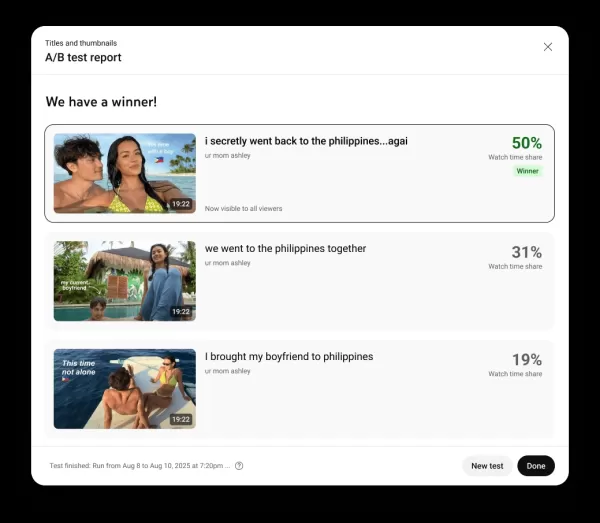 Image: YouTube
"No matter how good the video is, the thumbnail and title are what convince people to click and see if it's worth watching. Honestly, they might be the most important part," says lifestyle influencer Ashley Alexander, who received early access to test the tools. Alexander uses the thumbnail testing feature for every upload and has started incorporating the new thumbnail-and-title A/B tests into her process.
This wave of algorithm-optimization tools marks a significant shift. For years, creators experimented independently to crack each platform's code—crafting the perfect title or deciding on thumbnail expressions through trial and error. Now, platforms are increasingly direct in guiding content. TikTok, for example, highlights trending topics and user searches, encouraging videos that match. This approach lets YouTube and others steer creator output more overtly. "Optimizing" content serves both creators and the platform: both benefit when viewers spend more time watching.
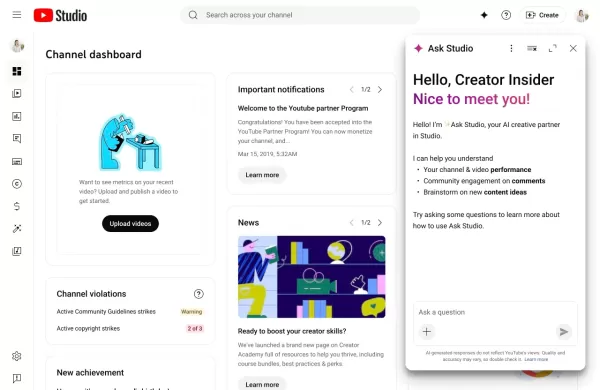 Image: YouTube
YouTube is also expanding viewer-facing AI tools like dubbing. An existing auto-dubbing feature now includes lip-sync to match the dubbed language. Videos using YouTube's AI dubbing will display a badge under the title and in the description. However, creators cannot edit or correct translations after upload.
Separately, a new collaboration feature will allow multiple creators to be added to a single video—essentially a cross-posting function. Each collaborator can view the video's performance metrics.
The integration of AI into content creation is accelerating across industries. Adult content creators use chatbots to interact with clients, and platforms urge advertisers to employ AI-generated models. YouTube's recent monetization policy update, which targets "inauthentic content," was widely seen as a move against mass-produced AI videos, raising concerns among creators about enforcement and demonetization criteria.
We've seen countless online communities grapple with a flood of AI content—but does it matter if the AI works behind the scenes? Do viewers care if their favorite YouTuber uses AI to brainstorm topics, as the platform suggests? And if everyone optimizes using the same built-in tools, does anyone truly gain an edge? What happens when every thumbnail and title is algorithmically perfected, or when everyone relies on the same AI for video ideas and scripts?
Creators like Alexander see these features as a starting point, not a shortcut. The AI-generated ideas provide a foundation, but she believes her own understanding of her audience is irreplaceable. For many creators, their audience connects with them as individuals making unique creative choices, not just outputting chatbot suggestions—a human relationship that AI cannot replicate.
Related article
 Warner Music acquires AI attribution startup Sureel AI
Warner Music Group (WMG) confirmed on Wednesday that it is acquiring Sureel AI, an artificial intelligence attribution startup. Sureel’s proprietary technology generates “AI DNA” for musical tracks, deconstructing them into constituent elements to tr
Amazon introduces Alexa for Shopping while pushing Rufus to the background
Amazon has launched Alexa for Shopping, merging its Rufus shopping chatbot with Alexa+ across the app, website, and Echo Show devices.The assistant answers product queries, compares items, tracks prices, and supports shopping reminders. It also handl
Microsoft, Azure and AI Tech Combat California Wildfire Risks
Microsoft invests in AI-driven wildfire detection, with Juan Lavista Ferres, CVP and Chief Data Scientist, discussing strategies to mitigate environmental damage.According to NASA, climate change impacts everyone on Earth, manifesting as rising tempe
Related Special Topic Recommendations
chatbot
Warner Music acquires AI attribution startup Sureel AI
Warner Music Group (WMG) confirmed on Wednesday that it is acquiring Sureel AI, an artificial intelligence attribution startup. Sureel’s proprietary technology generates “AI DNA” for musical tracks, deconstructing them into constituent elements to tr
Amazon introduces Alexa for Shopping while pushing Rufus to the background
Amazon has launched Alexa for Shopping, merging its Rufus shopping chatbot with Alexa+ across the app, website, and Echo Show devices.The assistant answers product queries, compares items, tracks prices, and supports shopping reminders. It also handl
Microsoft, Azure and AI Tech Combat California Wildfire Risks
Microsoft invests in AI-driven wildfire detection, with Juan Lavista Ferres, CVP and Chief Data Scientist, discussing strategies to mitigate environmental damage.According to NASA, climate change impacts everyone on Earth, manifesting as rising tempe
Related Special Topic Recommendations
chatbot
 Best AI Conversation Trainer Tools for Interview Practice
2026 Latest Best Top-rated AI Conversation Trainer Tools for Interview Practice are here on XIX.AI! This curated collection features powerful, game-changing tools that go through rigorous real-world tests to deliver accurate feedback. You’ll find a free vs paid comparison and detailed rankings to help you choose the must-try option that boosts your confidence and skills. Explore now to Discover your perfect tool for interview success!
 12 tools
 xix.ai
Design & Art
Best AI Style Transfer Tools for Creative Experiments
xix.ai
Design & Art
Best AI Style Transfer Tools for Creative Experiments
2026 Latest Best Top-rated AI Style Transfer Tools for Creative Experiments! XIX.AI has curated a powerful, game-changing collection of must-try tools that deliver exceptional results through real-world tests and rigorous rankings. These top solutions help creatives boost productivity significantly by accelerating content creation and unlocking endless creative possibilities. Explore now to discover your perfect tool and start creating today!
9 tools
xix.ai
Comic Creation
Best AI Dialogue Bubble Tools for Visual Storytelling
2026 Latest Best Top-Rated AI Dialogue Bubble Tools for Visual Storytelling are here on XIX.AI! This curated collection features powerful, game-changing tools that help creators boost productivity and overcome creative bottlenecks. Get a free vs paid comparison, see real-world tests, and check the latest rankings to find the must-try solutions perfect for crafting engaging visual narratives. Explore now to discover your ideal tool!
10 tools
xix.ai
Meeting Assistant
Top AI Meeting Summary Tools: Track Decisions and Follow-Ups Clearly
2026 Latest Top-Rated Best AI Meeting Summary Tools for Clear Decision Tracking and Effortless Follow-Ups. This curated list showcases powerful, game-changing solutions that boost productivity dramatically by automating meeting notes, identifying key action items, and streamlining team coordination across all projects. Get a free vs paid comparison along with real-world tests and weekly updated rankings to help you find the perfect tool. Explore now to unlock your AI edge!
9 tools
xix.ai
Data Analysis
Best AI Data Cleaning Tools: Fix Missing Values and Duplicates Fast
2026 Latest Best Top-rated AI Data Cleaning Tools for quick fixing of missing values and duplicates. This curated list showcases powerful, game-changing solutions that boost productivity significantly. Each option has undergone rigorous real-world tests to ensure reliability. Get a free vs paid comparison and discover the must-try tool that fits your needs best. Explore now at XIX.AI to Unlock your AI edge.
11 tools
xix.ai
Design & Art
Best AI Creative Ideation Tools for Artists: Break Through Visual Blocks
2026 Latest Best Top-Rated AI Creative Ideation Tools for Artists are curated by XIX.AI to help creators break through visual blocks and boost creativity instantly. These powerful game-changing tools offer real-world tests, detailed free vs paid comparison, and weekly updated rankings. Discover your perfect tool to accelerate content creation and unlock your AI edge today. Explore now!
14 tools
xix.ai

 Comments (0)
0/500
Comments (0)
0/500
Influencers and content creators juggle far more roles than their audiences see. Beyond the spotlight, most handle a mix of duties like content moderation, video editing, photography, social media strategy, scriptwriting, and brainstorming. What if AI could shoulder much of that workload? And what if the social media platforms themselves offered the tools to make it happen?
At Tuesday's Made on YouTube event in New York, the company unveiled a suite of new AI features designed for creators, many targeting the unseen labor behind every video. Unlike earlier tools—such as AI background music generators or AI photo and video creators—these new offerings focus heavily on content strategy. They're marketed as ways to help creators connect with new viewers and more effectively engage their existing audience.
One key addition is Ask Studio, an AI chatbot creators can query for analytics on their content's performance. Amjad Hanif, VP of product management, calls it a "creative partner." It answers questions like: How is the audience reacting to a video? What are its most engaging moments? The tool aggregates data from across a channel, including long-form videos and Shorts, acting as a faster, more integrated analytics platform. Creators can ask it to summarize comments, gauge viewer sentiment, and offer data-driven suggestions. For instance, if viewership dips at a specific point, Ask Studio can propose optimizations for future videos. It can also generate video ideas from comment feedback and suggest titles. Currently, it doesn't support direct channel comparisons (e.g., "What videos are working well for my competitors?").
Related
- YouTube makes it easier and more lucrative to go live
- YouTube is inching closer to becoming a shopping channel
YouTube is also rolling out an enhanced thumbnail and title A/B testing feature, building on a thumbnail testing tool announced last year. With this update, creators can test different pairings of thumbnails and titles to see which combination drives the most watch time, with the top performer automatically identified.
Image: YouTube"No matter how good the video is, the thumbnail and title are what convince people to click and see if it's worth watching. Honestly, they might be the most important part," says lifestyle influencer Ashley Alexander, who received early access to test the tools. Alexander uses the thumbnail testing feature for every upload and has started incorporating the new thumbnail-and-title A/B tests into her process.
This wave of algorithm-optimization tools marks a significant shift. For years, creators experimented independently to crack each platform's code—crafting the perfect title or deciding on thumbnail expressions through trial and error. Now, platforms are increasingly direct in guiding content. TikTok, for example, highlights trending topics and user searches, encouraging videos that match. This approach lets YouTube and others steer creator output more overtly. "Optimizing" content serves both creators and the platform: both benefit when viewers spend more time watching.
Image: YouTubeYouTube is also expanding viewer-facing AI tools like dubbing. An existing auto-dubbing feature now includes lip-sync to match the dubbed language. Videos using YouTube's AI dubbing will display a badge under the title and in the description. However, creators cannot edit or correct translations after upload.
Separately, a new collaboration feature will allow multiple creators to be added to a single video—essentially a cross-posting function. Each collaborator can view the video's performance metrics.
The integration of AI into content creation is accelerating across industries. Adult content creators use chatbots to interact with clients, and platforms urge advertisers to employ AI-generated models. YouTube's recent monetization policy update, which targets "inauthentic content," was widely seen as a move against mass-produced AI videos, raising concerns among creators about enforcement and demonetization criteria.
We've seen countless online communities grapple with a flood of AI content—but does it matter if the AI works behind the scenes? Do viewers care if their favorite YouTuber uses AI to brainstorm topics, as the platform suggests? And if everyone optimizes using the same built-in tools, does anyone truly gain an edge? What happens when every thumbnail and title is algorithmically perfected, or when everyone relies on the same AI for video ideas and scripts?
Creators like Alexander see these features as a starting point, not a shortcut. The AI-generated ideas provide a foundation, but she believes her own understanding of her audience is irreplaceable. For many creators, their audience connects with them as individuals making unique creative choices, not just outputting chatbot suggestions—a human relationship that AI cannot replicate.








 Warner Music acquires AI attribution startup Sureel AI
Warner Music Group (WMG) confirmed on Wednesday that it is acquiring Sureel AI, an artificial intelligence attribution startup. Sureel’s proprietary technology generates “AI DNA” for musical tracks, deconstructing them into constituent elements to tr
Amazon introduces Alexa for Shopping while pushing Rufus to the background
Amazon has launched Alexa for Shopping, merging its Rufus shopping chatbot with Alexa+ across the app, website, and Echo Show devices.The assistant answers product queries, compares items, tracks prices, and supports shopping reminders. It also handl
Warner Music acquires AI attribution startup Sureel AI
Warner Music Group (WMG) confirmed on Wednesday that it is acquiring Sureel AI, an artificial intelligence attribution startup. Sureel’s proprietary technology generates “AI DNA” for musical tracks, deconstructing them into constituent elements to tr
Amazon introduces Alexa for Shopping while pushing Rufus to the background
Amazon has launched Alexa for Shopping, merging its Rufus shopping chatbot with Alexa+ across the app, website, and Echo Show devices.The assistant answers product queries, compares items, tracks prices, and supports shopping reminders. It also handl
 Microsoft, Azure and AI Tech Combat California Wildfire Risks
Microsoft invests in AI-driven wildfire detection, with Juan Lavista Ferres, CVP and Chief Data Scientist, discussing strategies to mitigate environmental damage.According to NASA, climate change impacts everyone on Earth, manifesting as rising tempe
Microsoft, Azure and AI Tech Combat California Wildfire Risks
Microsoft invests in AI-driven wildfire detection, with Juan Lavista Ferres, CVP and Chief Data Scientist, discussing strategies to mitigate environmental damage.According to NASA, climate change impacts everyone on Earth, manifesting as rising tempe

2026 Latest Best Top-rated AI Conversation Trainer Tools for Interview Practice are here on XIX.AI! This curated collection features powerful, game-changing tools that go through rigorous real-world tests to deliver accurate feedback. You’ll find a free vs paid comparison and detailed rankings to help you choose the must-try option that boosts your confidence and skills. Explore now to Discover your perfect tool for interview success!
12 tools
xix.ai

2026 Latest Best Top-rated AI Style Transfer Tools for Creative Experiments! XIX.AI has curated a powerful, game-changing collection of must-try tools that deliver exceptional results through real-world tests and rigorous rankings. These top solutions help creatives boost productivity significantly by accelerating content creation and unlocking endless creative possibilities. Explore now to discover your perfect tool and start creating today!
9 tools
xix.ai
2026 Latest Best Top-Rated AI Dialogue Bubble Tools for Visual Storytelling are here on XIX.AI! This curated collection features powerful, game-changing tools that help creators boost productivity and overcome creative bottlenecks. Get a free vs paid comparison, see real-world tests, and check the latest rankings to find the must-try solutions perfect for crafting engaging visual narratives. Explore now to discover your ideal tool!
10 tools
xix.ai
2026 Latest Top-Rated Best AI Meeting Summary Tools for Clear Decision Tracking and Effortless Follow-Ups. This curated list showcases powerful, game-changing solutions that boost productivity dramatically by automating meeting notes, identifying key action items, and streamlining team coordination across all projects. Get a free vs paid comparison along with real-world tests and weekly updated rankings to help you find the perfect tool. Explore now to unlock your AI edge!
9 tools
xix.ai

2026 Latest Best Top-rated AI Data Cleaning Tools for quick fixing of missing values and duplicates. This curated list showcases powerful, game-changing solutions that boost productivity significantly. Each option has undergone rigorous real-world tests to ensure reliability. Get a free vs paid comparison and discover the must-try tool that fits your needs best. Explore now at XIX.AI to Unlock your AI edge.
11 tools
xix.ai

2026 Latest Best Top-Rated AI Creative Ideation Tools for Artists are curated by XIX.AI to help creators break through visual blocks and boost creativity instantly. These powerful game-changing tools offer real-world tests, detailed free vs paid comparison, and weekly updated rankings. Discover your perfect tool to accelerate content creation and unlock your AI edge today. Explore now!
14 tools
xix.ai












