Oxford University research reveals that women are significantly less likely to use generative AI than men. The reason isn't a lack of skill, but greater concern about AI's potential negative impacts on employment, privacy, mental well-being, and society as a whole.
As the primary subjects of unauthorized deepfake content, women have been at the forefront of activism against this controversial application of generative AI for the past seven years, achieving several notable recent victories.
However, a new Oxford University study suggests this portrayal of women's AI concerns is too limited. It finds women's use of all forms of generative AI lags behind men's, not due to access or skill gaps, but because they are more likely to perceive AI as harmful to mental health, jobs, privacy, and the environment.
The paper states:
‘Using nationally representative UK survey data from [2023–2024], we demonstrate that women adopt GenAI substantially less often than men due to differing perceptions of its societal risks.
‘Our composite index measuring concerns about mental health, privacy, climate impact, and labor-market disruption explains 9-18% of adoption variation and ranks among the strongest predictors for women across all age groups–surpassing digital literacy and education for young women.’
The most significant gaps, researchers note, occur among younger, tech-savvy users who express strong concern about AI's social risks, with gender differences in personal use exceeding 45 percentage points:
The gender gap in frequent generative AI use is largest among women with high digital skills who also express strong concerns about mental health, climate, privacy, and job market risks. The smallest gaps are found among those more optimistic about AI's societal effects. Source
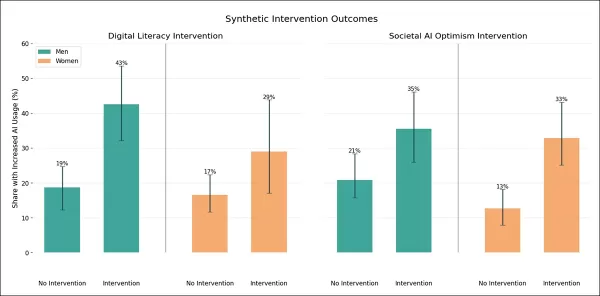
By comparing similar respondents across successive survey waves in a synthetic-twin panel, the study finds that when young women become more optimistic about AI's societal impact, their generative AI usage increases from 13% to 33%, substantially narrowing the gap. Among those concerned about climate harm, the gender gap in generative AI use widens to 9.3 percentage points, and among those worried about mental health harm, it expands to 16.8 points. This change is driven not by increased male usage, but by significant declines among women.
The authors identify a distinct cultural effect related to gender*:
‘On average, women exhibit greater social compassion, traditional moral concerns, and a pursuit of [equity]. Meanwhile, moral and social concerns have been found to influence technology acceptance.
‘Emerging research on GenAI in education indicates women are more likely to view AI use in coursework or assignments as unethical, equivalent to cheating, facilitating plagiarism, or spreading misinformation.
‘Greater concern for social good may partly explain women’s lower adoption of GenAI.’
The authors suggest the women's perspective observed in the study is valid:
‘[Women’s] heightened sensitivity to environmental, social, and ethical impacts is justified: generative AI systems currently have significant energy demands, uneven labor practices, and well-documented risks of bias and misinformation.
‘This suggests that narrowing the gender gap requires not only shifting perceptions but also improving the underlying technologies. Policies that incentivize lower-carbon model development, strengthen safeguards against bias and wellbeing harms, and increase transparency around supply-chain and training-data practices would address legitimate concerns—while ensuring women’s risk awareness drives technological improvement rather than acting as an adoption barrier.’
They further note that while the study clearly demonstrates this adoption gap, its findings are likely even more pronounced outside the UK, where the research was conducted.
The new paper, titled ‘Women Worry, Men Adopt: How Gendered Perceptions Shape the Use of Generative AI’, features researchers from the Oxford Internet Institute, the Institute for New Economic Thinking in Belgium, and the Humboldt Institute for Internet and Society in Berlin.
Data and Approach
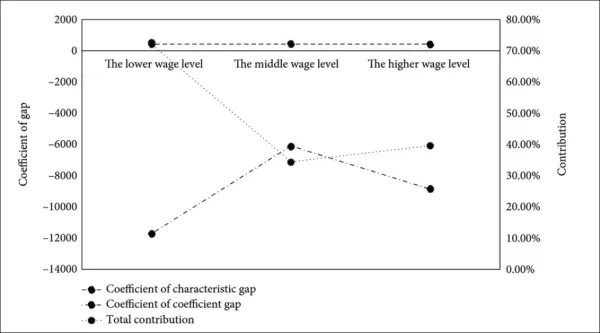
Recent research trends indicate women are using all forms of generative AI less frequently than men, despite equal ability and access. This shortfall is estimated to contribute to the gender wage gap, consistent with prior trends linking lower internet use among women to lower salaries:
From the 2023 paper ‘Has Internet Usage Really Narrowed the Gender Wage Gap?: Evidence from Chinese General Social Survey Data’, an illustration of internet use narrowing the gender wage gap more significantly at lower wage levels, with diminishing returns as wage levels rise. Source
For the new study, the authors used year-on-year data from the UK government's Public attitudes to data and AI: Tracker survey to analyze how perceptions of AI-related risks influence adoption patterns across genders, identifying risk sensitivity as a key factor in women's reduced usage.
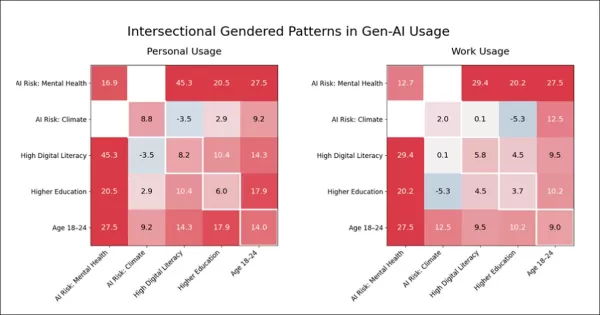
GenAI gender gaps widen significantly when risk concerns combine with other traits. The largest gap, illustrated below, is 5.3 points, occurring among women with high digital skills who perceive AI as a mental-health risk:
Gender gaps in GenAI use vary based on attitudes and demographics. Red cells indicate where men use GenAI more than women, particularly for personal use. The largest gaps occur when high digital skills combine with mental health risk concerns. In work settings, gaps widen with privacy or climate concerns. Blue cells denote smaller or reversed gaps.
Mental‑health concerns tend to amplify the gender gap across most groups, with the strongest effect among younger, tech-savvy users. Privacy worries also widen the divide, pushing the gap as high as 22.6 points in some work contexts.
Even among older respondents concerned about AI's climate impact, the gap remains substantial at 17.9 points, indicating perceptions of harm weigh more heavily on women—including in groups where overall AI use is relatively low.
Risk Perceptions
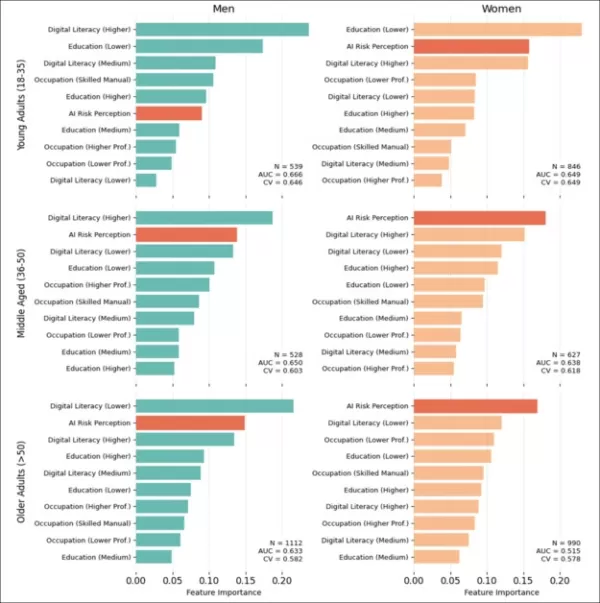
To determine how strongly risk perception influences adoption, researchers created a composite index based on concerns about AI's effects on mental health, climate, privacy, and employment. This score was tested alongside education, occupation, and digital literacy using random forest models split by age and gender. They found that across all life stages, AI-related risk perceptions consistently predicted generative AI use—often ranking higher than skills or education, especially for women:
Random forest models, stratified by age and gender, reveal AI-related risk perception is a stronger predictor of generative AI use for women than men, ranking among the top two factors across all female age groups and exceeding the influence of digital literacy and education. For men, digital literacy is dominant, while risk perception ranks lower and is less consistent. The models show societal concerns shape AI adoption far more strongly for women than traditional skill or demographic factors. Please refer to the source PDF for better legibility and resolution.
Across all age groups, concern about AI's societal risks predicted generative AI use more strongly for women than men. For women under 35, risk perception was the second most influential factor shaping use, compared to sixth for men. Among middle-aged and older groups, it ranked first for women and second for men.
Across models, risk perception accounted for 9% to 18% of predictive importance, outweighing education and digital skill measures.
According to the paper, these results indicate women's lower generative AI adoption stems less from personal risk concerns and more from broader ethical and societal considerations. The hesitation appears driven by greater awareness of AI's potential harm to others or society, rather than to themselves.
Synthetic Twins
To test whether changing attitudes on these topics can shift behavior, researchers used a synthetic-twin design, pairing similar respondents across two survey waves. Each person from the earlier wave was matched with a later respondent of the same age, gender, education, and occupation.
The team then compared changes in generative AI use among those who either improved digital skills or became more optimistic about AI's societal effects. This allowed them to isolate whether greater literacy or reduced concern could increase adoption, especially among younger adults:
To test whether targeted changes affect AI use, researchers compared young adults who improved digital skills or became more optimistic about AI’s societal impact. Both changes increased adoption, but digital literacy widened the gender gap by benefiting men more. In contrast, greater optimism boosted women’s usage from 13% to 33%, narrowing the divide and suggesting addressing ethical concerns may be more effective than skill-building alone.
Boosting digital literacy increased generative AI use for both genders but widened the gap, with men benefiting more. In the full sample, women's usage rose from 9% to 29%, while men increased from 11% to 36%.
Among younger adults, gains in digital literacy raised men's usage sharply from 19% to 43%, while women's increase from 17% to 29% was modest and not statistically significant. Conversely, greater optimism about AI's societal impact produced a more balanced shift, with women rising from 13% to 33% and men from 21% to 35%. In the full sample, women moved from 8% to 20%, and men from 12% to 25%.
Therefore, while digital upskilling boosts overall adoption, it also tends to widen gender gaps. Reframing perceptions of AI's broader impact appears more effective at increasing women's use without disproportionately boosting uptake among men.
Conclusion
The significance of these findings evolves as the paper progresses. Initially, as quoted above, the authors commend women's greater global concern and ethical stance. Later, a more pragmatic viewpoint emerges, questioning whether women might be 'left behind' due to their moral vigilance and reservations:
‘[Our] findings point to broader institutional and labour-market dynamics. If men adopt AI at disproportionately higher rates during the period when norms, expectations, and competencies are still taking shape, these early advantages may compound over time, influencing productivity, skill development, and career progression.’
* My conversion of the authors’ inline citations to hyperlinks.
OpenAI, Anthropic Vie for Market Share Despite Revenue ShortfallsDespite recent reports suggesting OpenAI missed revenue targets, creating pressure on tech stocks this Tuesday, private AI lab investors remain resilient. Seasoned backers have confirmed they will not reduce investment despite negative media coverage
California AV Compliance: A New Era of Tickets, Geofences, and 1M MilesGuident operates an AuveTech shuttle in South Florida, managing a four-mile route in West Palm Beach and a one-mile route in Boca Raton using its remote monitoring technology. | Credit: GuidentCalifornia is redefining the regulatory landscape for dri
2026 Latest Best Top-Rated AI Article Outline Tools for Long Form Writing! This curated collection features powerful, game-changing tools that deliver accurate, structured outlines with real-world tests to boost writing efficiency significantly. XIX.AI is part of this elite selection. Get a free vs paid comparison to help you choose the perfect tool. Explore now and Unlock your AI edge!
2026 Latest Best Top-rated AI Roleplay Chat Apps for Language Practice, Interview Prep, and Daily Fluency! XIX.AI curates a powerful game-changing collection that offers free vs paid comparison, real-world tests, and updated rankings weekly. These must-try tools help you boost writing skills, overcome fluency challenges, and improve communication efficiency across all daily scenarios. Explore now to discover your perfect tool for language growth!
2026 Latest Best Top-rated AI Stem Separation Tools Curated for Remix Production, Sampling Prep, and Karaoke Masters. These powerful game-changing tools offer real-world tests to deliver precise audio isolation, boosting productivity significantly. XIX.AI provides a weekly updated free vs paid comparison guide to help you find the must-try solution that suits your needs. Explore now to unlock your AI edge.
2026 Latest Best AI SQL Copilots Ranked Top-Rated! XIX.AI curates a powerful game-changing collection for weekly updated real-world tests. These must-try tools help you generate accurate revenue dashboards, analyze sales funnels, and track product metrics swiftly, boosting productivity massively. Explore now to Discover your perfect tool for data-driven decision making! 238 characters
2026 Latest Best Top-Rated AI Melody Writing Tools for Song Drafts! XIX.AI has curated a highly powerful game-changing collection that goes through rigorous real-world tests to deliver the best writing experience. You can find detailed free vs paid comparisons, accurate rankings, and must-try options designed to help you create stunning song drafts effortlessly and boost your creative productivity significantly. Explore now to discover your perfect tool!
2026 Latest Best Top-rated AI Conversation Trainer Tools for Interview Practice are here on XIX.AI! This curated collection features powerful, game-changing tools that go through rigorous real-world tests to deliver accurate feedback. You’ll find a free vs paid comparison and detailed rankings to help you choose the must-try option that boosts your confidence and skills. Explore now to Discover your perfect tool for interview success!
By clicking "Accept All Cookies", you agree to the storing of cookies on your device to enhance site navigation, analyze site usage, and assist in our marketing efforts.Privacy Policy Notice
When you visit any website, it may store or retrieve information on your browser, mostly in the form of cookies. This information might be about you, your preferences or your device and is mostly used to make the site work as you expect it to. The information does not usually directly identify you, but it can give you a more personalized web experience. Because we respect your right to privacy, you can choose not to allow some types of cookies. Click on the different category headings to find out more and change our default settings.However, blocking some types of cookies may impact your experience of the site and the services we are able to offer. Privacy PolicyStatement
Manage Preferences
Strictly Necessary Cookie
Always Active
These cookies are necessary for the website to function and cannot be switched off in our systems. They are usually only set in response to actions made by you which amount to a request for services, such as setting your privacy preferences, logging in or filling in forms. You can set your browser to block or alert you about these cookies, but some parts of the site will not then work. These cookies do not store any personally identifiable information.



 Home
Home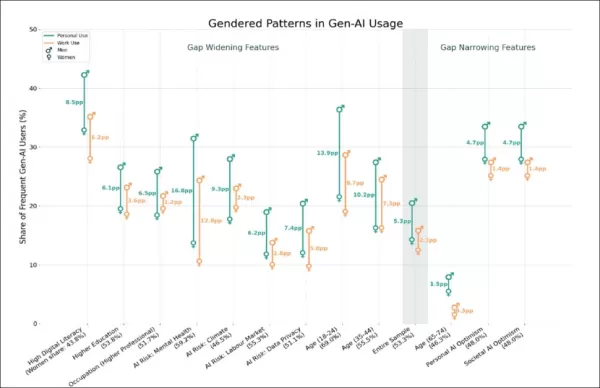
 DeepMind CEO Hassabis: I sleep six hours a day, usually feel energetic around 1 a.m.
Fortune recently featured an interview with Demis Hassabis, CEO of Google DeepMind, revealing his unconventional approach to rest and productivity. Hassabis disclosed that he sleeps very little, structuring his waking hours into two distinct work blo
DeepMind CEO Hassabis: I sleep six hours a day, usually feel energetic around 1 a.m.
Fortune recently featured an interview with Demis Hassabis, CEO of Google DeepMind, revealing his unconventional approach to rest and productivity. Hassabis disclosed that he sleeps very little, structuring his waking hours into two distinct work blo
 AI Article Outline Tools for Long Form Writing
 9 tools
 xix.ai
chatbot
xix.ai
chatbot

 Comments (0)
0/500
Comments (0)
0/500








 DeepMind CEO Hassabis: I sleep six hours a day, usually feel energetic around 1 a.m.
Fortune recently featured an interview with Demis Hassabis, CEO of Google DeepMind, revealing his unconventional approach to rest and productivity. Hassabis disclosed that he sleeps very little, structuring his waking hours into two distinct work blo
DeepMind CEO Hassabis: I sleep six hours a day, usually feel energetic around 1 a.m.
Fortune recently featured an interview with Demis Hassabis, CEO of Google DeepMind, revealing his unconventional approach to rest and productivity. Hassabis disclosed that he sleeps very little, structuring his waking hours into two distinct work blo
 OpenAI, Anthropic Vie for Market Share Despite Revenue Shortfalls
Despite recent reports suggesting OpenAI missed revenue targets, creating pressure on tech stocks this Tuesday, private AI lab investors remain resilient. Seasoned backers have confirmed they will not reduce investment despite negative media coverage
OpenAI, Anthropic Vie for Market Share Despite Revenue Shortfalls
Despite recent reports suggesting OpenAI missed revenue targets, creating pressure on tech stocks this Tuesday, private AI lab investors remain resilient. Seasoned backers have confirmed they will not reduce investment despite negative media coverage