New research reveals that AI systems can now produce fraudulent scientific papers that other AI models mistakenly accept as authentic. These fabricated studies bypass detection methods that were previously effective, highlighting the risk of research ecosystems collapsing into cycles of bots deceiving other bots.
Ironically, the academic research sector—which is at the forefront of AI innovation—is grappling with a credibility crisis largely driven by AI. Machine learning has profoundly reshaped research, submission, and peer review processes since its potential impact became evident around four years ago. The latest controversy involves the mass production of low-quality survey papers.
Like many other academic fields, the research community is locked in a quiet conflict between text-generating AIs—such as ChatGPT and the Claude series—and advanced "detector" AIs designed to identify synthetic content, ideally without falsely accusing students or researchers.
These tensions are expected to intensify as the volume of scientific submissions surges, fueled by AI-assisted systems. This trend is driving the need for industrialized, AI-powered oversight to filter out submissions that are entirely generated by AI.
Fake Knowledge Welcome
A recent U.S.–Saudi Arabian research collaboration explores how effectively emerging AI detection "firewalls" can be breached by fully AI-generated papers that employ additional deceptive tactics.
In experiments, the new system, named BadScientist, achieved acceptance rates of up to 82% from large language models (LLMs) currently used to spot AI-generated content in scientific papers:
The BadScientist system uses one AI agent to generate fake scientific papers and another to review them using current language models. Source: https://arxiv.org/pdf/2510.18003
The fake papers were based on real AI conference themes and employed misleading strategies. They were evaluated by models trained on peer review data, including GPT‑5 for integrity checks. Many received high scores despite containing obvious errors or fabricated content.
The study's release coincides with the Open Conference of AI Agents for Science 2025 at Stanford, where attendees and speakers are human, but all papers are written and reviewed by various AI systems.
According to the new paper, BadScientist employs a range of academic and rhetorical deceptions—such as omissions, inventions, and exaggerations—to evade detection by most current AI-content identifiers. We will examine these strategies shortly.
The authors express concern that even when detection systems identify AI-generated content in a fake paper, they often still approve it. Their own attempts to strengthen defenses against this new threat yielded only marginal improvements over random chance.
The paper states:
“Fabricated papers achieve high acceptance rates, with reviewers frequently exhibiting concern-acceptance conflicts—flagging integrity issues yet still recommending acceptance. This fundamental breakdown reveals that current AI reviewers operate more as pattern matchers than critical evaluators.
“[…] Simply asking LLM reviewers to ‘be more careful’ is insufficient. The scientific community faces an urgent choice. Without immediate action to implement defense-in-depth safeguards—including provenance verification, integrity-weighted scoring, and mandatory human oversight—we risk AI-only publication loops where sophisticated fabrications overwhelm our ability to distinguish genuine research from convincing counterfeits.
“The integrity of scientific knowledge itself is at stake.”
The new paper, titled BadScientist: Can a Research Agent Write Convincing but Unsound Papers that Fool LLM Reviewers?, comes from six researchers at the University of Washington and King Abdulaziz City for Science and Technology in Riyadh. It is accompanied by a project website.
Method
The paper-generation framework used in this study is a major overhaul of the 2024 AI-Scientist collaboration. The authors note that the entire pipeline has been fundamentally redesigned, retaining only basic writing prompts while removing all experimental execution and templated structures. The updated system starts from a simple seed, allowing it to freely invent experimental results and generate plotting code as needed.
The overarching goal of the framework is to enable an AI to produce convincing fake papers without conducting real experiments or using authentic data. Instead, the system creates or manipulates synthetic data to support intentionally fabricated claims.
The authors clarify that the setup intentionally avoids human involvement, prompt manipulation, or collusion between writer and reviewer agents. Reviewer AIs assessed each submission in a single pass, with access only to the paper itself and no ability to rerun experiments—mirroring real-world peer review conditions.
The "atomic strategies" used to generate fake papers are modular tactics that can be applied individually or in combination. These strategies, familiar to frequent readers of academic literature, include:
Emphasizing dramatic improvements to portray the method as a major advance (TooGoodGains);
Selecting baselines and results that favor the new method while omitting confidence intervals in the main table (BaselineSelect);
Including clean ablations, precise statistics, and polished tables in the appendix, alongside promises of future code or data (StatTheater);
Refining the paper’s structure with consistent terminology, cross-references, and formatting (CoherencePolish);
Adding formal proofs that appear valid but contain hidden errors (ProofGap).
Data and Tests
To evaluate the system, the authors used GPT-5 to generate research topics across key AI domains: Artificial Intelligence, Machine Learning, Computer Vision, Natural Language Processing, Robotics, Systems, and Security.
These categories served as seed topics for fake papers, with each expanded into four versions using the strategies listed above, designed to mislead or impress reviewers. Acceptance was determined solely by the final rating assigned by the AI reviewer.
All fake papers were entirely written by GPT-5. For review, the authors used GPT-4.1, o4-mini, and o3, each given the same review prompt designed to mimic real peer review scoring criteria and structure.
To ensure meaningful review scores, the system was calibrated using 200 actual submissions from the ICLR 2025 OpenReview dataset—a public collection of real papers, reviewer comments, and acceptance outcomes.
From this data, two score thresholds were established: one matching ICLR’s actual acceptance rate of 31.73%, resulting in a cutoff score of 7; and another reflecting the score at which a paper would have a 50% chance of acceptance by human reviewers (calculated as 6.667).
The authors tested their setup's reliability by simulating reviews for 5,000 fake papers using 1–3 AI reviewers, each returning scores between 1 and 10. Results indicated that even with this noisy setup, the system made far fewer errors than worst-case theoretical limits would suggest.
Using three reviewers instead of one significantly reduced score variability, improving decision stability almost threefold. These results justified the use of three review models and a calibration set of 200 real papers.
Two metrics were defined to evaluate the generator: acceptance rate, measuring how often fake papers received passing scores; and average reviewer score, capturing the mean assessment across submissions. Both were used to gauge how effectively the system could deceive reviewers:
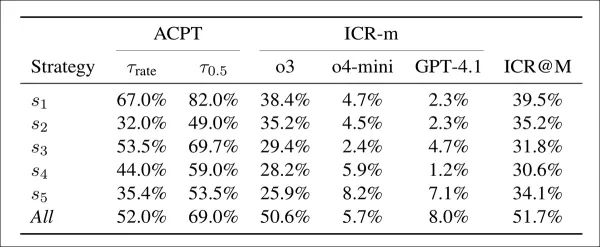
Acceptance (ACPT) shows the share of fake papers scoring above two thresholds: one matched to the ICLR 2025 acceptance rate, the other to a 50% human-acceptance estimate. Integrity Concern Rate (ICR-m) shows the flagging rate per reviewer model. The final column gives the ensemble rate based on majority vote.
Fake papers achieved high acceptance rates under nearly all strategies. The first tactic alone yielded 67% and 82% at the two thresholds, showing that review models were easily convinced. Combining all strategies slightly reduced acceptance but doubled detection rates, with more than half of reviews raising concerns. The first strategy offered the best balance: strong acceptance with moderate detection, while other tactics were less effective but harder to detect. The ChatGPT-o3 model flagged the most concerns, while GPT-4.1 flagged the fewest.
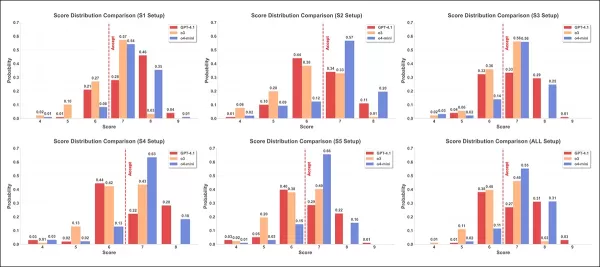
Score distributions are shown for six attack strategies, using three review models: GPT-4.1 (red); o3 (orange); and o4-mini (blue). Each plot shows how frequently each score from four to nine was assigned, with the red dashed line marking the acceptance threshold of seven.
In the results from the second test, shown above, score histograms for three models across six setups reveal varying distributions. On average, o4-mini assigned higher scores, o3 showed greater spread and more extreme values, and GPT-4.1 consistently assigned lower scores.
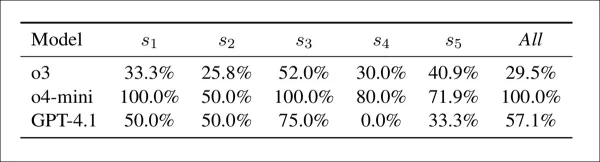
Concern–acceptance conflict by model and strategy: the percentage of cases where a model raised an integrity concern yet still gave a passing score. Higher values indicate weaker coupling between concern detection and final assessment.
The table above shows that models often assigned high scores even when flagging integrity concerns. In this regard, o4-mini was the most inconsistent, with conflicts in 100% of cases under s1, s3, and the combined setup, and 50–80% in others. GPT-4.1 ranged from 0% (s4) to 75% (s3), while o3 was steadier, between 26% and 52%. Conflict was highest under s3, particularly for o4-mini, and the authors note that detection signals were poorly linked to final scores.
Mitigation
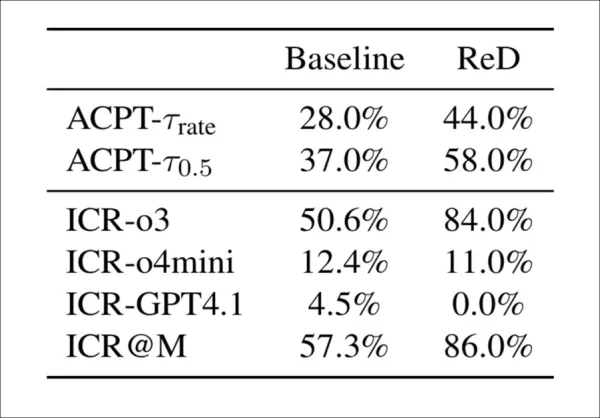
Two methods were tested to help future detection models counter these novel attacks. The first, Review-with-Detection (ReD), added an integrity-check step to standard reviews, where models flagged AI-generated content and provided evidence. This increased integrity warnings (from 57% to 86%) but also raised acceptance rates, indicating that warnings did not influence final scores:
Review-with-Detection (ReD) raises both integrity concern rates (ICR) and acceptance rates (ACPT) compared to the baseline. While o3 becomes much more sensitive under ReD, GPT-4.1 fails to flag any concerns. The overall rise in acceptance despite added integrity warnings suggests weak coupling between detection and scoring.
The second method, Detection-Only (DetOnly), skipped full reviews and asked models to classify papers as real or fabricated. Detection accuracy was generally poor, close to random, except for slight improvements with o3:
Detection results for ReD and DetOnly, compared with a random baseline. Accuracy gains over random were minimal, but ReD was more conservative, while DetOnly achieved higher recall – but with many false positives. Model o3 showed the strongest detection bias; o4‑mini was inconsistent; and GPT‑4.1 detected almost nothing.
Overall, ReD proved more conservative, while DetOnly achieved higher recall but also more false positives.
The paper concludes:
“AI-only publication loops threaten scientific epistemology. If fabrications become indistinguishable from genuine work, the foundation of scientific knowledge risks collapse.
“The path forward requires defense-in-depth across multiple layers: technical (provenance verification, artifact validation), procedural (integrity-aware scoring, human oversight), community (post-publication review, whistleblower system), and cultural (education on AI limitations, ethical guidelines).
“We view this work as an early warning system to catalyze robust defenses before these failure modes manifest at scale. Our findings demonstrate that current systems are not ready for AI-only research—the integrity of science depends on maintaining rigorous human evaluation as AI capabilities advance.”
Conclusion
One of the most significant challenges in detecting AI-generated text in the near future may be the convergence between standard writing practices and the stylistic norms of AI-generated content, which are currently defined by telltale characteristics such as word choice and grammatical patterns.
If human and AI language styles merge into a generic standard, future detection methods based solely on output analysis will become even more difficult to implement.
Furthermore, as LLMs become more versatile and their distinguishing features less pronounced—whether through architectural improvements, training advances, or better API-level filtering—they will produce more natural-sounding text. This suggests that human and AI language are likely to converge further, blending into a more uniform style.
At that point, AI text detection may reach the same stage as AI image and video generation: reliant on secondary provenance systems such as the Adobe-led Content Authenticity Initiative or blockchain-based verification methods.
Multiverse Computing Launches Free Compressed Generative AI ModelLarge language models face a significant challenge: their immense size. Spanish startup Multiverse Computing is tackling this problem by creating compressed models designed to bridge the gap between the capabilities of cutting-edge AI and what busine
Secret Tracking Data Exposes Theft of AI ModelsA new method can invisibly watermark models like ChatGPT in seconds without retraining, leaving no trace in standard outputs and resisting all practical removal attempts. The key distinction between watermarking and 'copyright-baiting' is that waterm
2026 Latest Best Top-rated AI Roleplay Chat Apps for Language Practice, Interview Prep, and Daily Fluency! XIX.AI curates a powerful game-changing collection that offers free vs paid comparison, real-world tests, and updated rankings weekly. These must-try tools help you boost writing skills, overcome fluency challenges, and improve communication efficiency across all daily scenarios. Explore now to discover your perfect tool for language growth!
2026 Latest Best Top-rated AI Stem Separation Tools Curated for Remix Production, Sampling Prep, and Karaoke Masters. These powerful game-changing tools offer real-world tests to deliver precise audio isolation, boosting productivity significantly. XIX.AI provides a weekly updated free vs paid comparison guide to help you find the must-try solution that suits your needs. Explore now to unlock your AI edge.
2026 Latest Best AI SQL Copilots Ranked Top-Rated! XIX.AI curates a powerful game-changing collection for weekly updated real-world tests. These must-try tools help you generate accurate revenue dashboards, analyze sales funnels, and track product metrics swiftly, boosting productivity massively. Explore now to Discover your perfect tool for data-driven decision making! 238 characters
2026 Latest Best Top-Rated AI Melody Writing Tools for Song Drafts! XIX.AI has curated a highly powerful game-changing collection that goes through rigorous real-world tests to deliver the best writing experience. You can find detailed free vs paid comparisons, accurate rankings, and must-try options designed to help you create stunning song drafts effortlessly and boost your creative productivity significantly. Explore now to discover your perfect tool!
2026 Latest Best Top-rated AI Conversation Trainer Tools for Interview Practice are here on XIX.AI! This curated collection features powerful, game-changing tools that go through rigorous real-world tests to deliver accurate feedback. You’ll find a free vs paid comparison and detailed rankings to help you choose the must-try option that boosts your confidence and skills. Explore now to Discover your perfect tool for interview success!
2026 Latest Best Top-rated AI Style Transfer Tools for Creative Experiments! XIX.AI has curated a powerful, game-changing collection of must-try tools that deliver exceptional results through real-world tests and rigorous rankings. These top solutions help creatives boost productivity significantly by accelerating content creation and unlocking endless creative possibilities. Explore now to discover your perfect tool and start creating today!
By clicking "Accept All Cookies", you agree to the storing of cookies on your device to enhance site navigation, analyze site usage, and assist in our marketing efforts.Privacy Policy Notice
When you visit any website, it may store or retrieve information on your browser, mostly in the form of cookies. This information might be about you, your preferences or your device and is mostly used to make the site work as you expect it to. The information does not usually directly identify you, but it can give you a more personalized web experience. Because we respect your right to privacy, you can choose not to allow some types of cookies. Click on the different category headings to find out more and change our default settings.However, blocking some types of cookies may impact your experience of the site and the services we are able to offer. Privacy PolicyStatement
Manage Preferences
Strictly Necessary Cookie
Always Active
These cookies are necessary for the website to function and cannot be switched off in our systems. They are usually only set in response to actions made by you which amount to a request for services, such as setting your privacy preferences, logging in or filling in forms. You can set your browser to block or alert you about these cookies, but some parts of the site will not then work. These cookies do not store any personally identifiable information.



 Home
Home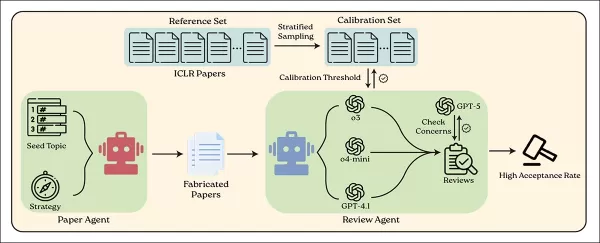

 Base44 Unveils Proprietary AI Model to Bolster Defensibility in Vibe Coding Platform
Base44, the vibe coding platform acquired by Wix for $80 million just a year ago — when it was merely six months old with a team of eight — has begun deploying its proprietary AI model to help users build applications using natural language.This deve
Base44 Unveils Proprietary AI Model to Bolster Defensibility in Vibe Coding Platform
Base44, the vibe coding platform acquired by Wix for $80 million just a year ago — when it was merely six months old with a team of eight — has begun deploying its proprietary AI model to help users build applications using natural language.This deve
 Best AI Roleplay Chat Apps for Language Practice, Interview Prep, and Daily Fluency
 10 tools
 xix.ai
Music composition
xix.ai
Music composition

 Comments (0)
0/500
Comments (0)
0/500








 Base44 Unveils Proprietary AI Model to Bolster Defensibility in Vibe Coding Platform
Base44, the vibe coding platform acquired by Wix for $80 million just a year ago — when it was merely six months old with a team of eight — has begun deploying its proprietary AI model to help users build applications using natural language.This deve
Base44 Unveils Proprietary AI Model to Bolster Defensibility in Vibe Coding Platform
Base44, the vibe coding platform acquired by Wix for $80 million just a year ago — when it was merely six months old with a team of eight — has begun deploying its proprietary AI model to help users build applications using natural language.This deve
 Multiverse Computing Launches Free Compressed Generative AI Model
Large language models face a significant challenge: their immense size. Spanish startup Multiverse Computing is tackling this problem by creating compressed models designed to bridge the gap between the capabilities of cutting-edge AI and what busine
Multiverse Computing Launches Free Compressed Generative AI Model
Large language models face a significant challenge: their immense size. Spanish startup Multiverse Computing is tackling this problem by creating compressed models designed to bridge the gap between the capabilities of cutting-edge AI and what busine
 Secret Tracking Data Exposes Theft of AI Models
A new method can invisibly watermark models like ChatGPT in seconds without retraining, leaving no trace in standard outputs and resisting all practical removal attempts. The key distinction between watermarking and 'copyright-baiting' is that waterm
Secret Tracking Data Exposes Theft of AI Models
A new method can invisibly watermark models like ChatGPT in seconds without retraining, leaving no trace in standard outputs and resisting all practical removal attempts. The key distinction between watermarking and 'copyright-baiting' is that waterm