


 Home
HomeSK hynix Considers Major US IPO to Alleviate Memory Chip Shortage
SK hynix, a South Korean memory chip leader already traded on the KOSPI, is preparing for a potential U.S. stock listing that could reportedly raise between $10 billion and $14 billion.
The company announced this week it has confidentially submitted a Form F-1 with U.S. regulators, targeting a listing in the second half of 2026.
The key question, however, extends beyond fundraising: it's whether a U.S. listing can elevate its market valuation as a pivotal player in the AI chip supply chain.
Despite its crucial role in producing high-bandwidth memory (HBM)—essential for AI systems from companies like Nvidia—the stock has historically traded at a discount compared to global competitors, according to a Seoul-based semiconductor analyst. While its market capitalization is approximately $440 billion, its valuation multiples remain below those of U.S.-listed chip firms, prompting debate over whether geography, rather than business fundamentals, contributes to this gap.
The move is widely viewed as an attempt to align its valuation with global peers such as Micron.
"A U.S. listing for SK hynix could help narrow a persistent valuation gap with international peers. Despite possessing comparable—and in some respects superior—production capabilities relative to U.S. chipmakers, the Korean company has long traded at a discount, partly due to its primary listing being in Korea," the analyst told TechCrunch.
The analyst also highlighted structural considerations influencing the deal. "SK Square, SK hynix's largest shareholder with a 20.07% stake as of December 2025, is required to maintain at least a 20% ownership under South Korea's holding company regulations."
Based on current share prices, issuing roughly 2% in new shares could raise $10 billion to $14 billion while enabling SK Square to preserve its ownership level, the analyst noted. (Under South Korea's Fair Trade Act, holding companies must maintain minimum stakes—at least 20% for listed subsidiaries—to retain control.)
There is precedent for this strategy. Taiwan Semiconductor Manufacturing Company (TSMC), for instance, has seen its U.S.-listed shares trade at a premium to its Taiwan-listed shares at times, especially during periods of strong AI-related demand. This suggests a cross-listing can affect how investors value the same core business.
The move is already sending waves through South Korea's broader chip sector. Following SK hynix's filing, some investors are urging Samsung Electronics to consider a similar U.S. listing. According to a Bloomberg report, major shareholder Artisan Partners stated on Friday that an American Depositary Receipt (ADR) listing could help boost Samsung's valuation and provide U.S. retail investors access to its stock.
A Capital Push to Meet AI-Driven Demand
SK hynix's planned ADR listing is also widely interpreted as a strategy to secure funding for anticipated increases in capital expenditure, driven by rising demand for memory from AI semiconductors.
At its annual general meeting on March 25, SK hynix CEO Noh-Jung Kwak stated that financial strength will be crucial for sustaining growth in the AI era. He added that the company aims to accumulate approximately $75 billion (over 100 trillion KRW) in net cash to support long-term investments.
Soaring memory costs and constrained supply have become bottlenecks, not only slowing AI infrastructure development but also affecting other sectors like consumer gaming. This situation, dubbed 'RAMmageddon,' is projected to persist until at least 2027 if market conditions remain unchanged, according to a Nature report.
Whether this dire forecast materializes remains to be seen. Major tech companies are exploring solutions beyond simply increasing production. For example, Google recently introduced TurboQuant, an ultra-efficient AI memory compression algorithm designed to make AI significantly more memory-efficient.
Nevertheless, indicators suggest that expanded memory production will also be necessary. SK hynix is preparing for a series of capital-intensive projects. The company plans to invest around $400 billion by 2050 to develop a semiconductor cluster in Yongin, South Korea. It is also building new facilities in South Korea and Indiana, with planned investments of approximately $25 billion and $3.3 billion, respectively, highlighting the substantial capital required.
This week, the chipmaker also announced it will acquire advanced extreme ultraviolet (EUV) lithography scanners from ASML by 2027 in a $7.9 billion deal, aimed at boosting HBM production for AI applications.
A landmark U.S. initial public offering would help finance all these ambitions. And it might just prompt other Korean chipmakers to follow suit.
Related article
 SK Hynix in talks with Intel to build memory chips in US
SK Hynix, a leading South Korean memory chip manufacturer, is in talks with Intel about producing RAM chips in the United States for the first time, according to a Reuters report citing anonymous sources.Reports suggest the two companies have explore
US investors to gain access to SK Hynix, another memory maker riding the AI boom
SK Hynix, a leading South Korean memory chip manufacturer and key competitor to Samsung and Micron, announced plans to offer approximately 17.8 million shares in a U.S. initial public offering on Monday. If investor demand meets expectations, the com
South Korean tech giants pledge over $550B to ease RAMageddon
The two largest memory chip companies in the world are planning to invest $518 billion (approximately 800 trillion won) to build four new memory fabrication plants in southwestern South Korea, a region that has historically seen very little semicondu
Related Special Topic Recommendations
Design & Art
SK Hynix in talks with Intel to build memory chips in US
SK Hynix, a leading South Korean memory chip manufacturer, is in talks with Intel about producing RAM chips in the United States for the first time, according to a Reuters report citing anonymous sources.Reports suggest the two companies have explore
US investors to gain access to SK Hynix, another memory maker riding the AI boom
SK Hynix, a leading South Korean memory chip manufacturer and key competitor to Samsung and Micron, announced plans to offer approximately 17.8 million shares in a U.S. initial public offering on Monday. If investor demand meets expectations, the com
South Korean tech giants pledge over $550B to ease RAMageddon
The two largest memory chip companies in the world are planning to invest $518 billion (approximately 800 trillion won) to build four new memory fabrication plants in southwestern South Korea, a region that has historically seen very little semicondu
Related Special Topic Recommendations
Design & Art
 Top AI Illustration Tools: Create Editorial Scenes and Cover Art Faster
2026 Latest Top-rated AI Illustration Tools: Our curated list features the best powerfully designed tools for creating stunning editorial scenes and eye-catching cover art quickly. Each option has gone through rigorous real-world tests, offering a free vs paid comparison to help you find the perfect match for your workflow. Try these must-try solutions today to unlock your AI edge and boost your creative productivity. Explore now at XIX.AI.
 10 tools
 xix.ai
Education and Learning
Top AI Tutors for Exam Prep: Practice Math, Science, and English
xix.ai
Education and Learning
Top AI Tutors for Exam Prep: Practice Math, Science, and English
2026 Latest Top-Rated Best AI Tutors for Exam Prep are here on XIX.AI! Our curated list features powerful game-changing tools that offer free vs paid comparison, real-world tests, and weekly updated rankings. They help boost your writing efficiency, simplify complex topic learning, and unlock your academic potential. Explore now to Discover your perfect exam prep tool and Start creating today to Unlock your AI edge!
10 tools
xix.ai
Finance
AI Budget Planning Tools for Personal Money Management
2026 Latest Best Top-Rated AI Budget Planning Tools for Personal Money Management are here on XIX.AI! This curated collection features powerful, game-changing solutions that help you conduct real-world tests, understand spending habits, and create personalized plans to boost productivity. Enjoy a free vs paid comparison along with detailed rankings. Must-try tools designed to simplify money management and unlock your AI edge. Explore now!
11 tools
xix.ai
Health & Wellness
AI Sleep Tracking Assistants: Improve Recovery with Better Bedtime Habits
2026 Latest Best Top-Rated AI Sleep Tracking Assistants curated for ultimate recovery. This fully updated weekly guide features powerful tools that deliver real-world tests, free vs paid comparison, and detailed rankings to help you find the must-try solution that boosts sleep quality and supports better bedtime habits. Explore now at XIX.AI to Unlock your AI edge.
10 tools
xix.ai
Data Analysis
AI SQL Copilots for Product and Revenue Analytics
2026 Latest Best Top-Rated AI SQL Copilots for Product and Revenue Analytics! XIX.AI has curated a powerful, game-changing collection of must-try tools that undergo real-world tests through weekly updated rankings. These tools help users boost productivity significantly by accelerating data analysis, streamlining complex queries, and generating accurate insights to drive smarter business decisions. Explore now to Discover your perfect tool for unlocking your AI edge!
14 tools
xix.ai
Education and Learning
Best AI Homework Helpers That Teach: Learn Concepts, Not Just Answers
2026 Latest Best Top-Rated AI Homework Helpers That Teach Core Concepts Not Just Answers Powerful Tools for Students Must-Try Curated List Weekly Updated Free vs Paid Comparison Real-World Tests Accurate Rankings to Help You Unlock Your Full Learning Potential Explore now to Discover your perfect tool for smarter studying.
10 tools
xix.ai

 Comments (1)
0/500
Comments (1)
0/500
![JoseLewis]()
So SK hynix wants to float on US soil? I guess they're hungry for that sweet American cash. But calling it a solution to the memory chip shortage feels like a stretch—more like a way to fund more fabs while dodging Korean taxes. 🙄
SK hynix, a South Korean memory chip leader already traded on the KOSPI, is preparing for a potential U.S. stock listing that could reportedly raise between $10 billion and $14 billion.
The company announced this week it has confidentially submitted a Form F-1 with U.S. regulators, targeting a listing in the second half of 2026.
The key question, however, extends beyond fundraising: it's whether a U.S. listing can elevate its market valuation as a pivotal player in the AI chip supply chain.
Despite its crucial role in producing high-bandwidth memory (HBM)—essential for AI systems from companies like Nvidia—the stock has historically traded at a discount compared to global competitors, according to a Seoul-based semiconductor analyst. While its market capitalization is approximately $440 billion, its valuation multiples remain below those of U.S.-listed chip firms, prompting debate over whether geography, rather than business fundamentals, contributes to this gap.
The move is widely viewed as an attempt to align its valuation with global peers such as Micron.
"A U.S. listing for SK hynix could help narrow a persistent valuation gap with international peers. Despite possessing comparable—and in some respects superior—production capabilities relative to U.S. chipmakers, the Korean company has long traded at a discount, partly due to its primary listing being in Korea," the analyst told TechCrunch.
The analyst also highlighted structural considerations influencing the deal. "SK Square, SK hynix's largest shareholder with a 20.07% stake as of December 2025, is required to maintain at least a 20% ownership under South Korea's holding company regulations."
Based on current share prices, issuing roughly 2% in new shares could raise $10 billion to $14 billion while enabling SK Square to preserve its ownership level, the analyst noted. (Under South Korea's Fair Trade Act, holding companies must maintain minimum stakes—at least 20% for listed subsidiaries—to retain control.)
There is precedent for this strategy. Taiwan Semiconductor Manufacturing Company (TSMC), for instance, has seen its U.S.-listed shares trade at a premium to its Taiwan-listed shares at times, especially during periods of strong AI-related demand. This suggests a cross-listing can affect how investors value the same core business.
The move is already sending waves through South Korea's broader chip sector. Following SK hynix's filing, some investors are urging Samsung Electronics to consider a similar U.S. listing. According to a Bloomberg report, major shareholder Artisan Partners stated on Friday that an American Depositary Receipt (ADR) listing could help boost Samsung's valuation and provide U.S. retail investors access to its stock.
A Capital Push to Meet AI-Driven Demand
SK hynix's planned ADR listing is also widely interpreted as a strategy to secure funding for anticipated increases in capital expenditure, driven by rising demand for memory from AI semiconductors.
At its annual general meeting on March 25, SK hynix CEO Noh-Jung Kwak stated that financial strength will be crucial for sustaining growth in the AI era. He added that the company aims to accumulate approximately $75 billion (over 100 trillion KRW) in net cash to support long-term investments.
Soaring memory costs and constrained supply have become bottlenecks, not only slowing AI infrastructure development but also affecting other sectors like consumer gaming. This situation, dubbed 'RAMmageddon,' is projected to persist until at least 2027 if market conditions remain unchanged, according to a Nature report.
Whether this dire forecast materializes remains to be seen. Major tech companies are exploring solutions beyond simply increasing production. For example, Google recently introduced TurboQuant, an ultra-efficient AI memory compression algorithm designed to make AI significantly more memory-efficient.
Nevertheless, indicators suggest that expanded memory production will also be necessary. SK hynix is preparing for a series of capital-intensive projects. The company plans to invest around $400 billion by 2050 to develop a semiconductor cluster in Yongin, South Korea. It is also building new facilities in South Korea and Indiana, with planned investments of approximately $25 billion and $3.3 billion, respectively, highlighting the substantial capital required.
This week, the chipmaker also announced it will acquire advanced extreme ultraviolet (EUV) lithography scanners from ASML by 2027 in a $7.9 billion deal, aimed at boosting HBM production for AI applications.
A landmark U.S. initial public offering would help finance all these ambitions. And it might just prompt other Korean chipmakers to follow suit.








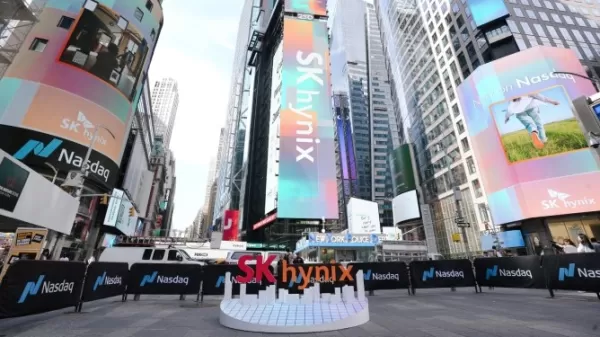 SK Hynix in talks with Intel to build memory chips in US
SK Hynix, a leading South Korean memory chip manufacturer, is in talks with Intel about producing RAM chips in the United States for the first time, according to a Reuters report citing anonymous sources.Reports suggest the two companies have explore
SK Hynix in talks with Intel to build memory chips in US
SK Hynix, a leading South Korean memory chip manufacturer, is in talks with Intel about producing RAM chips in the United States for the first time, according to a Reuters report citing anonymous sources.Reports suggest the two companies have explore
 US investors to gain access to SK Hynix, another memory maker riding the AI boom
SK Hynix, a leading South Korean memory chip manufacturer and key competitor to Samsung and Micron, announced plans to offer approximately 17.8 million shares in a U.S. initial public offering on Monday. If investor demand meets expectations, the com
US investors to gain access to SK Hynix, another memory maker riding the AI boom
SK Hynix, a leading South Korean memory chip manufacturer and key competitor to Samsung and Micron, announced plans to offer approximately 17.8 million shares in a U.S. initial public offering on Monday. If investor demand meets expectations, the com
 South Korean tech giants pledge over $550B to ease RAMageddon
The two largest memory chip companies in the world are planning to invest $518 billion (approximately 800 trillion won) to build four new memory fabrication plants in southwestern South Korea, a region that has historically seen very little semicondu
South Korean tech giants pledge over $550B to ease RAMageddon
The two largest memory chip companies in the world are planning to invest $518 billion (approximately 800 trillion won) to build four new memory fabrication plants in southwestern South Korea, a region that has historically seen very little semicondu

2026 Latest Top-rated AI Illustration Tools: Our curated list features the best powerfully designed tools for creating stunning editorial scenes and eye-catching cover art quickly. Each option has gone through rigorous real-world tests, offering a free vs paid comparison to help you find the perfect match for your workflow. Try these must-try solutions today to unlock your AI edge and boost your creative productivity. Explore now at XIX.AI.
10 tools
xix.ai

2026 Latest Top-Rated Best AI Tutors for Exam Prep are here on XIX.AI! Our curated list features powerful game-changing tools that offer free vs paid comparison, real-world tests, and weekly updated rankings. They help boost your writing efficiency, simplify complex topic learning, and unlock your academic potential. Explore now to Discover your perfect exam prep tool and Start creating today to Unlock your AI edge!
10 tools
xix.ai

2026 Latest Best Top-Rated AI Budget Planning Tools for Personal Money Management are here on XIX.AI! This curated collection features powerful, game-changing solutions that help you conduct real-world tests, understand spending habits, and create personalized plans to boost productivity. Enjoy a free vs paid comparison along with detailed rankings. Must-try tools designed to simplify money management and unlock your AI edge. Explore now!
11 tools
xix.ai

2026 Latest Best Top-Rated AI Sleep Tracking Assistants curated for ultimate recovery. This fully updated weekly guide features powerful tools that deliver real-world tests, free vs paid comparison, and detailed rankings to help you find the must-try solution that boosts sleep quality and supports better bedtime habits. Explore now at XIX.AI to Unlock your AI edge.
10 tools
xix.ai

2026 Latest Best Top-Rated AI SQL Copilots for Product and Revenue Analytics! XIX.AI has curated a powerful, game-changing collection of must-try tools that undergo real-world tests through weekly updated rankings. These tools help users boost productivity significantly by accelerating data analysis, streamlining complex queries, and generating accurate insights to drive smarter business decisions. Explore now to Discover your perfect tool for unlocking your AI edge!
14 tools
xix.ai

2026 Latest Best Top-Rated AI Homework Helpers That Teach Core Concepts Not Just Answers Powerful Tools for Students Must-Try Curated List Weekly Updated Free vs Paid Comparison Real-World Tests Accurate Rankings to Help You Unlock Your Full Learning Potential Explore now to Discover your perfect tool for smarter studying.
10 tools
xix.ai

So SK hynix wants to float on US soil? I guess they're hungry for that sweet American cash. But calling it a solution to the memory chip shortage feels like a stretch—more like a way to fund more fabs while dodging Korean taxes. 🙄












