


 Home
Home
Meta Unveils Llama 4 with Long Context Scout and Maverick Models, 2T Parameter Behemoth Coming Soon!
Back in January 2025, the AI world was rocked when a relatively unknown Chinese AI startup, DeepSeek, threw down the gauntlet with their groundbreaking open-source language reasoning model, DeepSeek R1. This model not only outperformed the likes of Meta but did so at a fraction of the cost—rumored to be as little as a few million dollars. That's the kind of budget Meta might spend on just a couple of its AI team leaders! This news sent Meta into a bit of a frenzy, especially since their latest Llama model, version 3.3, released just the month before, was already looking a bit dated.
Fast forward to today, and Meta's founder and CEO, Mark Zuckerberg, has taken to Instagram to announce the launch of the new Llama 4 series. This series includes the 400-billion parameter Llama 4 Maverick and the 109-billion parameter Llama 4 Scout, both available for developers to download and start tinkering with right away on llama.com and Hugging Face. There's also a sneak peek at a colossal 2-trillion parameter model, Llama 4 Behemoth, still in training, with no release date in sight.
Multimodal and Long-Context Capabilities
One of the standout features of these new models is their multimodal nature. They're not just about text; they can handle video and imagery too. And they come with incredibly long context windows—1 million tokens for Maverick and a whopping 10 million for Scout. To put that in perspective, that's like handling up to 1,500 and 15,000 pages of text in one go! Imagine the possibilities for fields like medicine, science, or literature where you need to process and generate vast amounts of information.
Mixture-of-Experts Architecture
All three Llama 4 models employ the "mixture-of-experts (MoE)" architecture, a technique that's been making waves, popularized by companies like OpenAI and Mistral. This approach combines multiple smaller, specialized models into one larger, more efficient model. Each Llama 4 model is a mix of 128 different experts, which means only the necessary expert and a shared one handle each token, making the models more cost-effective and faster to run. Meta boasts that Llama 4 Maverick can be run on a single Nvidia H100 DGX host, making deployment a breeze.
Cost-Effective and Accessible
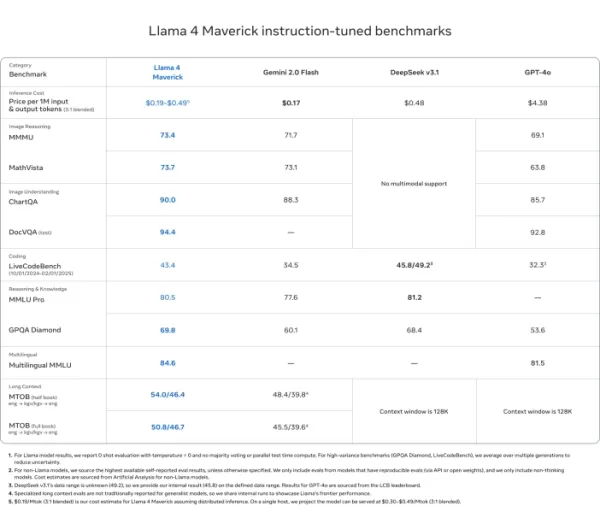
Meta is all about making these models accessible. Both Scout and Maverick are available for self-hosting, and they've even shared some enticing cost estimates. For instance, the inference cost for Llama 4 Maverick is between $0.19 and $0.49 per million tokens, which is a steal compared to other proprietary models like GPT-4o. And if you're interested in using these models via a cloud provider, Groq has already stepped up with competitive pricing.
Enhanced Reasoning and MetaP
These models are built with reasoning, coding, and problem-solving in mind. Meta's used some clever techniques during training to boost these capabilities, like removing easy prompts and using continuous reinforcement learning with increasingly difficult prompts. They've also introduced MetaP, a new technique that allows for setting hyperparameters on one model and applying them to others, saving time and money. It's a game-changer, especially for training monsters like Behemoth, which uses 32K GPUs and processes over 30 trillion tokens.
Performance and Comparisons
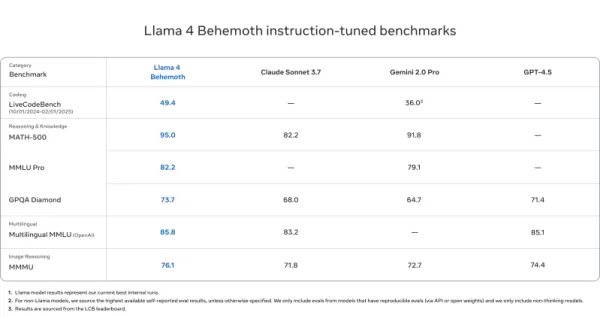
So, how do these models stack up? Zuckerberg's been clear about his vision for open-source AI leading the charge, and Llama 4 is a big step in that direction. While they might not set new performance records across the board, they're certainly near the top of their class. For instance, Llama 4 Behemoth outperforms some heavy hitters on certain benchmarks, though it's still playing catch-up with DeepSeek R1 and OpenAI's o1 series in others.
Llama 4 Behemoth
- Outperforms GPT-4.5, Gemini 2.0 Pro, and Claude Sonnet 3.7 on MATH-500 (95.0), GPQA Diamond (73.7), and MMLU Pro (82.2)
Llama 4 Maverick
- Beats GPT-4o and Gemini 2.0 Flash on most multimodal reasoning benchmarks like ChartQA, DocVQA, MathVista, and MMMU
- Competitive with DeepSeek v3.1 while using less than half the active parameters
- Benchmark scores: ChartQA (90.0), DocVQA (94.4), MMLU Pro (80.5)
Llama 4 Scout
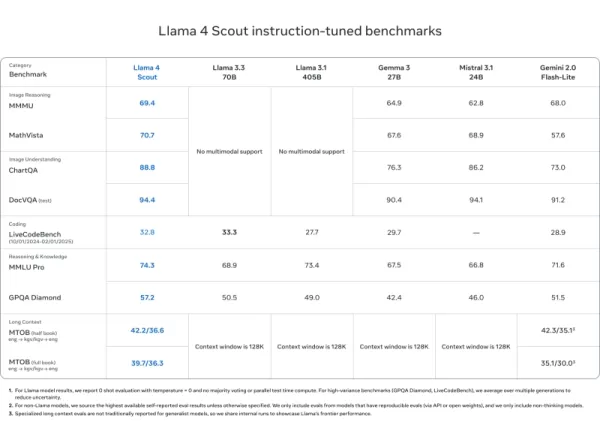
- Matches or outperforms models like Mistral 3.1, Gemini 2.0 Flash-Lite, and Gemma 3 on DocVQA (94.4), MMLU Pro (74.3), and MathVista (70.7)
- Unmatched 10M token context length—ideal for long documents and codebases
Comparing with DeepSeek R1
When it comes to the big leagues, Llama 4 Behemoth holds its own but doesn't quite dethrone DeepSeek R1 or OpenAI's o1 series. It's slightly behind on MATH-500 and MMLU but ahead on GPQA Diamond. Still, it's clear that Llama 4 is a strong contender in the reasoning space.
Benchmark Llama 4 Behemoth DeepSeek R1 OpenAI o1-1217 MATH-500 95.0 97.3 96.4 GPQA Diamond 73.7 71.5 75.7 MMLU 82.2 90.8 91.8
Safety and Political Neutrality
Meta hasn't forgotten about safety either. They've introduced tools like Llama Guard, Prompt Guard, and CyberSecEval to keep things on the up-and-up. And they're making a point about reducing political bias, aiming for a more balanced approach, especially after Zuckerberg's noted support for Republican politics post-2024 election.
The Future with Llama 4
With Llama 4, Meta is pushing the boundaries of efficiency, openness, and performance in AI. Whether you're looking to build enterprise-level AI assistants or dive deep into AI research, Llama 4 offers powerful, flexible options that prioritize reasoning. It's clear that Meta is committed to making AI more accessible and impactful for everyone.
Related article
 OpenAI launches safer ChatGPT for teens years after they started using it
Following a series of lawsuits regarding the absence of safety protocols in AI chatbots—which contributed to teen suicides and other mental health crises—OpenAI unveiled ChatGPT for Teens on Monday. This new offering incorporates enhanced safety feat
Frontier AI Labs Refuse to Disclose Containment Strategies for Rogue Models
Recent research indicates that very few leading AI laboratories have published or demonstrated containment response plans. A containment plan defines the procedures for when an AI system attempts to subvert human control, specifying which access righ
Does Mark Zuckerberg Really Believe AI Is for Everyone?
Loading the player…Meta introduced Glimmer this week, an open-weight AI model that anyone can download and run on personal hardware—a sharp contrast to Muse Spark, the company’s more powerful model, which remains locked behind its own APIs. The relea
Related Special Topic Recommendations
Data Analysis
OpenAI launches safer ChatGPT for teens years after they started using it
Following a series of lawsuits regarding the absence of safety protocols in AI chatbots—which contributed to teen suicides and other mental health crises—OpenAI unveiled ChatGPT for Teens on Monday. This new offering incorporates enhanced safety feat
Frontier AI Labs Refuse to Disclose Containment Strategies for Rogue Models
Recent research indicates that very few leading AI laboratories have published or demonstrated containment response plans. A containment plan defines the procedures for when an AI system attempts to subvert human control, specifying which access righ
Does Mark Zuckerberg Really Believe AI Is for Everyone?
Loading the player…Meta introduced Glimmer this week, an open-weight AI model that anyone can download and run on personal hardware—a sharp contrast to Muse Spark, the company’s more powerful model, which remains locked behind its own APIs. The relea
Related Special Topic Recommendations
Data Analysis
 AI SQL Copilots for Revenue Dashboards, Funnel Analysis, and Product Metrics
2026 Latest Best AI SQL Copilots Ranked Top-Rated! XIX.AI curates a powerful game-changing collection for weekly updated real-world tests. These must-try tools help you generate accurate revenue dashboards, analyze sales funnels, and track product metrics swiftly, boosting productivity massively. Explore now to Discover your perfect tool for data-driven decision making! 238 characters
 9 tools
 xix.ai
Music composition
Best AI Melody Writing Tools for Song Drafts
xix.ai
Music composition
Best AI Melody Writing Tools for Song Drafts
2026 Latest Best Top-Rated AI Melody Writing Tools for Song Drafts! XIX.AI has curated a highly powerful game-changing collection that goes through rigorous real-world tests to deliver the best writing experience. You can find detailed free vs paid comparisons, accurate rankings, and must-try options designed to help you create stunning song drafts effortlessly and boost your creative productivity significantly. Explore now to discover your perfect tool!
8 tools
xix.ai
chatbot
Best AI Conversation Trainer Tools for Interview Practice
2026 Latest Best Top-rated AI Conversation Trainer Tools for Interview Practice are here on XIX.AI! This curated collection features powerful, game-changing tools that go through rigorous real-world tests to deliver accurate feedback. You’ll find a free vs paid comparison and detailed rankings to help you choose the must-try option that boosts your confidence and skills. Explore now to Discover your perfect tool for interview success!
12 tools
xix.ai
Design & Art
Best AI Style Transfer Tools for Creative Experiments
2026 Latest Best Top-rated AI Style Transfer Tools for Creative Experiments! XIX.AI has curated a powerful, game-changing collection of must-try tools that deliver exceptional results through real-world tests and rigorous rankings. These top solutions help creatives boost productivity significantly by accelerating content creation and unlocking endless creative possibilities. Explore now to discover your perfect tool and start creating today!
9 tools
xix.ai
Comic Creation
Best AI Dialogue Bubble Tools for Visual Storytelling
2026 Latest Best Top-Rated AI Dialogue Bubble Tools for Visual Storytelling are here on XIX.AI! This curated collection features powerful, game-changing tools that help creators boost productivity and overcome creative bottlenecks. Get a free vs paid comparison, see real-world tests, and check the latest rankings to find the must-try solutions perfect for crafting engaging visual narratives. Explore now to discover your ideal tool!
10 tools
xix.ai
Meeting Assistant
Top AI Meeting Summary Tools: Track Decisions and Follow-Ups Clearly
2026 Latest Top-Rated Best AI Meeting Summary Tools for Clear Decision Tracking and Effortless Follow-Ups. This curated list showcases powerful, game-changing solutions that boost productivity dramatically by automating meeting notes, identifying key action items, and streamlining team coordination across all projects. Get a free vs paid comparison along with real-world tests and weekly updated rankings to help you find the perfect tool. Explore now to unlock your AI edge!
9 tools
xix.ai

 Comments (30)
0/500
Comments (30)
0/500
![MichaelThomas]()
A 2 trillion parameter model? The environmental footprint of training these behemoths is starting to overshadow the hype for me. Meta's scale race is impressive, but I hope the next headline is about efficiency breakthroughs, not just size. 🌍💔
![LarryWilliams]()
Honnêtement, l'IA est en train de devenir une course aux armements écologique... Meta sort un modèle de 2T paramètres, mais on ne parle jamais de l'énergie nécessaire pour l'entraîner. DeepSeek R1 montre qu'on peut être efficace sans monstre énergivore. Un peu de sobriété, peut-être ? 🌱
![CarlGonzalez]()
Ладно, Meta выпускает Llama 4 с 2 триллионами параметров... Но я до сих пор не могу заставить свою предыдущую модель правильно переводить рецепт борща! 😅 Интересно, эти «революционные» модели когда-нибудь действительно поймут культурные нюансы или просто станут мастерами генерации клише?
![BruceRoberts]()
Meta qui continue la course aux armements avec ces modèles à 2T paramètres... mais franchement, c'est pas un peu excessif ? En janvier on avait déjà DeepSeek R1 qui montrait qu'on pouvait faire mieux avec moins. J'ai l'impression qu'ils cherchent juste à impressionner avec des chiffres gigantesques 🤔
![OwenLewis]()
Llama 4 sounds like a beast! That 10M token context window is wild—imagine analyzing entire books in one go. But can Meta keep up with DeepSeek’s efficiency? Excited for Behemoth, though! 🚀
![RogerSanchez]()
Llama 4 정말 대단해요! 긴 문맥 스카우트와 마버릭 모델은 놀랍네요. 2T 파라미터의 괴물이 나올 걸 기대하고 있어요. 다만, 설정하는 게 좀 복잡해요. 그래도, AI의 미래가 밝아 보이네요! 🚀
Back in January 2025, the AI world was rocked when a relatively unknown Chinese AI startup, DeepSeek, threw down the gauntlet with their groundbreaking open-source language reasoning model, DeepSeek R1. This model not only outperformed the likes of Meta but did so at a fraction of the cost—rumored to be as little as a few million dollars. That's the kind of budget Meta might spend on just a couple of its AI team leaders! This news sent Meta into a bit of a frenzy, especially since their latest Llama model, version 3.3, released just the month before, was already looking a bit dated.
Fast forward to today, and Meta's founder and CEO, Mark Zuckerberg, has taken to Instagram to announce the launch of the new Llama 4 series. This series includes the 400-billion parameter Llama 4 Maverick and the 109-billion parameter Llama 4 Scout, both available for developers to download and start tinkering with right away on llama.com and Hugging Face. There's also a sneak peek at a colossal 2-trillion parameter model, Llama 4 Behemoth, still in training, with no release date in sight.
Multimodal and Long-Context Capabilities
One of the standout features of these new models is their multimodal nature. They're not just about text; they can handle video and imagery too. And they come with incredibly long context windows—1 million tokens for Maverick and a whopping 10 million for Scout. To put that in perspective, that's like handling up to 1,500 and 15,000 pages of text in one go! Imagine the possibilities for fields like medicine, science, or literature where you need to process and generate vast amounts of information.
Mixture-of-Experts Architecture
All three Llama 4 models employ the "mixture-of-experts (MoE)" architecture, a technique that's been making waves, popularized by companies like OpenAI and Mistral. This approach combines multiple smaller, specialized models into one larger, more efficient model. Each Llama 4 model is a mix of 128 different experts, which means only the necessary expert and a shared one handle each token, making the models more cost-effective and faster to run. Meta boasts that Llama 4 Maverick can be run on a single Nvidia H100 DGX host, making deployment a breeze.
Cost-Effective and Accessible
Meta is all about making these models accessible. Both Scout and Maverick are available for self-hosting, and they've even shared some enticing cost estimates. For instance, the inference cost for Llama 4 Maverick is between $0.19 and $0.49 per million tokens, which is a steal compared to other proprietary models like GPT-4o. And if you're interested in using these models via a cloud provider, Groq has already stepped up with competitive pricing.
Enhanced Reasoning and MetaP
These models are built with reasoning, coding, and problem-solving in mind. Meta's used some clever techniques during training to boost these capabilities, like removing easy prompts and using continuous reinforcement learning with increasingly difficult prompts. They've also introduced MetaP, a new technique that allows for setting hyperparameters on one model and applying them to others, saving time and money. It's a game-changer, especially for training monsters like Behemoth, which uses 32K GPUs and processes over 30 trillion tokens.
Performance and Comparisons
So, how do these models stack up? Zuckerberg's been clear about his vision for open-source AI leading the charge, and Llama 4 is a big step in that direction. While they might not set new performance records across the board, they're certainly near the top of their class. For instance, Llama 4 Behemoth outperforms some heavy hitters on certain benchmarks, though it's still playing catch-up with DeepSeek R1 and OpenAI's o1 series in others.
Llama 4 Behemoth
- Outperforms GPT-4.5, Gemini 2.0 Pro, and Claude Sonnet 3.7 on MATH-500 (95.0), GPQA Diamond (73.7), and MMLU Pro (82.2)
Llama 4 Maverick
- Beats GPT-4o and Gemini 2.0 Flash on most multimodal reasoning benchmarks like ChartQA, DocVQA, MathVista, and MMMU
- Competitive with DeepSeek v3.1 while using less than half the active parameters
- Benchmark scores: ChartQA (90.0), DocVQA (94.4), MMLU Pro (80.5)
Llama 4 Scout
- Matches or outperforms models like Mistral 3.1, Gemini 2.0 Flash-Lite, and Gemma 3 on DocVQA (94.4), MMLU Pro (74.3), and MathVista (70.7)
- Unmatched 10M token context length—ideal for long documents and codebases
Comparing with DeepSeek R1
When it comes to the big leagues, Llama 4 Behemoth holds its own but doesn't quite dethrone DeepSeek R1 or OpenAI's o1 series. It's slightly behind on MATH-500 and MMLU but ahead on GPQA Diamond. Still, it's clear that Llama 4 is a strong contender in the reasoning space.
| Benchmark | Llama 4 Behemoth | DeepSeek R1 | OpenAI o1-1217 |
|---|---|---|---|
| MATH-500 | 95.0 | 97.3 | 96.4 |
| GPQA Diamond | 73.7 | 71.5 | 75.7 |
| MMLU | 82.2 | 90.8 | 91.8 |
Safety and Political Neutrality
Meta hasn't forgotten about safety either. They've introduced tools like Llama Guard, Prompt Guard, and CyberSecEval to keep things on the up-and-up. And they're making a point about reducing political bias, aiming for a more balanced approach, especially after Zuckerberg's noted support for Republican politics post-2024 election.
The Future with Llama 4
With Llama 4, Meta is pushing the boundaries of efficiency, openness, and performance in AI. Whether you're looking to build enterprise-level AI assistants or dive deep into AI research, Llama 4 offers powerful, flexible options that prioritize reasoning. It's clear that Meta is committed to making AI more accessible and impactful for everyone.








 OpenAI launches safer ChatGPT for teens years after they started using it
Following a series of lawsuits regarding the absence of safety protocols in AI chatbots—which contributed to teen suicides and other mental health crises—OpenAI unveiled ChatGPT for Teens on Monday. This new offering incorporates enhanced safety feat
OpenAI launches safer ChatGPT for teens years after they started using it
Following a series of lawsuits regarding the absence of safety protocols in AI chatbots—which contributed to teen suicides and other mental health crises—OpenAI unveiled ChatGPT for Teens on Monday. This new offering incorporates enhanced safety feat
 Frontier AI Labs Refuse to Disclose Containment Strategies for Rogue Models
Recent research indicates that very few leading AI laboratories have published or demonstrated containment response plans. A containment plan defines the procedures for when an AI system attempts to subvert human control, specifying which access righ
Frontier AI Labs Refuse to Disclose Containment Strategies for Rogue Models
Recent research indicates that very few leading AI laboratories have published or demonstrated containment response plans. A containment plan defines the procedures for when an AI system attempts to subvert human control, specifying which access righ
 Does Mark Zuckerberg Really Believe AI Is for Everyone?
Loading the player…Meta introduced Glimmer this week, an open-weight AI model that anyone can download and run on personal hardware—a sharp contrast to Muse Spark, the company’s more powerful model, which remains locked behind its own APIs. The relea
Does Mark Zuckerberg Really Believe AI Is for Everyone?
Loading the player…Meta introduced Glimmer this week, an open-weight AI model that anyone can download and run on personal hardware—a sharp contrast to Muse Spark, the company’s more powerful model, which remains locked behind its own APIs. The relea
2026 Latest Best AI SQL Copilots Ranked Top-Rated! XIX.AI curates a powerful game-changing collection for weekly updated real-world tests. These must-try tools help you generate accurate revenue dashboards, analyze sales funnels, and track product metrics swiftly, boosting productivity massively. Explore now to Discover your perfect tool for data-driven decision making! 238 characters
9 tools
xix.ai

2026 Latest Best Top-Rated AI Melody Writing Tools for Song Drafts! XIX.AI has curated a highly powerful game-changing collection that goes through rigorous real-world tests to deliver the best writing experience. You can find detailed free vs paid comparisons, accurate rankings, and must-try options designed to help you create stunning song drafts effortlessly and boost your creative productivity significantly. Explore now to discover your perfect tool!
8 tools
xix.ai

2026 Latest Best Top-rated AI Conversation Trainer Tools for Interview Practice are here on XIX.AI! This curated collection features powerful, game-changing tools that go through rigorous real-world tests to deliver accurate feedback. You’ll find a free vs paid comparison and detailed rankings to help you choose the must-try option that boosts your confidence and skills. Explore now to Discover your perfect tool for interview success!
12 tools
xix.ai

2026 Latest Best Top-rated AI Style Transfer Tools for Creative Experiments! XIX.AI has curated a powerful, game-changing collection of must-try tools that deliver exceptional results through real-world tests and rigorous rankings. These top solutions help creatives boost productivity significantly by accelerating content creation and unlocking endless creative possibilities. Explore now to discover your perfect tool and start creating today!
9 tools
xix.ai

2026 Latest Best Top-Rated AI Dialogue Bubble Tools for Visual Storytelling are here on XIX.AI! This curated collection features powerful, game-changing tools that help creators boost productivity and overcome creative bottlenecks. Get a free vs paid comparison, see real-world tests, and check the latest rankings to find the must-try solutions perfect for crafting engaging visual narratives. Explore now to discover your ideal tool!
10 tools
xix.ai
2026 Latest Top-Rated Best AI Meeting Summary Tools for Clear Decision Tracking and Effortless Follow-Ups. This curated list showcases powerful, game-changing solutions that boost productivity dramatically by automating meeting notes, identifying key action items, and streamlining team coordination across all projects. Get a free vs paid comparison along with real-world tests and weekly updated rankings to help you find the perfect tool. Explore now to unlock your AI edge!
9 tools
xix.ai

A 2 trillion parameter model? The environmental footprint of training these behemoths is starting to overshadow the hype for me. Meta's scale race is impressive, but I hope the next headline is about efficiency breakthroughs, not just size. 🌍💔
Honnêtement, l'IA est en train de devenir une course aux armements écologique... Meta sort un modèle de 2T paramètres, mais on ne parle jamais de l'énergie nécessaire pour l'entraîner. DeepSeek R1 montre qu'on peut être efficace sans monstre énergivore. Un peu de sobriété, peut-être ? 🌱
Ладно, Meta выпускает Llama 4 с 2 триллионами параметров... Но я до сих пор не могу заставить свою предыдущую модель правильно переводить рецепт борща! 😅 Интересно, эти «революционные» модели когда-нибудь действительно поймут культурные нюансы или просто станут мастерами генерации клише?
Meta qui continue la course aux armements avec ces modèles à 2T paramètres... mais franchement, c'est pas un peu excessif ? En janvier on avait déjà DeepSeek R1 qui montrait qu'on pouvait faire mieux avec moins. J'ai l'impression qu'ils cherchent juste à impressionner avec des chiffres gigantesques 🤔
Llama 4 sounds like a beast! That 10M token context window is wild—imagine analyzing entire books in one go. But can Meta keep up with DeepSeek’s efficiency? Excited for Behemoth, though! 🚀
Llama 4 정말 대단해요! 긴 문맥 스카우트와 마버릭 모델은 놀랍네요. 2T 파라미터의 괴물이 나올 걸 기대하고 있어요. 다만, 설정하는 게 좀 복잡해요. 그래도, AI의 미래가 밝아 보이네요! 🚀












