


 Home
HomeJD Vance Criticizes EU AI Regulations in Paris, Praises US Tech Leadership
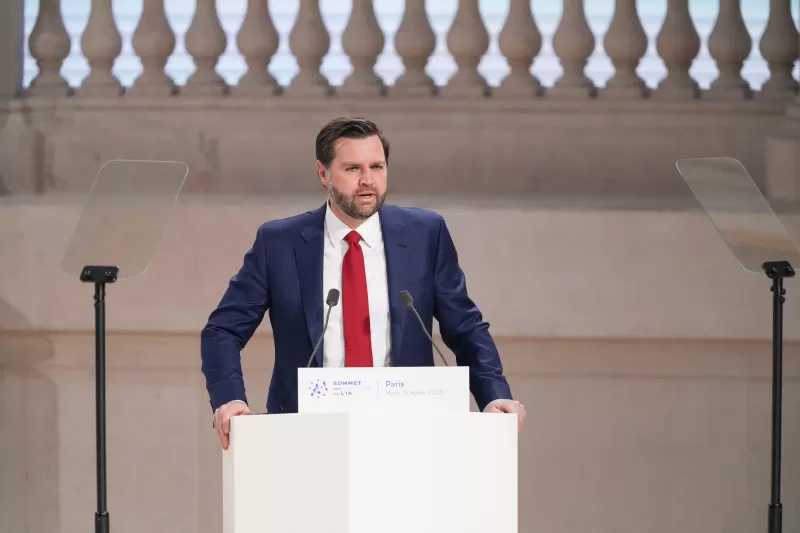
At the AI Action Summit in Paris this week, the U.S. opted out of signing the conference's summary statement, but made its presence felt through a speech by Vice President JD Vance. Speaking to a crowd filled with dignitaries, tech moguls, and regulators, Vance outlined the Trump administration's stance on AI development: the U.S. aims to maintain its dominance and sees regulation as a potential hindrance.
Vance announced that the U.S. is crafting its own AI action plan, one that steers clear of what he called an "overly precautionary regulatory regime" yet ensures that all Americans can reap the benefits of this transformative technology. He invited other nations to collaborate with the U.S. and consider adopting a similar approach if it suits their needs, sidestepping any mention of existing EU regulations.
His speech marked a shift in the AI discourse from risk to opportunity. "I'm not here this morning to talk about AI safety, which was the theme a couple of years back," Vance stated. "I'm here to discuss AI opportunity." He emphasized the U.S.'s ambition to lead the field and warned that excessive regulation could stifle progress.
Vance outlined four key areas where the U.S. would concentrate its efforts. First, he stressed maintaining U.S. AI technology as the global benchmark and a preferred partner for governments and businesses worldwide. Second, he cautioned against excessive regulation, advocating for deregulation and "pro-growth" AI policies instead. Third, he addressed concerns about bias and the misuse of AI for censorship, asserting that "American AI will not be co-opted into a tool for authoritarian censorship." Finally, he touched on labor, pledging that the Trump administration would foster AI as a means for job creation in the U.S.
Throughout his speech, Vance critiqued the concept of AI safety, suggesting that an overemphasis on safety could detract from industrialization efforts. "The AI future won't be won by worrying about safety," he declared. "It will be won by building, from reliable power plants to the manufacturing facilities that can produce future chips."
He also hinted that calls for AI safety might be driven by political and opportunistic motives, questioning whether such regulations truly benefit the public or merely serve the interests of large incumbents. "Over the last few years, we've seen governments, businesses, and nonprofits push unpopular and, I believe, historically inaccurate social agendas through AI," he remarked.
Toward the end, Vance slightly softened his stance on safety, acknowledging that "this doesn't mean all concerns about safety are dismissed, but focus matters. We must seize the opportunity to harness AI to improve our nations' well-being."
Ironically, Vance's call for lighter regulation echoed sentiments from European officials at the Summit. EU President Ursula von der Leyen emphasized the need for AI to be safe and trusted, highlighting the purpose of the AI Act to establish a unified set of safety rules across the EU. "Instead of 27 different national regulations, we need to cut red tape," she said.
High-level speeches like these often gloss over the practical challenges of implementing ideas, especially when those ideas may clash in complex real-world scenarios. Vance did not delve into specifics regarding how the U.S. would handle AI tools from other countries or the impact AI has already had on labor, which has been cited by many tech firms as a reason for workforce reductions. Nor did he address how his proposed "level playing field" in regulation might affect smaller companies compared to Big Tech.
The conference is set to continue later today.
Read our full coverage of the Artificial Intelligence Action Summit in Paris.
TechCrunch has an AI-focused newsletter! Sign up here to get it in your inbox every Wednesday.
Related article
 Stripe to Acquire OpenRouter as AI Model Routing Gains Momentum
Stripe has agreed to acquire OpenRouter, an AI model-routing platform that gives developers access to hundreds of models through a single interface. The deal adds model selection and routing to Stripe’s existing work around AI usage and token-based b
Former OpenAI Researcher Barrett Zoph Returns to Google to Support Gemini Development
Barret Zoph, who previously abruptly left and joined OpenAI due to a disagreement with Thinking Machines Lab CEO Miriam Mularati, has once again changed employers. Alphabet's Google announced that Zoph will return as Vice President of Research, bring
How Recursive Intelligence Raised $335M at $4B Valuation in 4 Months
The co-founders of startup Ricursive Intelligence seemed destined to be co-founders.Anna Goldie, CEO, and Azalia Mirhoseini, CTO, are so well-known in the AI community that they were among those AI engineers who “got those weird emails from Zuckerber
Related Special Topic Recommendations
Design & Art
Stripe to Acquire OpenRouter as AI Model Routing Gains Momentum
Stripe has agreed to acquire OpenRouter, an AI model-routing platform that gives developers access to hundreds of models through a single interface. The deal adds model selection and routing to Stripe’s existing work around AI usage and token-based b
Former OpenAI Researcher Barrett Zoph Returns to Google to Support Gemini Development
Barret Zoph, who previously abruptly left and joined OpenAI due to a disagreement with Thinking Machines Lab CEO Miriam Mularati, has once again changed employers. Alphabet's Google announced that Zoph will return as Vice President of Research, bring
How Recursive Intelligence Raised $335M at $4B Valuation in 4 Months
The co-founders of startup Ricursive Intelligence seemed destined to be co-founders.Anna Goldie, CEO, and Azalia Mirhoseini, CTO, are so well-known in the AI community that they were among those AI engineers who “got those weird emails from Zuckerber
Related Special Topic Recommendations
Design & Art
 Top AI Illustration Tools: Create Editorial Scenes and Cover Art Faster
2026 Latest Top-rated AI Illustration Tools: Our curated list features the best powerfully designed tools for creating stunning editorial scenes and eye-catching cover art quickly. Each option has gone through rigorous real-world tests, offering a free vs paid comparison to help you find the perfect match for your workflow. Try these must-try solutions today to unlock your AI edge and boost your creative productivity. Explore now at XIX.AI.
 10 tools
 xix.ai
Education and Learning
Top AI Tutors for Exam Prep: Practice Math, Science, and English
xix.ai
Education and Learning
Top AI Tutors for Exam Prep: Practice Math, Science, and English
2026 Latest Top-Rated Best AI Tutors for Exam Prep are here on XIX.AI! Our curated list features powerful game-changing tools that offer free vs paid comparison, real-world tests, and weekly updated rankings. They help boost your writing efficiency, simplify complex topic learning, and unlock your academic potential. Explore now to Discover your perfect exam prep tool and Start creating today to Unlock your AI edge!
10 tools
xix.ai
Finance
AI Budget Planning Tools for Personal Money Management
2026 Latest Best Top-Rated AI Budget Planning Tools for Personal Money Management are here on XIX.AI! This curated collection features powerful, game-changing solutions that help you conduct real-world tests, understand spending habits, and create personalized plans to boost productivity. Enjoy a free vs paid comparison along with detailed rankings. Must-try tools designed to simplify money management and unlock your AI edge. Explore now!
11 tools
xix.ai
Health & Wellness
AI Sleep Tracking Assistants: Improve Recovery with Better Bedtime Habits
2026 Latest Best Top-Rated AI Sleep Tracking Assistants curated for ultimate recovery. This fully updated weekly guide features powerful tools that deliver real-world tests, free vs paid comparison, and detailed rankings to help you find the must-try solution that boosts sleep quality and supports better bedtime habits. Explore now at XIX.AI to Unlock your AI edge.
10 tools
xix.ai
Data Analysis
AI SQL Copilots for Product and Revenue Analytics
2026 Latest Best Top-Rated AI SQL Copilots for Product and Revenue Analytics! XIX.AI has curated a powerful, game-changing collection of must-try tools that undergo real-world tests through weekly updated rankings. These tools help users boost productivity significantly by accelerating data analysis, streamlining complex queries, and generating accurate insights to drive smarter business decisions. Explore now to Discover your perfect tool for unlocking your AI edge!
14 tools
xix.ai
Education and Learning
Best AI Homework Helpers That Teach: Learn Concepts, Not Just Answers
2026 Latest Best Top-Rated AI Homework Helpers That Teach Core Concepts Not Just Answers Powerful Tools for Students Must-Try Curated List Weekly Updated Free vs Paid Comparison Real-World Tests Accurate Rankings to Help You Unlock Your Full Learning Potential Explore now to Discover your perfect tool for smarter studying.
10 tools
xix.ai

 Comments (32)
0/500
Comments (32)
0/500
![AlbertScott]()
Typical American chest-thumping – Vance's speech sounded like a pep rally for the tech bros rather than a serious policy discussion. EU has its issues but totally ignoring cooperation is a bad look. 😅
![RichardSmith]()
Interesting take from Vance. He's basically saying 'our tech giants are better because we don't regulate them much' 🙄. But is that really leadership? The EU's approach might be more thoughtful. Different priorities I guess.
![NicholasSanchez]()
JD Vance의 연설은 정말 멋졌어요! EU의 AI 규제를 비판하고 미국의 기술 리더십을 칭찬했어요. 그의 대담한 발언이 새롭게 느껴졌지만, 좀 더 온화하게 말했으면 좋겠어요. 그래도 강력한 메시지였어요. 꼭 들어보세요!
![PaulBrown]()
JD Vanceのスピーチは最高だった!EUのAI規制を批判し、アメリカのテクノロジーリーダーシップを称賛した。彼の勇敢な発言は新鮮だったけど、もう少し穏やかに話せば良かったのにね。それでも強力なメッセージだったよ。ぜひ聞いてみて!
![JuanLewis]()
JD Vance's speech at the AI Summit was fire! He totally called out the EU's AI regulations and praised US tech leadership. It's refreshing to hear someone speak so boldly. But did he have to be so confrontational? 🤔 Still, it was a powerful statement. Give it a listen!
![JohnYoung]()
JD 밴스의 AI 액션 서밋에서의 연설은 대담한 움직임이었어요! 그는 EU의 AI 규제를 비판하면서 미국을 지도에 올려놓았어요. 테크 리더십에 대한 강한 입장을 듣는 것은 새롭지만, 비판뿐만 아니라 더 많은 해결책을 제시했으면 좋겠어요. 그래도 사람들이 이야기하게 만드는 계기가 되었어요! 🇺🇸💬
At the AI Action Summit in Paris this week, the U.S. opted out of signing the conference's summary statement, but made its presence felt through a speech by Vice President JD Vance. Speaking to a crowd filled with dignitaries, tech moguls, and regulators, Vance outlined the Trump administration's stance on AI development: the U.S. aims to maintain its dominance and sees regulation as a potential hindrance.
Vance announced that the U.S. is crafting its own AI action plan, one that steers clear of what he called an "overly precautionary regulatory regime" yet ensures that all Americans can reap the benefits of this transformative technology. He invited other nations to collaborate with the U.S. and consider adopting a similar approach if it suits their needs, sidestepping any mention of existing EU regulations.
His speech marked a shift in the AI discourse from risk to opportunity. "I'm not here this morning to talk about AI safety, which was the theme a couple of years back," Vance stated. "I'm here to discuss AI opportunity." He emphasized the U.S.'s ambition to lead the field and warned that excessive regulation could stifle progress.
Vance outlined four key areas where the U.S. would concentrate its efforts. First, he stressed maintaining U.S. AI technology as the global benchmark and a preferred partner for governments and businesses worldwide. Second, he cautioned against excessive regulation, advocating for deregulation and "pro-growth" AI policies instead. Third, he addressed concerns about bias and the misuse of AI for censorship, asserting that "American AI will not be co-opted into a tool for authoritarian censorship." Finally, he touched on labor, pledging that the Trump administration would foster AI as a means for job creation in the U.S.
Throughout his speech, Vance critiqued the concept of AI safety, suggesting that an overemphasis on safety could detract from industrialization efforts. "The AI future won't be won by worrying about safety," he declared. "It will be won by building, from reliable power plants to the manufacturing facilities that can produce future chips."
He also hinted that calls for AI safety might be driven by political and opportunistic motives, questioning whether such regulations truly benefit the public or merely serve the interests of large incumbents. "Over the last few years, we've seen governments, businesses, and nonprofits push unpopular and, I believe, historically inaccurate social agendas through AI," he remarked.
Toward the end, Vance slightly softened his stance on safety, acknowledging that "this doesn't mean all concerns about safety are dismissed, but focus matters. We must seize the opportunity to harness AI to improve our nations' well-being."
Ironically, Vance's call for lighter regulation echoed sentiments from European officials at the Summit. EU President Ursula von der Leyen emphasized the need for AI to be safe and trusted, highlighting the purpose of the AI Act to establish a unified set of safety rules across the EU. "Instead of 27 different national regulations, we need to cut red tape," she said.
High-level speeches like these often gloss over the practical challenges of implementing ideas, especially when those ideas may clash in complex real-world scenarios. Vance did not delve into specifics regarding how the U.S. would handle AI tools from other countries or the impact AI has already had on labor, which has been cited by many tech firms as a reason for workforce reductions. Nor did he address how his proposed "level playing field" in regulation might affect smaller companies compared to Big Tech.
The conference is set to continue later today.
Read our full coverage of the Artificial Intelligence Action Summit in Paris.
TechCrunch has an AI-focused newsletter! Sign up here to get it in your inbox every Wednesday.








 Stripe to Acquire OpenRouter as AI Model Routing Gains Momentum
Stripe has agreed to acquire OpenRouter, an AI model-routing platform that gives developers access to hundreds of models through a single interface. The deal adds model selection and routing to Stripe’s existing work around AI usage and token-based b
Stripe to Acquire OpenRouter as AI Model Routing Gains Momentum
Stripe has agreed to acquire OpenRouter, an AI model-routing platform that gives developers access to hundreds of models through a single interface. The deal adds model selection and routing to Stripe’s existing work around AI usage and token-based b
 Former OpenAI Researcher Barrett Zoph Returns to Google to Support Gemini Development
Barret Zoph, who previously abruptly left and joined OpenAI due to a disagreement with Thinking Machines Lab CEO Miriam Mularati, has once again changed employers. Alphabet's Google announced that Zoph will return as Vice President of Research, bring
Former OpenAI Researcher Barrett Zoph Returns to Google to Support Gemini Development
Barret Zoph, who previously abruptly left and joined OpenAI due to a disagreement with Thinking Machines Lab CEO Miriam Mularati, has once again changed employers. Alphabet's Google announced that Zoph will return as Vice President of Research, bring
 How Recursive Intelligence Raised $335M at $4B Valuation in 4 Months
The co-founders of startup Ricursive Intelligence seemed destined to be co-founders.Anna Goldie, CEO, and Azalia Mirhoseini, CTO, are so well-known in the AI community that they were among those AI engineers who “got those weird emails from Zuckerber
How Recursive Intelligence Raised $335M at $4B Valuation in 4 Months
The co-founders of startup Ricursive Intelligence seemed destined to be co-founders.Anna Goldie, CEO, and Azalia Mirhoseini, CTO, are so well-known in the AI community that they were among those AI engineers who “got those weird emails from Zuckerber

2026 Latest Top-rated AI Illustration Tools: Our curated list features the best powerfully designed tools for creating stunning editorial scenes and eye-catching cover art quickly. Each option has gone through rigorous real-world tests, offering a free vs paid comparison to help you find the perfect match for your workflow. Try these must-try solutions today to unlock your AI edge and boost your creative productivity. Explore now at XIX.AI.
10 tools
xix.ai

2026 Latest Top-Rated Best AI Tutors for Exam Prep are here on XIX.AI! Our curated list features powerful game-changing tools that offer free vs paid comparison, real-world tests, and weekly updated rankings. They help boost your writing efficiency, simplify complex topic learning, and unlock your academic potential. Explore now to Discover your perfect exam prep tool and Start creating today to Unlock your AI edge!
10 tools
xix.ai

2026 Latest Best Top-Rated AI Budget Planning Tools for Personal Money Management are here on XIX.AI! This curated collection features powerful, game-changing solutions that help you conduct real-world tests, understand spending habits, and create personalized plans to boost productivity. Enjoy a free vs paid comparison along with detailed rankings. Must-try tools designed to simplify money management and unlock your AI edge. Explore now!
11 tools
xix.ai

2026 Latest Best Top-Rated AI Sleep Tracking Assistants curated for ultimate recovery. This fully updated weekly guide features powerful tools that deliver real-world tests, free vs paid comparison, and detailed rankings to help you find the must-try solution that boosts sleep quality and supports better bedtime habits. Explore now at XIX.AI to Unlock your AI edge.
10 tools
xix.ai

2026 Latest Best Top-Rated AI SQL Copilots for Product and Revenue Analytics! XIX.AI has curated a powerful, game-changing collection of must-try tools that undergo real-world tests through weekly updated rankings. These tools help users boost productivity significantly by accelerating data analysis, streamlining complex queries, and generating accurate insights to drive smarter business decisions. Explore now to Discover your perfect tool for unlocking your AI edge!
14 tools
xix.ai

2026 Latest Best Top-Rated AI Homework Helpers That Teach Core Concepts Not Just Answers Powerful Tools for Students Must-Try Curated List Weekly Updated Free vs Paid Comparison Real-World Tests Accurate Rankings to Help You Unlock Your Full Learning Potential Explore now to Discover your perfect tool for smarter studying.
10 tools
xix.ai

Typical American chest-thumping – Vance's speech sounded like a pep rally for the tech bros rather than a serious policy discussion. EU has its issues but totally ignoring cooperation is a bad look. 😅
Interesting take from Vance. He's basically saying 'our tech giants are better because we don't regulate them much' 🙄. But is that really leadership? The EU's approach might be more thoughtful. Different priorities I guess.
JD Vance의 연설은 정말 멋졌어요! EU의 AI 규제를 비판하고 미국의 기술 리더십을 칭찬했어요. 그의 대담한 발언이 새롭게 느껴졌지만, 좀 더 온화하게 말했으면 좋겠어요. 그래도 강력한 메시지였어요. 꼭 들어보세요!
JD Vanceのスピーチは最高だった!EUのAI規制を批判し、アメリカのテクノロジーリーダーシップを称賛した。彼の勇敢な発言は新鮮だったけど、もう少し穏やかに話せば良かったのにね。それでも強力なメッセージだったよ。ぜひ聞いてみて!
JD Vance's speech at the AI Summit was fire! He totally called out the EU's AI regulations and praised US tech leadership. It's refreshing to hear someone speak so boldly. But did he have to be so confrontational? 🤔 Still, it was a powerful statement. Give it a listen!
JD 밴스의 AI 액션 서밋에서의 연설은 대담한 움직임이었어요! 그는 EU의 AI 규제를 비판하면서 미국을 지도에 올려놓았어요. 테크 리더십에 대한 강한 입장을 듣는 것은 새롭지만, 비판뿐만 아니라 더 많은 해결책을 제시했으면 좋겠어요. 그래도 사람들이 이야기하게 만드는 계기가 되었어요! 🇺🇸💬












