


 Home
HomeConntour secures $7M from General Catalyst and YC for AI-powered security video search
The surveillance technology industry is currently under scrutiny, though not for the most favorable reasons. Controversies have flared as U.S. Immigration and Customs Enforcement reportedly accessed Flock’s camera network for surveillance, and home camera maker Ring faced criticism for developing features that allow law enforcement to request neighborhood footage from homeowners. These developments have sparked a broad debate around safety, privacy, and the ethics of monitoring.
Yet controversy does not diminish market demand. Continued advances in vision-language models are fueling growth for companies that help businesses oversee their premises more effectively.
Matan Goldner, co‑founder and CEO of video surveillance startup Conntour, acknowledges that ethical considerations are serious enough that his company is highly selective about its clients. While that might seem counterintuitive for a startup barely two years old, Goldner says Conntour can afford to be choosy because it already counts several large government and publicly listed entities among its customers, including Singapore’s Central Narcotics Bureau.
“The fact that we have such big customers allows us to select them and to stay in control. We’re really in control of who is using it, what is the use case, and we can select what we think is moral and, of course, legal. We use all our judgment, and we make decisions based on specific customers that we’re okay to work with because we know how they will use it,” Goldner told TechCrunch in an exclusive interview.
That traction has done more than just allow Conntour to be selective. Investors have taken notice: the startup recently raised a $7 million seed round from General Catalyst, Y Combinator, SV Angel, and Liquid 2 Ventures.
Goldner said the round closed within 72 hours. “I think I scheduled around 90 meetings in like eight days, and just after three days — we started on Monday and by Wednesday afternoon, we were done,” he said.
Conntour’s pickiness may well be justified, especially given the power of modern AI tools in this field. The company’s video platform uses AI models to let security personnel query camera feeds in natural language, finding any object, person, or situation in real time — essentially a Google‑like search engine tailored to security video. It can also monitor for threats autonomously based on preset rules and surface automatic alerts.
Unlike legacy systems that rely on rigid definitions or parameters to detect specific objects, motion patterns, or behaviors, Conntour says its system uses natural‑language and vision‑language models, offering high flexibility and usability. A user might ask, “Find instances of someone in sneakers passing a bag in the lobby,” and Conntour’s system quickly scans all recorded footage or live feeds to return relevant results.
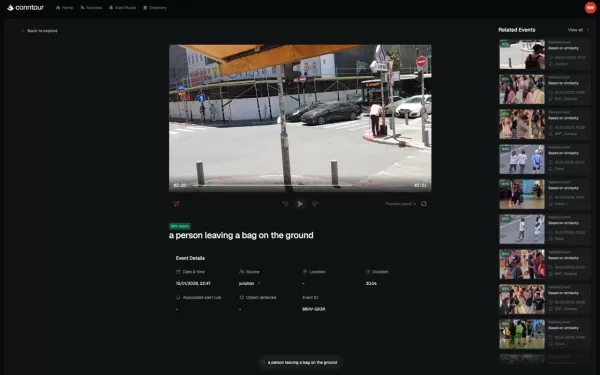
A screenshot of Conntour’s platform in action. Image Credits: Conntour
Because the platform integrates AI models, users can simply ask questions about footage and receive answers in text, accompanied by the relevant video clips, as well as generate incident reports.
The company’s key selling point, however, is its scalability. Goldner explained that the platform differs from other AI video search services because it’s designed to efficiently scale to systems with thousands of camera feeds. In fact, he said, Conntour’s system can monitor up to 50 camera feeds on a single consumer GPU like Nvidia’s RTX 4090.
The company achieves this by employing multiple models and logic systems, then determining which combination requires the least computing power to produce the best results for each user query.
Conntour claims its system can be deployed entirely on‑premises, fully in the cloud, or a mix of both. It can integrate with most existing security systems or serve as a standalone full surveillance platform.
Still, the video surveillance industry has long faced a persistent challenge: the quality of surveillance is only as good as the footage captured. It’s difficult to discern details from a poorly lit parking lot recorded by a low‑resolution camera with a dirty lens, for example.
Goldner says Conntour hedges against this by providing a confidence score alongside its search results. If the source camera feed lacks sufficient quality, the system returns results with low confidence levels.
Looking ahead, Goldner says the biggest technical challenge is bringing the full capability of large language models to the system while maintaining efficiency.
“We have two things that we want to do at the same time, and they contradict each other. On one hand, we want to provide full natural‑language flexibility, LLM‑style, so you can ask anything. On the other hand, there’s efficiency — we want it to use very few resources, because processing thousands of feeds is just insane. This contradiction is the biggest technical barrier and problem in our field, and it’s what we’re working really hard to solve.”
Related article
 Otter.ai Secures $320 Million Growth Funding From General Catalyst for Meeting Tool
On Tuesday, Otter.ai, a meeting note-taking platform, announced a $320 million investment from General Catalyst’s Customer Value Fund (CVF). This fund supports startups without requiring equity dilution, instead seeking returns based on marketing per
Ex-Ramp Engineers Raise $20M for Melius Platform After Pivoting From First Product
Melius, an AI-driven platform for creating ad campaigns, images, and videos, announced on Tuesday that it has secured $25 million in total funding. This includes a $20 million Series A round led by CRV and a $5 million seed round backed by General Ca
What Is an Applied Research Lab?
AfterQuery is an applied research lab curating data solutions to accelerate foundation model development. Credit: AfterQueryBacked by Altos Ventures and Y Combinator, AfterQuery is an applied research lab that encodes human expertise into data to tra
Related Special Topic Recommendations
Design & Art
Otter.ai Secures $320 Million Growth Funding From General Catalyst for Meeting Tool
On Tuesday, Otter.ai, a meeting note-taking platform, announced a $320 million investment from General Catalyst’s Customer Value Fund (CVF). This fund supports startups without requiring equity dilution, instead seeking returns based on marketing per
Ex-Ramp Engineers Raise $20M for Melius Platform After Pivoting From First Product
Melius, an AI-driven platform for creating ad campaigns, images, and videos, announced on Tuesday that it has secured $25 million in total funding. This includes a $20 million Series A round led by CRV and a $5 million seed round backed by General Ca
What Is an Applied Research Lab?
AfterQuery is an applied research lab curating data solutions to accelerate foundation model development. Credit: AfterQueryBacked by Altos Ventures and Y Combinator, AfterQuery is an applied research lab that encodes human expertise into data to tra
Related Special Topic Recommendations
Design & Art
 Top AI Illustration Tools: Create Editorial Scenes and Cover Art Faster
2026 Latest Top-rated AI Illustration Tools: Our curated list features the best powerfully designed tools for creating stunning editorial scenes and eye-catching cover art quickly. Each option has gone through rigorous real-world tests, offering a free vs paid comparison to help you find the perfect match for your workflow. Try these must-try solutions today to unlock your AI edge and boost your creative productivity. Explore now at XIX.AI.
 10 tools
 xix.ai
Education and Learning
Top AI Tutors for Exam Prep: Practice Math, Science, and English
xix.ai
Education and Learning
Top AI Tutors for Exam Prep: Practice Math, Science, and English
2026 Latest Top-Rated Best AI Tutors for Exam Prep are here on XIX.AI! Our curated list features powerful game-changing tools that offer free vs paid comparison, real-world tests, and weekly updated rankings. They help boost your writing efficiency, simplify complex topic learning, and unlock your academic potential. Explore now to Discover your perfect exam prep tool and Start creating today to Unlock your AI edge!
10 tools
xix.ai
Finance
AI Budget Planning Tools for Personal Money Management
2026 Latest Best Top-Rated AI Budget Planning Tools for Personal Money Management are here on XIX.AI! This curated collection features powerful, game-changing solutions that help you conduct real-world tests, understand spending habits, and create personalized plans to boost productivity. Enjoy a free vs paid comparison along with detailed rankings. Must-try tools designed to simplify money management and unlock your AI edge. Explore now!
11 tools
xix.ai
Health & Wellness
AI Sleep Tracking Assistants: Improve Recovery with Better Bedtime Habits
2026 Latest Best Top-Rated AI Sleep Tracking Assistants curated for ultimate recovery. This fully updated weekly guide features powerful tools that deliver real-world tests, free vs paid comparison, and detailed rankings to help you find the must-try solution that boosts sleep quality and supports better bedtime habits. Explore now at XIX.AI to Unlock your AI edge.
10 tools
xix.ai
Data Analysis
AI SQL Copilots for Product and Revenue Analytics
2026 Latest Best Top-Rated AI SQL Copilots for Product and Revenue Analytics! XIX.AI has curated a powerful, game-changing collection of must-try tools that undergo real-world tests through weekly updated rankings. These tools help users boost productivity significantly by accelerating data analysis, streamlining complex queries, and generating accurate insights to drive smarter business decisions. Explore now to Discover your perfect tool for unlocking your AI edge!
14 tools
xix.ai
Education and Learning
Best AI Homework Helpers That Teach: Learn Concepts, Not Just Answers
2026 Latest Best Top-Rated AI Homework Helpers That Teach Core Concepts Not Just Answers Powerful Tools for Students Must-Try Curated List Weekly Updated Free vs Paid Comparison Real-World Tests Accurate Rankings to Help You Unlock Your Full Learning Potential Explore now to Discover your perfect tool for smarter studying.
10 tools
xix.ai

 Comments (0)
0/500
Comments (0)
0/500
The surveillance technology industry is currently under scrutiny, though not for the most favorable reasons. Controversies have flared as U.S. Immigration and Customs Enforcement reportedly accessed Flock’s camera network for surveillance, and home camera maker Ring faced criticism for developing features that allow law enforcement to request neighborhood footage from homeowners. These developments have sparked a broad debate around safety, privacy, and the ethics of monitoring.
Yet controversy does not diminish market demand. Continued advances in vision-language models are fueling growth for companies that help businesses oversee their premises more effectively.
Matan Goldner, co‑founder and CEO of video surveillance startup Conntour, acknowledges that ethical considerations are serious enough that his company is highly selective about its clients. While that might seem counterintuitive for a startup barely two years old, Goldner says Conntour can afford to be choosy because it already counts several large government and publicly listed entities among its customers, including Singapore’s Central Narcotics Bureau.
“The fact that we have such big customers allows us to select them and to stay in control. We’re really in control of who is using it, what is the use case, and we can select what we think is moral and, of course, legal. We use all our judgment, and we make decisions based on specific customers that we’re okay to work with because we know how they will use it,” Goldner told TechCrunch in an exclusive interview.
That traction has done more than just allow Conntour to be selective. Investors have taken notice: the startup recently raised a $7 million seed round from General Catalyst, Y Combinator, SV Angel, and Liquid 2 Ventures.
Goldner said the round closed within 72 hours. “I think I scheduled around 90 meetings in like eight days, and just after three days — we started on Monday and by Wednesday afternoon, we were done,” he said.
Conntour’s pickiness may well be justified, especially given the power of modern AI tools in this field. The company’s video platform uses AI models to let security personnel query camera feeds in natural language, finding any object, person, or situation in real time — essentially a Google‑like search engine tailored to security video. It can also monitor for threats autonomously based on preset rules and surface automatic alerts.
Unlike legacy systems that rely on rigid definitions or parameters to detect specific objects, motion patterns, or behaviors, Conntour says its system uses natural‑language and vision‑language models, offering high flexibility and usability. A user might ask, “Find instances of someone in sneakers passing a bag in the lobby,” and Conntour’s system quickly scans all recorded footage or live feeds to return relevant results.
A screenshot of Conntour’s platform in action. Image Credits: Conntour
Because the platform integrates AI models, users can simply ask questions about footage and receive answers in text, accompanied by the relevant video clips, as well as generate incident reports.
The company’s key selling point, however, is its scalability. Goldner explained that the platform differs from other AI video search services because it’s designed to efficiently scale to systems with thousands of camera feeds. In fact, he said, Conntour’s system can monitor up to 50 camera feeds on a single consumer GPU like Nvidia’s RTX 4090.
The company achieves this by employing multiple models and logic systems, then determining which combination requires the least computing power to produce the best results for each user query.
Conntour claims its system can be deployed entirely on‑premises, fully in the cloud, or a mix of both. It can integrate with most existing security systems or serve as a standalone full surveillance platform.
Still, the video surveillance industry has long faced a persistent challenge: the quality of surveillance is only as good as the footage captured. It’s difficult to discern details from a poorly lit parking lot recorded by a low‑resolution camera with a dirty lens, for example.
Goldner says Conntour hedges against this by providing a confidence score alongside its search results. If the source camera feed lacks sufficient quality, the system returns results with low confidence levels.
Looking ahead, Goldner says the biggest technical challenge is bringing the full capability of large language models to the system while maintaining efficiency.
“We have two things that we want to do at the same time, and they contradict each other. On one hand, we want to provide full natural‑language flexibility, LLM‑style, so you can ask anything. On the other hand, there’s efficiency — we want it to use very few resources, because processing thousands of feeds is just insane. This contradiction is the biggest technical barrier and problem in our field, and it’s what we’re working really hard to solve.”








 Otter.ai Secures $320 Million Growth Funding From General Catalyst for Meeting Tool
On Tuesday, Otter.ai, a meeting note-taking platform, announced a $320 million investment from General Catalyst’s Customer Value Fund (CVF). This fund supports startups without requiring equity dilution, instead seeking returns based on marketing per
Otter.ai Secures $320 Million Growth Funding From General Catalyst for Meeting Tool
On Tuesday, Otter.ai, a meeting note-taking platform, announced a $320 million investment from General Catalyst’s Customer Value Fund (CVF). This fund supports startups without requiring equity dilution, instead seeking returns based on marketing per
 Ex-Ramp Engineers Raise $20M for Melius Platform After Pivoting From First Product
Melius, an AI-driven platform for creating ad campaigns, images, and videos, announced on Tuesday that it has secured $25 million in total funding. This includes a $20 million Series A round led by CRV and a $5 million seed round backed by General Ca
Ex-Ramp Engineers Raise $20M for Melius Platform After Pivoting From First Product
Melius, an AI-driven platform for creating ad campaigns, images, and videos, announced on Tuesday that it has secured $25 million in total funding. This includes a $20 million Series A round led by CRV and a $5 million seed round backed by General Ca
 What Is an Applied Research Lab?
AfterQuery is an applied research lab curating data solutions to accelerate foundation model development. Credit: AfterQueryBacked by Altos Ventures and Y Combinator, AfterQuery is an applied research lab that encodes human expertise into data to tra
What Is an Applied Research Lab?
AfterQuery is an applied research lab curating data solutions to accelerate foundation model development. Credit: AfterQueryBacked by Altos Ventures and Y Combinator, AfterQuery is an applied research lab that encodes human expertise into data to tra

2026 Latest Top-rated AI Illustration Tools: Our curated list features the best powerfully designed tools for creating stunning editorial scenes and eye-catching cover art quickly. Each option has gone through rigorous real-world tests, offering a free vs paid comparison to help you find the perfect match for your workflow. Try these must-try solutions today to unlock your AI edge and boost your creative productivity. Explore now at XIX.AI.
10 tools
xix.ai

2026 Latest Top-Rated Best AI Tutors for Exam Prep are here on XIX.AI! Our curated list features powerful game-changing tools that offer free vs paid comparison, real-world tests, and weekly updated rankings. They help boost your writing efficiency, simplify complex topic learning, and unlock your academic potential. Explore now to Discover your perfect exam prep tool and Start creating today to Unlock your AI edge!
10 tools
xix.ai

2026 Latest Best Top-Rated AI Budget Planning Tools for Personal Money Management are here on XIX.AI! This curated collection features powerful, game-changing solutions that help you conduct real-world tests, understand spending habits, and create personalized plans to boost productivity. Enjoy a free vs paid comparison along with detailed rankings. Must-try tools designed to simplify money management and unlock your AI edge. Explore now!
11 tools
xix.ai

2026 Latest Best Top-Rated AI Sleep Tracking Assistants curated for ultimate recovery. This fully updated weekly guide features powerful tools that deliver real-world tests, free vs paid comparison, and detailed rankings to help you find the must-try solution that boosts sleep quality and supports better bedtime habits. Explore now at XIX.AI to Unlock your AI edge.
10 tools
xix.ai

2026 Latest Best Top-Rated AI SQL Copilots for Product and Revenue Analytics! XIX.AI has curated a powerful, game-changing collection of must-try tools that undergo real-world tests through weekly updated rankings. These tools help users boost productivity significantly by accelerating data analysis, streamlining complex queries, and generating accurate insights to drive smarter business decisions. Explore now to Discover your perfect tool for unlocking your AI edge!
14 tools
xix.ai

2026 Latest Best Top-Rated AI Homework Helpers That Teach Core Concepts Not Just Answers Powerful Tools for Students Must-Try Curated List Weekly Updated Free vs Paid Comparison Real-World Tests Accurate Rankings to Help You Unlock Your Full Learning Potential Explore now to Discover your perfect tool for smarter studying.
10 tools
xix.ai












