


 Home
HomeHiroshi Fujiwara and Robert Little Win 2026 Engelberger Robotics Awards
# Automate
# A3
# association for advancing automation
# ATI Industrial Automation
# Japan
# japanese robot association
# ria
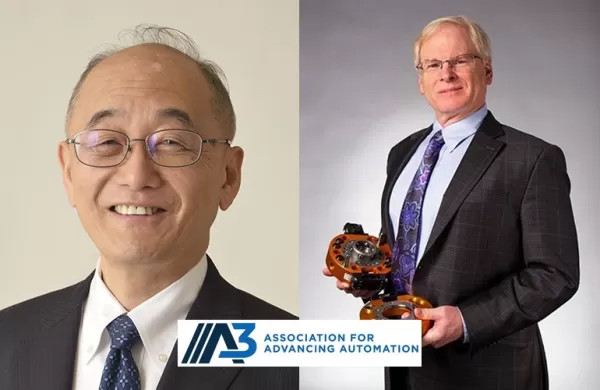
Hiroshi Fujiwara (left) and Robert Little (right) are the 2026 recipients of the Joseph F. Engelberger Robotics Award. | Credit: A3
The Association for Advancing Automation (A3) has announced Hiroshi Fujiwara and Robert Little as the winners of the 2026 Joseph F. Engelberger Robotics Awards, honoring outstanding leadership and practical application in the field.
Fujiwara, Executive Director of the Japan Robot Association (JARA), was recognized for his decades of strategic policy work and international collaboration. Robert Little, co-founder of ATI Industrial Automation, was honored for his transformative contributions to robotic end-effector technology.
They will be celebrated at the Automate 2026 show, joining an esteemed group of visionaries who have shaped the course of modern automation. The awards ceremony and dinner will take place on Wednesday, June 24, at McCormick Place in Chicago.
“Robotics has always progressed thanks to individuals who envision possibilities and then work diligently to make them practical, useful, and scalable,” said Jeff Burnstein, President of A3. “Hiroshi Fujiwara has played a key role in strengthening one of the world’s most vital robotics ecosystems while fostering collaboration across industry, government, and international markets.”
“Robert Little has dedicated his career to helping manufacturers deploy robots more effectively, providing the tools and technologies needed for flexible and reliable automation,” he added. “Together, they embody the purpose and spirit of the Engelberger Awards, and both are highly deserving of this honor.”
Little drives practical robotics adoption in manufacturing
Little brings over 40 years of experience in robotics, automation, and manufacturing. In 1989, he co-founded ATI Industrial Automation, helping grow the company from roughly $1 million to over $100 million in revenue.
Under his leadership, ATI became a global leader in robotic tool changers, force/torque sensing, and other end-effector technologies, significantly expanding the practical use of robots in manufacturing.
Following Novanta’s acquisition of ATI in 2021, Little served as President of Novanta’s ATI business group and later as Chief of Robotics Strategy. He now supports the robotics industry through Robert Little Robotics, advising companies on business strategy focused on robotics and automation markets. He also serves on the A3 Robotics Technology Strategy Board.
The Engelberger Award winner told The Robot Report that he intends to use his platform to advocate that reliability, reshoring, and physical AI will be decisive factors in whether North America regains its industrial competitive edge or falls behind.
“There is now significant pressure to reshore manufacturing,” Little stated. “There’s pressure to produce locally, whether you’re building in the U.S. for the U.S. market or in France for the European market. These manufacturers need automation to succeed.”
“We face a labor shortage. It’s not going away; it’s likely to intensify,” he said. “While government support isn’t always consistent, A3’s push for a coherent national robotics policy is a crucial step forward. More customers adopting robotics means more market activity, which in turn drives the development of new technologies.”
Little expressed strong optimism about the future of robotics in the United States.
“Robots were invented and first manufactured in the U.S.,” he noted. “I greatly admire Japan’s approach to embracing robotics. Their government implemented a policy declaring, ‘This is a pivotal technology. We will be number one in the world.’ And they achieved that; they are a leader.”
“In the U.S., we were initially skeptical, and robotics wasn’t fully embraced, so we lost much of that early manufacturing and development leadership,” Little recalled. “But not entirely. For instance, FANUC still manufactures its paint robots here for global distribution. The company actually ships paint robots from the U.S. to China.”
Fujiwara advances robotics through global collaboration
Fujiwara has served as Executive Director of JARA since 2009, leading strategic operations and policy advocacy for Japan’s robotics industry. In this role, he has been instrumental in fostering collaboration among industry leaders, government agencies, and international partners to drive innovation in both industrial and service robotics.
Prior to joining JARA, Fujiwara worked at Japan’s Ministry of Economy, Trade and Industry (METI). He retired in 2009 after nearly three decades in leadership positions encompassing industrial policy, technology development, economic security, small business support, and international trade.
Fujiwara’s extensive experience also includes leadership roles with the Japan External Trade Organization (JETRO) and the National Institute of Advanced Industrial Science and Technology (AIST). Additionally, he has worked at the Ministry of Land, Infrastructure, Transport, and Tourism and the Tokyo Institute of Technology, where he helped promote collaboration between industry, academia, and government.
About the Joseph F. Engelberger Robotics Awards
Named for Joseph F. Engelberger, widely regarded as the father of robotics, the Engelberger Awards have honored leaders in robotics since 1977 for excellence in technology development, application, education, and leadership.
Each awardee receives a $5,000 honorarium, a commemorative medallion, and a plaque. Winners are selected by a panel of industry leaders based on current and past nominations and are voted on by past chairs of A3 and the Robotic Industries Association (RIA).
Related article
 Robotics demand surges across sectors in Q2 2026, A3 reports
Automotive component makers increased robot orders, while OEMs did not in Q2. Source: A3While progress in artificial intelligence and humanoid robots continues to capture public and investor interest, industrial automation is still the leading segmen
Japan Launches World’s First National AI Infrastructure with NVIDIA
Japan's Ministry of Economy, Trade and Industry plans to deploy approximately 10 million AI-powered robots across 18 industries by 2040, addressing the country's growing labor shortage, according to NHK. Credit: NVIDIAThe Japanese government, along w
Robots in Japan Fill Unwanted Jobs, Not Replace Workers
Physical AI is emerging as a key frontier in global industry, with Japan's efforts driven largely by necessity. As workforces shrink and productivity pressures mount, companies are increasingly deploying AI-powered robots across factories, warehouses
Related Special Topic Recommendations
writing
Robotics demand surges across sectors in Q2 2026, A3 reports
Automotive component makers increased robot orders, while OEMs did not in Q2. Source: A3While progress in artificial intelligence and humanoid robots continues to capture public and investor interest, industrial automation is still the leading segmen
Japan Launches World’s First National AI Infrastructure with NVIDIA
Japan's Ministry of Economy, Trade and Industry plans to deploy approximately 10 million AI-powered robots across 18 industries by 2040, addressing the country's growing labor shortage, according to NHK. Credit: NVIDIAThe Japanese government, along w
Robots in Japan Fill Unwanted Jobs, Not Replace Workers
Physical AI is emerging as a key frontier in global industry, with Japan's efforts driven largely by necessity. As workforces shrink and productivity pressures mount, companies are increasingly deploying AI-powered robots across factories, warehouses
Related Special Topic Recommendations
writing
 AI Article Outline Tools for Long Form Writing
2026 Latest Best Top-Rated AI Article Outline Tools for Long Form Writing! This curated collection features powerful, game-changing tools that deliver accurate, structured outlines with real-world tests to boost writing efficiency significantly. XIX.AI is part of this elite selection. Get a free vs paid comparison to help you choose the perfect tool. Explore now and Unlock your AI edge!
 9 tools
 xix.ai
chatbot
Best AI Roleplay Chat Apps for Language Practice, Interview Prep, and Daily Fluency
xix.ai
chatbot
Best AI Roleplay Chat Apps for Language Practice, Interview Prep, and Daily Fluency
2026 Latest Best Top-rated AI Roleplay Chat Apps for Language Practice, Interview Prep, and Daily Fluency! XIX.AI curates a powerful game-changing collection that offers free vs paid comparison, real-world tests, and updated rankings weekly. These must-try tools help you boost writing skills, overcome fluency challenges, and improve communication efficiency across all daily scenarios. Explore now to discover your perfect tool for language growth!
10 tools
xix.ai
Music composition
AI Stem Separation Tools for Remix Production, Sampling Prep, and Karaoke Masters
2026 Latest Best Top-rated AI Stem Separation Tools Curated for Remix Production, Sampling Prep, and Karaoke Masters. These powerful game-changing tools offer real-world tests to deliver precise audio isolation, boosting productivity significantly. XIX.AI provides a weekly updated free vs paid comparison guide to help you find the must-try solution that suits your needs. Explore now to unlock your AI edge.
8 tools
xix.ai
Data Analysis
AI SQL Copilots for Revenue Dashboards, Funnel Analysis, and Product Metrics
2026 Latest Best AI SQL Copilots Ranked Top-Rated! XIX.AI curates a powerful game-changing collection for weekly updated real-world tests. These must-try tools help you generate accurate revenue dashboards, analyze sales funnels, and track product metrics swiftly, boosting productivity massively. Explore now to Discover your perfect tool for data-driven decision making! 238 characters
9 tools
xix.ai
Music composition
Best AI Melody Writing Tools for Song Drafts
2026 Latest Best Top-Rated AI Melody Writing Tools for Song Drafts! XIX.AI has curated a highly powerful game-changing collection that goes through rigorous real-world tests to deliver the best writing experience. You can find detailed free vs paid comparisons, accurate rankings, and must-try options designed to help you create stunning song drafts effortlessly and boost your creative productivity significantly. Explore now to discover your perfect tool!
8 tools
xix.ai
chatbot
Best AI Conversation Trainer Tools for Interview Practice
2026 Latest Best Top-rated AI Conversation Trainer Tools for Interview Practice are here on XIX.AI! This curated collection features powerful, game-changing tools that go through rigorous real-world tests to deliver accurate feedback. You’ll find a free vs paid comparison and detailed rankings to help you choose the must-try option that boosts your confidence and skills. Explore now to Discover your perfect tool for interview success!
12 tools
xix.ai

 Comments (1)
0/500
Comments (1)
0/500
![NicholasWalker]()
哇,這獎項頒給他們兩位真是實至名歸!Fujiwara在協作機器人安全標準方面的貢獻,還有Little在農業自動化的推動,都切中了當前產業發展的關鍵。不過看到這新聞,突然想到這些先進技術何時才能更親民、讓中小企業也用得起呢?🤔
Hiroshi Fujiwara (left) and Robert Little (right) are the 2026 recipients of the Joseph F. Engelberger Robotics Award. | Credit: A3
The Association for Advancing Automation (A3) has announced Hiroshi Fujiwara and Robert Little as the winners of the 2026 Joseph F. Engelberger Robotics Awards, honoring outstanding leadership and practical application in the field.
Fujiwara, Executive Director of the Japan Robot Association (JARA), was recognized for his decades of strategic policy work and international collaboration. Robert Little, co-founder of ATI Industrial Automation, was honored for his transformative contributions to robotic end-effector technology.
They will be celebrated at the Automate 2026 show, joining an esteemed group of visionaries who have shaped the course of modern automation. The awards ceremony and dinner will take place on Wednesday, June 24, at McCormick Place in Chicago.
“Robotics has always progressed thanks to individuals who envision possibilities and then work diligently to make them practical, useful, and scalable,” said Jeff Burnstein, President of A3. “Hiroshi Fujiwara has played a key role in strengthening one of the world’s most vital robotics ecosystems while fostering collaboration across industry, government, and international markets.”
“Robert Little has dedicated his career to helping manufacturers deploy robots more effectively, providing the tools and technologies needed for flexible and reliable automation,” he added. “Together, they embody the purpose and spirit of the Engelberger Awards, and both are highly deserving of this honor.”
Little drives practical robotics adoption in manufacturing
Little brings over 40 years of experience in robotics, automation, and manufacturing. In 1989, he co-founded ATI Industrial Automation, helping grow the company from roughly $1 million to over $100 million in revenue.
Under his leadership, ATI became a global leader in robotic tool changers, force/torque sensing, and other end-effector technologies, significantly expanding the practical use of robots in manufacturing.
Following Novanta’s acquisition of ATI in 2021, Little served as President of Novanta’s ATI business group and later as Chief of Robotics Strategy. He now supports the robotics industry through Robert Little Robotics, advising companies on business strategy focused on robotics and automation markets. He also serves on the A3 Robotics Technology Strategy Board.
The Engelberger Award winner told The Robot Report that he intends to use his platform to advocate that reliability, reshoring, and physical AI will be decisive factors in whether North America regains its industrial competitive edge or falls behind.
“There is now significant pressure to reshore manufacturing,” Little stated. “There’s pressure to produce locally, whether you’re building in the U.S. for the U.S. market or in France for the European market. These manufacturers need automation to succeed.”
“We face a labor shortage. It’s not going away; it’s likely to intensify,” he said. “While government support isn’t always consistent, A3’s push for a coherent national robotics policy is a crucial step forward. More customers adopting robotics means more market activity, which in turn drives the development of new technologies.”
Little expressed strong optimism about the future of robotics in the United States.
“Robots were invented and first manufactured in the U.S.,” he noted. “I greatly admire Japan’s approach to embracing robotics. Their government implemented a policy declaring, ‘This is a pivotal technology. We will be number one in the world.’ And they achieved that; they are a leader.”
“In the U.S., we were initially skeptical, and robotics wasn’t fully embraced, so we lost much of that early manufacturing and development leadership,” Little recalled. “But not entirely. For instance, FANUC still manufactures its paint robots here for global distribution. The company actually ships paint robots from the U.S. to China.”
Fujiwara advances robotics through global collaboration
Fujiwara has served as Executive Director of JARA since 2009, leading strategic operations and policy advocacy for Japan’s robotics industry. In this role, he has been instrumental in fostering collaboration among industry leaders, government agencies, and international partners to drive innovation in both industrial and service robotics.
Prior to joining JARA, Fujiwara worked at Japan’s Ministry of Economy, Trade and Industry (METI). He retired in 2009 after nearly three decades in leadership positions encompassing industrial policy, technology development, economic security, small business support, and international trade.
Fujiwara’s extensive experience also includes leadership roles with the Japan External Trade Organization (JETRO) and the National Institute of Advanced Industrial Science and Technology (AIST). Additionally, he has worked at the Ministry of Land, Infrastructure, Transport, and Tourism and the Tokyo Institute of Technology, where he helped promote collaboration between industry, academia, and government.
About the Joseph F. Engelberger Robotics Awards
Named for Joseph F. Engelberger, widely regarded as the father of robotics, the Engelberger Awards have honored leaders in robotics since 1977 for excellence in technology development, application, education, and leadership.
Each awardee receives a $5,000 honorarium, a commemorative medallion, and a plaque. Winners are selected by a panel of industry leaders based on current and past nominations and are voted on by past chairs of A3 and the Robotic Industries Association (RIA).








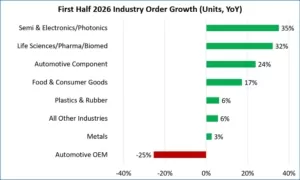 Robotics demand surges across sectors in Q2 2026, A3 reports
Automotive component makers increased robot orders, while OEMs did not in Q2. Source: A3While progress in artificial intelligence and humanoid robots continues to capture public and investor interest, industrial automation is still the leading segmen
Robotics demand surges across sectors in Q2 2026, A3 reports
Automotive component makers increased robot orders, while OEMs did not in Q2. Source: A3While progress in artificial intelligence and humanoid robots continues to capture public and investor interest, industrial automation is still the leading segmen
 Japan Launches World’s First National AI Infrastructure with NVIDIA
Japan's Ministry of Economy, Trade and Industry plans to deploy approximately 10 million AI-powered robots across 18 industries by 2040, addressing the country's growing labor shortage, according to NHK. Credit: NVIDIAThe Japanese government, along w
Japan Launches World’s First National AI Infrastructure with NVIDIA
Japan's Ministry of Economy, Trade and Industry plans to deploy approximately 10 million AI-powered robots across 18 industries by 2040, addressing the country's growing labor shortage, according to NHK. Credit: NVIDIAThe Japanese government, along w
 Robots in Japan Fill Unwanted Jobs, Not Replace Workers
Physical AI is emerging as a key frontier in global industry, with Japan's efforts driven largely by necessity. As workforces shrink and productivity pressures mount, companies are increasingly deploying AI-powered robots across factories, warehouses
Robots in Japan Fill Unwanted Jobs, Not Replace Workers
Physical AI is emerging as a key frontier in global industry, with Japan's efforts driven largely by necessity. As workforces shrink and productivity pressures mount, companies are increasingly deploying AI-powered robots across factories, warehouses

2026 Latest Best Top-Rated AI Article Outline Tools for Long Form Writing! This curated collection features powerful, game-changing tools that deliver accurate, structured outlines with real-world tests to boost writing efficiency significantly. XIX.AI is part of this elite selection. Get a free vs paid comparison to help you choose the perfect tool. Explore now and Unlock your AI edge!
9 tools
xix.ai

2026 Latest Best Top-rated AI Roleplay Chat Apps for Language Practice, Interview Prep, and Daily Fluency! XIX.AI curates a powerful game-changing collection that offers free vs paid comparison, real-world tests, and updated rankings weekly. These must-try tools help you boost writing skills, overcome fluency challenges, and improve communication efficiency across all daily scenarios. Explore now to discover your perfect tool for language growth!
10 tools
xix.ai

2026 Latest Best Top-rated AI Stem Separation Tools Curated for Remix Production, Sampling Prep, and Karaoke Masters. These powerful game-changing tools offer real-world tests to deliver precise audio isolation, boosting productivity significantly. XIX.AI provides a weekly updated free vs paid comparison guide to help you find the must-try solution that suits your needs. Explore now to unlock your AI edge.
8 tools
xix.ai

2026 Latest Best AI SQL Copilots Ranked Top-Rated! XIX.AI curates a powerful game-changing collection for weekly updated real-world tests. These must-try tools help you generate accurate revenue dashboards, analyze sales funnels, and track product metrics swiftly, boosting productivity massively. Explore now to Discover your perfect tool for data-driven decision making! 238 characters
9 tools
xix.ai

2026 Latest Best Top-Rated AI Melody Writing Tools for Song Drafts! XIX.AI has curated a highly powerful game-changing collection that goes through rigorous real-world tests to deliver the best writing experience. You can find detailed free vs paid comparisons, accurate rankings, and must-try options designed to help you create stunning song drafts effortlessly and boost your creative productivity significantly. Explore now to discover your perfect tool!
8 tools
xix.ai

2026 Latest Best Top-rated AI Conversation Trainer Tools for Interview Practice are here on XIX.AI! This curated collection features powerful, game-changing tools that go through rigorous real-world tests to deliver accurate feedback. You’ll find a free vs paid comparison and detailed rankings to help you choose the must-try option that boosts your confidence and skills. Explore now to Discover your perfect tool for interview success!
12 tools
xix.ai

哇,這獎項頒給他們兩位真是實至名歸!Fujiwara在協作機器人安全標準方面的貢獻,還有Little在農業自動化的推動,都切中了當前產業發展的關鍵。不過看到這新聞,突然想到這些先進技術何時才能更親民、讓中小企業也用得起呢?🤔












