


 Home
HomeAnthropic's New Tool Reveals Exactly Why LLMs Fail
Large language models (LLMs) are revolutionizing enterprise operations, yet their opaque decision-making processes often create unpredictability challenges. To address this, Anthropic open-sourced its circuit tracing tool, enabling developers to peer inside models and modify their core mechanisms.
This breakthrough tool helps diagnose erratic behaviors in open-weight models while enabling precise tuning for specialized business applications.
Decoding AI decision pathways
The tool leverages "mechanistic interpretability" - analyzing neural activations rather than just inputs and outputs. Originally developed for Claude 3.5 Haiku, it now works with models like Gemma-2-2b and Llama-3.2-1b, complete with instructional Colab notebooks.
Its attribution graphs function like AI blueprints, mapping how internal features interact during reasoning. Researchers can experimentally modify these neural pathways and observe behavioral changes - essentially debugging AI cognition.
Integration with Neuronpedia creates an open ecosystem for neural network experimentation.
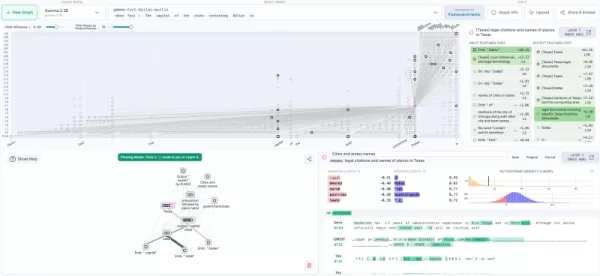
Circuit tracing visualization on Neuronpedia (source: Anthropic blog) Enterprise implementation roadmap
While groundbreaking, the tool faces obstacles like high memory demands and complex interpretation requirements - typical frontier research challenges. Its open-source nature accelerates community-driven improvements toward scalable, automated solutions.
Practical business benefits emerge as the technology matures:
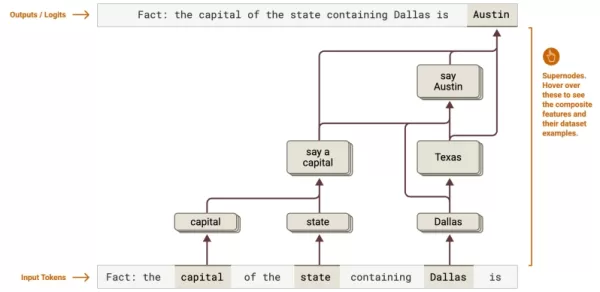
Source: Anthropic Cognitive mapping: Reveals multi-step reasoning chains - like tracing Texas capital determination from Dallas to Austin. Enterprises can optimize complex workflows in legal analysis or data processing.
Numerical transparency: Exposes unique calculation methods, detecting arithmetic errors in financial models while ensuring computational integrity.
Multilingual consistency: Identifies universal versus language-specific circuits, troubleshooting localization issues in global deployments.
Hallucination reduction: Pinpoints faulty "default refusal" circuits that cause inaccurate responses when overridden.
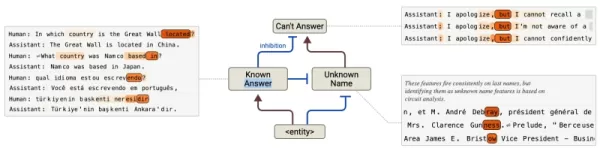
Source: Anthropic Beyond troubleshooting, these insights enable surgical model optimization. Instead of superficial output tweaking, businesses can directly adjust underlying mechanisms - correcting alignment biases in assistant personas or reinforcing ethical constraints.
As LLMs assume mission-critical roles, such interpretability tools become essential for building trustworthy, auditable AI systems that align with organizational values and compliance requirements.
Related article
 Base44 Unveils Proprietary AI Model to Bolster Defensibility in Vibe Coding Platform
Base44, the vibe coding platform acquired by Wix for $80 million just a year ago — when it was merely six months old with a team of eight — has begun deploying its proprietary AI model to help users build applications using natural language.This deve
Bayer Leverages Iambic AI to Speed Drug Discovery
Juergen Eckhardt, M.D., serves as Head of Business Development and Licensing at Bayer Pharmaceuticals.Bayer is leveraging Iambic Therapeutics to deploy frontier AI models for drug discovery, alongside a major decarbonization project at its plant in S
Multiverse Computing Launches Free Compressed Generative AI Model
Large language models face a significant challenge: their immense size. Spanish startup Multiverse Computing is tackling this problem by creating compressed models designed to bridge the gap between the capabilities of cutting-edge AI and what busine
Related Special Topic Recommendations
Data Analysis
Base44 Unveils Proprietary AI Model to Bolster Defensibility in Vibe Coding Platform
Base44, the vibe coding platform acquired by Wix for $80 million just a year ago — when it was merely six months old with a team of eight — has begun deploying its proprietary AI model to help users build applications using natural language.This deve
Bayer Leverages Iambic AI to Speed Drug Discovery
Juergen Eckhardt, M.D., serves as Head of Business Development and Licensing at Bayer Pharmaceuticals.Bayer is leveraging Iambic Therapeutics to deploy frontier AI models for drug discovery, alongside a major decarbonization project at its plant in S
Multiverse Computing Launches Free Compressed Generative AI Model
Large language models face a significant challenge: their immense size. Spanish startup Multiverse Computing is tackling this problem by creating compressed models designed to bridge the gap between the capabilities of cutting-edge AI and what busine
Related Special Topic Recommendations
Data Analysis
 AI SQL Copilots for Revenue Dashboards, Funnel Analysis, and Product Metrics
2026 Latest Best AI SQL Copilots Ranked Top-Rated! XIX.AI curates a powerful game-changing collection for weekly updated real-world tests. These must-try tools help you generate accurate revenue dashboards, analyze sales funnels, and track product metrics swiftly, boosting productivity massively. Explore now to Discover your perfect tool for data-driven decision making! 238 characters
 9 tools
 xix.ai
Music composition
Best AI Melody Writing Tools for Song Drafts
xix.ai
Music composition
Best AI Melody Writing Tools for Song Drafts
2026 Latest Best Top-Rated AI Melody Writing Tools for Song Drafts! XIX.AI has curated a highly powerful game-changing collection that goes through rigorous real-world tests to deliver the best writing experience. You can find detailed free vs paid comparisons, accurate rankings, and must-try options designed to help you create stunning song drafts effortlessly and boost your creative productivity significantly. Explore now to discover your perfect tool!
8 tools
xix.ai
chatbot
Best AI Conversation Trainer Tools for Interview Practice
2026 Latest Best Top-rated AI Conversation Trainer Tools for Interview Practice are here on XIX.AI! This curated collection features powerful, game-changing tools that go through rigorous real-world tests to deliver accurate feedback. You’ll find a free vs paid comparison and detailed rankings to help you choose the must-try option that boosts your confidence and skills. Explore now to Discover your perfect tool for interview success!
12 tools
xix.ai
Design & Art
Best AI Style Transfer Tools for Creative Experiments
2026 Latest Best Top-rated AI Style Transfer Tools for Creative Experiments! XIX.AI has curated a powerful, game-changing collection of must-try tools that deliver exceptional results through real-world tests and rigorous rankings. These top solutions help creatives boost productivity significantly by accelerating content creation and unlocking endless creative possibilities. Explore now to discover your perfect tool and start creating today!
9 tools
xix.ai
Comic Creation
Best AI Dialogue Bubble Tools for Visual Storytelling
2026 Latest Best Top-Rated AI Dialogue Bubble Tools for Visual Storytelling are here on XIX.AI! This curated collection features powerful, game-changing tools that help creators boost productivity and overcome creative bottlenecks. Get a free vs paid comparison, see real-world tests, and check the latest rankings to find the must-try solutions perfect for crafting engaging visual narratives. Explore now to discover your ideal tool!
10 tools
xix.ai
Meeting Assistant
Top AI Meeting Summary Tools: Track Decisions and Follow-Ups Clearly
2026 Latest Top-Rated Best AI Meeting Summary Tools for Clear Decision Tracking and Effortless Follow-Ups. This curated list showcases powerful, game-changing solutions that boost productivity dramatically by automating meeting notes, identifying key action items, and streamlining team coordination across all projects. Get a free vs paid comparison along with real-world tests and weekly updated rankings to help you find the perfect tool. Explore now to unlock your AI edge!
9 tools
xix.ai

 Comments (3)
0/500
Comments (3)
0/500
![GeorgeMartinez]()
Anthropicの新しいツール、LLMの失敗理由を明確に示すってすごいね。企業の業務でLLMが使われてるけど、判断プロセスがブラックボックスすぎて困ってた人にとっては朗報かも。でも、回路トレースって言われても私には難しすぎる…😅 開発者なら嬉しいだろうけど、一般ユーザーには少し遠い話だな。AIの透明性向上には役立ちそうだけど、実用化までにはまだ時間がかかりそうだね。
![ScottPerez]()
¡Qué herramienta más necesaria! Siempre me ha dado desconfianza que estos modelos tan poderosos funcionen como una 'caja negra'. Que Anthropic abra esto, aunque sea un primer paso, me parece crucial para avanzar con más responsabilidad. ¿Creéis que pronto será algo estándar en todas las APIs? 🤔 Esta transparencia es clave para usos serios en empresas.
![BruceMartínez]()
This tool could be a game-changer for debugging LLM failures! 🌟 Finally some transparency in these black boxes. Makes me wonder if other AI labs will follow suit with similar diagnostic tools. However, the real question is: will this actually help prevent those weird biased outputs we sometimes see?
Large language models (LLMs) are revolutionizing enterprise operations, yet their opaque decision-making processes often create unpredictability challenges. To address this, Anthropic open-sourced its circuit tracing tool, enabling developers to peer inside models and modify their core mechanisms.
This breakthrough tool helps diagnose erratic behaviors in open-weight models while enabling precise tuning for specialized business applications.
Decoding AI decision pathways
The tool leverages "mechanistic interpretability" - analyzing neural activations rather than just inputs and outputs. Originally developed for Claude 3.5 Haiku, it now works with models like Gemma-2-2b and Llama-3.2-1b, complete with instructional Colab notebooks.
Its attribution graphs function like AI blueprints, mapping how internal features interact during reasoning. Researchers can experimentally modify these neural pathways and observe behavioral changes - essentially debugging AI cognition.
Integration with Neuronpedia creates an open ecosystem for neural network experimentation.
Enterprise implementation roadmap
While groundbreaking, the tool faces obstacles like high memory demands and complex interpretation requirements - typical frontier research challenges. Its open-source nature accelerates community-driven improvements toward scalable, automated solutions.
Practical business benefits emerge as the technology matures:
Cognitive mapping: Reveals multi-step reasoning chains - like tracing Texas capital determination from Dallas to Austin. Enterprises can optimize complex workflows in legal analysis or data processing.
Numerical transparency: Exposes unique calculation methods, detecting arithmetic errors in financial models while ensuring computational integrity.
Multilingual consistency: Identifies universal versus language-specific circuits, troubleshooting localization issues in global deployments.
Hallucination reduction: Pinpoints faulty "default refusal" circuits that cause inaccurate responses when overridden.
Beyond troubleshooting, these insights enable surgical model optimization. Instead of superficial output tweaking, businesses can directly adjust underlying mechanisms - correcting alignment biases in assistant personas or reinforcing ethical constraints.
As LLMs assume mission-critical roles, such interpretability tools become essential for building trustworthy, auditable AI systems that align with organizational values and compliance requirements.








 Base44 Unveils Proprietary AI Model to Bolster Defensibility in Vibe Coding Platform
Base44, the vibe coding platform acquired by Wix for $80 million just a year ago — when it was merely six months old with a team of eight — has begun deploying its proprietary AI model to help users build applications using natural language.This deve
Base44 Unveils Proprietary AI Model to Bolster Defensibility in Vibe Coding Platform
Base44, the vibe coding platform acquired by Wix for $80 million just a year ago — when it was merely six months old with a team of eight — has begun deploying its proprietary AI model to help users build applications using natural language.This deve
 Bayer Leverages Iambic AI to Speed Drug Discovery
Juergen Eckhardt, M.D., serves as Head of Business Development and Licensing at Bayer Pharmaceuticals.Bayer is leveraging Iambic Therapeutics to deploy frontier AI models for drug discovery, alongside a major decarbonization project at its plant in S
Bayer Leverages Iambic AI to Speed Drug Discovery
Juergen Eckhardt, M.D., serves as Head of Business Development and Licensing at Bayer Pharmaceuticals.Bayer is leveraging Iambic Therapeutics to deploy frontier AI models for drug discovery, alongside a major decarbonization project at its plant in S
 Multiverse Computing Launches Free Compressed Generative AI Model
Large language models face a significant challenge: their immense size. Spanish startup Multiverse Computing is tackling this problem by creating compressed models designed to bridge the gap between the capabilities of cutting-edge AI and what busine
Multiverse Computing Launches Free Compressed Generative AI Model
Large language models face a significant challenge: their immense size. Spanish startup Multiverse Computing is tackling this problem by creating compressed models designed to bridge the gap between the capabilities of cutting-edge AI and what busine

2026 Latest Best AI SQL Copilots Ranked Top-Rated! XIX.AI curates a powerful game-changing collection for weekly updated real-world tests. These must-try tools help you generate accurate revenue dashboards, analyze sales funnels, and track product metrics swiftly, boosting productivity massively. Explore now to Discover your perfect tool for data-driven decision making! 238 characters
9 tools
xix.ai

2026 Latest Best Top-Rated AI Melody Writing Tools for Song Drafts! XIX.AI has curated a highly powerful game-changing collection that goes through rigorous real-world tests to deliver the best writing experience. You can find detailed free vs paid comparisons, accurate rankings, and must-try options designed to help you create stunning song drafts effortlessly and boost your creative productivity significantly. Explore now to discover your perfect tool!
8 tools
xix.ai

2026 Latest Best Top-rated AI Conversation Trainer Tools for Interview Practice are here on XIX.AI! This curated collection features powerful, game-changing tools that go through rigorous real-world tests to deliver accurate feedback. You’ll find a free vs paid comparison and detailed rankings to help you choose the must-try option that boosts your confidence and skills. Explore now to Discover your perfect tool for interview success!
12 tools
xix.ai

2026 Latest Best Top-rated AI Style Transfer Tools for Creative Experiments! XIX.AI has curated a powerful, game-changing collection of must-try tools that deliver exceptional results through real-world tests and rigorous rankings. These top solutions help creatives boost productivity significantly by accelerating content creation and unlocking endless creative possibilities. Explore now to discover your perfect tool and start creating today!
9 tools
xix.ai

2026 Latest Best Top-Rated AI Dialogue Bubble Tools for Visual Storytelling are here on XIX.AI! This curated collection features powerful, game-changing tools that help creators boost productivity and overcome creative bottlenecks. Get a free vs paid comparison, see real-world tests, and check the latest rankings to find the must-try solutions perfect for crafting engaging visual narratives. Explore now to discover your ideal tool!
10 tools
xix.ai
2026 Latest Top-Rated Best AI Meeting Summary Tools for Clear Decision Tracking and Effortless Follow-Ups. This curated list showcases powerful, game-changing solutions that boost productivity dramatically by automating meeting notes, identifying key action items, and streamlining team coordination across all projects. Get a free vs paid comparison along with real-world tests and weekly updated rankings to help you find the perfect tool. Explore now to unlock your AI edge!
9 tools
xix.ai

Anthropicの新しいツール、LLMの失敗理由を明確に示すってすごいね。企業の業務でLLMが使われてるけど、判断プロセスがブラックボックスすぎて困ってた人にとっては朗報かも。でも、回路トレースって言われても私には難しすぎる…😅 開発者なら嬉しいだろうけど、一般ユーザーには少し遠い話だな。AIの透明性向上には役立ちそうだけど、実用化までにはまだ時間がかかりそうだね。
¡Qué herramienta más necesaria! Siempre me ha dado desconfianza que estos modelos tan poderosos funcionen como una 'caja negra'. Que Anthropic abra esto, aunque sea un primer paso, me parece crucial para avanzar con más responsabilidad. ¿Creéis que pronto será algo estándar en todas las APIs? 🤔 Esta transparencia es clave para usos serios en empresas.
This tool could be a game-changer for debugging LLM failures! 🌟 Finally some transparency in these black boxes. Makes me wonder if other AI labs will follow suit with similar diagnostic tools. However, the real question is: will this actually help prevent those weird biased outputs we sometimes see?












