


 Home
HomeCopilotKit secures $27M to help developers deploy app-native AI agents
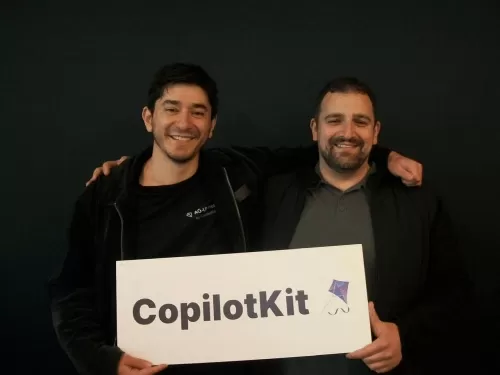
Many companies today offer AI merely as a chatbot embedded in their apps. Users type or dictate instructions, and the AI bot attempts to execute them. However, the experience often feels clunky. A text-based interface doesn't always deliver a smooth experience—for instance, when using a travel app to book a full itinerary, you might have to scroll through large amounts of text.
CopilotKit's founders believe this approach doesn't fully leverage the capabilities of AI agents and LLMs. Co-founders Atai Barkai (right in the image above) and Uli Barkai (left) see the future as enabling agents to operate within applications, understand user actions, take relevant steps, and present useful interfaces rather than merely returning lengthy text blocks.
CopilotKit's widely used AG-UI protocol addresses the first part of that vision. This open-source standard defines how AI agents connect and interact with user interfaces—such as web browsers or apps—offering features like streaming chat, front-end tool calls, and state sharing to support human-in-the-loop workflows. In essence, AG-UI provides developers with the framework and tools to embed AI agents inside their applications.
CopilotKit is also developing an enterprise toolkit built on AG-UI, adding support, self-hosted deployment options, and other essential features for companies considering integrating agents into their products. To bring this toolkit to market, the Seattle-based startup has raised $27 million in a Series A round led by Glilot Capital, NFX, and SignalFire, TechCrunch has exclusively learned.
The flexibility of the user interface is a key selling point. CEO Atai Barkai told TechCrunch that developers can use the startup's framework to define specifications and building blocks for dynamic interfaces, which an AI agent can then use to generate context-appropriate UIs.
“The agent can respond not just with text blocks but with interactive UIs designed by your own company,” Atai explained. “For instance, if a user asks for a revenue breakdown by category, instead of a dense, hard-to-read paragraph, they get a pie chart—your own pie chart design—that they can interact with [...] So all your agents can easily communicate with a UI, use the component catalog, and present that to users.”
Atai also noted that CopilotKit's toolkit gives developers complete control over how much their AI agent can modify the UI. They can choose to make the interface “pixel-perfect” or simply provide broad building blocks that the AI can assemble as needed.
The funding comes after a period of strong adoption for both AG-UI and CopilotKit. The protocol, which works alongside the widely used Model Context Protocol (MCP) and Agent2Agent (A2A) protocol, is now supported by major AI infrastructure providers such as Google, Microsoft, Amazon, and Oracle, as well as popular frameworks like LangChain, Mastra, PydanticAI, and Agno.
Atai said that CopilotKit and AG-UI—the company's strongest claim to ecosystem relevance—see millions of installs each week, and a large portion of Fortune 500 companies use the protocol and the startup's tools in production. Additionally, CopilotKit counts enterprise giants like Deutsche Telekom, Docusign, Cisco, and S&P Global as its customers.
To capitalize on this growing interest, the company is also launching CopilotKit Enterprise Intelligence, a self-hostable solution that bundles several infrastructure features for fully deploying agents within applications.
CopilotKit faces intense competition in the enterprise agent tools market. Cloud platform Vercel's open-source AI SDK helps developers build AI applications with similar capabilities, while Assistant-ui provides components for creating AI chat interfaces. Meanwhile, OpenAI's Apps SDK also offers a way to build richer interfaces, but only within ChatGPT.
Atai argues that CopilotKit differs from these offerings because it takes a horizontal, enterprise-friendly approach rather than a vertically integrated one. Instead of providing a full-stack AI platform, CopilotKit aims to support whatever agent framework, cloud provider, or backend an enterprise already has.
“If there are two things we hear in almost every enterprise conversation, it's that they want optionality and self-hosting,” he said. “They might already be using the Google, Amazon, Oracle, Microsoft, LangChain, or Mastra stacks. They want optionality and self-hosting—two things they don’t really get from the Vercel stack.”
Maintaining that open positioning will be crucial. Companies that build on their own open-source infrastructure often face a tension: they want their technology to remain a neutral standard while also building a business on top of it. However, Atai said that AG-UI is a fully open protocol, and CopilotKit's commercial product is designed to strengthen the open-source stack for enterprises, not replace it.
“They are very complementary. Our strategy is to become the default choice in the ecosystem and then monetize the top enterprises,” added Uli, the startup's head of growth. “So it's in our best interest that the open source is the best available, and that 95% of users can just build and get started without paying or talking to anyone.”
The company currently has about 25 employees and plans to use the new funding to expand its team.
Related article
 Sesame, AI Startup by Oculus Founders, Debuts on iOS
On Thursday, Sesame, an AI startup founded by the creators of Oculus and other former Meta VR team members, unveiled a public preview of its conversational AI agents, which have been in development for over a year. Through its new iOS application, Se
NEA’s Tiffany Luck: Enterprises Still Grappling With AI ROI
Loading the player…Earlier this year, “tokenmaxxing” dominated Silicon Valley, with CEOs urging staff to maximize AI usage. That enthusiasm quickly met reality. Uber reportedly exceeded its annual AI budget within months, some firms reduced Claude li
OpenAI launches new initiative to help find and patch open-source bugs
OpenAI launched a new initiative Monday to bolster open source cybersecurity and mitigate vulnerabilities.“Patch the Planet,” a nod to the 1995 film Hackers, partners OpenAI with security firm Trail of Bits to help maintainers secure their projects.T
Related Special Topic Recommendations
chatbot
Sesame, AI Startup by Oculus Founders, Debuts on iOS
On Thursday, Sesame, an AI startup founded by the creators of Oculus and other former Meta VR team members, unveiled a public preview of its conversational AI agents, which have been in development for over a year. Through its new iOS application, Se
NEA’s Tiffany Luck: Enterprises Still Grappling With AI ROI
Loading the player…Earlier this year, “tokenmaxxing” dominated Silicon Valley, with CEOs urging staff to maximize AI usage. That enthusiasm quickly met reality. Uber reportedly exceeded its annual AI budget within months, some firms reduced Claude li
OpenAI launches new initiative to help find and patch open-source bugs
OpenAI launched a new initiative Monday to bolster open source cybersecurity and mitigate vulnerabilities.“Patch the Planet,” a nod to the 1995 film Hackers, partners OpenAI with security firm Trail of Bits to help maintainers secure their projects.T
Related Special Topic Recommendations
chatbot
 Best AI Roleplay Chat Apps for Language Practice, Interview Prep, and Daily Fluency
2026 Latest Best Top-rated AI Roleplay Chat Apps for Language Practice, Interview Prep, and Daily Fluency! XIX.AI curates a powerful game-changing collection that offers free vs paid comparison, real-world tests, and updated rankings weekly. These must-try tools help you boost writing skills, overcome fluency challenges, and improve communication efficiency across all daily scenarios. Explore now to discover your perfect tool for language growth!
 10 tools
 xix.ai
Music composition
AI Stem Separation Tools for Remix Production, Sampling Prep, and Karaoke Masters
xix.ai
Music composition
AI Stem Separation Tools for Remix Production, Sampling Prep, and Karaoke Masters
2026 Latest Best Top-rated AI Stem Separation Tools Curated for Remix Production, Sampling Prep, and Karaoke Masters. These powerful game-changing tools offer real-world tests to deliver precise audio isolation, boosting productivity significantly. XIX.AI provides a weekly updated free vs paid comparison guide to help you find the must-try solution that suits your needs. Explore now to unlock your AI edge.
8 tools
xix.ai
Data Analysis
AI SQL Copilots for Revenue Dashboards, Funnel Analysis, and Product Metrics
2026 Latest Best AI SQL Copilots Ranked Top-Rated! XIX.AI curates a powerful game-changing collection for weekly updated real-world tests. These must-try tools help you generate accurate revenue dashboards, analyze sales funnels, and track product metrics swiftly, boosting productivity massively. Explore now to Discover your perfect tool for data-driven decision making! 238 characters
9 tools
xix.ai
Music composition
Best AI Melody Writing Tools for Song Drafts
2026 Latest Best Top-Rated AI Melody Writing Tools for Song Drafts! XIX.AI has curated a highly powerful game-changing collection that goes through rigorous real-world tests to deliver the best writing experience. You can find detailed free vs paid comparisons, accurate rankings, and must-try options designed to help you create stunning song drafts effortlessly and boost your creative productivity significantly. Explore now to discover your perfect tool!
8 tools
xix.ai
chatbot
Best AI Conversation Trainer Tools for Interview Practice
2026 Latest Best Top-rated AI Conversation Trainer Tools for Interview Practice are here on XIX.AI! This curated collection features powerful, game-changing tools that go through rigorous real-world tests to deliver accurate feedback. You’ll find a free vs paid comparison and detailed rankings to help you choose the must-try option that boosts your confidence and skills. Explore now to Discover your perfect tool for interview success!
12 tools
xix.ai
Design & Art
Best AI Style Transfer Tools for Creative Experiments
2026 Latest Best Top-rated AI Style Transfer Tools for Creative Experiments! XIX.AI has curated a powerful, game-changing collection of must-try tools that deliver exceptional results through real-world tests and rigorous rankings. These top solutions help creatives boost productivity significantly by accelerating content creation and unlocking endless creative possibilities. Explore now to discover your perfect tool and start creating today!
9 tools
xix.ai

 Comments (0)
0/500
Comments (0)
0/500
Many companies today offer AI merely as a chatbot embedded in their apps. Users type or dictate instructions, and the AI bot attempts to execute them. However, the experience often feels clunky. A text-based interface doesn't always deliver a smooth experience—for instance, when using a travel app to book a full itinerary, you might have to scroll through large amounts of text.
CopilotKit's founders believe this approach doesn't fully leverage the capabilities of AI agents and LLMs. Co-founders Atai Barkai (right in the image above) and Uli Barkai (left) see the future as enabling agents to operate within applications, understand user actions, take relevant steps, and present useful interfaces rather than merely returning lengthy text blocks.
CopilotKit's widely used AG-UI protocol addresses the first part of that vision. This open-source standard defines how AI agents connect and interact with user interfaces—such as web browsers or apps—offering features like streaming chat, front-end tool calls, and state sharing to support human-in-the-loop workflows. In essence, AG-UI provides developers with the framework and tools to embed AI agents inside their applications.
CopilotKit is also developing an enterprise toolkit built on AG-UI, adding support, self-hosted deployment options, and other essential features for companies considering integrating agents into their products. To bring this toolkit to market, the Seattle-based startup has raised $27 million in a Series A round led by Glilot Capital, NFX, and SignalFire, TechCrunch has exclusively learned.
The flexibility of the user interface is a key selling point. CEO Atai Barkai told TechCrunch that developers can use the startup's framework to define specifications and building blocks for dynamic interfaces, which an AI agent can then use to generate context-appropriate UIs.
“The agent can respond not just with text blocks but with interactive UIs designed by your own company,” Atai explained. “For instance, if a user asks for a revenue breakdown by category, instead of a dense, hard-to-read paragraph, they get a pie chart—your own pie chart design—that they can interact with [...] So all your agents can easily communicate with a UI, use the component catalog, and present that to users.”
Atai also noted that CopilotKit's toolkit gives developers complete control over how much their AI agent can modify the UI. They can choose to make the interface “pixel-perfect” or simply provide broad building blocks that the AI can assemble as needed.
The funding comes after a period of strong adoption for both AG-UI and CopilotKit. The protocol, which works alongside the widely used Model Context Protocol (MCP) and Agent2Agent (A2A) protocol, is now supported by major AI infrastructure providers such as Google, Microsoft, Amazon, and Oracle, as well as popular frameworks like LangChain, Mastra, PydanticAI, and Agno.
Atai said that CopilotKit and AG-UI—the company's strongest claim to ecosystem relevance—see millions of installs each week, and a large portion of Fortune 500 companies use the protocol and the startup's tools in production. Additionally, CopilotKit counts enterprise giants like Deutsche Telekom, Docusign, Cisco, and S&P Global as its customers.
To capitalize on this growing interest, the company is also launching CopilotKit Enterprise Intelligence, a self-hostable solution that bundles several infrastructure features for fully deploying agents within applications.
CopilotKit faces intense competition in the enterprise agent tools market. Cloud platform Vercel's open-source AI SDK helps developers build AI applications with similar capabilities, while Assistant-ui provides components for creating AI chat interfaces. Meanwhile, OpenAI's Apps SDK also offers a way to build richer interfaces, but only within ChatGPT.
Atai argues that CopilotKit differs from these offerings because it takes a horizontal, enterprise-friendly approach rather than a vertically integrated one. Instead of providing a full-stack AI platform, CopilotKit aims to support whatever agent framework, cloud provider, or backend an enterprise already has.
“If there are two things we hear in almost every enterprise conversation, it's that they want optionality and self-hosting,” he said. “They might already be using the Google, Amazon, Oracle, Microsoft, LangChain, or Mastra stacks. They want optionality and self-hosting—two things they don’t really get from the Vercel stack.”
Maintaining that open positioning will be crucial. Companies that build on their own open-source infrastructure often face a tension: they want their technology to remain a neutral standard while also building a business on top of it. However, Atai said that AG-UI is a fully open protocol, and CopilotKit's commercial product is designed to strengthen the open-source stack for enterprises, not replace it.
“They are very complementary. Our strategy is to become the default choice in the ecosystem and then monetize the top enterprises,” added Uli, the startup's head of growth. “So it's in our best interest that the open source is the best available, and that 95% of users can just build and get started without paying or talking to anyone.”
The company currently has about 25 employees and plans to use the new funding to expand its team.








 Sesame, AI Startup by Oculus Founders, Debuts on iOS
On Thursday, Sesame, an AI startup founded by the creators of Oculus and other former Meta VR team members, unveiled a public preview of its conversational AI agents, which have been in development for over a year. Through its new iOS application, Se
Sesame, AI Startup by Oculus Founders, Debuts on iOS
On Thursday, Sesame, an AI startup founded by the creators of Oculus and other former Meta VR team members, unveiled a public preview of its conversational AI agents, which have been in development for over a year. Through its new iOS application, Se
 NEA’s Tiffany Luck: Enterprises Still Grappling With AI ROI
Loading the player…Earlier this year, “tokenmaxxing” dominated Silicon Valley, with CEOs urging staff to maximize AI usage. That enthusiasm quickly met reality. Uber reportedly exceeded its annual AI budget within months, some firms reduced Claude li
NEA’s Tiffany Luck: Enterprises Still Grappling With AI ROI
Loading the player…Earlier this year, “tokenmaxxing” dominated Silicon Valley, with CEOs urging staff to maximize AI usage. That enthusiasm quickly met reality. Uber reportedly exceeded its annual AI budget within months, some firms reduced Claude li
 OpenAI launches new initiative to help find and patch open-source bugs
OpenAI launched a new initiative Monday to bolster open source cybersecurity and mitigate vulnerabilities.“Patch the Planet,” a nod to the 1995 film Hackers, partners OpenAI with security firm Trail of Bits to help maintainers secure their projects.T
OpenAI launches new initiative to help find and patch open-source bugs
OpenAI launched a new initiative Monday to bolster open source cybersecurity and mitigate vulnerabilities.“Patch the Planet,” a nod to the 1995 film Hackers, partners OpenAI with security firm Trail of Bits to help maintainers secure their projects.T

2026 Latest Best Top-rated AI Roleplay Chat Apps for Language Practice, Interview Prep, and Daily Fluency! XIX.AI curates a powerful game-changing collection that offers free vs paid comparison, real-world tests, and updated rankings weekly. These must-try tools help you boost writing skills, overcome fluency challenges, and improve communication efficiency across all daily scenarios. Explore now to discover your perfect tool for language growth!
10 tools
xix.ai

2026 Latest Best Top-rated AI Stem Separation Tools Curated for Remix Production, Sampling Prep, and Karaoke Masters. These powerful game-changing tools offer real-world tests to deliver precise audio isolation, boosting productivity significantly. XIX.AI provides a weekly updated free vs paid comparison guide to help you find the must-try solution that suits your needs. Explore now to unlock your AI edge.
8 tools
xix.ai

2026 Latest Best AI SQL Copilots Ranked Top-Rated! XIX.AI curates a powerful game-changing collection for weekly updated real-world tests. These must-try tools help you generate accurate revenue dashboards, analyze sales funnels, and track product metrics swiftly, boosting productivity massively. Explore now to Discover your perfect tool for data-driven decision making! 238 characters
9 tools
xix.ai

2026 Latest Best Top-Rated AI Melody Writing Tools for Song Drafts! XIX.AI has curated a highly powerful game-changing collection that goes through rigorous real-world tests to deliver the best writing experience. You can find detailed free vs paid comparisons, accurate rankings, and must-try options designed to help you create stunning song drafts effortlessly and boost your creative productivity significantly. Explore now to discover your perfect tool!
8 tools
xix.ai
2026 Latest Best Top-rated AI Conversation Trainer Tools for Interview Practice are here on XIX.AI! This curated collection features powerful, game-changing tools that go through rigorous real-world tests to deliver accurate feedback. You’ll find a free vs paid comparison and detailed rankings to help you choose the must-try option that boosts your confidence and skills. Explore now to Discover your perfect tool for interview success!
12 tools
xix.ai

2026 Latest Best Top-rated AI Style Transfer Tools for Creative Experiments! XIX.AI has curated a powerful, game-changing collection of must-try tools that deliver exceptional results through real-world tests and rigorous rankings. These top solutions help creatives boost productivity significantly by accelerating content creation and unlocking endless creative possibilities. Explore now to discover your perfect tool and start creating today!
9 tools
xix.ai












