


 Home
HomeWorms and Springs Inspire Soft Robot Breakthroughs
Researchers at Georgia Tech have achieved an impressive feat: a 5-inch soft robot that can hurl itself 10 feet into the air, reaching the height of a basketball hoop, despite having no legs. The design draws inspiration from the unassuming nematode, a microscopic roundworm thinner than a human hair known for jumping many times its body length.
This worm stores elastic energy by pinching its body into tight coils, then releases it suddenly to propel itself skyward or backward like an acrobat. Engineers replicated this motion with their "SoftJM" robot, a flexible silicone rod reinforced with a stiff carbon-fiber spine. By altering how it bends, the robot can launch itself forward or backward, all without wheels or legs.
In action, this bio-inspired robot coils up like a sprinter in a starting block before explosively straightening to jump. High-speed footage reveals how the worm curves its head upward and kinks its midsection to hop backward, then straightens and kinks its tail to spring forward.
The Georgia Tech team discovered that these sharp bends, typically problematic in hoses or cables, allow both the worm and the robot to store significantly more energy. As one researcher explained, a kinked straw is useless, but a kinked worm behaves like a loaded spring. In the lab, the soft robot successfully reproduced this mechanism: it pinches its middle or tail, builds tension, and releases it in a burst lasting about a tenth of a millisecond to soar into the air.

Soft Robots on the Rise
Soft robotics is a relatively new but fast-growing field that frequently looks to nature for inspiration. Unlike rigid metal machines, soft robots are constructed from flexible materials that can squeeze, stretch, and adapt to their environment. Pioneering work includes Harvard's Octobot, a fully autonomous robot made entirely from silicone and fluid channels with no rigid parts, inspired by octopus musculature. Since then, engineers have developed a menagerie of soft machines, from worm-like crawlers and gelatinous grippers to wearable exosuits and vine-inspired rollers.
For instance, Yale researchers designed a turtle-inspired soft robot whose limbs transition between floppy flippers and rigid "land legs" for swimming or walking. At UC Santa Barbara, scientists created a vine-like robot that grows toward light using only a light-sensitive "skin," extending itself through narrow spaces like a plant stem. These and other bio-inspired innovations demonstrate how soft materials enable entirely new forms of movement.

Advocates argue that soft robots can access environments beyond the reach of traditional robots. The U.S. National Science Foundation highlights that adaptive soft machines "explore spaces previously unreachable," including inside the human body. Some feature programmable "skins" that alter stiffness or color for camouflage or grip. Engineers are also exploring techniques like origami/kirigami and shape-memory polymers, allowing these robots to reconfigure themselves on the fly.
Engineering Flexible Motion
Designing a soft robot to move like an animal presents significant challenges. Without rigid joints or conventional motors, engineers must rely on material properties and intelligent geometry. For example, Georgia Tech's jumping robot required an internal carbon-fiber spine within its rubbery body to generate sufficient spring force. Integrating sensors and control systems is also complex. As Penn State engineers note, traditional stiff electronics would immobilize a soft robot.
To make their small, crawling rescue robot "smart," they meticulously distributed flexible circuits across its body to preserve flexibility. Even power poses a challenge: some soft robots use external magnetic fields or pressurized air because carrying a heavy battery would impede their movement.
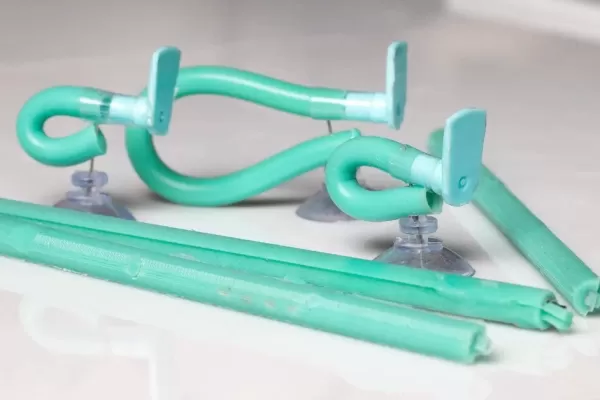
The nematode-inspired soft robots from Georgia Tech (Photo: Candler Hobbs)
Another hurdle is leveraging the correct physics. The nematode-robot team discovered that kinks are beneficial. While a kink halts flow in a standard rubber tube, in a soft worm-like body, it gradually builds internal pressure, enabling greater bending before release. Through simulations and experiments with water-filled balloon models, researchers proved their flexible design could store substantial elastic energy when bent and release it in a rapid hop. The result is remarkable: from a standstill, the robot can repeatedly jump 10 feet high simply by flexing its spine. Such breakthroughs in storing and releasing energy within elastic materials are emblematic of soft robotics engineering.
Real-World Hoppers and Helpers
What practical applications do these soft robots have? In theory, they can operate in situations too dangerous or confined for rigid machines. In disaster zones, for example, soft bots could wiggle under rubble or into collapsed structures to locate survivors. Penn State demonstrated a magnetically controlled soft crawler prototype capable of navigating tight debris and even channels the size of blood vessels.
In medicine, microscopic soft robots could deliver drugs directly within the body. An MIT study envisioned a thread-thin soft robot navigating arteries to clear clots, potentially treating strokes without invasive surgery. Harvard researchers are also developing soft wearable exoskeletons, like a lightweight inflatable sleeve that helped an ALS patient lift a shoulder, instantly improving their range of motion.
Space agencies are also interested in soft leapers. Wheels can bog down in sand or on rocks, but a hopping robot could bound over craters and dunes. NASA is conceptualizing novel jumpers for the Moon and icy moons. One concept, a soccer-ball-sized bot named SPARROW, would use steam jets from vaporized ice to hop many miles across Europa or Enceladus. In the low gravity of these moons, a small jump covers vast distance—a one-meter leap on Earth could propel a robot a hundred meters on Enceladus. The vision is for swarms of these hoppers to traverse alien terrain "with complete freedom," where wheeled rovers would become stuck. On Earth, future soft jumpers could assist search-and-rescue missions by leaping over rivers, mud, or unstable ground that would stop conventional robots.

Soft robots are also finding roles in industry and agriculture. The NSF notes their potential as safe collaborative assistants on factory floors and farms because they yield upon contact with a person. Researchers have even created soft grippers that gently harvest delicate fruit without bruising it. The inherent flexibility of these machines allows them to operate in spaces too small or pliable for rigid devices.
Ultimately, experts believe soft robotics will transform numerous fields. From worms to wearable suits to lunar hoppers, this line of research demonstrates how studying small creatures can lead to giant leaps in technology.
Related article
 Toyota’s $6.4bn robotics estimate puts physical AI in focus
Toyota Motor projects that rolling out automation across its manufacturing facilities, subsidiaries, and key suppliers may require approximately 400,000 robots and an annual expenditure of roughly 1 trillion yen ($6.4 billion) starting in 2028.Accord
Japan tackles labor shortage with AI model for 10 million robots
Japan’s AI robotics initiative has transitioned from a discussion topic into an official national strategy. The government recently validated widely cited projections: deploying 10 million AI-driven robots across 18 sectors by 2040, supported by publ
Universal Robots Unveils Gen 7 for Physical AI Deployment
Will Healy, Director of Product & Industry Marketing at Universal Robots, credited for the imageWill Healy, Director of Product & Industry Marketing at Universal Robots, emphasizes that following the Gen 7 release, AI-driven robots must prioritize ad
Related Special Topic Recommendations
Design & Art
Toyota’s $6.4bn robotics estimate puts physical AI in focus
Toyota Motor projects that rolling out automation across its manufacturing facilities, subsidiaries, and key suppliers may require approximately 400,000 robots and an annual expenditure of roughly 1 trillion yen ($6.4 billion) starting in 2028.Accord
Japan tackles labor shortage with AI model for 10 million robots
Japan’s AI robotics initiative has transitioned from a discussion topic into an official national strategy. The government recently validated widely cited projections: deploying 10 million AI-driven robots across 18 sectors by 2040, supported by publ
Universal Robots Unveils Gen 7 for Physical AI Deployment
Will Healy, Director of Product & Industry Marketing at Universal Robots, credited for the imageWill Healy, Director of Product & Industry Marketing at Universal Robots, emphasizes that following the Gen 7 release, AI-driven robots must prioritize ad
Related Special Topic Recommendations
Design & Art
 Top AI Illustration Tools: Create Editorial Scenes and Cover Art Faster
2026 Latest Top-rated AI Illustration Tools: Our curated list features the best powerfully designed tools for creating stunning editorial scenes and eye-catching cover art quickly. Each option has gone through rigorous real-world tests, offering a free vs paid comparison to help you find the perfect match for your workflow. Try these must-try solutions today to unlock your AI edge and boost your creative productivity. Explore now at XIX.AI.
 10 tools
 xix.ai
Education and Learning
Top AI Tutors for Exam Prep: Practice Math, Science, and English
xix.ai
Education and Learning
Top AI Tutors for Exam Prep: Practice Math, Science, and English
2026 Latest Top-Rated Best AI Tutors for Exam Prep are here on XIX.AI! Our curated list features powerful game-changing tools that offer free vs paid comparison, real-world tests, and weekly updated rankings. They help boost your writing efficiency, simplify complex topic learning, and unlock your academic potential. Explore now to Discover your perfect exam prep tool and Start creating today to Unlock your AI edge!
10 tools
xix.ai
Finance
AI Budget Planning Tools for Personal Money Management
2026 Latest Best Top-Rated AI Budget Planning Tools for Personal Money Management are here on XIX.AI! This curated collection features powerful, game-changing solutions that help you conduct real-world tests, understand spending habits, and create personalized plans to boost productivity. Enjoy a free vs paid comparison along with detailed rankings. Must-try tools designed to simplify money management and unlock your AI edge. Explore now!
11 tools
xix.ai
Health & Wellness
AI Sleep Tracking Assistants: Improve Recovery with Better Bedtime Habits
2026 Latest Best Top-Rated AI Sleep Tracking Assistants curated for ultimate recovery. This fully updated weekly guide features powerful tools that deliver real-world tests, free vs paid comparison, and detailed rankings to help you find the must-try solution that boosts sleep quality and supports better bedtime habits. Explore now at XIX.AI to Unlock your AI edge.
10 tools
xix.ai
Data Analysis
AI SQL Copilots for Product and Revenue Analytics
2026 Latest Best Top-Rated AI SQL Copilots for Product and Revenue Analytics! XIX.AI has curated a powerful, game-changing collection of must-try tools that undergo real-world tests through weekly updated rankings. These tools help users boost productivity significantly by accelerating data analysis, streamlining complex queries, and generating accurate insights to drive smarter business decisions. Explore now to Discover your perfect tool for unlocking your AI edge!
14 tools
xix.ai
Education and Learning
Best AI Homework Helpers That Teach: Learn Concepts, Not Just Answers
2026 Latest Best Top-Rated AI Homework Helpers That Teach Core Concepts Not Just Answers Powerful Tools for Students Must-Try Curated List Weekly Updated Free vs Paid Comparison Real-World Tests Accurate Rankings to Help You Unlock Your Full Learning Potential Explore now to Discover your perfect tool for smarter studying.
10 tools
xix.ai

 Comments (3)
0/500
Comments (3)
0/500
![EdwardTaylor]()
線虫とバネで動くソフトロボット、バスケットボールのリングの高さまで跳ぶなんて!脚がないのにこれだけ飛ぶのは魔法みたい。Georgia Techの技術は本当にスゴイ。未来の救助活動や狭い場所での作業に大活躍しそうだね。🦾✨ #ロボット技術 #イノベーション
![DanielMartin]()
That's insane! A 5-inch soft robot jumping as high as a basketball hoop? Nature really is the best engineer. I wonder if this could be used for search and rescue in tight spaces. 🦗🤖
![AndrewAllen]()
Ce robot mou sans pattes qui saute aussi haut qu'un panier de basket ? C'est complètement fou 😂 Ça me rappelle les vers qui se tortillent, mais en version high-tech. J'aimerais savoir si cette technologie pourrait être utilisée pour l'exploration spatiale un jour.
Researchers at Georgia Tech have achieved an impressive feat: a 5-inch soft robot that can hurl itself 10 feet into the air, reaching the height of a basketball hoop, despite having no legs. The design draws inspiration from the unassuming nematode, a microscopic roundworm thinner than a human hair known for jumping many times its body length.
This worm stores elastic energy by pinching its body into tight coils, then releases it suddenly to propel itself skyward or backward like an acrobat. Engineers replicated this motion with their "SoftJM" robot, a flexible silicone rod reinforced with a stiff carbon-fiber spine. By altering how it bends, the robot can launch itself forward or backward, all without wheels or legs.
In action, this bio-inspired robot coils up like a sprinter in a starting block before explosively straightening to jump. High-speed footage reveals how the worm curves its head upward and kinks its midsection to hop backward, then straightens and kinks its tail to spring forward.
The Georgia Tech team discovered that these sharp bends, typically problematic in hoses or cables, allow both the worm and the robot to store significantly more energy. As one researcher explained, a kinked straw is useless, but a kinked worm behaves like a loaded spring. In the lab, the soft robot successfully reproduced this mechanism: it pinches its middle or tail, builds tension, and releases it in a burst lasting about a tenth of a millisecond to soar into the air.
Soft Robots on the Rise
Soft robotics is a relatively new but fast-growing field that frequently looks to nature for inspiration. Unlike rigid metal machines, soft robots are constructed from flexible materials that can squeeze, stretch, and adapt to their environment. Pioneering work includes Harvard's Octobot, a fully autonomous robot made entirely from silicone and fluid channels with no rigid parts, inspired by octopus musculature. Since then, engineers have developed a menagerie of soft machines, from worm-like crawlers and gelatinous grippers to wearable exosuits and vine-inspired rollers.
For instance, Yale researchers designed a turtle-inspired soft robot whose limbs transition between floppy flippers and rigid "land legs" for swimming or walking. At UC Santa Barbara, scientists created a vine-like robot that grows toward light using only a light-sensitive "skin," extending itself through narrow spaces like a plant stem. These and other bio-inspired innovations demonstrate how soft materials enable entirely new forms of movement.
Advocates argue that soft robots can access environments beyond the reach of traditional robots. The U.S. National Science Foundation highlights that adaptive soft machines "explore spaces previously unreachable," including inside the human body. Some feature programmable "skins" that alter stiffness or color for camouflage or grip. Engineers are also exploring techniques like origami/kirigami and shape-memory polymers, allowing these robots to reconfigure themselves on the fly.
Engineering Flexible Motion
Designing a soft robot to move like an animal presents significant challenges. Without rigid joints or conventional motors, engineers must rely on material properties and intelligent geometry. For example, Georgia Tech's jumping robot required an internal carbon-fiber spine within its rubbery body to generate sufficient spring force. Integrating sensors and control systems is also complex. As Penn State engineers note, traditional stiff electronics would immobilize a soft robot.
To make their small, crawling rescue robot "smart," they meticulously distributed flexible circuits across its body to preserve flexibility. Even power poses a challenge: some soft robots use external magnetic fields or pressurized air because carrying a heavy battery would impede their movement.
The nematode-inspired soft robots from Georgia Tech (Photo: Candler Hobbs)
Another hurdle is leveraging the correct physics. The nematode-robot team discovered that kinks are beneficial. While a kink halts flow in a standard rubber tube, in a soft worm-like body, it gradually builds internal pressure, enabling greater bending before release. Through simulations and experiments with water-filled balloon models, researchers proved their flexible design could store substantial elastic energy when bent and release it in a rapid hop. The result is remarkable: from a standstill, the robot can repeatedly jump 10 feet high simply by flexing its spine. Such breakthroughs in storing and releasing energy within elastic materials are emblematic of soft robotics engineering.
Real-World Hoppers and Helpers
What practical applications do these soft robots have? In theory, they can operate in situations too dangerous or confined for rigid machines. In disaster zones, for example, soft bots could wiggle under rubble or into collapsed structures to locate survivors. Penn State demonstrated a magnetically controlled soft crawler prototype capable of navigating tight debris and even channels the size of blood vessels.
In medicine, microscopic soft robots could deliver drugs directly within the body. An MIT study envisioned a thread-thin soft robot navigating arteries to clear clots, potentially treating strokes without invasive surgery. Harvard researchers are also developing soft wearable exoskeletons, like a lightweight inflatable sleeve that helped an ALS patient lift a shoulder, instantly improving their range of motion.
Space agencies are also interested in soft leapers. Wheels can bog down in sand or on rocks, but a hopping robot could bound over craters and dunes. NASA is conceptualizing novel jumpers for the Moon and icy moons. One concept, a soccer-ball-sized bot named SPARROW, would use steam jets from vaporized ice to hop many miles across Europa or Enceladus. In the low gravity of these moons, a small jump covers vast distance—a one-meter leap on Earth could propel a robot a hundred meters on Enceladus. The vision is for swarms of these hoppers to traverse alien terrain "with complete freedom," where wheeled rovers would become stuck. On Earth, future soft jumpers could assist search-and-rescue missions by leaping over rivers, mud, or unstable ground that would stop conventional robots.
Soft robots are also finding roles in industry and agriculture. The NSF notes their potential as safe collaborative assistants on factory floors and farms because they yield upon contact with a person. Researchers have even created soft grippers that gently harvest delicate fruit without bruising it. The inherent flexibility of these machines allows them to operate in spaces too small or pliable for rigid devices.
Ultimately, experts believe soft robotics will transform numerous fields. From worms to wearable suits to lunar hoppers, this line of research demonstrates how studying small creatures can lead to giant leaps in technology.








 Toyota’s $6.4bn robotics estimate puts physical AI in focus
Toyota Motor projects that rolling out automation across its manufacturing facilities, subsidiaries, and key suppliers may require approximately 400,000 robots and an annual expenditure of roughly 1 trillion yen ($6.4 billion) starting in 2028.Accord
Toyota’s $6.4bn robotics estimate puts physical AI in focus
Toyota Motor projects that rolling out automation across its manufacturing facilities, subsidiaries, and key suppliers may require approximately 400,000 robots and an annual expenditure of roughly 1 trillion yen ($6.4 billion) starting in 2028.Accord
 Japan tackles labor shortage with AI model for 10 million robots
Japan’s AI robotics initiative has transitioned from a discussion topic into an official national strategy. The government recently validated widely cited projections: deploying 10 million AI-driven robots across 18 sectors by 2040, supported by publ
Japan tackles labor shortage with AI model for 10 million robots
Japan’s AI robotics initiative has transitioned from a discussion topic into an official national strategy. The government recently validated widely cited projections: deploying 10 million AI-driven robots across 18 sectors by 2040, supported by publ
 Universal Robots Unveils Gen 7 for Physical AI Deployment
Will Healy, Director of Product & Industry Marketing at Universal Robots, credited for the imageWill Healy, Director of Product & Industry Marketing at Universal Robots, emphasizes that following the Gen 7 release, AI-driven robots must prioritize ad
Universal Robots Unveils Gen 7 for Physical AI Deployment
Will Healy, Director of Product & Industry Marketing at Universal Robots, credited for the imageWill Healy, Director of Product & Industry Marketing at Universal Robots, emphasizes that following the Gen 7 release, AI-driven robots must prioritize ad

2026 Latest Top-rated AI Illustration Tools: Our curated list features the best powerfully designed tools for creating stunning editorial scenes and eye-catching cover art quickly. Each option has gone through rigorous real-world tests, offering a free vs paid comparison to help you find the perfect match for your workflow. Try these must-try solutions today to unlock your AI edge and boost your creative productivity. Explore now at XIX.AI.
10 tools
xix.ai

2026 Latest Top-Rated Best AI Tutors for Exam Prep are here on XIX.AI! Our curated list features powerful game-changing tools that offer free vs paid comparison, real-world tests, and weekly updated rankings. They help boost your writing efficiency, simplify complex topic learning, and unlock your academic potential. Explore now to Discover your perfect exam prep tool and Start creating today to Unlock your AI edge!
10 tools
xix.ai

2026 Latest Best Top-Rated AI Budget Planning Tools for Personal Money Management are here on XIX.AI! This curated collection features powerful, game-changing solutions that help you conduct real-world tests, understand spending habits, and create personalized plans to boost productivity. Enjoy a free vs paid comparison along with detailed rankings. Must-try tools designed to simplify money management and unlock your AI edge. Explore now!
11 tools
xix.ai

2026 Latest Best Top-Rated AI Sleep Tracking Assistants curated for ultimate recovery. This fully updated weekly guide features powerful tools that deliver real-world tests, free vs paid comparison, and detailed rankings to help you find the must-try solution that boosts sleep quality and supports better bedtime habits. Explore now at XIX.AI to Unlock your AI edge.
10 tools
xix.ai

2026 Latest Best Top-Rated AI SQL Copilots for Product and Revenue Analytics! XIX.AI has curated a powerful, game-changing collection of must-try tools that undergo real-world tests through weekly updated rankings. These tools help users boost productivity significantly by accelerating data analysis, streamlining complex queries, and generating accurate insights to drive smarter business decisions. Explore now to Discover your perfect tool for unlocking your AI edge!
14 tools
xix.ai

2026 Latest Best Top-Rated AI Homework Helpers That Teach Core Concepts Not Just Answers Powerful Tools for Students Must-Try Curated List Weekly Updated Free vs Paid Comparison Real-World Tests Accurate Rankings to Help You Unlock Your Full Learning Potential Explore now to Discover your perfect tool for smarter studying.
10 tools
xix.ai

線虫とバネで動くソフトロボット、バスケットボールのリングの高さまで跳ぶなんて!脚がないのにこれだけ飛ぶのは魔法みたい。Georgia Techの技術は本当にスゴイ。未来の救助活動や狭い場所での作業に大活躍しそうだね。🦾✨ #ロボット技術 #イノベーション
That's insane! A 5-inch soft robot jumping as high as a basketball hoop? Nature really is the best engineer. I wonder if this could be used for search and rescue in tight spaces. 🦗🤖
Ce robot mou sans pattes qui saute aussi haut qu'un panier de basket ? C'est complètement fou 😂 Ça me rappelle les vers qui se tortillent, mais en version high-tech. J'aimerais savoir si cette technologie pourrait être utilisée pour l'exploration spatiale un jour.












