


 Home
HomeMajor Korean Manufacturers Support Config, the 'TSMC of Robot Data'
Asia's advancement in physical AI is driven by the same manufacturing expertise that established the region as a global industrial leader. In South Korea, Japan, China, and Taiwan, manufacturing continues to be a cornerstone of economic expansion. Unlike economies more focused on services or software, these nations have historically depended on mass production, export-oriented industries, and highly efficient supply chains. This structural base is now influencing the adoption of artificial intelligence and directing investment trends.
This context makes it especially noteworthy that Config, a startup based in Seoul and San Jose developing the data infrastructure for robotic foundation models (RFMs), has secured investment from the venture capital arms of South Korea's largest manufacturing conglomerates.
Samsung Venture Investment led its oversubscribed $27 million seed funding round, valuing the company at over $200 million and bringing its total funding to $35 million. Strategic investors in the round included Hyundai Motor's venture arm ZER01NE Ventures, LG Tech Ventures, and SKT America, the venture capital unit of the South Korean telecom giant. They were joined by angel investor Pieter Abbeel (co-founder of Covariant AI and a UC Berkeley professor) and financial backers such as Mirae Asset Ventures, Korea Development Bank, GS Futures, Kakao Ventures, and Z Ventures.
Config was founded in January 2025 by CEO Minjoon Seo, a former researcher at Meta and chief scientist at Twelve Labs, along with three co-founders who previously worked at Waymo, Google, and Naver. Rather than constructing robots, the team concentrates on a more fundamental objective: providing the essential data robots require to learn and function. They believe superior data will be crucial for enhancing robot utility.
Training large language models is costly due to the necessary computing power, but the raw material—vast amounts of text from the internet—is readily available. Teaching robots to move presents a distinct challenge, Seo explained in an exclusive interview with TechCrunch. Every piece of training data must be physically gathered, requiring the robot, a facility to operate it, and personnel. This makes developing robotics AI more expensive than software-only chatbots, according to Seo. As companies pursue more capable robots, the expenses for data collection and labeling can escalate rapidly.
Config aims to be the enabling force behind other companies' robot AI. The startup likens its role to that of TSMC, the Taiwanese chipmaker that manufactures for Apple, Nvidia, and AMD without competing with them. Config seeks to play a similar part in robotics by supplying foundational data. This strategy is gaining momentum as major manufacturers increasingly look to develop their own proprietary robot AI instead of relying solely on external vendors. This is the market Config is targeting.
Config is already generating revenue, according to COO and co-founder Jack Bang. The startup's current clientele includes large manufacturers, system integrators, and companies in the agriculture and defense sectors, Bang told TechCrunch. Its peers in the field include Physical Intelligence, Generalist AI, and Skild AI.
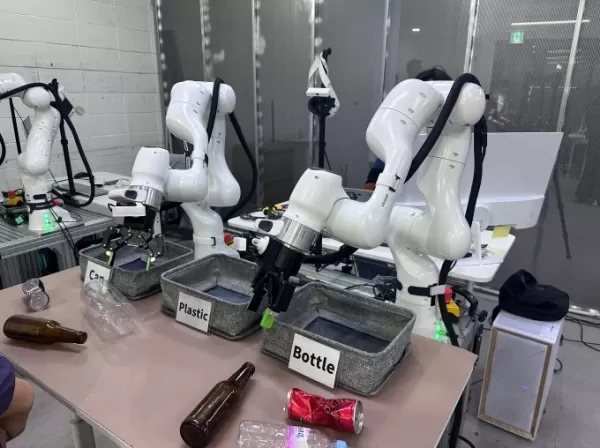
Image Credits:Kate Park
Config captures humans performing physical tasks in both controlled studio settings and real-world environments. The company operates from Seoul and Hanoi, where a workforce of nearly 300 manages data production. To date, it has amassed over 100,000 hours of human motion data, which is more than 30 times the size of AgiBot World, the largest comparable open-source dataset at approximately 3,000 hours.
Most robotics teams train AI models on human motion data and subsequently adapt those models for robots. Config is taking a different approach, Seo stated. The company focuses on transforming the data before the training process begins, making it better suited to how robots move and interact with their surroundings. Seo compared the process to language translation. Training a model on one type of data and expecting it to work flawlessly in another context, Seo said, is akin to trying to teach Korean using only English-language materials.
"The data must be converted, not the model. This conversion technology is Config's core technical differentiator," Seo emphasized.
The new funding will be allocated toward three key priorities: scaling its data operations in Vietnam and Seoul to reach one million hours of collected data, growing its enterprise platform business to achieve $10 million in Annual Recurring Revenue (ARR) by the end of 2027, and launching a cloud-based Robot-as-a-Service product that allows companies to utilize Config's foundation model without needing specialized onboard hardware.
Related article
 Startup bets India’s gig workforce can train global robots
India’s online food delivery sector has expanded rapidly in recent years, marked by the public listings of Zomato and Swiggy and a surge in cloud kitchens. Concurrently, on-demand home service startups like Urban Company, Snabbit, and Pronto have see
Robot brain builders are pushing out of their GPT-2 era
Physical AI has emerged as one of the most dynamic sectors in venture capital, with companies securing billions in funding to apply the foundational tools behind Large Language Models to the field of robotics.This enthusiasm drove a major IPO for Uni
Toyota’s $6.4bn robotics estimate puts physical AI in focus
Toyota Motor projects that rolling out automation across its manufacturing facilities, subsidiaries, and key suppliers may require approximately 400,000 robots and an annual expenditure of roughly 1 trillion yen ($6.4 billion) starting in 2028.Accord
Related Special Topic Recommendations
Design & Art
Startup bets India’s gig workforce can train global robots
India’s online food delivery sector has expanded rapidly in recent years, marked by the public listings of Zomato and Swiggy and a surge in cloud kitchens. Concurrently, on-demand home service startups like Urban Company, Snabbit, and Pronto have see
Robot brain builders are pushing out of their GPT-2 era
Physical AI has emerged as one of the most dynamic sectors in venture capital, with companies securing billions in funding to apply the foundational tools behind Large Language Models to the field of robotics.This enthusiasm drove a major IPO for Uni
Toyota’s $6.4bn robotics estimate puts physical AI in focus
Toyota Motor projects that rolling out automation across its manufacturing facilities, subsidiaries, and key suppliers may require approximately 400,000 robots and an annual expenditure of roughly 1 trillion yen ($6.4 billion) starting in 2028.Accord
Related Special Topic Recommendations
Design & Art
 Top AI Illustration Tools: Create Editorial Scenes and Cover Art Faster
2026 Latest Top-rated AI Illustration Tools: Our curated list features the best powerfully designed tools for creating stunning editorial scenes and eye-catching cover art quickly. Each option has gone through rigorous real-world tests, offering a free vs paid comparison to help you find the perfect match for your workflow. Try these must-try solutions today to unlock your AI edge and boost your creative productivity. Explore now at XIX.AI.
 10 tools
 xix.ai
Education and Learning
Top AI Tutors for Exam Prep: Practice Math, Science, and English
xix.ai
Education and Learning
Top AI Tutors for Exam Prep: Practice Math, Science, and English
2026 Latest Top-Rated Best AI Tutors for Exam Prep are here on XIX.AI! Our curated list features powerful game-changing tools that offer free vs paid comparison, real-world tests, and weekly updated rankings. They help boost your writing efficiency, simplify complex topic learning, and unlock your academic potential. Explore now to Discover your perfect exam prep tool and Start creating today to Unlock your AI edge!
10 tools
xix.ai
Finance
AI Budget Planning Tools for Personal Money Management
2026 Latest Best Top-Rated AI Budget Planning Tools for Personal Money Management are here on XIX.AI! This curated collection features powerful, game-changing solutions that help you conduct real-world tests, understand spending habits, and create personalized plans to boost productivity. Enjoy a free vs paid comparison along with detailed rankings. Must-try tools designed to simplify money management and unlock your AI edge. Explore now!
11 tools
xix.ai
Health & Wellness
AI Sleep Tracking Assistants: Improve Recovery with Better Bedtime Habits
2026 Latest Best Top-Rated AI Sleep Tracking Assistants curated for ultimate recovery. This fully updated weekly guide features powerful tools that deliver real-world tests, free vs paid comparison, and detailed rankings to help you find the must-try solution that boosts sleep quality and supports better bedtime habits. Explore now at XIX.AI to Unlock your AI edge.
10 tools
xix.ai
Data Analysis
AI SQL Copilots for Product and Revenue Analytics
2026 Latest Best Top-Rated AI SQL Copilots for Product and Revenue Analytics! XIX.AI has curated a powerful, game-changing collection of must-try tools that undergo real-world tests through weekly updated rankings. These tools help users boost productivity significantly by accelerating data analysis, streamlining complex queries, and generating accurate insights to drive smarter business decisions. Explore now to Discover your perfect tool for unlocking your AI edge!
14 tools
xix.ai
Education and Learning
Best AI Homework Helpers That Teach: Learn Concepts, Not Just Answers
2026 Latest Best Top-Rated AI Homework Helpers That Teach Core Concepts Not Just Answers Powerful Tools for Students Must-Try Curated List Weekly Updated Free vs Paid Comparison Real-World Tests Accurate Rankings to Help You Unlock Your Full Learning Potential Explore now to Discover your perfect tool for smarter studying.
10 tools
xix.ai

 Comments (0)
0/500
Comments (0)
0/500
Asia's advancement in physical AI is driven by the same manufacturing expertise that established the region as a global industrial leader. In South Korea, Japan, China, and Taiwan, manufacturing continues to be a cornerstone of economic expansion. Unlike economies more focused on services or software, these nations have historically depended on mass production, export-oriented industries, and highly efficient supply chains. This structural base is now influencing the adoption of artificial intelligence and directing investment trends.
This context makes it especially noteworthy that Config, a startup based in Seoul and San Jose developing the data infrastructure for robotic foundation models (RFMs), has secured investment from the venture capital arms of South Korea's largest manufacturing conglomerates.
Samsung Venture Investment led its oversubscribed $27 million seed funding round, valuing the company at over $200 million and bringing its total funding to $35 million. Strategic investors in the round included Hyundai Motor's venture arm ZER01NE Ventures, LG Tech Ventures, and SKT America, the venture capital unit of the South Korean telecom giant. They were joined by angel investor Pieter Abbeel (co-founder of Covariant AI and a UC Berkeley professor) and financial backers such as Mirae Asset Ventures, Korea Development Bank, GS Futures, Kakao Ventures, and Z Ventures.
Config was founded in January 2025 by CEO Minjoon Seo, a former researcher at Meta and chief scientist at Twelve Labs, along with three co-founders who previously worked at Waymo, Google, and Naver. Rather than constructing robots, the team concentrates on a more fundamental objective: providing the essential data robots require to learn and function. They believe superior data will be crucial for enhancing robot utility.
Training large language models is costly due to the necessary computing power, but the raw material—vast amounts of text from the internet—is readily available. Teaching robots to move presents a distinct challenge, Seo explained in an exclusive interview with TechCrunch. Every piece of training data must be physically gathered, requiring the robot, a facility to operate it, and personnel. This makes developing robotics AI more expensive than software-only chatbots, according to Seo. As companies pursue more capable robots, the expenses for data collection and labeling can escalate rapidly.
Config aims to be the enabling force behind other companies' robot AI. The startup likens its role to that of TSMC, the Taiwanese chipmaker that manufactures for Apple, Nvidia, and AMD without competing with them. Config seeks to play a similar part in robotics by supplying foundational data. This strategy is gaining momentum as major manufacturers increasingly look to develop their own proprietary robot AI instead of relying solely on external vendors. This is the market Config is targeting.
Config is already generating revenue, according to COO and co-founder Jack Bang. The startup's current clientele includes large manufacturers, system integrators, and companies in the agriculture and defense sectors, Bang told TechCrunch. Its peers in the field include Physical Intelligence, Generalist AI, and Skild AI.
Image Credits:Kate Park
Config captures humans performing physical tasks in both controlled studio settings and real-world environments. The company operates from Seoul and Hanoi, where a workforce of nearly 300 manages data production. To date, it has amassed over 100,000 hours of human motion data, which is more than 30 times the size of AgiBot World, the largest comparable open-source dataset at approximately 3,000 hours.
Most robotics teams train AI models on human motion data and subsequently adapt those models for robots. Config is taking a different approach, Seo stated. The company focuses on transforming the data before the training process begins, making it better suited to how robots move and interact with their surroundings. Seo compared the process to language translation. Training a model on one type of data and expecting it to work flawlessly in another context, Seo said, is akin to trying to teach Korean using only English-language materials.
"The data must be converted, not the model. This conversion technology is Config's core technical differentiator," Seo emphasized.
The new funding will be allocated toward three key priorities: scaling its data operations in Vietnam and Seoul to reach one million hours of collected data, growing its enterprise platform business to achieve $10 million in Annual Recurring Revenue (ARR) by the end of 2027, and launching a cloud-based Robot-as-a-Service product that allows companies to utilize Config's foundation model without needing specialized onboard hardware.








 Startup bets India’s gig workforce can train global robots
India’s online food delivery sector has expanded rapidly in recent years, marked by the public listings of Zomato and Swiggy and a surge in cloud kitchens. Concurrently, on-demand home service startups like Urban Company, Snabbit, and Pronto have see
Startup bets India’s gig workforce can train global robots
India’s online food delivery sector has expanded rapidly in recent years, marked by the public listings of Zomato and Swiggy and a surge in cloud kitchens. Concurrently, on-demand home service startups like Urban Company, Snabbit, and Pronto have see
 Robot brain builders are pushing out of their GPT-2 era
Physical AI has emerged as one of the most dynamic sectors in venture capital, with companies securing billions in funding to apply the foundational tools behind Large Language Models to the field of robotics.This enthusiasm drove a major IPO for Uni
Robot brain builders are pushing out of their GPT-2 era
Physical AI has emerged as one of the most dynamic sectors in venture capital, with companies securing billions in funding to apply the foundational tools behind Large Language Models to the field of robotics.This enthusiasm drove a major IPO for Uni
 Toyota’s $6.4bn robotics estimate puts physical AI in focus
Toyota Motor projects that rolling out automation across its manufacturing facilities, subsidiaries, and key suppliers may require approximately 400,000 robots and an annual expenditure of roughly 1 trillion yen ($6.4 billion) starting in 2028.Accord
Toyota’s $6.4bn robotics estimate puts physical AI in focus
Toyota Motor projects that rolling out automation across its manufacturing facilities, subsidiaries, and key suppliers may require approximately 400,000 robots and an annual expenditure of roughly 1 trillion yen ($6.4 billion) starting in 2028.Accord

2026 Latest Top-rated AI Illustration Tools: Our curated list features the best powerfully designed tools for creating stunning editorial scenes and eye-catching cover art quickly. Each option has gone through rigorous real-world tests, offering a free vs paid comparison to help you find the perfect match for your workflow. Try these must-try solutions today to unlock your AI edge and boost your creative productivity. Explore now at XIX.AI.
10 tools
xix.ai

2026 Latest Top-Rated Best AI Tutors for Exam Prep are here on XIX.AI! Our curated list features powerful game-changing tools that offer free vs paid comparison, real-world tests, and weekly updated rankings. They help boost your writing efficiency, simplify complex topic learning, and unlock your academic potential. Explore now to Discover your perfect exam prep tool and Start creating today to Unlock your AI edge!
10 tools
xix.ai

2026 Latest Best Top-Rated AI Budget Planning Tools for Personal Money Management are here on XIX.AI! This curated collection features powerful, game-changing solutions that help you conduct real-world tests, understand spending habits, and create personalized plans to boost productivity. Enjoy a free vs paid comparison along with detailed rankings. Must-try tools designed to simplify money management and unlock your AI edge. Explore now!
11 tools
xix.ai

2026 Latest Best Top-Rated AI Sleep Tracking Assistants curated for ultimate recovery. This fully updated weekly guide features powerful tools that deliver real-world tests, free vs paid comparison, and detailed rankings to help you find the must-try solution that boosts sleep quality and supports better bedtime habits. Explore now at XIX.AI to Unlock your AI edge.
10 tools
xix.ai

2026 Latest Best Top-Rated AI SQL Copilots for Product and Revenue Analytics! XIX.AI has curated a powerful, game-changing collection of must-try tools that undergo real-world tests through weekly updated rankings. These tools help users boost productivity significantly by accelerating data analysis, streamlining complex queries, and generating accurate insights to drive smarter business decisions. Explore now to Discover your perfect tool for unlocking your AI edge!
14 tools
xix.ai

2026 Latest Best Top-Rated AI Homework Helpers That Teach Core Concepts Not Just Answers Powerful Tools for Students Must-Try Curated List Weekly Updated Free vs Paid Comparison Real-World Tests Accurate Rankings to Help You Unlock Your Full Learning Potential Explore now to Discover your perfect tool for smarter studying.
10 tools
xix.ai












