


 Home
HomeCanopii Aims to Break the Indoor Farming Mold
David Ashton grew up near Sacramento, California, and attended college in San Luis Obispo during the severe drought of the late 2000s.
He frequently drove the 300-mile route between Sacramento and San Luis Obispo, captivated by the vast lettuce fields—expanses of vibrant green set against a parched, barren landscape. The sight of these lush crops thriving under drought conditions, only to be shipped nationwide, left a lasting impression on Ashton. It later inspired him to found Canopii, a robotic farming startup focused on shortening produce supply chains.
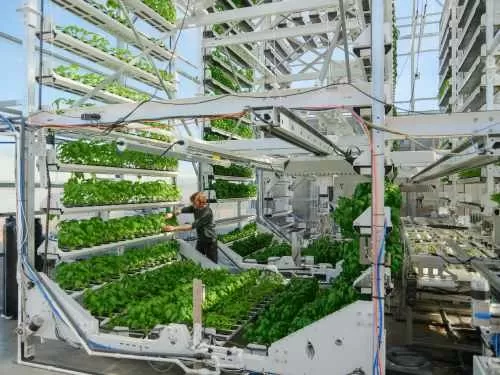
Based in Portland, Oregon, Canopii develops fully automated robotic greenhouses that manage the entire growing cycle from seeding to harvest without human intervention. A single unit can produce up to 40,000 pounds of produce annually, using only one water spigot and occupying an area the size of a basketball court.
The farm structures are manufactured by GK Designs and are currently optimized for cultivating herbs and specialty greens such as baby bok choy and gai lan (Chinese broccoli).
Ashton shared with TechCrunch that the idea for Canopii truly took root after an agtech company in Portland, where he was slated to work, filed for bankruptcy just as he was driving up the coast to relocate. He developed the plans during evenings while his wife was in medical school.
After three years of groundwork, he secured a $250,000 grant from the National Science Foundation to build a prototype. Following that success, he obtained a $1 million grant to construct a full-scale operational prototype.
“Now, five years later, we’ve reached a major milestone for the farm,” Ashton said. “We have an autonomous farm that grows everything from seed to harvest without any human involvement. We achieved this with a very small team and minimal capital, which sets us apart from the rest of the industry.”
To date, the company has raised approximately $3.6 million, with $2.3 million coming primarily from grants and the remainder from strategic partners.
Ashton is well aware of investor and venture capital skepticism toward the indoor farming sector, which saw high-profile companies like Bowery Farming and Plenty raise hundreds of millions before facing financial difficulties.
He contends that Canopii’s approach is fundamentally different from traditional vertical farms. By prioritizing deliberate, slow growth and avoiding venture capital initially, the company has sidestepped many common pitfalls.
“The capital structure needs to be diversified beyond just VC funding,” Ashton explained. “We’re a team of five now, and we’ve focused on perfecting a single farm unit, which has allowed us to learn extensively. If we had taken VC funding immediately and tried to scale within a year or two, it wouldn’t have been feasible for food infrastructure.”
The company has attracted interest from schools, restaurants, casinos, and other institutions. Having achieved its automation goal, Canopii now plans to establish its first commercial farm in downtown Portland. Looking ahead, the company aims to franchise these farm units—and yes, eventually seek venture capital when the time is right.
“We can mass-produce these farms like automobiles,” Ashton said. “A key achievement is that the entire system runs on just 100 amps at 240 volts—standard household power. You can literally install one in a backyard. That demonstrates the level of resource efficiency we’ve achieved with this farm.”
Related article
 Crypto exchange OKX aims to empower AI agents to hire and pay each other
As AI agents start serving individuals and collaborating with each other, they require mechanisms to locate tasks, compensate for services, and establish credibility. Crypto exchange OKX anticipates this future is arriving sooner than anticipated, in
Thiel-backed startup claims AI can judge journalism, despite risks to whistleblowers
Following his role in the lawsuit that led to Gawker’s bankruptcy, Aron D’Souza identified a critical flaw in the American media landscape: individuals harmed by coverage lacked effective means to respond.His answer is technology. D’Souza’s new ventu
Prentis, New AI Lab Co-Founded by Reid Hoffman and Marc Pincus, in Talks to Raise $100M
Prentis, an emerging AI research lab specializing in computer-use models, is co-founded by serial entrepreneur Ritankar Das alongside tech industry leaders Reid Hoffman and Marc Pincus. According to two individuals familiar with the matter, the compa
Related Special Topic Recommendations
writing
Crypto exchange OKX aims to empower AI agents to hire and pay each other
As AI agents start serving individuals and collaborating with each other, they require mechanisms to locate tasks, compensate for services, and establish credibility. Crypto exchange OKX anticipates this future is arriving sooner than anticipated, in
Thiel-backed startup claims AI can judge journalism, despite risks to whistleblowers
Following his role in the lawsuit that led to Gawker’s bankruptcy, Aron D’Souza identified a critical flaw in the American media landscape: individuals harmed by coverage lacked effective means to respond.His answer is technology. D’Souza’s new ventu
Prentis, New AI Lab Co-Founded by Reid Hoffman and Marc Pincus, in Talks to Raise $100M
Prentis, an emerging AI research lab specializing in computer-use models, is co-founded by serial entrepreneur Ritankar Das alongside tech industry leaders Reid Hoffman and Marc Pincus. According to two individuals familiar with the matter, the compa
Related Special Topic Recommendations
writing
 AI Article Outline Tools for Long Form Writing
2026 Latest Best Top-Rated AI Article Outline Tools for Long Form Writing! This curated collection features powerful, game-changing tools that deliver accurate, structured outlines with real-world tests to boost writing efficiency significantly. XIX.AI is part of this elite selection. Get a free vs paid comparison to help you choose the perfect tool. Explore now and Unlock your AI edge!
 9 tools
 xix.ai
chatbot
Best AI Roleplay Chat Apps for Language Practice, Interview Prep, and Daily Fluency
xix.ai
chatbot
Best AI Roleplay Chat Apps for Language Practice, Interview Prep, and Daily Fluency
2026 Latest Best Top-rated AI Roleplay Chat Apps for Language Practice, Interview Prep, and Daily Fluency! XIX.AI curates a powerful game-changing collection that offers free vs paid comparison, real-world tests, and updated rankings weekly. These must-try tools help you boost writing skills, overcome fluency challenges, and improve communication efficiency across all daily scenarios. Explore now to discover your perfect tool for language growth!
10 tools
xix.ai
Music composition
AI Stem Separation Tools for Remix Production, Sampling Prep, and Karaoke Masters
2026 Latest Best Top-rated AI Stem Separation Tools Curated for Remix Production, Sampling Prep, and Karaoke Masters. These powerful game-changing tools offer real-world tests to deliver precise audio isolation, boosting productivity significantly. XIX.AI provides a weekly updated free vs paid comparison guide to help you find the must-try solution that suits your needs. Explore now to unlock your AI edge.
8 tools
xix.ai
Data Analysis
AI SQL Copilots for Revenue Dashboards, Funnel Analysis, and Product Metrics
2026 Latest Best AI SQL Copilots Ranked Top-Rated! XIX.AI curates a powerful game-changing collection for weekly updated real-world tests. These must-try tools help you generate accurate revenue dashboards, analyze sales funnels, and track product metrics swiftly, boosting productivity massively. Explore now to Discover your perfect tool for data-driven decision making! 238 characters
9 tools
xix.ai
Music composition
Best AI Melody Writing Tools for Song Drafts
2026 Latest Best Top-Rated AI Melody Writing Tools for Song Drafts! XIX.AI has curated a highly powerful game-changing collection that goes through rigorous real-world tests to deliver the best writing experience. You can find detailed free vs paid comparisons, accurate rankings, and must-try options designed to help you create stunning song drafts effortlessly and boost your creative productivity significantly. Explore now to discover your perfect tool!
8 tools
xix.ai
chatbot
Best AI Conversation Trainer Tools for Interview Practice
2026 Latest Best Top-rated AI Conversation Trainer Tools for Interview Practice are here on XIX.AI! This curated collection features powerful, game-changing tools that go through rigorous real-world tests to deliver accurate feedback. You’ll find a free vs paid comparison and detailed rankings to help you choose the must-try option that boosts your confidence and skills. Explore now to Discover your perfect tool for interview success!
12 tools
xix.ai

 Comments (0)
0/500
Comments (0)
0/500
David Ashton grew up near Sacramento, California, and attended college in San Luis Obispo during the severe drought of the late 2000s.
He frequently drove the 300-mile route between Sacramento and San Luis Obispo, captivated by the vast lettuce fields—expanses of vibrant green set against a parched, barren landscape. The sight of these lush crops thriving under drought conditions, only to be shipped nationwide, left a lasting impression on Ashton. It later inspired him to found Canopii, a robotic farming startup focused on shortening produce supply chains.
Based in Portland, Oregon, Canopii develops fully automated robotic greenhouses that manage the entire growing cycle from seeding to harvest without human intervention. A single unit can produce up to 40,000 pounds of produce annually, using only one water spigot and occupying an area the size of a basketball court.
The farm structures are manufactured by GK Designs and are currently optimized for cultivating herbs and specialty greens such as baby bok choy and gai lan (Chinese broccoli).
Ashton shared with TechCrunch that the idea for Canopii truly took root after an agtech company in Portland, where he was slated to work, filed for bankruptcy just as he was driving up the coast to relocate. He developed the plans during evenings while his wife was in medical school.
After three years of groundwork, he secured a $250,000 grant from the National Science Foundation to build a prototype. Following that success, he obtained a $1 million grant to construct a full-scale operational prototype.
“Now, five years later, we’ve reached a major milestone for the farm,” Ashton said. “We have an autonomous farm that grows everything from seed to harvest without any human involvement. We achieved this with a very small team and minimal capital, which sets us apart from the rest of the industry.”
To date, the company has raised approximately $3.6 million, with $2.3 million coming primarily from grants and the remainder from strategic partners.
Ashton is well aware of investor and venture capital skepticism toward the indoor farming sector, which saw high-profile companies like Bowery Farming and Plenty raise hundreds of millions before facing financial difficulties.
He contends that Canopii’s approach is fundamentally different from traditional vertical farms. By prioritizing deliberate, slow growth and avoiding venture capital initially, the company has sidestepped many common pitfalls.
“The capital structure needs to be diversified beyond just VC funding,” Ashton explained. “We’re a team of five now, and we’ve focused on perfecting a single farm unit, which has allowed us to learn extensively. If we had taken VC funding immediately and tried to scale within a year or two, it wouldn’t have been feasible for food infrastructure.”
The company has attracted interest from schools, restaurants, casinos, and other institutions. Having achieved its automation goal, Canopii now plans to establish its first commercial farm in downtown Portland. Looking ahead, the company aims to franchise these farm units—and yes, eventually seek venture capital when the time is right.
“We can mass-produce these farms like automobiles,” Ashton said. “A key achievement is that the entire system runs on just 100 amps at 240 volts—standard household power. You can literally install one in a backyard. That demonstrates the level of resource efficiency we’ve achieved with this farm.”








 Crypto exchange OKX aims to empower AI agents to hire and pay each other
As AI agents start serving individuals and collaborating with each other, they require mechanisms to locate tasks, compensate for services, and establish credibility. Crypto exchange OKX anticipates this future is arriving sooner than anticipated, in
Crypto exchange OKX aims to empower AI agents to hire and pay each other
As AI agents start serving individuals and collaborating with each other, they require mechanisms to locate tasks, compensate for services, and establish credibility. Crypto exchange OKX anticipates this future is arriving sooner than anticipated, in
 Thiel-backed startup claims AI can judge journalism, despite risks to whistleblowers
Following his role in the lawsuit that led to Gawker’s bankruptcy, Aron D’Souza identified a critical flaw in the American media landscape: individuals harmed by coverage lacked effective means to respond.His answer is technology. D’Souza’s new ventu
Thiel-backed startup claims AI can judge journalism, despite risks to whistleblowers
Following his role in the lawsuit that led to Gawker’s bankruptcy, Aron D’Souza identified a critical flaw in the American media landscape: individuals harmed by coverage lacked effective means to respond.His answer is technology. D’Souza’s new ventu
 Prentis, New AI Lab Co-Founded by Reid Hoffman and Marc Pincus, in Talks to Raise $100M
Prentis, an emerging AI research lab specializing in computer-use models, is co-founded by serial entrepreneur Ritankar Das alongside tech industry leaders Reid Hoffman and Marc Pincus. According to two individuals familiar with the matter, the compa
Prentis, New AI Lab Co-Founded by Reid Hoffman and Marc Pincus, in Talks to Raise $100M
Prentis, an emerging AI research lab specializing in computer-use models, is co-founded by serial entrepreneur Ritankar Das alongside tech industry leaders Reid Hoffman and Marc Pincus. According to two individuals familiar with the matter, the compa

2026 Latest Best Top-Rated AI Article Outline Tools for Long Form Writing! This curated collection features powerful, game-changing tools that deliver accurate, structured outlines with real-world tests to boost writing efficiency significantly. XIX.AI is part of this elite selection. Get a free vs paid comparison to help you choose the perfect tool. Explore now and Unlock your AI edge!
9 tools
xix.ai

2026 Latest Best Top-rated AI Roleplay Chat Apps for Language Practice, Interview Prep, and Daily Fluency! XIX.AI curates a powerful game-changing collection that offers free vs paid comparison, real-world tests, and updated rankings weekly. These must-try tools help you boost writing skills, overcome fluency challenges, and improve communication efficiency across all daily scenarios. Explore now to discover your perfect tool for language growth!
10 tools
xix.ai

2026 Latest Best Top-rated AI Stem Separation Tools Curated for Remix Production, Sampling Prep, and Karaoke Masters. These powerful game-changing tools offer real-world tests to deliver precise audio isolation, boosting productivity significantly. XIX.AI provides a weekly updated free vs paid comparison guide to help you find the must-try solution that suits your needs. Explore now to unlock your AI edge.
8 tools
xix.ai

2026 Latest Best AI SQL Copilots Ranked Top-Rated! XIX.AI curates a powerful game-changing collection for weekly updated real-world tests. These must-try tools help you generate accurate revenue dashboards, analyze sales funnels, and track product metrics swiftly, boosting productivity massively. Explore now to Discover your perfect tool for data-driven decision making! 238 characters
9 tools
xix.ai

2026 Latest Best Top-Rated AI Melody Writing Tools for Song Drafts! XIX.AI has curated a highly powerful game-changing collection that goes through rigorous real-world tests to deliver the best writing experience. You can find detailed free vs paid comparisons, accurate rankings, and must-try options designed to help you create stunning song drafts effortlessly and boost your creative productivity significantly. Explore now to discover your perfect tool!
8 tools
xix.ai
2026 Latest Best Top-rated AI Conversation Trainer Tools for Interview Practice are here on XIX.AI! This curated collection features powerful, game-changing tools that go through rigorous real-world tests to deliver accurate feedback. You’ll find a free vs paid comparison and detailed rankings to help you choose the must-try option that boosts your confidence and skills. Explore now to Discover your perfect tool for interview success!
12 tools
xix.ai












