


 Home
World's largest orbital compute cluster now operational
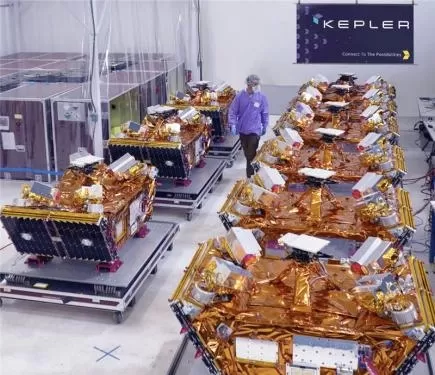
Despite all the buzz around space-based data centers, the number of GPUs in orbit remains quite small. But as that begins to shift, the emerging market for orbital computing is starting to take shape.
The biggest orbital computing cluster to date was deployed by Canada's Kepler Communications this past January. It features roughly 40 Nvidia Orin edge processors spread across 10 active satellites, all interconnected via laser communication links.
Kepler currently serves 18 customers, and on Monday it revealed its latest partner: Sophia Space, a startup that will test its proprietary orbital computer software on Kepler's satellite network.
Industry experts predict that large-scale orbital data centers, similar to those imagined by SpaceX and Blue Origin, won't become a reality until the 2030s. The initial phase will involve processing data gathered in orbit to enhance the performance of space-based sensors for both private and government use.
According to CEO Mina Mitry, Kepler views itself not as a data center operator, but as foundational infrastructure for space-based applications. The company aims to become a service layer offering networking capabilities to other satellites, as well as to drones and aircraft operating in Earth's atmosphere.
Sophia, meanwhile, is designing passively cooled space computers that address a major hurdle for orbital data centers: preventing high-performance processors from overheating without the need for heavy, costly active cooling systems that must be launched from Earth.
Under this new collaboration, Sophia will upload its custom operating system to a Kepler satellite and attempt to deploy and configure it across six GPUs on two separate spacecraft. While such tasks are routine in Earth-based data centers, this marks the first time they will be carried out in orbit. Successfully verifying the software's functionality in space will be a crucial risk-reduction step for Sophia before its scheduled satellite launch in late 2027.
For Kepler, this partnership serves to validate the usefulness of its network. Currently, the company handles and processes data either uploaded from Earth or gathered by payloads hosted on its own satellites. However, as the industry evolves, Kepler anticipates connecting with third-party satellites to deliver networking and data processing services.
Mitry notes that satellite companies are now designing future assets around this model, citing the advantages of offloading processing for power-intensive sensors such as synthetic aperture radar. The U.S. military is a key client for such work as it develops a new missile defense system that relies on satellites to detect and track threats. Kepler has already demonstrated a space-to-air laser link during a trial for the U.S. government.
This type of edge processing—analyzing data at the point of collection for quicker response times—is where orbital data centers will first demonstrate their worth. This approach distinguishes Sophia and Kepler from established space players like SpaceX and Blue Origin, as well as from startups such as Starcloud and Aetherflux, which are raising substantial funds to develop large-scale data centers using conventional data center processors.
Mitry told TechCrunch: “We believe the workload will involve more inference than training, so we prefer distributed GPUs optimized for inference rather than a single powerful GPU designed for training. If a system uses kilowatts of power but runs only 10% of the time, it’s not very efficient. In our case, our GPUs operate continuously at 100% utilization.”
Once these technologies are validated in orbit, the possibilities become endless. Sophia CEO Rob DeMillo notes that Wisconsin recently enacted a ban on new data center construction, a move that some members of Congress are also advocating. Any restriction on Earth-based data centers, in their view, makes the space-based option increasingly appealing.
Demillo mused, “There are no more data centers in this country. It’s going to get weird from here.”
Related article
 Former OpenAI Researcher Barrett Zoph Returns to Google to Support Gemini Development
Barret Zoph, who previously abruptly left and joined OpenAI due to a disagreement with Thinking Machines Lab CEO Miriam Mularati, has once again changed employers. Alphabet's Google announced that Zoph will return as Vice President of Research, bring
How Recursive Intelligence Raised $335M at $4B Valuation in 4 Months
The co-founders of startup Ricursive Intelligence seemed destined to be co-founders.Anna Goldie, CEO, and Azalia Mirhoseini, CTO, are so well-known in the AI community that they were among those AI engineers who “got those weird emails from Zuckerber
AI race won’t wait, nor will this TechCrunch Disrupt 25% discount
Every founder building in AI right now is asking the same question: Are we moving fast enough, and effectively enough? TechCrunch Disrupt 2026 puts you in the same room as the people wrestling with that existential question at the highest levels. Fro
Related Special Topic Recommendations
Design & Art
 Top AI Illustration Tools: Create Editorial Scenes and Cover Art Faster
2026 Latest Top-rated AI Illustration Tools: Our curated list features the best powerfully designed tools for creating stunning editorial scenes and eye-catching cover art quickly. Each option has gone through rigorous real-world tests, offering a free vs paid comparison to help you find the perfect match for your workflow. Try these must-try solutions today to unlock your AI edge and boost your creative productivity. Explore now at XIX.AI.
 10 tools
 xix.ai
Education and Learning
Top AI Tutors for Exam Prep: Practice Math, Science, and English
2026 Latest Top-Rated Best AI Tutors for Exam Prep are here on XIX.AI! Our curated list features powerful game-changing tools that offer free vs paid comparison, real-world tests, and weekly updated rankings. They help boost your writing efficiency, simplify complex topic learning, and unlock your academic potential. Explore now to Discover your perfect exam prep tool and Start creating today to Unlock your AI edge!
10 tools
xix.ai
Finance
AI Budget Planning Tools for Personal Money Management
2026 Latest Best Top-Rated AI Budget Planning Tools for Personal Money Management are here on XIX.AI! This curated collection features powerful, game-changing solutions that help you conduct real-world tests, understand spending habits, and create personalized plans to boost productivity. Enjoy a free vs paid comparison along with detailed rankings. Must-try tools designed to simplify money management and unlock your AI edge. Explore now!
11 tools
xix.ai
Health & Wellness
AI Sleep Tracking Assistants: Improve Recovery with Better Bedtime Habits
2026 Latest Best Top-Rated AI Sleep Tracking Assistants curated for ultimate recovery. This fully updated weekly guide features powerful tools that deliver real-world tests, free vs paid comparison, and detailed rankings to help you find the must-try solution that boosts sleep quality and supports better bedtime habits. Explore now at XIX.AI to Unlock your AI edge.
10 tools
xix.ai
Data Analysis
AI SQL Copilots for Product and Revenue Analytics
2026 Latest Best Top-Rated AI SQL Copilots for Product and Revenue Analytics! XIX.AI has curated a powerful, game-changing collection of must-try tools that undergo real-world tests through weekly updated rankings. These tools help users boost productivity significantly by accelerating data analysis, streamlining complex queries, and generating accurate insights to drive smarter business decisions. Explore now to Discover your perfect tool for unlocking your AI edge!
14 tools
xix.ai
Education and Learning
Best AI Homework Helpers That Teach: Learn Concepts, Not Just Answers
2026 Latest Best Top-Rated AI Homework Helpers That Teach Core Concepts Not Just Answers Powerful Tools for Students Must-Try Curated List Weekly Updated Free vs Paid Comparison Real-World Tests Accurate Rankings to Help You Unlock Your Full Learning Potential Explore now to Discover your perfect tool for smarter studying.
10 tools
xix.ai

 Comments (0)
0/500
Despite all the buzz around space-based data centers, the number of GPUs in orbit remains quite small. But as that begins to shift, the emerging market for orbital computing is starting to take shape.
The biggest orbital computing cluster to date was deployed by Canada's Kepler Communications this past January. It features roughly 40 Nvidia Orin edge processors spread across 10 active satellites, all interconnected via laser communication links.
Kepler currently serves 18 customers, and on Monday it revealed its latest partner: Sophia Space, a startup that will test its proprietary orbital computer software on Kepler's satellite network.
Industry experts predict that large-scale orbital data centers, similar to those imagined by SpaceX and Blue Origin, won't become a reality until the 2030s. The initial phase will involve processing data gathered in orbit to enhance the performance of space-based sensors for both private and government use.
According to CEO Mina Mitry, Kepler views itself not as a data center operator, but as foundational infrastructure for space-based applications. The company aims to become a service layer offering networking capabilities to other satellites, as well as to drones and aircraft operating in Earth's atmosphere.
Sophia, meanwhile, is designing passively cooled space computers that address a major hurdle for orbital data centers: preventing high-performance processors from overheating without the need for heavy, costly active cooling systems that must be launched from Earth.
Under this new collaboration, Sophia will upload its custom operating system to a Kepler satellite and attempt to deploy and configure it across six GPUs on two separate spacecraft. While such tasks are routine in Earth-based data centers, this marks the first time they will be carried out in orbit. Successfully verifying the software's functionality in space will be a crucial risk-reduction step for Sophia before its scheduled satellite launch in late 2027.
For Kepler, this partnership serves to validate the usefulness of its network. Currently, the company handles and processes data either uploaded from Earth or gathered by payloads hosted on its own satellites. However, as the industry evolves, Kepler anticipates connecting with third-party satellites to deliver networking and data processing services.
Mitry notes that satellite companies are now designing future assets around this model, citing the advantages of offloading processing for power-intensive sensors such as synthetic aperture radar. The U.S. military is a key client for such work as it develops a new missile defense system that relies on satellites to detect and track threats. Kepler has already demonstrated a space-to-air laser link during a trial for the U.S. government.
This type of edge processing—analyzing data at the point of collection for quicker response times—is where orbital data centers will first demonstrate their worth. This approach distinguishes Sophia and Kepler from established space players like SpaceX and Blue Origin, as well as from startups such as Starcloud and Aetherflux, which are raising substantial funds to develop large-scale data centers using conventional data center processors.
Mitry told TechCrunch: “We believe the workload will involve more inference than training, so we prefer distributed GPUs optimized for inference rather than a single powerful GPU designed for training. If a system uses kilowatts of power but runs only 10% of the time, it’s not very efficient. In our case, our GPUs operate continuously at 100% utilization.”
Once these technologies are validated in orbit, the possibilities become endless. Sophia CEO Rob DeMillo notes that Wisconsin recently enacted a ban on new data center construction, a move that some members of Congress are also advocating. Any restriction on Earth-based data centers, in their view, makes the space-based option increasingly appealing.
Demillo mused, “There are no more data centers in this country. It’s going to get weird from here.”








 Former OpenAI Researcher Barrett Zoph Returns to Google to Support Gemini Development
Barret Zoph, who previously abruptly left and joined OpenAI due to a disagreement with Thinking Machines Lab CEO Miriam Mularati, has once again changed employers. Alphabet's Google announced that Zoph will return as Vice President of Research, bring
 How Recursive Intelligence Raised $335M at $4B Valuation in 4 Months
The co-founders of startup Ricursive Intelligence seemed destined to be co-founders.Anna Goldie, CEO, and Azalia Mirhoseini, CTO, are so well-known in the AI community that they were among those AI engineers who “got those weird emails from Zuckerber
 AI race won’t wait, nor will this TechCrunch Disrupt 25% discount
Every founder building in AI right now is asking the same question: Are we moving fast enough, and effectively enough? TechCrunch Disrupt 2026 puts you in the same room as the people wrestling with that existential question at the highest levels. Fro

2026 Latest Top-rated AI Illustration Tools: Our curated list features the best powerfully designed tools for creating stunning editorial scenes and eye-catching cover art quickly. Each option has gone through rigorous real-world tests, offering a free vs paid comparison to help you find the perfect match for your workflow. Try these must-try solutions today to unlock your AI edge and boost your creative productivity. Explore now at XIX.AI.
10 tools
xix.ai

2026 Latest Top-Rated Best AI Tutors for Exam Prep are here on XIX.AI! Our curated list features powerful game-changing tools that offer free vs paid comparison, real-world tests, and weekly updated rankings. They help boost your writing efficiency, simplify complex topic learning, and unlock your academic potential. Explore now to Discover your perfect exam prep tool and Start creating today to Unlock your AI edge!
10 tools
xix.ai

2026 Latest Best Top-Rated AI Budget Planning Tools for Personal Money Management are here on XIX.AI! This curated collection features powerful, game-changing solutions that help you conduct real-world tests, understand spending habits, and create personalized plans to boost productivity. Enjoy a free vs paid comparison along with detailed rankings. Must-try tools designed to simplify money management and unlock your AI edge. Explore now!
11 tools
xix.ai

2026 Latest Best Top-Rated AI Sleep Tracking Assistants curated for ultimate recovery. This fully updated weekly guide features powerful tools that deliver real-world tests, free vs paid comparison, and detailed rankings to help you find the must-try solution that boosts sleep quality and supports better bedtime habits. Explore now at XIX.AI to Unlock your AI edge.
10 tools
xix.ai

2026 Latest Best Top-Rated AI SQL Copilots for Product and Revenue Analytics! XIX.AI has curated a powerful, game-changing collection of must-try tools that undergo real-world tests through weekly updated rankings. These tools help users boost productivity significantly by accelerating data analysis, streamlining complex queries, and generating accurate insights to drive smarter business decisions. Explore now to Discover your perfect tool for unlocking your AI edge!
14 tools
xix.ai

2026 Latest Best Top-Rated AI Homework Helpers That Teach Core Concepts Not Just Answers Powerful Tools for Students Must-Try Curated List Weekly Updated Free vs Paid Comparison Real-World Tests Accurate Rankings to Help You Unlock Your Full Learning Potential Explore now to Discover your perfect tool for smarter studying.
10 tools
xix.ai












