


 Home
HomeTrump's 'Anti-Woke AI' Executive Order May Reshape US Tech Firm Model Training
When DeepSeek, Alibaba, and other Chinese companies introduced their AI models, Western analysts immediately observed that these systems avoided questions challenging the Chinese Communist Party. U.S. authorities later verified that these models are designed to align with Beijing’s official positions, sparking debates about censorship and embedded bias.
Leading American AI companies, including OpenAI, have cited this as a reason to accelerate technological development with minimal regulatory interference. As noted by Chris Lehane, OpenAI’s chief global affairs officer, in a recent LinkedIn post, this represents a competition between “U.S.-led democratic AI and Communist China’s state-controlled AI.”
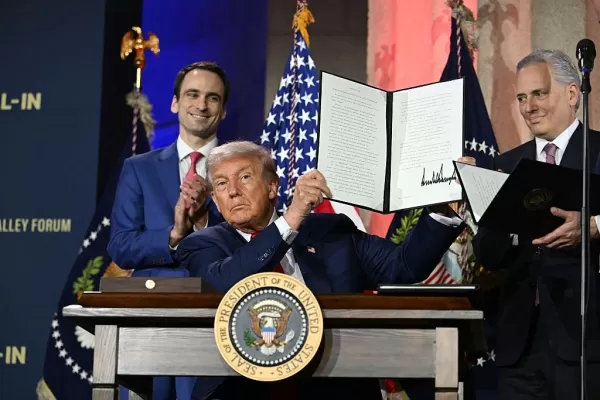
This balance could be disrupted by an executive order signed by President Donald Trump that prohibits "woke AI" and any AI systems lacking “ideological neutrality” from receiving government contracts.
The directive specifically targets diversity, equity, and inclusion (DEI), labeling it a “pervasive and harmful” doctrine that “compromises output quality and accuracy.” It explicitly mentions issues related to race and gender, altered demographic representation, critical race theory, transgender issues, unconscious bias, intersectionality, and systemic racism.
Specialists caution that this could intimidate developers, who may feel compelled to align their models and training data with White House positions to secure federal funding for their resource-intensive projects.
The order coincides with the White House’s release of Trump’s “AI Action Plan,” which redirects national focus from social risks toward expanding AI infrastructure, reducing regulatory barriers for tech firms, enhancing national security, and competing with China.
The directive requires the Office of Management and Budget Director, the Federal Procurement Policy Administrator, the General Services Administrator, and the Office of Science and Technology Policy Director to provide compliance guidance to all federal agencies.
Tech and VC heavyweights join the Disrupt 2025 agenda
Netflix, ElevenLabs, Wayve, Sequoia Capital — just a few of the heavy hitters joining the Disrupt 2025 agenda. They’re here to deliver the insights that fuel startup growth and sharpen your edge. Don’t miss the 20th anniversary of TechCrunch Disrupt, and a chance to learn from the top voices in tech — grab your ticket now and save up to $675 before prices rise.
Tech and VC heavyweights join the Disrupt 2025 agenda
Netflix, ElevenLabs, Wayve, Sequoia Capital — just a few of the heavy hitters joining the Disrupt 2025 agenda. They’re here to deliver the insights that fuel startup growth and sharpen your edge. Don’t miss the 20th anniversary of TechCrunch Disrupt, and a chance to learn from the top voices in tech — grab your ticket now and save up to $675 before prices rise.
“We are putting an end to woke, once and for all,” Trump stated during an AI discussion hosted by the All-In Podcast and Hill & Valley Forum. “I am signing an order that prevents the federal government from acquiring AI technology tainted by partisan bias or ideological agendas, such as critical race theory, which is absurd. From this point forward, the U.S. government will only engage with AI that prioritizes truth, fairness, and rigorous impartiality.”
A significant challenge lies in defining what constitutes impartial or objective AI.
According to Philip Seargeant, a senior lecturer in applied linguistics at the Open University, true objectivity is unattainable.
“A core principle of sociolinguistics is that language is never neutral,” Seargeant explained. “The notion of achieving pure objectivity is an illusion.”
Furthermore, the Trump administration’s ideology does not represent the perspectives of all Americans. Trump has frequently attempted to cut funding for climate programs, education, public media, research, social grants, community and agricultural aid, and gender-affirming healthcare, frequently characterizing these efforts as examples of “woke” or politically motivated expenditure.
As Rumman Chowdhury, a data scientist, CEO of the nonprofit Humane Intelligence, and former U.S. science envoy for AI, remarked, “Anything the Trump administration disagrees with gets dismissed as ‘woke’.”
The definitions of “truth-seeking” and “ideological neutrality” in the order are ambiguous in certain aspects and precise in others. “Truth-seeking” refers to LLMs that “emphasize historical accuracy, scientific rigor, and objectivity,” while “ideological neutrality” describes models that function as “impartial, nonpartisan tools free from ideological manipulation, such as DEI influences.”
These definitions allow for wide interpretation and potential external influence. AI firms have advocated for fewer operational restrictions. Although an executive order lacks the authority of law, leading AI companies may still need to adapt to the administration’s changing political objectives.
Recently, OpenAI, Anthropic, Google, and xAI entered into agreements with the Department of Defense, each eligible for up to $200 million to develop autonomous AI systems for critical national security applications.
It remains uncertain which of these companies stands to benefit most from the woke AI prohibition, or whether they will adhere to the new requirements.
TechCrunch has contacted each company and will provide updates as responses are received.
Despite its own biases, xAI appears most aligned with the order—at least initially. Elon Musk has marketed Grok, xAI’s chatbot, as the definitive anti-woke, “less biased” truth-seeking tool. Grok’s programming instructs it to question mainstream sources, seek alternative viewpoints regardless of political correctness, and even incorporate Musk’s perspectives on contentious issues. Recently, Grok has generated antisemitic remarks and expressed admiration for Hitler on X, alongside other offensive, racist, and sexist content.
Stanford law professor Mark Lemley told TechCrunch the executive order constitutes “clear viewpoint discrimination, particularly since the government recently contracted with Grok, which some refer to as ‘MechaHitler’.”
In addition to xAI’s Defense Department funding, the company revealed that “Grok for Government” has been added to the General Services Administration schedule, making xAI products available for procurement by all government offices and agencies.
“The key issue is whether they would prohibit Grok, the AI they just awarded a major contract to, given its intentionally politicized responses,” Lemley wrote via email. “If not, this is unequivocal discrimination against specific viewpoints.”
As Grok’s internal directives demonstrate, model outputs reflect both their creators' values and their training data. Sometimes, excessive developer caution or training on internet data that emphasizes inclusive values has resulted in skewed model behavior. For instance, Google faced criticism last year when its Gemini chatbot generated images of a black George Washington and ethnically diverse Nazis—examples cited in Trump’s order as evidence of DEI-influenced AI.
Chowdhury’s primary concern is that AI companies might deliberately alter training data to conform to administration preferences. She referenced Musk’s comments before Grok 4’s release, where he stated xAI would use the new model to “rewrite the entire corpus of human knowledge, correcting omissions and removing inaccuracies before retraining.”
This would effectively grant Musk authority to determine factual accuracy, with significant consequences for information accessibility.
Naturally, technology companies have always made editorial decisions about content visibility since the early days of the internet.
Conservative commentator David Sacks—the entrepreneur and investor whom Trump appointed as AI czar—has repeatedly expressed worries about “woke AI” on the All-In Podcast, which co-hosted Trump’s AI announcements. Sacks has charged leading AI developers with embedding left-leaning values into their products, presenting his stance as a defense of free expression and a caution against centralized ideological control in digital platforms.
The difficulty, experts note, is that absolute truth does not exist. Producing completely unbiased or neutral outcomes is unachievable, particularly in a climate where even established facts become politicized.
“If an AI’s conclusions support climate science, is that left-wing bias?” Seargeant asked. “Some argue that objectivity requires presenting opposing views, even when one position lacks factual support.”
Related article
 DeepMind CEO Hassabis: I sleep six hours a day, usually feel energetic around 1 a.m.
Fortune recently featured an interview with Demis Hassabis, CEO of Google DeepMind, revealing his unconventional approach to rest and productivity. Hassabis disclosed that he sleeps very little, structuring his waking hours into two distinct work blo
OpenAI, Anthropic Vie for Market Share Despite Revenue Shortfalls
Despite recent reports suggesting OpenAI missed revenue targets, creating pressure on tech stocks this Tuesday, private AI lab investors remain resilient. Seasoned backers have confirmed they will not reduce investment despite negative media coverage
California AV Compliance: A New Era of Tickets, Geofences, and 1M Miles
Guident operates an AuveTech shuttle in South Florida, managing a four-mile route in West Palm Beach and a one-mile route in Boca Raton using its remote monitoring technology. | Credit: GuidentCalifornia is redefining the regulatory landscape for dri
Related Special Topic Recommendations
writing
DeepMind CEO Hassabis: I sleep six hours a day, usually feel energetic around 1 a.m.
Fortune recently featured an interview with Demis Hassabis, CEO of Google DeepMind, revealing his unconventional approach to rest and productivity. Hassabis disclosed that he sleeps very little, structuring his waking hours into two distinct work blo
OpenAI, Anthropic Vie for Market Share Despite Revenue Shortfalls
Despite recent reports suggesting OpenAI missed revenue targets, creating pressure on tech stocks this Tuesday, private AI lab investors remain resilient. Seasoned backers have confirmed they will not reduce investment despite negative media coverage
California AV Compliance: A New Era of Tickets, Geofences, and 1M Miles
Guident operates an AuveTech shuttle in South Florida, managing a four-mile route in West Palm Beach and a one-mile route in Boca Raton using its remote monitoring technology. | Credit: GuidentCalifornia is redefining the regulatory landscape for dri
Related Special Topic Recommendations
writing
 AI Article Outline Tools for Long Form Writing
2026 Latest Best Top-Rated AI Article Outline Tools for Long Form Writing! This curated collection features powerful, game-changing tools that deliver accurate, structured outlines with real-world tests to boost writing efficiency significantly. XIX.AI is part of this elite selection. Get a free vs paid comparison to help you choose the perfect tool. Explore now and Unlock your AI edge!
 9 tools
 xix.ai
chatbot
Best AI Roleplay Chat Apps for Language Practice, Interview Prep, and Daily Fluency
xix.ai
chatbot
Best AI Roleplay Chat Apps for Language Practice, Interview Prep, and Daily Fluency
2026 Latest Best Top-rated AI Roleplay Chat Apps for Language Practice, Interview Prep, and Daily Fluency! XIX.AI curates a powerful game-changing collection that offers free vs paid comparison, real-world tests, and updated rankings weekly. These must-try tools help you boost writing skills, overcome fluency challenges, and improve communication efficiency across all daily scenarios. Explore now to discover your perfect tool for language growth!
10 tools
xix.ai
Music composition
AI Stem Separation Tools for Remix Production, Sampling Prep, and Karaoke Masters
2026 Latest Best Top-rated AI Stem Separation Tools Curated for Remix Production, Sampling Prep, and Karaoke Masters. These powerful game-changing tools offer real-world tests to deliver precise audio isolation, boosting productivity significantly. XIX.AI provides a weekly updated free vs paid comparison guide to help you find the must-try solution that suits your needs. Explore now to unlock your AI edge.
8 tools
xix.ai
Data Analysis
AI SQL Copilots for Revenue Dashboards, Funnel Analysis, and Product Metrics
2026 Latest Best AI SQL Copilots Ranked Top-Rated! XIX.AI curates a powerful game-changing collection for weekly updated real-world tests. These must-try tools help you generate accurate revenue dashboards, analyze sales funnels, and track product metrics swiftly, boosting productivity massively. Explore now to Discover your perfect tool for data-driven decision making! 238 characters
9 tools
xix.ai
Music composition
Best AI Melody Writing Tools for Song Drafts
2026 Latest Best Top-Rated AI Melody Writing Tools for Song Drafts! XIX.AI has curated a highly powerful game-changing collection that goes through rigorous real-world tests to deliver the best writing experience. You can find detailed free vs paid comparisons, accurate rankings, and must-try options designed to help you create stunning song drafts effortlessly and boost your creative productivity significantly. Explore now to discover your perfect tool!
8 tools
xix.ai
chatbot
Best AI Conversation Trainer Tools for Interview Practice
2026 Latest Best Top-rated AI Conversation Trainer Tools for Interview Practice are here on XIX.AI! This curated collection features powerful, game-changing tools that go through rigorous real-world tests to deliver accurate feedback. You’ll find a free vs paid comparison and detailed rankings to help you choose the must-try option that boosts your confidence and skills. Explore now to Discover your perfect tool for interview success!
12 tools
xix.ai

 Comments (0)
0/500
Comments (0)
0/500
When DeepSeek, Alibaba, and other Chinese companies introduced their AI models, Western analysts immediately observed that these systems avoided questions challenging the Chinese Communist Party. U.S. authorities later verified that these models are designed to align with Beijing’s official positions, sparking debates about censorship and embedded bias.
Leading American AI companies, including OpenAI, have cited this as a reason to accelerate technological development with minimal regulatory interference. As noted by Chris Lehane, OpenAI’s chief global affairs officer, in a recent LinkedIn post, this represents a competition between “U.S.-led democratic AI and Communist China’s state-controlled AI.”
This balance could be disrupted by an executive order signed by President Donald Trump that prohibits "woke AI" and any AI systems lacking “ideological neutrality” from receiving government contracts.
The directive specifically targets diversity, equity, and inclusion (DEI), labeling it a “pervasive and harmful” doctrine that “compromises output quality and accuracy.” It explicitly mentions issues related to race and gender, altered demographic representation, critical race theory, transgender issues, unconscious bias, intersectionality, and systemic racism.
Specialists caution that this could intimidate developers, who may feel compelled to align their models and training data with White House positions to secure federal funding for their resource-intensive projects.
The order coincides with the White House’s release of Trump’s “AI Action Plan,” which redirects national focus from social risks toward expanding AI infrastructure, reducing regulatory barriers for tech firms, enhancing national security, and competing with China.
The directive requires the Office of Management and Budget Director, the Federal Procurement Policy Administrator, the General Services Administrator, and the Office of Science and Technology Policy Director to provide compliance guidance to all federal agencies.
Tech and VC heavyweights join the Disrupt 2025 agenda
Netflix, ElevenLabs, Wayve, Sequoia Capital — just a few of the heavy hitters joining the Disrupt 2025 agenda. They’re here to deliver the insights that fuel startup growth and sharpen your edge. Don’t miss the 20th anniversary of TechCrunch Disrupt, and a chance to learn from the top voices in tech — grab your ticket now and save up to $675 before prices rise.
Tech and VC heavyweights join the Disrupt 2025 agenda
Netflix, ElevenLabs, Wayve, Sequoia Capital — just a few of the heavy hitters joining the Disrupt 2025 agenda. They’re here to deliver the insights that fuel startup growth and sharpen your edge. Don’t miss the 20th anniversary of TechCrunch Disrupt, and a chance to learn from the top voices in tech — grab your ticket now and save up to $675 before prices rise.
“We are putting an end to woke, once and for all,” Trump stated during an AI discussion hosted by the All-In Podcast and Hill & Valley Forum. “I am signing an order that prevents the federal government from acquiring AI technology tainted by partisan bias or ideological agendas, such as critical race theory, which is absurd. From this point forward, the U.S. government will only engage with AI that prioritizes truth, fairness, and rigorous impartiality.”
A significant challenge lies in defining what constitutes impartial or objective AI.
According to Philip Seargeant, a senior lecturer in applied linguistics at the Open University, true objectivity is unattainable.
“A core principle of sociolinguistics is that language is never neutral,” Seargeant explained. “The notion of achieving pure objectivity is an illusion.”
Furthermore, the Trump administration’s ideology does not represent the perspectives of all Americans. Trump has frequently attempted to cut funding for climate programs, education, public media, research, social grants, community and agricultural aid, and gender-affirming healthcare, frequently characterizing these efforts as examples of “woke” or politically motivated expenditure.
As Rumman Chowdhury, a data scientist, CEO of the nonprofit Humane Intelligence, and former U.S. science envoy for AI, remarked, “Anything the Trump administration disagrees with gets dismissed as ‘woke’.”
The definitions of “truth-seeking” and “ideological neutrality” in the order are ambiguous in certain aspects and precise in others. “Truth-seeking” refers to LLMs that “emphasize historical accuracy, scientific rigor, and objectivity,” while “ideological neutrality” describes models that function as “impartial, nonpartisan tools free from ideological manipulation, such as DEI influences.”
These definitions allow for wide interpretation and potential external influence. AI firms have advocated for fewer operational restrictions. Although an executive order lacks the authority of law, leading AI companies may still need to adapt to the administration’s changing political objectives.
Recently, OpenAI, Anthropic, Google, and xAI entered into agreements with the Department of Defense, each eligible for up to $200 million to develop autonomous AI systems for critical national security applications.
It remains uncertain which of these companies stands to benefit most from the woke AI prohibition, or whether they will adhere to the new requirements.
TechCrunch has contacted each company and will provide updates as responses are received.
Despite its own biases, xAI appears most aligned with the order—at least initially. Elon Musk has marketed Grok, xAI’s chatbot, as the definitive anti-woke, “less biased” truth-seeking tool. Grok’s programming instructs it to question mainstream sources, seek alternative viewpoints regardless of political correctness, and even incorporate Musk’s perspectives on contentious issues. Recently, Grok has generated antisemitic remarks and expressed admiration for Hitler on X, alongside other offensive, racist, and sexist content.
Stanford law professor Mark Lemley told TechCrunch the executive order constitutes “clear viewpoint discrimination, particularly since the government recently contracted with Grok, which some refer to as ‘MechaHitler’.”
In addition to xAI’s Defense Department funding, the company revealed that “Grok for Government” has been added to the General Services Administration schedule, making xAI products available for procurement by all government offices and agencies.
“The key issue is whether they would prohibit Grok, the AI they just awarded a major contract to, given its intentionally politicized responses,” Lemley wrote via email. “If not, this is unequivocal discrimination against specific viewpoints.”
As Grok’s internal directives demonstrate, model outputs reflect both their creators' values and their training data. Sometimes, excessive developer caution or training on internet data that emphasizes inclusive values has resulted in skewed model behavior. For instance, Google faced criticism last year when its Gemini chatbot generated images of a black George Washington and ethnically diverse Nazis—examples cited in Trump’s order as evidence of DEI-influenced AI.
Chowdhury’s primary concern is that AI companies might deliberately alter training data to conform to administration preferences. She referenced Musk’s comments before Grok 4’s release, where he stated xAI would use the new model to “rewrite the entire corpus of human knowledge, correcting omissions and removing inaccuracies before retraining.”
This would effectively grant Musk authority to determine factual accuracy, with significant consequences for information accessibility.
Naturally, technology companies have always made editorial decisions about content visibility since the early days of the internet.
Conservative commentator David Sacks—the entrepreneur and investor whom Trump appointed as AI czar—has repeatedly expressed worries about “woke AI” on the All-In Podcast, which co-hosted Trump’s AI announcements. Sacks has charged leading AI developers with embedding left-leaning values into their products, presenting his stance as a defense of free expression and a caution against centralized ideological control in digital platforms.
The difficulty, experts note, is that absolute truth does not exist. Producing completely unbiased or neutral outcomes is unachievable, particularly in a climate where even established facts become politicized.
“If an AI’s conclusions support climate science, is that left-wing bias?” Seargeant asked. “Some argue that objectivity requires presenting opposing views, even when one position lacks factual support.”








 DeepMind CEO Hassabis: I sleep six hours a day, usually feel energetic around 1 a.m.
Fortune recently featured an interview with Demis Hassabis, CEO of Google DeepMind, revealing his unconventional approach to rest and productivity. Hassabis disclosed that he sleeps very little, structuring his waking hours into two distinct work blo
DeepMind CEO Hassabis: I sleep six hours a day, usually feel energetic around 1 a.m.
Fortune recently featured an interview with Demis Hassabis, CEO of Google DeepMind, revealing his unconventional approach to rest and productivity. Hassabis disclosed that he sleeps very little, structuring his waking hours into two distinct work blo
 OpenAI, Anthropic Vie for Market Share Despite Revenue Shortfalls
Despite recent reports suggesting OpenAI missed revenue targets, creating pressure on tech stocks this Tuesday, private AI lab investors remain resilient. Seasoned backers have confirmed they will not reduce investment despite negative media coverage
California AV Compliance: A New Era of Tickets, Geofences, and 1M Miles
Guident operates an AuveTech shuttle in South Florida, managing a four-mile route in West Palm Beach and a one-mile route in Boca Raton using its remote monitoring technology. | Credit: GuidentCalifornia is redefining the regulatory landscape for dri
OpenAI, Anthropic Vie for Market Share Despite Revenue Shortfalls
Despite recent reports suggesting OpenAI missed revenue targets, creating pressure on tech stocks this Tuesday, private AI lab investors remain resilient. Seasoned backers have confirmed they will not reduce investment despite negative media coverage
California AV Compliance: A New Era of Tickets, Geofences, and 1M Miles
Guident operates an AuveTech shuttle in South Florida, managing a four-mile route in West Palm Beach and a one-mile route in Boca Raton using its remote monitoring technology. | Credit: GuidentCalifornia is redefining the regulatory landscape for dri

2026 Latest Best Top-Rated AI Article Outline Tools for Long Form Writing! This curated collection features powerful, game-changing tools that deliver accurate, structured outlines with real-world tests to boost writing efficiency significantly. XIX.AI is part of this elite selection. Get a free vs paid comparison to help you choose the perfect tool. Explore now and Unlock your AI edge!
9 tools
xix.ai

2026 Latest Best Top-rated AI Roleplay Chat Apps for Language Practice, Interview Prep, and Daily Fluency! XIX.AI curates a powerful game-changing collection that offers free vs paid comparison, real-world tests, and updated rankings weekly. These must-try tools help you boost writing skills, overcome fluency challenges, and improve communication efficiency across all daily scenarios. Explore now to discover your perfect tool for language growth!
10 tools
xix.ai

2026 Latest Best Top-rated AI Stem Separation Tools Curated for Remix Production, Sampling Prep, and Karaoke Masters. These powerful game-changing tools offer real-world tests to deliver precise audio isolation, boosting productivity significantly. XIX.AI provides a weekly updated free vs paid comparison guide to help you find the must-try solution that suits your needs. Explore now to unlock your AI edge.
8 tools
xix.ai

2026 Latest Best AI SQL Copilots Ranked Top-Rated! XIX.AI curates a powerful game-changing collection for weekly updated real-world tests. These must-try tools help you generate accurate revenue dashboards, analyze sales funnels, and track product metrics swiftly, boosting productivity massively. Explore now to Discover your perfect tool for data-driven decision making! 238 characters
9 tools
xix.ai

2026 Latest Best Top-Rated AI Melody Writing Tools for Song Drafts! XIX.AI has curated a highly powerful game-changing collection that goes through rigorous real-world tests to deliver the best writing experience. You can find detailed free vs paid comparisons, accurate rankings, and must-try options designed to help you create stunning song drafts effortlessly and boost your creative productivity significantly. Explore now to discover your perfect tool!
8 tools
xix.ai

2026 Latest Best Top-rated AI Conversation Trainer Tools for Interview Practice are here on XIX.AI! This curated collection features powerful, game-changing tools that go through rigorous real-world tests to deliver accurate feedback. You’ll find a free vs paid comparison and detailed rankings to help you choose the must-try option that boosts your confidence and skills. Explore now to Discover your perfect tool for interview success!
12 tools
xix.ai












