


 Home
HomeClaude Opus 4.7 Launches with Reliability Valued Over Intelligence
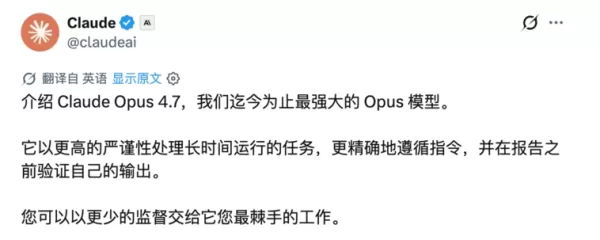
Anthropic has maintained an aggressive pace this year, rolling out new features almost every other day. The much-anticipated Claude Opus 4.7 has just been officially released, and interestingly, Anthropic was upfront in the announcement: "This is not our most powerful model." The rumored, stronger Claude Mythos Preview remains on standby. Still, Opus 4.7 has generated considerable attention because it tackles the issue of being "more reliable" rather than "smarter."
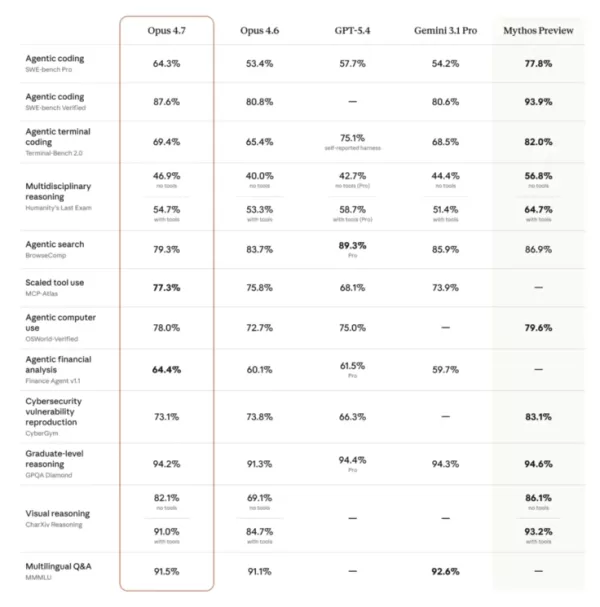
Benchmark results are notably impressive. On the rigorous coding benchmark SWE-bench Pro, 4.7 jumped from 53.4% in the previous version to 64.3%, a gain of nearly 11 percentage points, surpassing GPT-5.4 (57.7%) and Gemini 3.1 Pro (54.2%). On the visual reasoning benchmark CharXiv, it rose from 69.1% to 82.1%, driven by the newly added 2576-pixel long-side recognition capability, offering more than three times the clarity of its predecessor. On the tool call evaluation MCP-Atlas, it scored 77.3%, and on the legal AI platform Harvey's BigLaw benchmark, it reached 90.9%. However, on the agentic search evaluation BrowseComp, 4.7 saw a slight decline from 83.7% to 79.3%, overtaken by GPT-5.4 and Gemini—this is attributed to its "no fabrications" personality, preferring to report errors rather than guess when information is incomplete.
Beyond the numbers, the shift in temperament is more noteworthy. Replit's leader noted after testing: "It challenges me in technical discussions, helps me make better decisions, and truly acts like a better colleague." Data science platform Hex also observed that 4.7 directly reports errors when data is missing, rather than providing a "seemingly reasonable but completely incorrect" alternative value as before. At the same time, task resilience has improved significantly—Notion team tests indicate that the tool error rate has been reduced to one-third of previous levels, and when the tool chain fails, it can navigate obstacles and complete tasks independently. Vercel even discovered a new behavior: before writing system-level code, 4.7 first performs mathematical proofs on its own.
Of course, increased capability comes with a cost. 4.7 introduces a new tokenizer, generating 1 to 1.35 times more tokens for the same text. Additionally, it tends to "think a bit longer" on complex tasks, so actual consumption is almost certainly higher. To address this, Anthropic added an xhigh ultra-high thinking intensity level. Claude Code has set all packages to this level by default, and also launched the Deep Review instruction / ultrareview, Auto Mode extension for Max users, and a public beta version of the "task budget" feature to help developers manage token usage.
The more powerful Mythos Preview was recently made available to enterprises under the name "Project Glasswing" for cybersecurity research, but due to its overwhelming capability and incomplete security evaluations, it has not been publicly released yet.
Today's 4.7 represents the latest milestone in Anthropic's high-frequency delivery rhythm. Mythos will eventually arrive—and when it does, the already strong 4.7 may prove to be just the beginning.
Related article
 DeepMind CEO Hassabis: I sleep six hours a day, usually feel energetic around 1 a.m.
Fortune recently featured an interview with Demis Hassabis, CEO of Google DeepMind, revealing his unconventional approach to rest and productivity. Hassabis disclosed that he sleeps very little, structuring his waking hours into two distinct work blo
OpenAI, Anthropic Vie for Market Share Despite Revenue Shortfalls
Despite recent reports suggesting OpenAI missed revenue targets, creating pressure on tech stocks this Tuesday, private AI lab investors remain resilient. Seasoned backers have confirmed they will not reduce investment despite negative media coverage
California AV Compliance: A New Era of Tickets, Geofences, and 1M Miles
Guident operates an AuveTech shuttle in South Florida, managing a four-mile route in West Palm Beach and a one-mile route in Boca Raton using its remote monitoring technology. | Credit: GuidentCalifornia is redefining the regulatory landscape for dri
Related Special Topic Recommendations
Video creation
DeepMind CEO Hassabis: I sleep six hours a day, usually feel energetic around 1 a.m.
Fortune recently featured an interview with Demis Hassabis, CEO of Google DeepMind, revealing his unconventional approach to rest and productivity. Hassabis disclosed that he sleeps very little, structuring his waking hours into two distinct work blo
OpenAI, Anthropic Vie for Market Share Despite Revenue Shortfalls
Despite recent reports suggesting OpenAI missed revenue targets, creating pressure on tech stocks this Tuesday, private AI lab investors remain resilient. Seasoned backers have confirmed they will not reduce investment despite negative media coverage
California AV Compliance: A New Era of Tickets, Geofences, and 1M Miles
Guident operates an AuveTech shuttle in South Florida, managing a four-mile route in West Palm Beach and a one-mile route in Boca Raton using its remote monitoring technology. | Credit: GuidentCalifornia is redefining the regulatory landscape for dri
Related Special Topic Recommendations
Video creation
 AI Short-Form Video Hook Generators for Reels, Shorts, and Product Launch Campaigns
2026 Latest Best AI Short-Form Video Hook Generators for Reels Shorts and Product Launch Campaigns! XIX.AI curates top-rated powerful game-changing tools that deliver must-try results through real-world tests. This weekly updated page offers free vs paid comparison rankings to help you find the perfect solution for boosting content creativity and productivity. Explore now to Unlock your AI edge!
 11 tools
 xix.ai
writing
AI Article Outline Tools for Long Form Writing
xix.ai
writing
AI Article Outline Tools for Long Form Writing
2026 Latest Best Top-Rated AI Article Outline Tools for Long Form Writing! This curated collection features powerful, game-changing tools that deliver accurate, structured outlines with real-world tests to boost writing efficiency significantly. XIX.AI is part of this elite selection. Get a free vs paid comparison to help you choose the perfect tool. Explore now and Unlock your AI edge!
9 tools
xix.ai
chatbot
Best AI Roleplay Chat Apps for Language Practice, Interview Prep, and Daily Fluency
2026 Latest Best Top-rated AI Roleplay Chat Apps for Language Practice, Interview Prep, and Daily Fluency! XIX.AI curates a powerful game-changing collection that offers free vs paid comparison, real-world tests, and updated rankings weekly. These must-try tools help you boost writing skills, overcome fluency challenges, and improve communication efficiency across all daily scenarios. Explore now to discover your perfect tool for language growth!
10 tools
xix.ai
Music composition
AI Stem Separation Tools for Remix Production, Sampling Prep, and Karaoke Masters
2026 Latest Best Top-rated AI Stem Separation Tools Curated for Remix Production, Sampling Prep, and Karaoke Masters. These powerful game-changing tools offer real-world tests to deliver precise audio isolation, boosting productivity significantly. XIX.AI provides a weekly updated free vs paid comparison guide to help you find the must-try solution that suits your needs. Explore now to unlock your AI edge.
8 tools
xix.ai
Data Analysis
AI SQL Copilots for Revenue Dashboards, Funnel Analysis, and Product Metrics
2026 Latest Best AI SQL Copilots Ranked Top-Rated! XIX.AI curates a powerful game-changing collection for weekly updated real-world tests. These must-try tools help you generate accurate revenue dashboards, analyze sales funnels, and track product metrics swiftly, boosting productivity massively. Explore now to Discover your perfect tool for data-driven decision making! 238 characters
9 tools
xix.ai
Music composition
Best AI Melody Writing Tools for Song Drafts
2026 Latest Best Top-Rated AI Melody Writing Tools for Song Drafts! XIX.AI has curated a highly powerful game-changing collection that goes through rigorous real-world tests to deliver the best writing experience. You can find detailed free vs paid comparisons, accurate rankings, and must-try options designed to help you create stunning song drafts effortlessly and boost your creative productivity significantly. Explore now to discover your perfect tool!
8 tools
xix.ai

 Comments (0)
0/500
Comments (0)
0/500
Anthropic has maintained an aggressive pace this year, rolling out new features almost every other day. The much-anticipated Claude Opus 4.7 has just been officially released, and interestingly, Anthropic was upfront in the announcement: "This is not our most powerful model." The rumored, stronger Claude Mythos Preview remains on standby. Still, Opus 4.7 has generated considerable attention because it tackles the issue of being "more reliable" rather than "smarter."
Benchmark results are notably impressive. On the rigorous coding benchmark SWE-bench Pro, 4.7 jumped from 53.4% in the previous version to 64.3%, a gain of nearly 11 percentage points, surpassing GPT-5.4 (57.7%) and Gemini 3.1 Pro (54.2%). On the visual reasoning benchmark CharXiv, it rose from 69.1% to 82.1%, driven by the newly added 2576-pixel long-side recognition capability, offering more than three times the clarity of its predecessor. On the tool call evaluation MCP-Atlas, it scored 77.3%, and on the legal AI platform Harvey's BigLaw benchmark, it reached 90.9%. However, on the agentic search evaluation BrowseComp, 4.7 saw a slight decline from 83.7% to 79.3%, overtaken by GPT-5.4 and Gemini—this is attributed to its "no fabrications" personality, preferring to report errors rather than guess when information is incomplete.
Beyond the numbers, the shift in temperament is more noteworthy. Replit's leader noted after testing: "It challenges me in technical discussions, helps me make better decisions, and truly acts like a better colleague." Data science platform Hex also observed that 4.7 directly reports errors when data is missing, rather than providing a "seemingly reasonable but completely incorrect" alternative value as before. At the same time, task resilience has improved significantly—Notion team tests indicate that the tool error rate has been reduced to one-third of previous levels, and when the tool chain fails, it can navigate obstacles and complete tasks independently. Vercel even discovered a new behavior: before writing system-level code, 4.7 first performs mathematical proofs on its own.
Of course, increased capability comes with a cost. 4.7 introduces a new tokenizer, generating 1 to 1.35 times more tokens for the same text. Additionally, it tends to "think a bit longer" on complex tasks, so actual consumption is almost certainly higher. To address this, Anthropic added an xhigh ultra-high thinking intensity level. Claude Code has set all packages to this level by default, and also launched the Deep Review instruction / ultrareview, Auto Mode extension for Max users, and a public beta version of the "task budget" feature to help developers manage token usage.
The more powerful Mythos Preview was recently made available to enterprises under the name "Project Glasswing" for cybersecurity research, but due to its overwhelming capability and incomplete security evaluations, it has not been publicly released yet.
Today's 4.7 represents the latest milestone in Anthropic's high-frequency delivery rhythm. Mythos will eventually arrive—and when it does, the already strong 4.7 may prove to be just the beginning.








 DeepMind CEO Hassabis: I sleep six hours a day, usually feel energetic around 1 a.m.
Fortune recently featured an interview with Demis Hassabis, CEO of Google DeepMind, revealing his unconventional approach to rest and productivity. Hassabis disclosed that he sleeps very little, structuring his waking hours into two distinct work blo
DeepMind CEO Hassabis: I sleep six hours a day, usually feel energetic around 1 a.m.
Fortune recently featured an interview with Demis Hassabis, CEO of Google DeepMind, revealing his unconventional approach to rest and productivity. Hassabis disclosed that he sleeps very little, structuring his waking hours into two distinct work blo
 OpenAI, Anthropic Vie for Market Share Despite Revenue Shortfalls
Despite recent reports suggesting OpenAI missed revenue targets, creating pressure on tech stocks this Tuesday, private AI lab investors remain resilient. Seasoned backers have confirmed they will not reduce investment despite negative media coverage
California AV Compliance: A New Era of Tickets, Geofences, and 1M Miles
Guident operates an AuveTech shuttle in South Florida, managing a four-mile route in West Palm Beach and a one-mile route in Boca Raton using its remote monitoring technology. | Credit: GuidentCalifornia is redefining the regulatory landscape for dri
OpenAI, Anthropic Vie for Market Share Despite Revenue Shortfalls
Despite recent reports suggesting OpenAI missed revenue targets, creating pressure on tech stocks this Tuesday, private AI lab investors remain resilient. Seasoned backers have confirmed they will not reduce investment despite negative media coverage
California AV Compliance: A New Era of Tickets, Geofences, and 1M Miles
Guident operates an AuveTech shuttle in South Florida, managing a four-mile route in West Palm Beach and a one-mile route in Boca Raton using its remote monitoring technology. | Credit: GuidentCalifornia is redefining the regulatory landscape for dri

2026 Latest Best AI Short-Form Video Hook Generators for Reels Shorts and Product Launch Campaigns! XIX.AI curates top-rated powerful game-changing tools that deliver must-try results through real-world tests. This weekly updated page offers free vs paid comparison rankings to help you find the perfect solution for boosting content creativity and productivity. Explore now to Unlock your AI edge!
11 tools
xix.ai

2026 Latest Best Top-Rated AI Article Outline Tools for Long Form Writing! This curated collection features powerful, game-changing tools that deliver accurate, structured outlines with real-world tests to boost writing efficiency significantly. XIX.AI is part of this elite selection. Get a free vs paid comparison to help you choose the perfect tool. Explore now and Unlock your AI edge!
9 tools
xix.ai

2026 Latest Best Top-rated AI Roleplay Chat Apps for Language Practice, Interview Prep, and Daily Fluency! XIX.AI curates a powerful game-changing collection that offers free vs paid comparison, real-world tests, and updated rankings weekly. These must-try tools help you boost writing skills, overcome fluency challenges, and improve communication efficiency across all daily scenarios. Explore now to discover your perfect tool for language growth!
10 tools
xix.ai

2026 Latest Best Top-rated AI Stem Separation Tools Curated for Remix Production, Sampling Prep, and Karaoke Masters. These powerful game-changing tools offer real-world tests to deliver precise audio isolation, boosting productivity significantly. XIX.AI provides a weekly updated free vs paid comparison guide to help you find the must-try solution that suits your needs. Explore now to unlock your AI edge.
8 tools
xix.ai

2026 Latest Best AI SQL Copilots Ranked Top-Rated! XIX.AI curates a powerful game-changing collection for weekly updated real-world tests. These must-try tools help you generate accurate revenue dashboards, analyze sales funnels, and track product metrics swiftly, boosting productivity massively. Explore now to Discover your perfect tool for data-driven decision making! 238 characters
9 tools
xix.ai

2026 Latest Best Top-Rated AI Melody Writing Tools for Song Drafts! XIX.AI has curated a highly powerful game-changing collection that goes through rigorous real-world tests to deliver the best writing experience. You can find detailed free vs paid comparisons, accurate rankings, and must-try options designed to help you create stunning song drafts effortlessly and boost your creative productivity significantly. Explore now to discover your perfect tool!
8 tools
xix.ai












