


 Home
HomeTencent Unveils OpenSearch-VL: Open-Source Multimodal Deep Search Agent
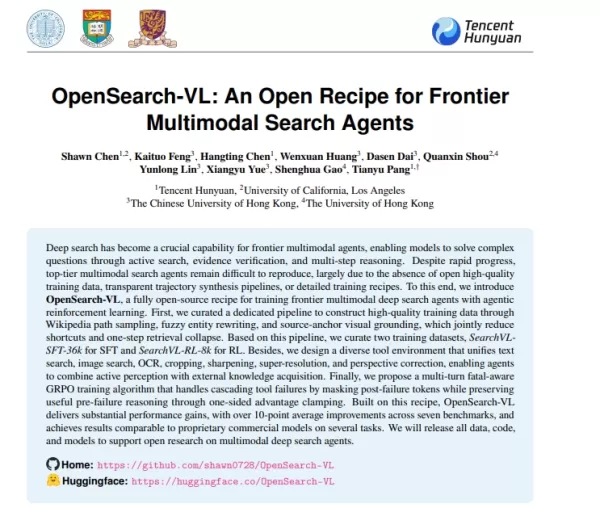
As multimodal large language models (MLLMs) advance rapidly, the key challenge in AI competition is shifting from simply "passively understanding images" to actively seeking evidence and reasoning. Yet the lack of high-quality training data, automated trajectory synthesis pipelines, and detailed training recipes has made it difficult for the open-source community to replicate top-tier multimodal search agents.
To overcome this bottleneck, a research team from Tencent Hunyuan, together with UCLA and The Chinese University of Hong Kong, has launched OpenSearch-VL. This fully open-source blueprint provides a path to building a state-of-the-art deep search agent through reinforcement learning (RL).
Innovative Data Pipeline Overcomes Search Shortcuts
The team identified high-quality training data as the primary bottleneck for model advancement. To train models for multi-step reasoning—beyond simple one-click image recognition—they designed a meticulous data consolidation pipeline.
This pipeline samples paths from Wikipedia's hyperlink graph, converting intricate entity relationships into multi-hop QA pairs. To prevent shortcut learning, researchers applied fuzzy entity rewriting to conceal direct answers and integrated visual localization anchored to source code. This approach compels the model to first detect visual signals, then iteratively retrieve information using external tools, preventing skill degradation during retrieval. As a result, the team constructed the SearchVL-SFT database (36,000 instruction fine-tuning trajectories) and the SearchVL-RL database (8,000 reinforcement learning trajectories).
Versatile Toolset Beyond Simple Search
OpenSearch-VL goes beyond basic text search. In real-world use, user-provided images are often blurry, distorted, or low-resolution, rendering conventional search tools ineffective.
To tackle this, the project incorporates a rich set of tools: web search, reverse image search, OCR, image cropping, sharpening, super-resolution, and perspective correction. The agent actively perceives and corrects imperfect visuals—much like a human—before querying external knowledge, ensuring reliable subsequent searches.
Fault-Aware Algorithm Enables Learning from Mistakes
In long-horizon tasks, tool calls can create cascading failures. A single timeout or error may derail the entire task. Traditional RL often discards these failed trajectories, wasting training resources.
OpenSearch-VL introduces Multi-round Fault-Aware GRPO, a training algorithm that identifies critical failure points in tool calls. It uses masking to filter out invalid post-failure information and applies one-sided advantage clipping to preserve useful logic from earlier steps. This way, even when the final outcome is failure, the model still learns effective search paths and exploration strategies from the preceding stages.
Experimental Results Rival Commercial Proprietary Models
Evaluation results demonstrate strong performance across seven mainstream multimodal deep search benchmarks, with an average improvement exceeding 10 percentage points. On certain specific tasks, OpenSearch-VL already matches the top closed-source commercial models.
The team plans to fully open-source all training data, code, and model weights for OpenSearch-VL, offering global developers a reproducible and improvable foundation that advances multimodal agent research into deeper territory.
Related article
 DeepMind CEO Hassabis: I sleep six hours a day, usually feel energetic around 1 a.m.
Fortune recently featured an interview with Demis Hassabis, CEO of Google DeepMind, revealing his unconventional approach to rest and productivity. Hassabis disclosed that he sleeps very little, structuring his waking hours into two distinct work blo
OpenAI, Anthropic Vie for Market Share Despite Revenue Shortfalls
Despite recent reports suggesting OpenAI missed revenue targets, creating pressure on tech stocks this Tuesday, private AI lab investors remain resilient. Seasoned backers have confirmed they will not reduce investment despite negative media coverage
California AV Compliance: A New Era of Tickets, Geofences, and 1M Miles
Guident operates an AuveTech shuttle in South Florida, managing a four-mile route in West Palm Beach and a one-mile route in Boca Raton using its remote monitoring technology. | Credit: GuidentCalifornia is redefining the regulatory landscape for dri
Related Special Topic Recommendations
chatbot
DeepMind CEO Hassabis: I sleep six hours a day, usually feel energetic around 1 a.m.
Fortune recently featured an interview with Demis Hassabis, CEO of Google DeepMind, revealing his unconventional approach to rest and productivity. Hassabis disclosed that he sleeps very little, structuring his waking hours into two distinct work blo
OpenAI, Anthropic Vie for Market Share Despite Revenue Shortfalls
Despite recent reports suggesting OpenAI missed revenue targets, creating pressure on tech stocks this Tuesday, private AI lab investors remain resilient. Seasoned backers have confirmed they will not reduce investment despite negative media coverage
California AV Compliance: A New Era of Tickets, Geofences, and 1M Miles
Guident operates an AuveTech shuttle in South Florida, managing a four-mile route in West Palm Beach and a one-mile route in Boca Raton using its remote monitoring technology. | Credit: GuidentCalifornia is redefining the regulatory landscape for dri
Related Special Topic Recommendations
chatbot
 Best AI Roleplay Chat Apps for Language Practice, Interview Prep, and Daily Fluency
2026 Latest Best Top-rated AI Roleplay Chat Apps for Language Practice, Interview Prep, and Daily Fluency! XIX.AI curates a powerful game-changing collection that offers free vs paid comparison, real-world tests, and updated rankings weekly. These must-try tools help you boost writing skills, overcome fluency challenges, and improve communication efficiency across all daily scenarios. Explore now to discover your perfect tool for language growth!
 10 tools
 xix.ai
Music composition
AI Stem Separation Tools for Remix Production, Sampling Prep, and Karaoke Masters
xix.ai
Music composition
AI Stem Separation Tools for Remix Production, Sampling Prep, and Karaoke Masters
2026 Latest Best Top-rated AI Stem Separation Tools Curated for Remix Production, Sampling Prep, and Karaoke Masters. These powerful game-changing tools offer real-world tests to deliver precise audio isolation, boosting productivity significantly. XIX.AI provides a weekly updated free vs paid comparison guide to help you find the must-try solution that suits your needs. Explore now to unlock your AI edge.
8 tools
xix.ai
Data Analysis
AI SQL Copilots for Revenue Dashboards, Funnel Analysis, and Product Metrics
2026 Latest Best AI SQL Copilots Ranked Top-Rated! XIX.AI curates a powerful game-changing collection for weekly updated real-world tests. These must-try tools help you generate accurate revenue dashboards, analyze sales funnels, and track product metrics swiftly, boosting productivity massively. Explore now to Discover your perfect tool for data-driven decision making! 238 characters
9 tools
xix.ai
Music composition
Best AI Melody Writing Tools for Song Drafts
2026 Latest Best Top-Rated AI Melody Writing Tools for Song Drafts! XIX.AI has curated a highly powerful game-changing collection that goes through rigorous real-world tests to deliver the best writing experience. You can find detailed free vs paid comparisons, accurate rankings, and must-try options designed to help you create stunning song drafts effortlessly and boost your creative productivity significantly. Explore now to discover your perfect tool!
8 tools
xix.ai
chatbot
Best AI Conversation Trainer Tools for Interview Practice
2026 Latest Best Top-rated AI Conversation Trainer Tools for Interview Practice are here on XIX.AI! This curated collection features powerful, game-changing tools that go through rigorous real-world tests to deliver accurate feedback. You’ll find a free vs paid comparison and detailed rankings to help you choose the must-try option that boosts your confidence and skills. Explore now to Discover your perfect tool for interview success!
12 tools
xix.ai
Design & Art
Best AI Style Transfer Tools for Creative Experiments
2026 Latest Best Top-rated AI Style Transfer Tools for Creative Experiments! XIX.AI has curated a powerful, game-changing collection of must-try tools that deliver exceptional results through real-world tests and rigorous rankings. These top solutions help creatives boost productivity significantly by accelerating content creation and unlocking endless creative possibilities. Explore now to discover your perfect tool and start creating today!
9 tools
xix.ai

 Comments (0)
0/500
Comments (0)
0/500
As multimodal large language models (MLLMs) advance rapidly, the key challenge in AI competition is shifting from simply "passively understanding images" to actively seeking evidence and reasoning. Yet the lack of high-quality training data, automated trajectory synthesis pipelines, and detailed training recipes has made it difficult for the open-source community to replicate top-tier multimodal search agents.
To overcome this bottleneck, a research team from Tencent Hunyuan, together with UCLA and The Chinese University of Hong Kong, has launched OpenSearch-VL. This fully open-source blueprint provides a path to building a state-of-the-art deep search agent through reinforcement learning (RL).
Innovative Data Pipeline Overcomes Search Shortcuts
The team identified high-quality training data as the primary bottleneck for model advancement. To train models for multi-step reasoning—beyond simple one-click image recognition—they designed a meticulous data consolidation pipeline.
This pipeline samples paths from Wikipedia's hyperlink graph, converting intricate entity relationships into multi-hop QA pairs. To prevent shortcut learning, researchers applied fuzzy entity rewriting to conceal direct answers and integrated visual localization anchored to source code. This approach compels the model to first detect visual signals, then iteratively retrieve information using external tools, preventing skill degradation during retrieval. As a result, the team constructed the SearchVL-SFT database (36,000 instruction fine-tuning trajectories) and the SearchVL-RL database (8,000 reinforcement learning trajectories).
Versatile Toolset Beyond Simple Search
OpenSearch-VL goes beyond basic text search. In real-world use, user-provided images are often blurry, distorted, or low-resolution, rendering conventional search tools ineffective.
To tackle this, the project incorporates a rich set of tools: web search, reverse image search, OCR, image cropping, sharpening, super-resolution, and perspective correction. The agent actively perceives and corrects imperfect visuals—much like a human—before querying external knowledge, ensuring reliable subsequent searches.
Fault-Aware Algorithm Enables Learning from Mistakes
In long-horizon tasks, tool calls can create cascading failures. A single timeout or error may derail the entire task. Traditional RL often discards these failed trajectories, wasting training resources.
OpenSearch-VL introduces Multi-round Fault-Aware GRPO, a training algorithm that identifies critical failure points in tool calls. It uses masking to filter out invalid post-failure information and applies one-sided advantage clipping to preserve useful logic from earlier steps. This way, even when the final outcome is failure, the model still learns effective search paths and exploration strategies from the preceding stages.
Experimental Results Rival Commercial Proprietary Models
Evaluation results demonstrate strong performance across seven mainstream multimodal deep search benchmarks, with an average improvement exceeding 10 percentage points. On certain specific tasks, OpenSearch-VL already matches the top closed-source commercial models.
The team plans to fully open-source all training data, code, and model weights for OpenSearch-VL, offering global developers a reproducible and improvable foundation that advances multimodal agent research into deeper territory.








 DeepMind CEO Hassabis: I sleep six hours a day, usually feel energetic around 1 a.m.
Fortune recently featured an interview with Demis Hassabis, CEO of Google DeepMind, revealing his unconventional approach to rest and productivity. Hassabis disclosed that he sleeps very little, structuring his waking hours into two distinct work blo
DeepMind CEO Hassabis: I sleep six hours a day, usually feel energetic around 1 a.m.
Fortune recently featured an interview with Demis Hassabis, CEO of Google DeepMind, revealing his unconventional approach to rest and productivity. Hassabis disclosed that he sleeps very little, structuring his waking hours into two distinct work blo
 OpenAI, Anthropic Vie for Market Share Despite Revenue Shortfalls
Despite recent reports suggesting OpenAI missed revenue targets, creating pressure on tech stocks this Tuesday, private AI lab investors remain resilient. Seasoned backers have confirmed they will not reduce investment despite negative media coverage
California AV Compliance: A New Era of Tickets, Geofences, and 1M Miles
Guident operates an AuveTech shuttle in South Florida, managing a four-mile route in West Palm Beach and a one-mile route in Boca Raton using its remote monitoring technology. | Credit: GuidentCalifornia is redefining the regulatory landscape for dri
OpenAI, Anthropic Vie for Market Share Despite Revenue Shortfalls
Despite recent reports suggesting OpenAI missed revenue targets, creating pressure on tech stocks this Tuesday, private AI lab investors remain resilient. Seasoned backers have confirmed they will not reduce investment despite negative media coverage
California AV Compliance: A New Era of Tickets, Geofences, and 1M Miles
Guident operates an AuveTech shuttle in South Florida, managing a four-mile route in West Palm Beach and a one-mile route in Boca Raton using its remote monitoring technology. | Credit: GuidentCalifornia is redefining the regulatory landscape for dri

2026 Latest Best Top-rated AI Roleplay Chat Apps for Language Practice, Interview Prep, and Daily Fluency! XIX.AI curates a powerful game-changing collection that offers free vs paid comparison, real-world tests, and updated rankings weekly. These must-try tools help you boost writing skills, overcome fluency challenges, and improve communication efficiency across all daily scenarios. Explore now to discover your perfect tool for language growth!
10 tools
xix.ai
2026 Latest Best Top-rated AI Stem Separation Tools Curated for Remix Production, Sampling Prep, and Karaoke Masters. These powerful game-changing tools offer real-world tests to deliver precise audio isolation, boosting productivity significantly. XIX.AI provides a weekly updated free vs paid comparison guide to help you find the must-try solution that suits your needs. Explore now to unlock your AI edge.
8 tools
xix.ai

2026 Latest Best AI SQL Copilots Ranked Top-Rated! XIX.AI curates a powerful game-changing collection for weekly updated real-world tests. These must-try tools help you generate accurate revenue dashboards, analyze sales funnels, and track product metrics swiftly, boosting productivity massively. Explore now to Discover your perfect tool for data-driven decision making! 238 characters
9 tools
xix.ai

2026 Latest Best Top-Rated AI Melody Writing Tools for Song Drafts! XIX.AI has curated a highly powerful game-changing collection that goes through rigorous real-world tests to deliver the best writing experience. You can find detailed free vs paid comparisons, accurate rankings, and must-try options designed to help you create stunning song drafts effortlessly and boost your creative productivity significantly. Explore now to discover your perfect tool!
8 tools
xix.ai

2026 Latest Best Top-rated AI Conversation Trainer Tools for Interview Practice are here on XIX.AI! This curated collection features powerful, game-changing tools that go through rigorous real-world tests to deliver accurate feedback. You’ll find a free vs paid comparison and detailed rankings to help you choose the must-try option that boosts your confidence and skills. Explore now to Discover your perfect tool for interview success!
12 tools
xix.ai

2026 Latest Best Top-rated AI Style Transfer Tools for Creative Experiments! XIX.AI has curated a powerful, game-changing collection of must-try tools that deliver exceptional results through real-world tests and rigorous rankings. These top solutions help creatives boost productivity significantly by accelerating content creation and unlocking endless creative possibilities. Explore now to discover your perfect tool and start creating today!
9 tools
xix.ai












