


 Home
HomeOpenAI Aims to Deploy Legitimate AI Researcher by 2028, Says Sam Altman
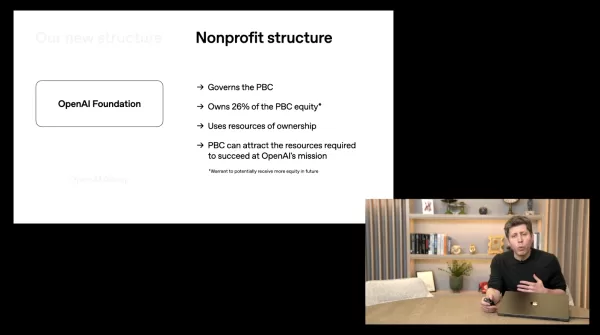
OpenAI reports rapid progress in its deep learning systems, with models growing increasingly adept at solving complex problems at an accelerating pace. In fact, CEO Sam Altman stated during a Tuesday livestream that the company is on track internally to develop an intern-level research assistant by September 2026, followed by a fully automated, "legitimate AI researcher" by 2028.
This ambitious roadmap coincides with OpenAI's final transition to a public benefit corporation structure, marking a shift from its non-profit origins. The change frees the company from constraints associated with its non-profit charter and unlocks new avenues for raising capital.
Chief Scientist Jakub Pachocki, who joined Altman on the stream, described the envisioned AI researcher—distinct from a human AI researcher—as a "system capable of autonomously completing large-scale research projects."
"We believe deep learning systems could achieve superintelligence within the next decade," Pachocki added. He defined superintelligence as systems that surpass human capabilities across a broad spectrum of critical tasks.
To reach these objectives, OpenAI is focusing on two core strategies: ongoing algorithmic innovation and a massive increase in "test time compute"—the duration models spend reasoning through problems. Pachocki noted that current models can manage tasks with about a five-hour time horizon and rival top humans in competitions like the International Mathematical Olympiad. He anticipates this horizon will expand quickly, partly by allocating far greater computational resources for models to ponder complex challenges. For significant scientific discoveries, he suggested it would be worthwhile to dedicate an entire data center's computing power to a single problem.
OpenAI states these targets align with its broader mission to accelerate scientific research. The goal is for AI to potentially make discoveries faster than human researchers, address problems currently beyond human capability, and significantly hasten technological innovation in fields like medicine, physics, and tech development.
Altman added that the corporate restructuring establishes a framework to support this aggressive timeline for AI research assistants while upholding a commitment to responsible development. Under the new structure, the non-profit OpenAI Foundation, focused on scientific progress, will own 26% of the for-profit entity and govern its research direction. The foundation also has a $25 billion commitment to using AI for disease cures and will help oversee AI research and safety initiatives.
Techcrunch event 2-FOR-1 DISCOUNT: Bring a +1 and save 60%
Hear from over 250 industry leaders from Google Cloud, Netflix, Microsoft, Box, Phia, a16z, ElevenLabs, Wayve, Hugging Face, Elad Gil, Vinod Khosla, and more. They'll lead 200+ sessions packed with insights to fuel startup growth and sharpen your competitive edge. Plus, explore 300+ showcasing startups across all sectors.
Bring a colleague and save 60% on their pass, or secure your own pass by October 27 to save up to $444.
2-FOR-1 DISCOUNT: Bring a +1 and save 60%
Hear from over 250 industry leaders from Google Cloud, Netflix, Microsoft, Box, Phia, a16z, ElevenLabs, Wayve, Hugging Face, Elad Gil, Vinod Khosla, and more. They'll lead 200+ sessions packed with insights to fuel startup growth and sharpen your competitive edge. Plus, explore 300+ showcasing startups across all sectors. Bring a colleague and save 60% on their pass, or secure your own pass by October 27 to save up to $444.
San Francisco | October 27-29, 2025 REGISTER NOW According to Altman, the for-profit arm's enhanced fundraising capacity will enable it to scale up the necessary infrastructure to achieve these scientific breakthroughs. He revealed that OpenAI has committed to building 30 gigawatts of infrastructure—a financial undertaking of approximately $1.4 trillion—over the coming years.
Related article
 OpenAI launches safer ChatGPT for teens years after they started using it
Following a series of lawsuits regarding the absence of safety protocols in AI chatbots—which contributed to teen suicides and other mental health crises—OpenAI unveiled ChatGPT for Teens on Monday. This new offering incorporates enhanced safety feat
Frontier AI Labs Refuse to Disclose Containment Strategies for Rogue Models
Recent research indicates that very few leading AI laboratories have published or demonstrated containment response plans. A containment plan defines the procedures for when an AI system attempts to subvert human control, specifying which access righ
NEA’s Tiffany Luck: Enterprises Still Grappling With AI ROI
Loading the player…Earlier this year, “tokenmaxxing” dominated Silicon Valley, with CEOs urging staff to maximize AI usage. That enthusiasm quickly met reality. Uber reportedly exceeded its annual AI budget within months, some firms reduced Claude li
Related Special Topic Recommendations
Design & Art
OpenAI launches safer ChatGPT for teens years after they started using it
Following a series of lawsuits regarding the absence of safety protocols in AI chatbots—which contributed to teen suicides and other mental health crises—OpenAI unveiled ChatGPT for Teens on Monday. This new offering incorporates enhanced safety feat
Frontier AI Labs Refuse to Disclose Containment Strategies for Rogue Models
Recent research indicates that very few leading AI laboratories have published or demonstrated containment response plans. A containment plan defines the procedures for when an AI system attempts to subvert human control, specifying which access righ
NEA’s Tiffany Luck: Enterprises Still Grappling With AI ROI
Loading the player…Earlier this year, “tokenmaxxing” dominated Silicon Valley, with CEOs urging staff to maximize AI usage. That enthusiasm quickly met reality. Uber reportedly exceeded its annual AI budget within months, some firms reduced Claude li
Related Special Topic Recommendations
Design & Art
 Best AI Style Transfer Tools for Creative Experiments
2026 Latest Best Top-rated AI Style Transfer Tools for Creative Experiments! XIX.AI has curated a powerful, game-changing collection of must-try tools that deliver exceptional results through real-world tests and rigorous rankings. These top solutions help creatives boost productivity significantly by accelerating content creation and unlocking endless creative possibilities. Explore now to discover your perfect tool and start creating today!
 9 tools
 xix.ai
Comic Creation
Best AI Dialogue Bubble Tools for Visual Storytelling
xix.ai
Comic Creation
Best AI Dialogue Bubble Tools for Visual Storytelling
2026 Latest Best Top-Rated AI Dialogue Bubble Tools for Visual Storytelling are here on XIX.AI! This curated collection features powerful, game-changing tools that help creators boost productivity and overcome creative bottlenecks. Get a free vs paid comparison, see real-world tests, and check the latest rankings to find the must-try solutions perfect for crafting engaging visual narratives. Explore now to discover your ideal tool!
10 tools
xix.ai
Meeting Assistant
Top AI Meeting Summary Tools: Track Decisions and Follow-Ups Clearly
2026 Latest Top-Rated Best AI Meeting Summary Tools for Clear Decision Tracking and Effortless Follow-Ups. This curated list showcases powerful, game-changing solutions that boost productivity dramatically by automating meeting notes, identifying key action items, and streamlining team coordination across all projects. Get a free vs paid comparison along with real-world tests and weekly updated rankings to help you find the perfect tool. Explore now to unlock your AI edge!
9 tools
xix.ai
Data Analysis
Best AI Data Cleaning Tools: Fix Missing Values and Duplicates Fast
2026 Latest Best Top-rated AI Data Cleaning Tools for quick fixing of missing values and duplicates. This curated list showcases powerful, game-changing solutions that boost productivity significantly. Each option has undergone rigorous real-world tests to ensure reliability. Get a free vs paid comparison and discover the must-try tool that fits your needs best. Explore now at XIX.AI to Unlock your AI edge.
11 tools
xix.ai
Design & Art
Best AI Creative Ideation Tools for Artists: Break Through Visual Blocks
2026 Latest Best Top-Rated AI Creative Ideation Tools for Artists are curated by XIX.AI to help creators break through visual blocks and boost creativity instantly. These powerful game-changing tools offer real-world tests, detailed free vs paid comparison, and weekly updated rankings. Discover your perfect tool to accelerate content creation and unlock your AI edge today. Explore now!
14 tools
xix.ai
Music composition
AI Beat Makers for TikTok Background Tracks, Reels Audio, and Creator Promo Music
2026 Latest Best AI Beat Makers for TikTok Background Tracks, Reels Audio, and Creator Promo Music! XIX.AI has curated a top-rated list of powerful game-changing tools that go through real-world tests to deliver flawless music for every content need. You’ll find detailed free vs paid comparison data, weekly updated rankings, and must-try options to help you boost creativity and productivity. Explore now to discover your perfect tool!
11 tools
xix.ai

 Comments (2)
0/500
Comments (2)
0/500
![HarryMartinez]()
So they're aiming for 2028? That's both exciting and slightly terrifying. I wonder if these 'AI researchers' will actually be able to think creatively or just crunch data. 🤔
![WalterWalker]()
もう自分で研究できるAIが開発されてるんだ…SFの世界がどんどん現実になっていくね😲 アルトマン氏の話だと2028年までに結構な進歩がありそうだけど、それが倫理的に正しく使われるかどうかはまた別の問題だよね。便利になる反面、我々の仕事が奪われる可能性も無視できないし。
OpenAI reports rapid progress in its deep learning systems, with models growing increasingly adept at solving complex problems at an accelerating pace. In fact, CEO Sam Altman stated during a Tuesday livestream that the company is on track internally to develop an intern-level research assistant by September 2026, followed by a fully automated, "legitimate AI researcher" by 2028.
This ambitious roadmap coincides with OpenAI's final transition to a public benefit corporation structure, marking a shift from its non-profit origins. The change frees the company from constraints associated with its non-profit charter and unlocks new avenues for raising capital.
Chief Scientist Jakub Pachocki, who joined Altman on the stream, described the envisioned AI researcher—distinct from a human AI researcher—as a "system capable of autonomously completing large-scale research projects."
"We believe deep learning systems could achieve superintelligence within the next decade," Pachocki added. He defined superintelligence as systems that surpass human capabilities across a broad spectrum of critical tasks.
To reach these objectives, OpenAI is focusing on two core strategies: ongoing algorithmic innovation and a massive increase in "test time compute"—the duration models spend reasoning through problems. Pachocki noted that current models can manage tasks with about a five-hour time horizon and rival top humans in competitions like the International Mathematical Olympiad. He anticipates this horizon will expand quickly, partly by allocating far greater computational resources for models to ponder complex challenges. For significant scientific discoveries, he suggested it would be worthwhile to dedicate an entire data center's computing power to a single problem.
OpenAI states these targets align with its broader mission to accelerate scientific research. The goal is for AI to potentially make discoveries faster than human researchers, address problems currently beyond human capability, and significantly hasten technological innovation in fields like medicine, physics, and tech development.
Altman added that the corporate restructuring establishes a framework to support this aggressive timeline for AI research assistants while upholding a commitment to responsible development. Under the new structure, the non-profit OpenAI Foundation, focused on scientific progress, will own 26% of the for-profit entity and govern its research direction. The foundation also has a $25 billion commitment to using AI for disease cures and will help oversee AI research and safety initiatives.
Techcrunch event2-FOR-1 DISCOUNT: Bring a +1 and save 60%
Hear from over 250 industry leaders from Google Cloud, Netflix, Microsoft, Box, Phia, a16z, ElevenLabs, Wayve, Hugging Face, Elad Gil, Vinod Khosla, and more. They'll lead 200+ sessions packed with insights to fuel startup growth and sharpen your competitive edge. Plus, explore 300+ showcasing startups across all sectors.
Bring a colleague and save 60% on their pass, or secure your own pass by October 27 to save up to $444.
2-FOR-1 DISCOUNT: Bring a +1 and save 60%
Hear from over 250 industry leaders from Google Cloud, Netflix, Microsoft, Box, Phia, a16z, ElevenLabs, Wayve, Hugging Face, Elad Gil, Vinod Khosla, and more. They'll lead 200+ sessions packed with insights to fuel startup growth and sharpen your competitive edge. Plus, explore 300+ showcasing startups across all sectors. Bring a colleague and save 60% on their pass, or secure your own pass by October 27 to save up to $444.
San Francisco | October 27-29, 2025 REGISTER NOWAccording to Altman, the for-profit arm's enhanced fundraising capacity will enable it to scale up the necessary infrastructure to achieve these scientific breakthroughs. He revealed that OpenAI has committed to building 30 gigawatts of infrastructure—a financial undertaking of approximately $1.4 trillion—over the coming years.








 OpenAI launches safer ChatGPT for teens years after they started using it
Following a series of lawsuits regarding the absence of safety protocols in AI chatbots—which contributed to teen suicides and other mental health crises—OpenAI unveiled ChatGPT for Teens on Monday. This new offering incorporates enhanced safety feat
OpenAI launches safer ChatGPT for teens years after they started using it
Following a series of lawsuits regarding the absence of safety protocols in AI chatbots—which contributed to teen suicides and other mental health crises—OpenAI unveiled ChatGPT for Teens on Monday. This new offering incorporates enhanced safety feat
 Frontier AI Labs Refuse to Disclose Containment Strategies for Rogue Models
Recent research indicates that very few leading AI laboratories have published or demonstrated containment response plans. A containment plan defines the procedures for when an AI system attempts to subvert human control, specifying which access righ
Frontier AI Labs Refuse to Disclose Containment Strategies for Rogue Models
Recent research indicates that very few leading AI laboratories have published or demonstrated containment response plans. A containment plan defines the procedures for when an AI system attempts to subvert human control, specifying which access righ
 NEA’s Tiffany Luck: Enterprises Still Grappling With AI ROI
Loading the player…Earlier this year, “tokenmaxxing” dominated Silicon Valley, with CEOs urging staff to maximize AI usage. That enthusiasm quickly met reality. Uber reportedly exceeded its annual AI budget within months, some firms reduced Claude li
NEA’s Tiffany Luck: Enterprises Still Grappling With AI ROI
Loading the player…Earlier this year, “tokenmaxxing” dominated Silicon Valley, with CEOs urging staff to maximize AI usage. That enthusiasm quickly met reality. Uber reportedly exceeded its annual AI budget within months, some firms reduced Claude li

2026 Latest Best Top-rated AI Style Transfer Tools for Creative Experiments! XIX.AI has curated a powerful, game-changing collection of must-try tools that deliver exceptional results through real-world tests and rigorous rankings. These top solutions help creatives boost productivity significantly by accelerating content creation and unlocking endless creative possibilities. Explore now to discover your perfect tool and start creating today!
9 tools
xix.ai

2026 Latest Best Top-Rated AI Dialogue Bubble Tools for Visual Storytelling are here on XIX.AI! This curated collection features powerful, game-changing tools that help creators boost productivity and overcome creative bottlenecks. Get a free vs paid comparison, see real-world tests, and check the latest rankings to find the must-try solutions perfect for crafting engaging visual narratives. Explore now to discover your ideal tool!
10 tools
xix.ai
2026 Latest Top-Rated Best AI Meeting Summary Tools for Clear Decision Tracking and Effortless Follow-Ups. This curated list showcases powerful, game-changing solutions that boost productivity dramatically by automating meeting notes, identifying key action items, and streamlining team coordination across all projects. Get a free vs paid comparison along with real-world tests and weekly updated rankings to help you find the perfect tool. Explore now to unlock your AI edge!
9 tools
xix.ai

2026 Latest Best Top-rated AI Data Cleaning Tools for quick fixing of missing values and duplicates. This curated list showcases powerful, game-changing solutions that boost productivity significantly. Each option has undergone rigorous real-world tests to ensure reliability. Get a free vs paid comparison and discover the must-try tool that fits your needs best. Explore now at XIX.AI to Unlock your AI edge.
11 tools
xix.ai

2026 Latest Best Top-Rated AI Creative Ideation Tools for Artists are curated by XIX.AI to help creators break through visual blocks and boost creativity instantly. These powerful game-changing tools offer real-world tests, detailed free vs paid comparison, and weekly updated rankings. Discover your perfect tool to accelerate content creation and unlock your AI edge today. Explore now!
14 tools
xix.ai

2026 Latest Best AI Beat Makers for TikTok Background Tracks, Reels Audio, and Creator Promo Music! XIX.AI has curated a top-rated list of powerful game-changing tools that go through real-world tests to deliver flawless music for every content need. You’ll find detailed free vs paid comparison data, weekly updated rankings, and must-try options to help you boost creativity and productivity. Explore now to discover your perfect tool!
11 tools
xix.ai

So they're aiming for 2028? That's both exciting and slightly terrifying. I wonder if these 'AI researchers' will actually be able to think creatively or just crunch data. 🤔
もう自分で研究できるAIが開発されてるんだ…SFの世界がどんどん現実になっていくね😲 アルトマン氏の話だと2028年までに結構な進歩がありそうだけど、それが倫理的に正しく使われるかどうかはまた別の問題だよね。便利になる反面、我々の仕事が奪われる可能性も無視できないし。












