


 Home
HomeQwenLong-L1 Solves Complex Reasoning Task Beyond Current LLMs' Capabilities
Alibaba Group has unveiled QwenLong-L1, a new framework designed to empower large language models (LLMs) to reason across exceptionally long documents. This breakthrough has the potential to fuel a new generation of enterprise applications that demand deep comprehension and insightful analysis of extensive materials, including comprehensive corporate reports, detailed financial statements, and complex legal agreements.
The Obstacle of Long-Form AI Reasoning
Recent progress in large reasoning models (LRMs), especially through reinforcement learning (RL), has dramatically boosted their problem-solving skills. Studies indicate that RL fine-tuning equips LRMs with a form of "slow thinking" akin to human cognition, enabling them to craft sophisticated strategies for tackling intricate tasks.
However, these gains are largely confined to working with relatively brief text passages, usually around 4,000 tokens. A significant hurdle remains in scaling this reasoning ability to far longer contexts, such as 120,000 tokens. Effective long-form reasoning demands a firm grasp of the entire document and the capacity for multi-step analysis. "This constraint significantly hinders practical uses that involve external knowledge, like in-depth research where LRMs need to gather and process information from data-rich sources," note the QwenLong-L1 developers in their research paper.
The team frames these obstacles under the concept of "long-context reasoning RL." Unlike short-context reasoning, which often leverages the model's internal knowledge, this approach requires models to accurately find and anchor relevant facts within lengthy inputs. Only then can they construct logical reasoning chains based on this retrieved information.
Training models for this via RL is challenging, frequently leading to inefficient learning and unstable optimization. Models often fail to converge on effective solutions or lose their capacity to explore varied reasoning pathways.
QwenLong-L1: A Structured, Multi-Stage Framework
QwenLong-L1 is a reinforcement learning framework crafted to help LRMs evolve from handling short texts to generalizing robustly across long contexts. It enhances existing short-context LRMs through a deliberate, phased process:
Warm-up Supervised Fine-Tuning (SFT): The model first undergoes SFT using examples of long-context reasoning. This phase builds a strong foundation, teaching the model to accurately anchor information from long documents and develop core skills in context understanding, logical chain generation, and answer extraction.
Curriculum-Guided Phased RL: Here, the model trains through multiple phases where the target document length increases progressively. This step-by-step, curriculum-based method helps the model steadily adapt its reasoning strategies from shorter to increasingly longer texts, avoiding the instability of abrupt exposure to vast documents.
Difficulty-Aware Retrospective Sampling: The final stage incorporates the most challenging examples from earlier training phases. By prioritizing difficult instances, it ensures the model continues learning from tough problems and is encouraged to explore more diverse and complex reasoning routes.
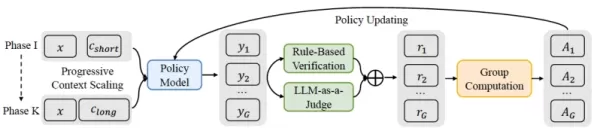
QwenLong-L1 process Source: arXiv Beyond this structured training, QwenLong-L1 employs a specialized reward system. While training for short-context tasks often uses strict rule-based rewards (e.g., for a correct math answer), QwenLong-L1 uses a hybrid mechanism. It combines rule-based verification for precision with an "LLM-as-a-judge" that compares the semantic meaning of the generated answer to the reference. This allows greater flexibility in evaluating the diverse ways correct answers can be phrased within long, nuanced documents.
Evaluating QwenLong-L1's Performance
The Alibaba team tested QwenLong-L1 primarily using document question-answering (DocQA), a task highly pertinent to enterprise needs where AI must decipher dense documents to answer complex queries.
Results across seven long-context DocQA benchmarks demonstrated QwenLong-L1's strength. The QWENLONG-L1-32B model (based on DeepSeek-R1-Distill-Qwen-32B) achieved performance on par with Anthropic's Claude-3.7 Sonnet Thinking and outperformed models like OpenAI's o3-mini and Qwen3-235B-A22B. The smaller QWENLONG-L1-14B model also surpassed Google's Gemini 2.0 Flash Thinking and Qwen3-32B.
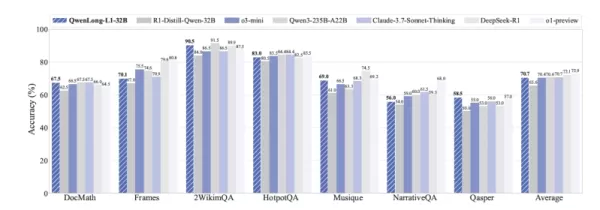
Source: arXiv A key finding for real-world use is how RL training cultivates specialized long-context reasoning behaviors. The paper highlights that QwenLong-L1 trained models improve at "grounding" (linking answers to specific document sections), "subgoal setting" (decomposing complex questions), "backtracking" (identifying and correcting mid-reasoning errors), and "verification" (re-checking their answers).
For example, where a base model might be derailed by irrelevant details in a financial report or loop endlessly on tangential analysis, a QwenLong-L1 trained model showed effective self-reflection. It could filter out distracting information, backtrack from incorrect approaches, and successfully reach the right conclusion.
Frameworks like QwenLong-L1 could substantially broaden AI's enterprise utility. Potential applications span legal technology (analyzing voluminous legal documents), finance (conducting deep due diligence on annual reports and financial filings for risk or investment insights), and customer service (reviewing lengthy interaction histories to provide more contextual support). The researchers have made the code for the QwenLong-L1 framework and the weights for the trained models publicly available.
Related article
 Meituan Reshapes AI Strategy: Banning Doubao, Pushing In-House LongCat
The competitive landscape of large AI models in China has recently seen subtle changes. According to the latest information, Meituan has issued an internal notice to strictly restrict access to the "Doubao" large model. This move indicates that Meitu
DeepSeek Closes $7B First Funding Round With Valuation Above $50B
DeepSeek, an AI unicorn, has secured its initial funding round exceeding $7 billion (roughly 50 billion RMB) via an unconventional structure, pushing its post-money valuation beyond $50 billion.This financing round introduces a key innovation: invest
ByteDance's DouBao Beta Tests AI Agent for Ride-Hailing, Reshaping Service Entry Points
On June 22, ByteDance’s AI assistant, Dou Bao APP, launched a limited rollout of its ride-hailing feature in Beijing and Hangzhou. This move signals a shift for large language models from virtual interaction to tangible services, positioning them as
Related Special Topic Recommendations
Video creation
Meituan Reshapes AI Strategy: Banning Doubao, Pushing In-House LongCat
The competitive landscape of large AI models in China has recently seen subtle changes. According to the latest information, Meituan has issued an internal notice to strictly restrict access to the "Doubao" large model. This move indicates that Meitu
DeepSeek Closes $7B First Funding Round With Valuation Above $50B
DeepSeek, an AI unicorn, has secured its initial funding round exceeding $7 billion (roughly 50 billion RMB) via an unconventional structure, pushing its post-money valuation beyond $50 billion.This financing round introduces a key innovation: invest
ByteDance's DouBao Beta Tests AI Agent for Ride-Hailing, Reshaping Service Entry Points
On June 22, ByteDance’s AI assistant, Dou Bao APP, launched a limited rollout of its ride-hailing feature in Beijing and Hangzhou. This move signals a shift for large language models from virtual interaction to tangible services, positioning them as
Related Special Topic Recommendations
Video creation
 AI Demo Video Tools for SaaS Product Marketing
2026 Latest Best Top-rated AI Demo Video Tools for SaaS Product Marketing, carefully curated by XIX.AI. These powerful game-changing solutions help marketers create high-quality video content fast, boost writing efficiency, and streamline marketing workflows. Enjoy a free vs paid comparison along with real-world tests and updated rankings weekly. Explore now to Discover your perfect tool for boosting SaaS sales!
 9 tools
 xix.ai
Prompt
AI Prompt Testing Tools for Better Output Quality
xix.ai
Prompt
AI Prompt Testing Tools for Better Output Quality
2026 Latest Best Top-rated AI Prompt Testing Tools for Better Output Quality! XIX.AI has curated a powerful, game-changing collection of highly efficient tools that undergo rigorous real-world tests to ensure consistent top-tier results. You’ll find detailed free vs paid comparison insights, comprehensive rankings, and expert guidance to help you identify the must-try solutions that boost your workflow significantly. Explore now to unlock your AI edge!
11 tools
xix.ai
Business
AI Customer Insight Tools for Product Positioning
2026 Latest Best Top-rated AI Customer Insight Tools for Product Positioning! XIX.AI has curated a powerful, game-changing collection that goes through real-world tests and weekly updated rankings. It helps you uncover customer needs quickly to boost writing efficiency, create optimal SEO content, and craft perfect social media messages without wasting time. Explore now to Discover your perfect tool and Unlock your AI edge.
10 tools
xix.ai
Meeting Assistant
Zoom AI Note Takers for Client Calls, Internal Syncs, and Decision Tracking
2026 Latest Best Zoom AI note takers ranked by performance and usability. XIX.AI has curated a top-rated list of powerful tools that help you take accurate notes during client calls, streamline internal team syncs, and keep track of key decisions effortlessly. Get a free vs paid comparison along with real-world tests to find the must-try solution that boosts your productivity significantly. Explore now!
12 tools
xix.ai
Data Analysis
AI Spreadsheet Analysis Tools: Ask Questions and Get Charts Instantly
2026 Latest Best Top-rated AI Spreadsheet Analysis Tools are here on XIX.AI! This curated list features powerful, game-changing solutions that allow you to ask questions directly in spreadsheets and get accurate charts instantly, boosting your productivity significantly. We conduct real-world tests and provide a free vs paid comparison along with weekly updated rankings to help you find the perfect tool for streamlining data tasks. Explore now to Unlock your AI edge!
19 tools
xix.ai
design
AI Wireframe Tools for Product Designers
2026 Latest Best Top-Rated AI Wireframe Tools for Product Designers! XIX.AI has curated a powerful, game-changing collection of must-try tools that go through rigorous real-world tests. You’ll find detailed weekly updated rankings, free vs paid comparison insights, and all the key info you need to choose the perfect tool to boost your design efficiency and unlock your AI edge. Explore now!
8 tools
xix.ai

 Comments (1)
0/500
Comments (1)
0/500
![AlbertHernández]()
Finally, an LLM that doesn't give up after page 50! 📚 As a legal analyst, reading 200-page contracts without losing context is a nightmare. This QwenLong-L1 framework could be a game-changer for enterprise workflows, though I'm still skeptical about the latency costs. Let's hope it's not just another hype cycle. 🤔
Alibaba Group has unveiled QwenLong-L1, a new framework designed to empower large language models (LLMs) to reason across exceptionally long documents. This breakthrough has the potential to fuel a new generation of enterprise applications that demand deep comprehension and insightful analysis of extensive materials, including comprehensive corporate reports, detailed financial statements, and complex legal agreements.
The Obstacle of Long-Form AI Reasoning
Recent progress in large reasoning models (LRMs), especially through reinforcement learning (RL), has dramatically boosted their problem-solving skills. Studies indicate that RL fine-tuning equips LRMs with a form of "slow thinking" akin to human cognition, enabling them to craft sophisticated strategies for tackling intricate tasks.
However, these gains are largely confined to working with relatively brief text passages, usually around 4,000 tokens. A significant hurdle remains in scaling this reasoning ability to far longer contexts, such as 120,000 tokens. Effective long-form reasoning demands a firm grasp of the entire document and the capacity for multi-step analysis. "This constraint significantly hinders practical uses that involve external knowledge, like in-depth research where LRMs need to gather and process information from data-rich sources," note the QwenLong-L1 developers in their research paper.
The team frames these obstacles under the concept of "long-context reasoning RL." Unlike short-context reasoning, which often leverages the model's internal knowledge, this approach requires models to accurately find and anchor relevant facts within lengthy inputs. Only then can they construct logical reasoning chains based on this retrieved information.
Training models for this via RL is challenging, frequently leading to inefficient learning and unstable optimization. Models often fail to converge on effective solutions or lose their capacity to explore varied reasoning pathways.
QwenLong-L1: A Structured, Multi-Stage Framework
QwenLong-L1 is a reinforcement learning framework crafted to help LRMs evolve from handling short texts to generalizing robustly across long contexts. It enhances existing short-context LRMs through a deliberate, phased process:
Warm-up Supervised Fine-Tuning (SFT): The model first undergoes SFT using examples of long-context reasoning. This phase builds a strong foundation, teaching the model to accurately anchor information from long documents and develop core skills in context understanding, logical chain generation, and answer extraction.
Curriculum-Guided Phased RL: Here, the model trains through multiple phases where the target document length increases progressively. This step-by-step, curriculum-based method helps the model steadily adapt its reasoning strategies from shorter to increasingly longer texts, avoiding the instability of abrupt exposure to vast documents.
Difficulty-Aware Retrospective Sampling: The final stage incorporates the most challenging examples from earlier training phases. By prioritizing difficult instances, it ensures the model continues learning from tough problems and is encouraged to explore more diverse and complex reasoning routes.
Beyond this structured training, QwenLong-L1 employs a specialized reward system. While training for short-context tasks often uses strict rule-based rewards (e.g., for a correct math answer), QwenLong-L1 uses a hybrid mechanism. It combines rule-based verification for precision with an "LLM-as-a-judge" that compares the semantic meaning of the generated answer to the reference. This allows greater flexibility in evaluating the diverse ways correct answers can be phrased within long, nuanced documents.
Evaluating QwenLong-L1's Performance
The Alibaba team tested QwenLong-L1 primarily using document question-answering (DocQA), a task highly pertinent to enterprise needs where AI must decipher dense documents to answer complex queries.
Results across seven long-context DocQA benchmarks demonstrated QwenLong-L1's strength. The QWENLONG-L1-32B model (based on DeepSeek-R1-Distill-Qwen-32B) achieved performance on par with Anthropic's Claude-3.7 Sonnet Thinking and outperformed models like OpenAI's o3-mini and Qwen3-235B-A22B. The smaller QWENLONG-L1-14B model also surpassed Google's Gemini 2.0 Flash Thinking and Qwen3-32B.
A key finding for real-world use is how RL training cultivates specialized long-context reasoning behaviors. The paper highlights that QwenLong-L1 trained models improve at "grounding" (linking answers to specific document sections), "subgoal setting" (decomposing complex questions), "backtracking" (identifying and correcting mid-reasoning errors), and "verification" (re-checking their answers).
For example, where a base model might be derailed by irrelevant details in a financial report or loop endlessly on tangential analysis, a QwenLong-L1 trained model showed effective self-reflection. It could filter out distracting information, backtrack from incorrect approaches, and successfully reach the right conclusion.
Frameworks like QwenLong-L1 could substantially broaden AI's enterprise utility. Potential applications span legal technology (analyzing voluminous legal documents), finance (conducting deep due diligence on annual reports and financial filings for risk or investment insights), and customer service (reviewing lengthy interaction histories to provide more contextual support). The researchers have made the code for the QwenLong-L1 framework and the weights for the trained models publicly available.








 Meituan Reshapes AI Strategy: Banning Doubao, Pushing In-House LongCat
The competitive landscape of large AI models in China has recently seen subtle changes. According to the latest information, Meituan has issued an internal notice to strictly restrict access to the "Doubao" large model. This move indicates that Meitu
Meituan Reshapes AI Strategy: Banning Doubao, Pushing In-House LongCat
The competitive landscape of large AI models in China has recently seen subtle changes. According to the latest information, Meituan has issued an internal notice to strictly restrict access to the "Doubao" large model. This move indicates that Meitu
 DeepSeek Closes $7B First Funding Round With Valuation Above $50B
DeepSeek, an AI unicorn, has secured its initial funding round exceeding $7 billion (roughly 50 billion RMB) via an unconventional structure, pushing its post-money valuation beyond $50 billion.This financing round introduces a key innovation: invest
DeepSeek Closes $7B First Funding Round With Valuation Above $50B
DeepSeek, an AI unicorn, has secured its initial funding round exceeding $7 billion (roughly 50 billion RMB) via an unconventional structure, pushing its post-money valuation beyond $50 billion.This financing round introduces a key innovation: invest
 ByteDance's DouBao Beta Tests AI Agent for Ride-Hailing, Reshaping Service Entry Points
On June 22, ByteDance’s AI assistant, Dou Bao APP, launched a limited rollout of its ride-hailing feature in Beijing and Hangzhou. This move signals a shift for large language models from virtual interaction to tangible services, positioning them as
ByteDance's DouBao Beta Tests AI Agent for Ride-Hailing, Reshaping Service Entry Points
On June 22, ByteDance’s AI assistant, Dou Bao APP, launched a limited rollout of its ride-hailing feature in Beijing and Hangzhou. This move signals a shift for large language models from virtual interaction to tangible services, positioning them as
2026 Latest Best Top-rated AI Demo Video Tools for SaaS Product Marketing, carefully curated by XIX.AI. These powerful game-changing solutions help marketers create high-quality video content fast, boost writing efficiency, and streamline marketing workflows. Enjoy a free vs paid comparison along with real-world tests and updated rankings weekly. Explore now to Discover your perfect tool for boosting SaaS sales!
9 tools
xix.ai

2026 Latest Best Top-rated AI Prompt Testing Tools for Better Output Quality! XIX.AI has curated a powerful, game-changing collection of highly efficient tools that undergo rigorous real-world tests to ensure consistent top-tier results. You’ll find detailed free vs paid comparison insights, comprehensive rankings, and expert guidance to help you identify the must-try solutions that boost your workflow significantly. Explore now to unlock your AI edge!
11 tools
xix.ai

2026 Latest Best Top-rated AI Customer Insight Tools for Product Positioning! XIX.AI has curated a powerful, game-changing collection that goes through real-world tests and weekly updated rankings. It helps you uncover customer needs quickly to boost writing efficiency, create optimal SEO content, and craft perfect social media messages without wasting time. Explore now to Discover your perfect tool and Unlock your AI edge.
10 tools
xix.ai

2026 Latest Best Zoom AI note takers ranked by performance and usability. XIX.AI has curated a top-rated list of powerful tools that help you take accurate notes during client calls, streamline internal team syncs, and keep track of key decisions effortlessly. Get a free vs paid comparison along with real-world tests to find the must-try solution that boosts your productivity significantly. Explore now!
12 tools
xix.ai

2026 Latest Best Top-rated AI Spreadsheet Analysis Tools are here on XIX.AI! This curated list features powerful, game-changing solutions that allow you to ask questions directly in spreadsheets and get accurate charts instantly, boosting your productivity significantly. We conduct real-world tests and provide a free vs paid comparison along with weekly updated rankings to help you find the perfect tool for streamlining data tasks. Explore now to Unlock your AI edge!
19 tools
xix.ai
2026 Latest Best Top-Rated AI Wireframe Tools for Product Designers! XIX.AI has curated a powerful, game-changing collection of must-try tools that go through rigorous real-world tests. You’ll find detailed weekly updated rankings, free vs paid comparison insights, and all the key info you need to choose the perfect tool to boost your design efficiency and unlock your AI edge. Explore now!
8 tools
xix.ai

Finally, an LLM that doesn't give up after page 50! 📚 As a legal analyst, reading 200-page contracts without losing context is a nightmare. This QwenLong-L1 framework could be a game-changer for enterprise workflows, though I'm still skeptical about the latency costs. Let's hope it's not just another hype cycle. 🤔












