


 Home
HomeOuster Unveils Stereolabs ZED X Nano Wrist-Mounted Camera
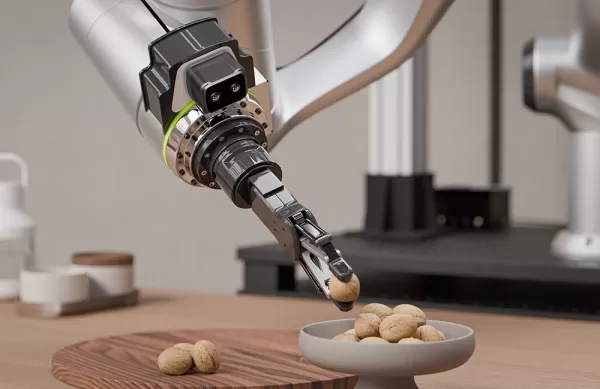
Ouster provides digital lidar, cameras, AI computing, sensor fusion and perception software, and AI models. | Source: Ouster
Ouster, Inc. announced the release of the Stereolabs ZED X Nano yesterday, a compact wrist-mounted stereo camera designed for robotic manipulation, imitation learning, and high-volume data collection.
“Building on Stereolabs' leadership in AI vision and perception solutions, the ZED X Nano allows us to penetrate deeper into the industrial and robotics markets, securing new applications that require more compact form factors,” said Ouster CEO Angus Pacala. “The future of Physical AI relies on vast amounts of high-quality, low-latency image data gathered at the edge. With the ZED X Nano, we are providing roboticists with a significant upgrade to their vision systems, enabling machines to perceive, reason, act, and learn with exceptional precision.”
As robotics teams scale up imitation learning and reinforcement learning for manipulation tasks, RGB image quality and end-to-end capture latency have become major bottlenecks. Conventional cameras often depend on USB connectivity, capture lower-resolution 720p RGB and depth data, and require CPU-mediated pipelines that limit throughput and increase latency.
Ouster engineered the Stereolabs ZED X Nano to address these challenges. It is 40% shorter in height than comparable solutions and mounts directly onto robotic wrists and end-of-arm tooling. It utilizes the same reliable 1920×1200 global shutter sensor found across the flagship ZED X camera line. The camera can capture high-resolution RGB and depth images at up to 120 frames per second for training data and manipulation tasks.
The ZED X Nano is available for pre-order starting today, with shipments commencing in May 2026.
ZED X Nano is engineered for physical AI, delivering sub-millimeter accuracy
The core of the ZED X Nano features an ultra-low-latency capture pipeline with a fully zero-copy data path from sensor to GPU. This allows frames to stream directly into NVIDIA hardware encoders and AI inference pipelines simultaneously.
For data collection teams, this enables higher-throughput dataset capture at full resolution. For deployment teams, it allows perception, segmentation, and policy networks to run in parallel on the same video feeds, freeing up more GPU resources.
Depth sensing is powered by Stereolabs' Neural Depth Engine, an AI-driven stereo depth system that achieves sub-millimeter accuracy along the Z-axis. Ouster states this depth engine provides significantly better lateral (XY) positioning than traditional structured-light or time-of-flight cameras. It offers critical advantages for grasp pose estimation, precise placement, and assembly tasks where lateral error can lead to manipulation failure. With a minimum depth-sensing range of 3 centimeters, the camera can also detect objects closer than many competing solutions on the market.
Ouster designed the ZED X Nano for durability. It features an onboard vibration-resistant IMU and is powered by a ruggedized GMSL2 connection with next-generation cabling built to withstand the repeated motion and cable stress of robotic arms. This replaces a fragile USB-C port with an industrial-grade link that can transmit video up to 15 meters while offering EMI resistance and secure locking connectors.
The ZED X Nano is the latest Stereolabs product to offer seamless native integration with NVIDIA Isaac Sim and Isaac Lab for sim-to-real transfer, alongside full support for ROS and ROS 2. Teams developing imitation learning or reinforcement learning pipelines can capture high-fidelity demonstrations, train in simulation using accurately matched camera models, and deploy to physical hardware—all utilizing the same sensor and software stack.
Related article
 Stripe to Acquire OpenRouter as AI Model Routing Gains Momentum
Stripe has agreed to acquire OpenRouter, an AI model-routing platform that gives developers access to hundreds of models through a single interface. The deal adds model selection and routing to Stripe’s existing work around AI usage and token-based b
Former OpenAI Researcher Barrett Zoph Returns to Google to Support Gemini Development
Barret Zoph, who previously abruptly left and joined OpenAI due to a disagreement with Thinking Machines Lab CEO Miriam Mularati, has once again changed employers. Alphabet's Google announced that Zoph will return as Vice President of Research, bring
How Recursive Intelligence Raised $335M at $4B Valuation in 4 Months
The co-founders of startup Ricursive Intelligence seemed destined to be co-founders.Anna Goldie, CEO, and Azalia Mirhoseini, CTO, are so well-known in the AI community that they were among those AI engineers who “got those weird emails from Zuckerber
Related Special Topic Recommendations
Design & Art
Stripe to Acquire OpenRouter as AI Model Routing Gains Momentum
Stripe has agreed to acquire OpenRouter, an AI model-routing platform that gives developers access to hundreds of models through a single interface. The deal adds model selection and routing to Stripe’s existing work around AI usage and token-based b
Former OpenAI Researcher Barrett Zoph Returns to Google to Support Gemini Development
Barret Zoph, who previously abruptly left and joined OpenAI due to a disagreement with Thinking Machines Lab CEO Miriam Mularati, has once again changed employers. Alphabet's Google announced that Zoph will return as Vice President of Research, bring
How Recursive Intelligence Raised $335M at $4B Valuation in 4 Months
The co-founders of startup Ricursive Intelligence seemed destined to be co-founders.Anna Goldie, CEO, and Azalia Mirhoseini, CTO, are so well-known in the AI community that they were among those AI engineers who “got those weird emails from Zuckerber
Related Special Topic Recommendations
Design & Art
 Top AI Illustration Tools: Create Editorial Scenes and Cover Art Faster
2026 Latest Top-rated AI Illustration Tools: Our curated list features the best powerfully designed tools for creating stunning editorial scenes and eye-catching cover art quickly. Each option has gone through rigorous real-world tests, offering a free vs paid comparison to help you find the perfect match for your workflow. Try these must-try solutions today to unlock your AI edge and boost your creative productivity. Explore now at XIX.AI.
 10 tools
 xix.ai
Education and Learning
Top AI Tutors for Exam Prep: Practice Math, Science, and English
xix.ai
Education and Learning
Top AI Tutors for Exam Prep: Practice Math, Science, and English
2026 Latest Top-Rated Best AI Tutors for Exam Prep are here on XIX.AI! Our curated list features powerful game-changing tools that offer free vs paid comparison, real-world tests, and weekly updated rankings. They help boost your writing efficiency, simplify complex topic learning, and unlock your academic potential. Explore now to Discover your perfect exam prep tool and Start creating today to Unlock your AI edge!
10 tools
xix.ai
Finance
AI Budget Planning Tools for Personal Money Management
2026 Latest Best Top-Rated AI Budget Planning Tools for Personal Money Management are here on XIX.AI! This curated collection features powerful, game-changing solutions that help you conduct real-world tests, understand spending habits, and create personalized plans to boost productivity. Enjoy a free vs paid comparison along with detailed rankings. Must-try tools designed to simplify money management and unlock your AI edge. Explore now!
11 tools
xix.ai
Health & Wellness
AI Sleep Tracking Assistants: Improve Recovery with Better Bedtime Habits
2026 Latest Best Top-Rated AI Sleep Tracking Assistants curated for ultimate recovery. This fully updated weekly guide features powerful tools that deliver real-world tests, free vs paid comparison, and detailed rankings to help you find the must-try solution that boosts sleep quality and supports better bedtime habits. Explore now at XIX.AI to Unlock your AI edge.
10 tools
xix.ai
Data Analysis
AI SQL Copilots for Product and Revenue Analytics
2026 Latest Best Top-Rated AI SQL Copilots for Product and Revenue Analytics! XIX.AI has curated a powerful, game-changing collection of must-try tools that undergo real-world tests through weekly updated rankings. These tools help users boost productivity significantly by accelerating data analysis, streamlining complex queries, and generating accurate insights to drive smarter business decisions. Explore now to Discover your perfect tool for unlocking your AI edge!
14 tools
xix.ai
Education and Learning
Best AI Homework Helpers That Teach: Learn Concepts, Not Just Answers
2026 Latest Best Top-Rated AI Homework Helpers That Teach Core Concepts Not Just Answers Powerful Tools for Students Must-Try Curated List Weekly Updated Free vs Paid Comparison Real-World Tests Accurate Rankings to Help You Unlock Your Full Learning Potential Explore now to Discover your perfect tool for smarter studying.
10 tools
xix.ai

 Comments (0)
0/500
Comments (0)
0/500
Ouster provides digital lidar, cameras, AI computing, sensor fusion and perception software, and AI models. | Source: Ouster
Ouster, Inc. announced the release of the Stereolabs ZED X Nano yesterday, a compact wrist-mounted stereo camera designed for robotic manipulation, imitation learning, and high-volume data collection.
“Building on Stereolabs' leadership in AI vision and perception solutions, the ZED X Nano allows us to penetrate deeper into the industrial and robotics markets, securing new applications that require more compact form factors,” said Ouster CEO Angus Pacala. “The future of Physical AI relies on vast amounts of high-quality, low-latency image data gathered at the edge. With the ZED X Nano, we are providing roboticists with a significant upgrade to their vision systems, enabling machines to perceive, reason, act, and learn with exceptional precision.”
As robotics teams scale up imitation learning and reinforcement learning for manipulation tasks, RGB image quality and end-to-end capture latency have become major bottlenecks. Conventional cameras often depend on USB connectivity, capture lower-resolution 720p RGB and depth data, and require CPU-mediated pipelines that limit throughput and increase latency.
Ouster engineered the Stereolabs ZED X Nano to address these challenges. It is 40% shorter in height than comparable solutions and mounts directly onto robotic wrists and end-of-arm tooling. It utilizes the same reliable 1920×1200 global shutter sensor found across the flagship ZED X camera line. The camera can capture high-resolution RGB and depth images at up to 120 frames per second for training data and manipulation tasks.
The ZED X Nano is available for pre-order starting today, with shipments commencing in May 2026.
ZED X Nano is engineered for physical AI, delivering sub-millimeter accuracy
The core of the ZED X Nano features an ultra-low-latency capture pipeline with a fully zero-copy data path from sensor to GPU. This allows frames to stream directly into NVIDIA hardware encoders and AI inference pipelines simultaneously.
For data collection teams, this enables higher-throughput dataset capture at full resolution. For deployment teams, it allows perception, segmentation, and policy networks to run in parallel on the same video feeds, freeing up more GPU resources.
Depth sensing is powered by Stereolabs' Neural Depth Engine, an AI-driven stereo depth system that achieves sub-millimeter accuracy along the Z-axis. Ouster states this depth engine provides significantly better lateral (XY) positioning than traditional structured-light or time-of-flight cameras. It offers critical advantages for grasp pose estimation, precise placement, and assembly tasks where lateral error can lead to manipulation failure. With a minimum depth-sensing range of 3 centimeters, the camera can also detect objects closer than many competing solutions on the market.
Ouster designed the ZED X Nano for durability. It features an onboard vibration-resistant IMU and is powered by a ruggedized GMSL2 connection with next-generation cabling built to withstand the repeated motion and cable stress of robotic arms. This replaces a fragile USB-C port with an industrial-grade link that can transmit video up to 15 meters while offering EMI resistance and secure locking connectors.
The ZED X Nano is the latest Stereolabs product to offer seamless native integration with NVIDIA Isaac Sim and Isaac Lab for sim-to-real transfer, alongside full support for ROS and ROS 2. Teams developing imitation learning or reinforcement learning pipelines can capture high-fidelity demonstrations, train in simulation using accurately matched camera models, and deploy to physical hardware—all utilizing the same sensor and software stack.








 Stripe to Acquire OpenRouter as AI Model Routing Gains Momentum
Stripe has agreed to acquire OpenRouter, an AI model-routing platform that gives developers access to hundreds of models through a single interface. The deal adds model selection and routing to Stripe’s existing work around AI usage and token-based b
Stripe to Acquire OpenRouter as AI Model Routing Gains Momentum
Stripe has agreed to acquire OpenRouter, an AI model-routing platform that gives developers access to hundreds of models through a single interface. The deal adds model selection and routing to Stripe’s existing work around AI usage and token-based b
 Former OpenAI Researcher Barrett Zoph Returns to Google to Support Gemini Development
Barret Zoph, who previously abruptly left and joined OpenAI due to a disagreement with Thinking Machines Lab CEO Miriam Mularati, has once again changed employers. Alphabet's Google announced that Zoph will return as Vice President of Research, bring
Former OpenAI Researcher Barrett Zoph Returns to Google to Support Gemini Development
Barret Zoph, who previously abruptly left and joined OpenAI due to a disagreement with Thinking Machines Lab CEO Miriam Mularati, has once again changed employers. Alphabet's Google announced that Zoph will return as Vice President of Research, bring
 How Recursive Intelligence Raised $335M at $4B Valuation in 4 Months
The co-founders of startup Ricursive Intelligence seemed destined to be co-founders.Anna Goldie, CEO, and Azalia Mirhoseini, CTO, are so well-known in the AI community that they were among those AI engineers who “got those weird emails from Zuckerber
How Recursive Intelligence Raised $335M at $4B Valuation in 4 Months
The co-founders of startup Ricursive Intelligence seemed destined to be co-founders.Anna Goldie, CEO, and Azalia Mirhoseini, CTO, are so well-known in the AI community that they were among those AI engineers who “got those weird emails from Zuckerber
2026 Latest Top-rated AI Illustration Tools: Our curated list features the best powerfully designed tools for creating stunning editorial scenes and eye-catching cover art quickly. Each option has gone through rigorous real-world tests, offering a free vs paid comparison to help you find the perfect match for your workflow. Try these must-try solutions today to unlock your AI edge and boost your creative productivity. Explore now at XIX.AI.
10 tools
xix.ai

2026 Latest Top-Rated Best AI Tutors for Exam Prep are here on XIX.AI! Our curated list features powerful game-changing tools that offer free vs paid comparison, real-world tests, and weekly updated rankings. They help boost your writing efficiency, simplify complex topic learning, and unlock your academic potential. Explore now to Discover your perfect exam prep tool and Start creating today to Unlock your AI edge!
10 tools
xix.ai

2026 Latest Best Top-Rated AI Budget Planning Tools for Personal Money Management are here on XIX.AI! This curated collection features powerful, game-changing solutions that help you conduct real-world tests, understand spending habits, and create personalized plans to boost productivity. Enjoy a free vs paid comparison along with detailed rankings. Must-try tools designed to simplify money management and unlock your AI edge. Explore now!
11 tools
xix.ai

2026 Latest Best Top-Rated AI Sleep Tracking Assistants curated for ultimate recovery. This fully updated weekly guide features powerful tools that deliver real-world tests, free vs paid comparison, and detailed rankings to help you find the must-try solution that boosts sleep quality and supports better bedtime habits. Explore now at XIX.AI to Unlock your AI edge.
10 tools
xix.ai

2026 Latest Best Top-Rated AI SQL Copilots for Product and Revenue Analytics! XIX.AI has curated a powerful, game-changing collection of must-try tools that undergo real-world tests through weekly updated rankings. These tools help users boost productivity significantly by accelerating data analysis, streamlining complex queries, and generating accurate insights to drive smarter business decisions. Explore now to Discover your perfect tool for unlocking your AI edge!
14 tools
xix.ai

2026 Latest Best Top-Rated AI Homework Helpers That Teach Core Concepts Not Just Answers Powerful Tools for Students Must-Try Curated List Weekly Updated Free vs Paid Comparison Real-World Tests Accurate Rankings to Help You Unlock Your Full Learning Potential Explore now to Discover your perfect tool for smarter studying.
10 tools
xix.ai












