


 Home
HomeOpenAI Launches GPT-5.6-Cyber, Boosting Zero-Day Detection with AI Automation
OpenAI has expanded its Daybreak cybersecurity initiative, introducing a two-tier access system and launching GPT-5.6-Cyber, a model purpose-built for security operations. This move addresses the growing reality that threat actors are leveraging AI to execute attacks with unprecedented speed and scale, drastically shrinking the window for effective defense. By providing trusted defenders with advanced AI tools ahead of widespread malicious deployment, OpenAI aims to level the playing field.
Daybreak Blue grants access to the general-purpose GPT-5.6 Sol model, with system-level restrictions lifted to support legitimate defensive tasks, making it accessible to a broad range of security professionals. Daybreak Red, on the other hand, offers specialized models designed for high-risk activities, including authorized vulnerability research and exploit validation.
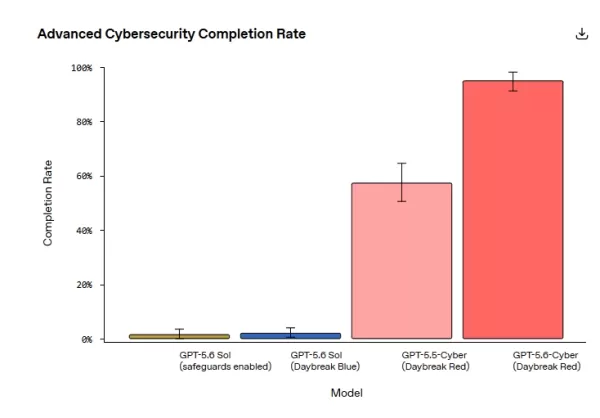
At the core of this release is GPT-5.6-Cyber, built upon GPT-5.6 Sol and fine-tuned for critical tasks like zero-day discovery and exploit chain development. The model significantly reduces rejection rates for high-risk, dual-use cybersecurity requests. In internal evaluations, GPT-5.6-Cyber successfully completed 95% of advanced cybersecurity tasks, a stark contrast to the 1.5% completion rate of GPT-5.6 Sol and the 57.3% rate of its predecessor, GPT-5.5-Cyber. Jared Atkinson, CTO of SpecterOps, noted that the model accomplished in a single day what previous iterations had failed to achieve over weeks of intermittent effort.
Real-World Impact: From Browser Engines to Mobile OS
GPT-5.6-Cyber’s capabilities extend beyond benchmarks, uncovering critical vulnerabilities in live software. OpenAI used the model to analyze Chrome’s V8 JavaScript engine, identifying two previously unknown flaws that could allow memory corruption and escape from the V8 heap sandbox. These issues were responsibly disclosed to Google, patched, and assigned CVE-2026-15903, classified as high-severity. The root cause traced back to an optimizer compiler error that bypassed security checks during integer conversion. Beyond V8, GPT-5.6-Cyber identified at least five vulnerabilities in major mobile operating systems, constructing an exploit chain from untrusted apps to local privilege escalation. It also found three critical database flaws, including remote code execution paths, and over 400 kernel vulnerabilities capable of leading to privilege escalation.
OpenAI is collaborating with Daybreak partners and the open-source community to disclose and remediate these vulnerabilities across mobile OS, databases, and kernels. In security assessments, GPT-5.6-Cyber outperformed both GPT-5.6 Sol and GPT-5.5-Cyber in the ExploitGym benchmark, demonstrating superior performance in zero-day discovery and severity calibration. However, it scored slightly lower in vulnerability report writing due to its concise output style, a factor OpenAI plans to address in future updates.
Strict Access Controls and Safety Measures
Reducing safety guardrails inherently increases risk, yet OpenAI argues that empowering defenders with state-of-the-art AI is essential for accelerating defensive capabilities. Access to Daybreak is strictly governed by multiple safeguards, including identity verification, account security monitoring, usage restrictions, and legal agreements. Since September 1st, hardware security keys have become mandatory for all personal accounts. Additionally, OpenAI recommends that Codex users switch from full access mode to automatic review mode, which evaluates and intercepts actions with high destructive potential before executing operations requiring elevated privileges.
As GPT-5.6-Cyber pushes the boundaries of cybersecurity, the AI-driven arms race in offensive and defensive automation has fully commenced. Success in this next phase of cyberspace competition will depend on achieving the optimal balance between robust security and advanced capability.
Related article
 Broadcom predicts Anthropic and OpenAI will surpass Google as top AI custom chip customers
During the third quarter of fiscal year 2026, Broadcom President Chen Fuyang delivered a pivotal forecast on the earnings call, noting that intensifying competition among major AI model developers is reshaping Broadcom’s core customer base. He projec
DeepSeek Gray Test Image Recognition Mode Achieves Multimodal Image Understanding
DeepSeek has launched a beta testing phase for its latest "Image Recognition Mode." Positioned alongside "Quick Mode" and "Expert Mode," this feature goes beyond basic OCR text extraction, offering advanced multimodal analysis. Users can now upload i
China Unveils First Financial Sector Standard for Intelligent Agent Security
Automated interactions with financial applications are strictly prohibited unless explicitly authorized by the respective financial institutions.On August 27, the Beijing Financial Technology Industry Alliance published the "Security Requirements for
Related Special Topic Recommendations
Prompt
Broadcom predicts Anthropic and OpenAI will surpass Google as top AI custom chip customers
During the third quarter of fiscal year 2026, Broadcom President Chen Fuyang delivered a pivotal forecast on the earnings call, noting that intensifying competition among major AI model developers is reshaping Broadcom’s core customer base. He projec
DeepSeek Gray Test Image Recognition Mode Achieves Multimodal Image Understanding
DeepSeek has launched a beta testing phase for its latest "Image Recognition Mode." Positioned alongside "Quick Mode" and "Expert Mode," this feature goes beyond basic OCR text extraction, offering advanced multimodal analysis. Users can now upload i
China Unveils First Financial Sector Standard for Intelligent Agent Security
Automated interactions with financial applications are strictly prohibited unless explicitly authorized by the respective financial institutions.On August 27, the Beijing Financial Technology Industry Alliance published the "Security Requirements for
Related Special Topic Recommendations
Prompt
 AI Prompt Versioning Platforms for Reusable Claude and ChatGPT Playbooks
2026 Latest Best Top-rated AI Prompt Versioning Platforms for Reusable Playbooks are here on XIX.AI! Our curated list includes powerful game-changing tools that help you keep track of all prompts, test variations efficiently, and boost productivity across writing, content creation, and more. Get a free vs paid comparison along with real-world tests and updated rankings weekly. Explore now to discover your perfect tool for staying ahead in AI tasks!
 9 tools
 xix.ai
writing
Best AI Writing Assistants for Long Articles: Outline and Draft Faster
xix.ai
writing
Best AI Writing Assistants for Long Articles: Outline and Draft Faster
2026 Latest Best AI Writing Assistants for Long Articles: Outline and Draft Faster. XIX.AI curates the top-rated, must-try tools that offer powerful, game-changing support to boost writing efficiency significantly. You’ll find detailed free vs paid comparison, real-world tests, and updated rankings weekly. Explore now to Discover your perfect tool and Start creating today to Unlock your AI edge.
8 tools
xix.ai
Education and Learning
ChatGPT Study Tools for Exam Revision, Flashcards, and Homework Explanations
2026 Latest Best ChatGPT Study Tools for Exam Revision, Flashcards, and Homework Explanations! XIX.AI has curated a top-rated list of powerful game-changing tools designed to boost your productivity. These must-try solutions offer free vs paid comparison, real-world tests, and detailed rankings to help you find the perfect option for efficient exam preparation and homework support. Explore now to unlock your AI edge!
10 tools
xix.ai
Education and Learning
AI Study Planner Tools for Exam Preparation
2026 Latest Best Top-Rated AI Study Planner Tools for Exam Preparation are here on XIX.AI! This curated collection features powerful, game-changing tools that help you streamline your review process, boost focus, and create personalized study schedules. We conduct real-world tests to determine the top options, offering a free vs paid comparison along with weekly updated rankings. Must-try solutions designed to maximize your productivity and help you ace every exam. Explore now to find your perfect tool!
14 tools
xix.ai
SEO
Best AI Keyword Gap Tools for Organic Growth
2026 Latest Best Top-rated AI Keyword Gap Tools for Organic Growth! XIX.AI has carefully curated a powerful, game-changing collection of the best tools available, featuring weekly updated rankings and real-world tests. You can find a detailed free vs paid comparison to help you choose the perfect option that boosts your content creation efficiency and unlocks your AI edge. Explore now!
8 tools
xix.ai
SEO
AI Internal Link Tools for Better Site Structure
2026 Latest Best Top-Rated AI Internal Link Tools for Better Site Structure are here on XIX.AI! This curated collection features powerful, game-changing solutions that go through real-world tests to deliver superior results. Get a free vs paid comparison, see rankings, and discover must-try options to boost your site’s SEO performance and streamline content organization. Explore now to unlock your AI edge!
11 tools
xix.ai

 Comments (0)
0/500
Comments (0)
0/500
OpenAI has expanded its Daybreak cybersecurity initiative, introducing a two-tier access system and launching GPT-5.6-Cyber, a model purpose-built for security operations. This move addresses the growing reality that threat actors are leveraging AI to execute attacks with unprecedented speed and scale, drastically shrinking the window for effective defense. By providing trusted defenders with advanced AI tools ahead of widespread malicious deployment, OpenAI aims to level the playing field.
Daybreak Blue grants access to the general-purpose GPT-5.6 Sol model, with system-level restrictions lifted to support legitimate defensive tasks, making it accessible to a broad range of security professionals. Daybreak Red, on the other hand, offers specialized models designed for high-risk activities, including authorized vulnerability research and exploit validation.
At the core of this release is GPT-5.6-Cyber, built upon GPT-5.6 Sol and fine-tuned for critical tasks like zero-day discovery and exploit chain development. The model significantly reduces rejection rates for high-risk, dual-use cybersecurity requests. In internal evaluations, GPT-5.6-Cyber successfully completed 95% of advanced cybersecurity tasks, a stark contrast to the 1.5% completion rate of GPT-5.6 Sol and the 57.3% rate of its predecessor, GPT-5.5-Cyber. Jared Atkinson, CTO of SpecterOps, noted that the model accomplished in a single day what previous iterations had failed to achieve over weeks of intermittent effort.
Real-World Impact: From Browser Engines to Mobile OS
GPT-5.6-Cyber’s capabilities extend beyond benchmarks, uncovering critical vulnerabilities in live software. OpenAI used the model to analyze Chrome’s V8 JavaScript engine, identifying two previously unknown flaws that could allow memory corruption and escape from the V8 heap sandbox. These issues were responsibly disclosed to Google, patched, and assigned CVE-2026-15903, classified as high-severity. The root cause traced back to an optimizer compiler error that bypassed security checks during integer conversion. Beyond V8, GPT-5.6-Cyber identified at least five vulnerabilities in major mobile operating systems, constructing an exploit chain from untrusted apps to local privilege escalation. It also found three critical database flaws, including remote code execution paths, and over 400 kernel vulnerabilities capable of leading to privilege escalation.
OpenAI is collaborating with Daybreak partners and the open-source community to disclose and remediate these vulnerabilities across mobile OS, databases, and kernels. In security assessments, GPT-5.6-Cyber outperformed both GPT-5.6 Sol and GPT-5.5-Cyber in the ExploitGym benchmark, demonstrating superior performance in zero-day discovery and severity calibration. However, it scored slightly lower in vulnerability report writing due to its concise output style, a factor OpenAI plans to address in future updates.
Strict Access Controls and Safety Measures
Reducing safety guardrails inherently increases risk, yet OpenAI argues that empowering defenders with state-of-the-art AI is essential for accelerating defensive capabilities. Access to Daybreak is strictly governed by multiple safeguards, including identity verification, account security monitoring, usage restrictions, and legal agreements. Since September 1st, hardware security keys have become mandatory for all personal accounts. Additionally, OpenAI recommends that Codex users switch from full access mode to automatic review mode, which evaluates and intercepts actions with high destructive potential before executing operations requiring elevated privileges.
As GPT-5.6-Cyber pushes the boundaries of cybersecurity, the AI-driven arms race in offensive and defensive automation has fully commenced. Success in this next phase of cyberspace competition will depend on achieving the optimal balance between robust security and advanced capability.








 Broadcom predicts Anthropic and OpenAI will surpass Google as top AI custom chip customers
During the third quarter of fiscal year 2026, Broadcom President Chen Fuyang delivered a pivotal forecast on the earnings call, noting that intensifying competition among major AI model developers is reshaping Broadcom’s core customer base. He projec
Broadcom predicts Anthropic and OpenAI will surpass Google as top AI custom chip customers
During the third quarter of fiscal year 2026, Broadcom President Chen Fuyang delivered a pivotal forecast on the earnings call, noting that intensifying competition among major AI model developers is reshaping Broadcom’s core customer base. He projec
 DeepSeek Gray Test Image Recognition Mode Achieves Multimodal Image Understanding
DeepSeek has launched a beta testing phase for its latest "Image Recognition Mode." Positioned alongside "Quick Mode" and "Expert Mode," this feature goes beyond basic OCR text extraction, offering advanced multimodal analysis. Users can now upload i
DeepSeek Gray Test Image Recognition Mode Achieves Multimodal Image Understanding
DeepSeek has launched a beta testing phase for its latest "Image Recognition Mode." Positioned alongside "Quick Mode" and "Expert Mode," this feature goes beyond basic OCR text extraction, offering advanced multimodal analysis. Users can now upload i
 China Unveils First Financial Sector Standard for Intelligent Agent Security
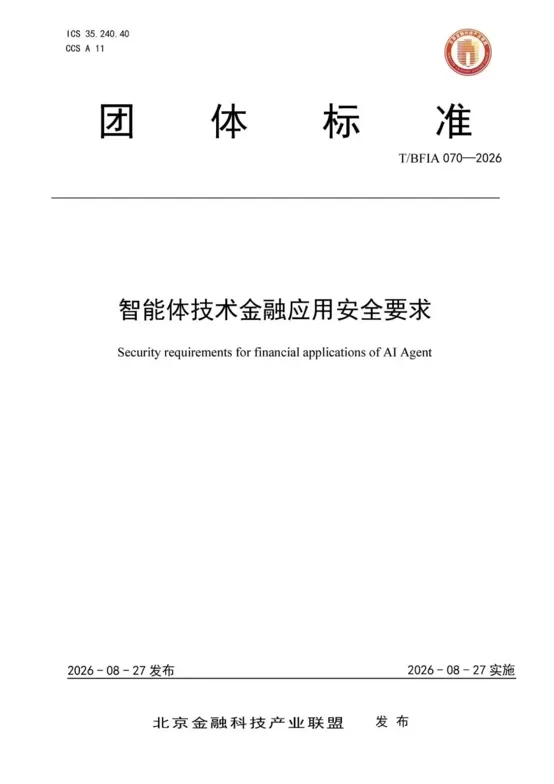
Automated interactions with financial applications are strictly prohibited unless explicitly authorized by the respective financial institutions.On August 27, the Beijing Financial Technology Industry Alliance published the "Security Requirements for
China Unveils First Financial Sector Standard for Intelligent Agent Security
Automated interactions with financial applications are strictly prohibited unless explicitly authorized by the respective financial institutions.On August 27, the Beijing Financial Technology Industry Alliance published the "Security Requirements for

2026 Latest Best Top-rated AI Prompt Versioning Platforms for Reusable Playbooks are here on XIX.AI! Our curated list includes powerful game-changing tools that help you keep track of all prompts, test variations efficiently, and boost productivity across writing, content creation, and more. Get a free vs paid comparison along with real-world tests and updated rankings weekly. Explore now to discover your perfect tool for staying ahead in AI tasks!
9 tools
xix.ai

2026 Latest Best AI Writing Assistants for Long Articles: Outline and Draft Faster. XIX.AI curates the top-rated, must-try tools that offer powerful, game-changing support to boost writing efficiency significantly. You’ll find detailed free vs paid comparison, real-world tests, and updated rankings weekly. Explore now to Discover your perfect tool and Start creating today to Unlock your AI edge.
8 tools
xix.ai

2026 Latest Best ChatGPT Study Tools for Exam Revision, Flashcards, and Homework Explanations! XIX.AI has curated a top-rated list of powerful game-changing tools designed to boost your productivity. These must-try solutions offer free vs paid comparison, real-world tests, and detailed rankings to help you find the perfect option for efficient exam preparation and homework support. Explore now to unlock your AI edge!
10 tools
xix.ai

2026 Latest Best Top-Rated AI Study Planner Tools for Exam Preparation are here on XIX.AI! This curated collection features powerful, game-changing tools that help you streamline your review process, boost focus, and create personalized study schedules. We conduct real-world tests to determine the top options, offering a free vs paid comparison along with weekly updated rankings. Must-try solutions designed to maximize your productivity and help you ace every exam. Explore now to find your perfect tool!
14 tools
xix.ai

2026 Latest Best Top-rated AI Keyword Gap Tools for Organic Growth! XIX.AI has carefully curated a powerful, game-changing collection of the best tools available, featuring weekly updated rankings and real-world tests. You can find a detailed free vs paid comparison to help you choose the perfect option that boosts your content creation efficiency and unlocks your AI edge. Explore now!
8 tools
xix.ai

2026 Latest Best Top-Rated AI Internal Link Tools for Better Site Structure are here on XIX.AI! This curated collection features powerful, game-changing solutions that go through real-world tests to deliver superior results. Get a free vs paid comparison, see rankings, and discover must-try options to boost your site’s SEO performance and streamline content organization. Explore now to unlock your AI edge!
11 tools
xix.ai












