


 Home
HomeMarvis Unveils Custom Model Function, Integrating Kimi and Zhipu GLM
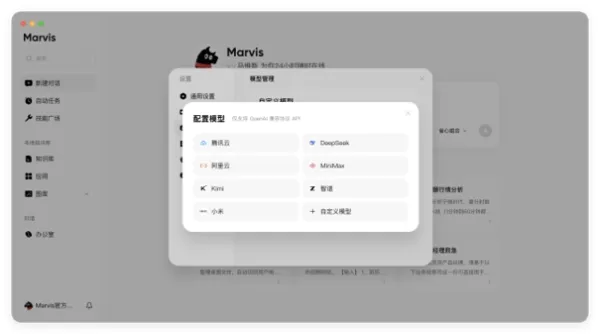
On September 1st, Marvis, Tencent’s operating system-level AI assistant, officially rolled out its "Custom Model" feature. This update allows users to seamlessly integrate third-party models that adhere to industry-standard interface protocols into Marvis. Supported providers include major platforms such as Tencent Cloud, Alibaba Cloud, DeepSeek, Minimax, Kimi, Zhipu, and Xiaomi. Additionally, the feature supports locally deployed open-source models and enables cross-device synchronization for a consistent experience.
Unlocking Model Flexibility: Freedom to Choose
Over the past year, the large language model landscape has accelerated, with new leaders emerging monthly. No single model dominates all use cases; some excel in long-form writing, others in code generation, and some in speed or cost-efficiency. Consequently, user demand for the ability to switch between models freely has grown significantly.
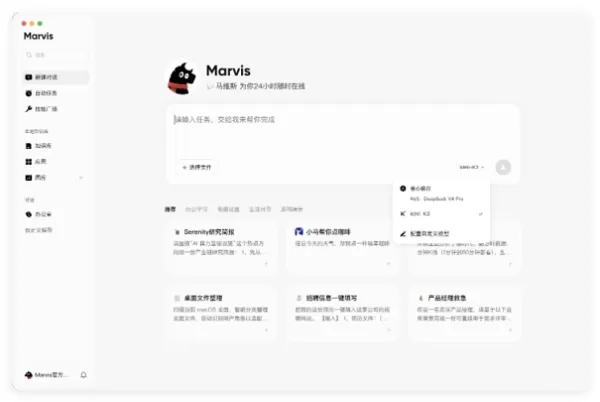
This update addresses that need by granting users full control over model selection. Previously, Marvis was limited to its built-in models. Now, users can opt for pre-configured combinations like HuanYuan Hy4preview and DeepSeek-V4Pro, or connect to any large model compatible with standard interface protocols.
From a user interface standpoint, accessing "Custom Model" settings is straightforward: navigate to "Settings - Model Management." The system offers quick setup options for models from Tencent Cloud and DeepSeek, while also providing a manual entry for users to add specific models. Once configured, users can switch between different models during conversations, selecting the most appropriate tool for each task.
Notably, Marvis provides each user with a daily free quota of 10 million tokens, which suffices for most everyday tasks. However, for high-frequency or heavy-use scenarios like extensive code generation or long-document processing, this limit may be reached. By integrating third-party services via custom models, usage is billed to the user’s external account, bypassing Marvis’s daily quota. This offers a practical solution for power users who need higher capacity.
Local Model Integration: Simplifying Private Deployment
Beyond cloud-based options, this update also supports local model integration. For users prioritizing data privacy or seeking to reduce API costs, Marvis now allows them to run open-source models locally on their computers. By using third-party applications and completing a simple configuration within Marvis, users can operate in "local mode."
The key value here is accessibility. Previously, Marvis’s native "local mode" required high-end hardware with substantial local computing power. By accessing local models through the custom model feature, users can leverage "efficiency mode," which lowers the hardware barriers and reduces performance constraints associated with running models locally.
From a security perspective, local model integration ensures that conversation data never leaves the user’s device, eliminating the need to transmit information through cloud servers. This makes it ideal for environments with strict data privacy requirements.
Cross-Device Synchronization: One Configuration, All Devices
The third major feature is cross-device synchronization. Custom model configurations are treated as personal account assets, tied to the user’s account rather than a specific device. This means that whether you log in to Marvis on a Windows PC, Mac, or mobile device, your configured model list will automatically sync, eliminating the need to reconfigure settings on each device.
Marvis currently supports Mac, Windows, iOS, Android, and iPad. For professionals who frequently switch between devices, this ensures continuity: a model configured on an office computer can be used on a mobile device during travel, maintaining an uninterrupted AI workflow across all platforms.
Decoupling AI assistants from underlying models is becoming an industry standard. Users no longer need to replace entire applications to test new models or juggle multiple assistants. The custom model feature is now available in the latest version of Marvis. Users can access it by updating the app and navigating to "Settings - Model Management."
Related article
 DeepSeek Unveils First Open-Source Multimodal Model Engineered for AI Agents
DeepSeek has released DeepSeek-V4-Flash-Vision-Exp on Hugging Face, marking the debut of the first experimental multimodal model in the V4 series under the MIT License. With 305B parameters and built on the V4-Flash-0731 foundation, this model integr
US health agencies evaluate OpenAI and Anthropic AI models
Public health agencies nationwide are set to evaluate generative AI through a new initiative led by the Coalition for Health AI, in partnership with OpenAI, Anthropic, and Accenture.The Public Health Use Case and Learning Scaling Engine (PULSE) will
Alipay’s Touch and Pay to Transform 30 Million Offline Touchpoints Into an AI-Driven Business Network
Following the launch of a full-stack AI payment system and the AI-powered Alipay assistant "Abao," Alipay announced on July 8 that its "Touch and Pay" solution has undergone a comprehensive AI upgrade. The millions of "Touch and Pay" devices deployed
Related Special Topic Recommendations
writing
DeepSeek Unveils First Open-Source Multimodal Model Engineered for AI Agents
DeepSeek has released DeepSeek-V4-Flash-Vision-Exp on Hugging Face, marking the debut of the first experimental multimodal model in the V4 series under the MIT License. With 305B parameters and built on the V4-Flash-0731 foundation, this model integr
US health agencies evaluate OpenAI and Anthropic AI models
Public health agencies nationwide are set to evaluate generative AI through a new initiative led by the Coalition for Health AI, in partnership with OpenAI, Anthropic, and Accenture.The Public Health Use Case and Learning Scaling Engine (PULSE) will
Alipay’s Touch and Pay to Transform 30 Million Offline Touchpoints Into an AI-Driven Business Network
Following the launch of a full-stack AI payment system and the AI-powered Alipay assistant "Abao," Alipay announced on July 8 that its "Touch and Pay" solution has undergone a comprehensive AI upgrade. The millions of "Touch and Pay" devices deployed
Related Special Topic Recommendations
writing
 Best AI Editing Tools for Clear Business Writing
2026 Latest Best Top-rated AI Editing Tools for Clear Business Writing are here on XIX.AI! This curated list features powerful, game-changing solutions that help you boost writing efficiency significantly through real-world tests and rigorous rankings. You’ll find a free vs paid comparison to help you choose the perfect fit. Explore now and Unlock your AI edge!
 10 tools
 xix.ai
Animation Creation
Best AI Motion Cleanup Tools for Mocap Retargeting in Shorts, Ads, and Game Trailers
xix.ai
Animation Creation
Best AI Motion Cleanup Tools for Mocap Retargeting in Shorts, Ads, and Game Trailers
2026 Latest Best Top-rated AI Motion Cleanup Tools for Mocap Retargeting in Shorts, Ads, and Game Trailers! XIX.AI has curated a powerful game-changing collection featuring weekly updated rankings, free vs paid comparison, and real-world tests to help you find the must-try solution that boosts productivity and unlocks your creative edge. Explore now to discover your perfect tool for flawless motion edits.
9 tools
xix.ai
Comic Creation
Best AI Manga Background Generators for Serialized Stories
2026 Latest Best Top-rated AI Manga Background Generators for Serialized Stories! This curated list features powerful game-changing tools that help creators craft stunning visual content fast, boosting productivity significantly. Every option has undergone real-world tests to ensure top quality. Check out the free vs paid comparison and rankings to find your perfect fit. Explore now at XIX.AI to unlock your AI edge in manga creation.
9 tools
xix.ai
chatbot
Best AI Chat Companions: Hold Natural Talks with Long-Term Memory
2026 Latest Best AI Chat Companions Ranking features top-rated, powerful tools known for their ability to hold natural conversations and retain long-term memory. This curated list includes must-try options across free and paid tiers, backed by real-world tests and weekly updated rankings. XIX.AI stands out as a trusted choice in this elite collection. Explore now to discover your perfect AI chat companion and unlock your productivity edge today.
11 tools
xix.ai
Animation Creation
Best AI Animation Generators: Turn Ideas into Motion Clips Fast
2026 Latest Best Top-Rated AI Animation Generators! XIX.AI curates a powerful game-changing collection of must-try tools for turning creative ideas into high-quality motion clips swiftly. Each option has undergone rigorous real-world tests, featuring detailed free vs paid comparison and updated weekly rankings to help you find the perfect fit for boosting your animation productivity. Explore now to unlock your AI edge!
11 tools
xix.ai
Text-to-speech
Top Multilingual AI Voice Generators: Localize Audio at Scale
2026 Latest Top-Rated Best Multilingual AI Voice Generators for Large-Scale Audio Localization. This curated list features powerful, game-changing tools that deliver high-quality localized audio fast. Each option has undergone rigorous real-world tests to ensure reliability. Get a free vs paid comparison and discover the perfect fit for your projects. Explore now at XIX.AI to unlock your AI edge.
18 tools
xix.ai

 Comments (0)
0/500
Comments (0)
0/500
On September 1st, Marvis, Tencent’s operating system-level AI assistant, officially rolled out its "Custom Model" feature. This update allows users to seamlessly integrate third-party models that adhere to industry-standard interface protocols into Marvis. Supported providers include major platforms such as Tencent Cloud, Alibaba Cloud, DeepSeek, Minimax, Kimi, Zhipu, and Xiaomi. Additionally, the feature supports locally deployed open-source models and enables cross-device synchronization for a consistent experience.
Unlocking Model Flexibility: Freedom to Choose
Over the past year, the large language model landscape has accelerated, with new leaders emerging monthly. No single model dominates all use cases; some excel in long-form writing, others in code generation, and some in speed or cost-efficiency. Consequently, user demand for the ability to switch between models freely has grown significantly.
This update addresses that need by granting users full control over model selection. Previously, Marvis was limited to its built-in models. Now, users can opt for pre-configured combinations like HuanYuan Hy4preview and DeepSeek-V4Pro, or connect to any large model compatible with standard interface protocols.
From a user interface standpoint, accessing "Custom Model" settings is straightforward: navigate to "Settings - Model Management." The system offers quick setup options for models from Tencent Cloud and DeepSeek, while also providing a manual entry for users to add specific models. Once configured, users can switch between different models during conversations, selecting the most appropriate tool for each task.
Notably, Marvis provides each user with a daily free quota of 10 million tokens, which suffices for most everyday tasks. However, for high-frequency or heavy-use scenarios like extensive code generation or long-document processing, this limit may be reached. By integrating third-party services via custom models, usage is billed to the user’s external account, bypassing Marvis’s daily quota. This offers a practical solution for power users who need higher capacity.
Local Model Integration: Simplifying Private Deployment
Beyond cloud-based options, this update also supports local model integration. For users prioritizing data privacy or seeking to reduce API costs, Marvis now allows them to run open-source models locally on their computers. By using third-party applications and completing a simple configuration within Marvis, users can operate in "local mode."
The key value here is accessibility. Previously, Marvis’s native "local mode" required high-end hardware with substantial local computing power. By accessing local models through the custom model feature, users can leverage "efficiency mode," which lowers the hardware barriers and reduces performance constraints associated with running models locally.
From a security perspective, local model integration ensures that conversation data never leaves the user’s device, eliminating the need to transmit information through cloud servers. This makes it ideal for environments with strict data privacy requirements.
Cross-Device Synchronization: One Configuration, All Devices
The third major feature is cross-device synchronization. Custom model configurations are treated as personal account assets, tied to the user’s account rather than a specific device. This means that whether you log in to Marvis on a Windows PC, Mac, or mobile device, your configured model list will automatically sync, eliminating the need to reconfigure settings on each device.
Marvis currently supports Mac, Windows, iOS, Android, and iPad. For professionals who frequently switch between devices, this ensures continuity: a model configured on an office computer can be used on a mobile device during travel, maintaining an uninterrupted AI workflow across all platforms.
Decoupling AI assistants from underlying models is becoming an industry standard. Users no longer need to replace entire applications to test new models or juggle multiple assistants. The custom model feature is now available in the latest version of Marvis. Users can access it by updating the app and navigating to "Settings - Model Management."








 DeepSeek Unveils First Open-Source Multimodal Model Engineered for AI Agents
DeepSeek has released DeepSeek-V4-Flash-Vision-Exp on Hugging Face, marking the debut of the first experimental multimodal model in the V4 series under the MIT License. With 305B parameters and built on the V4-Flash-0731 foundation, this model integr
DeepSeek Unveils First Open-Source Multimodal Model Engineered for AI Agents
DeepSeek has released DeepSeek-V4-Flash-Vision-Exp on Hugging Face, marking the debut of the first experimental multimodal model in the V4 series under the MIT License. With 305B parameters and built on the V4-Flash-0731 foundation, this model integr
 US health agencies evaluate OpenAI and Anthropic AI models
Public health agencies nationwide are set to evaluate generative AI through a new initiative led by the Coalition for Health AI, in partnership with OpenAI, Anthropic, and Accenture.The Public Health Use Case and Learning Scaling Engine (PULSE) will
US health agencies evaluate OpenAI and Anthropic AI models
Public health agencies nationwide are set to evaluate generative AI through a new initiative led by the Coalition for Health AI, in partnership with OpenAI, Anthropic, and Accenture.The Public Health Use Case and Learning Scaling Engine (PULSE) will
 Alipay’s Touch and Pay to Transform 30 Million Offline Touchpoints Into an AI-Driven Business Network
Following the launch of a full-stack AI payment system and the AI-powered Alipay assistant "Abao," Alipay announced on July 8 that its "Touch and Pay" solution has undergone a comprehensive AI upgrade. The millions of "Touch and Pay" devices deployed
Alipay’s Touch and Pay to Transform 30 Million Offline Touchpoints Into an AI-Driven Business Network
Following the launch of a full-stack AI payment system and the AI-powered Alipay assistant "Abao," Alipay announced on July 8 that its "Touch and Pay" solution has undergone a comprehensive AI upgrade. The millions of "Touch and Pay" devices deployed

2026 Latest Best Top-rated AI Editing Tools for Clear Business Writing are here on XIX.AI! This curated list features powerful, game-changing solutions that help you boost writing efficiency significantly through real-world tests and rigorous rankings. You’ll find a free vs paid comparison to help you choose the perfect fit. Explore now and Unlock your AI edge!
10 tools
xix.ai

2026 Latest Best Top-rated AI Motion Cleanup Tools for Mocap Retargeting in Shorts, Ads, and Game Trailers! XIX.AI has curated a powerful game-changing collection featuring weekly updated rankings, free vs paid comparison, and real-world tests to help you find the must-try solution that boosts productivity and unlocks your creative edge. Explore now to discover your perfect tool for flawless motion edits.
9 tools
xix.ai

2026 Latest Best Top-rated AI Manga Background Generators for Serialized Stories! This curated list features powerful game-changing tools that help creators craft stunning visual content fast, boosting productivity significantly. Every option has undergone real-world tests to ensure top quality. Check out the free vs paid comparison and rankings to find your perfect fit. Explore now at XIX.AI to unlock your AI edge in manga creation.
9 tools
xix.ai

2026 Latest Best AI Chat Companions Ranking features top-rated, powerful tools known for their ability to hold natural conversations and retain long-term memory. This curated list includes must-try options across free and paid tiers, backed by real-world tests and weekly updated rankings. XIX.AI stands out as a trusted choice in this elite collection. Explore now to discover your perfect AI chat companion and unlock your productivity edge today.
11 tools
xix.ai

2026 Latest Best Top-Rated AI Animation Generators! XIX.AI curates a powerful game-changing collection of must-try tools for turning creative ideas into high-quality motion clips swiftly. Each option has undergone rigorous real-world tests, featuring detailed free vs paid comparison and updated weekly rankings to help you find the perfect fit for boosting your animation productivity. Explore now to unlock your AI edge!
11 tools
xix.ai

2026 Latest Top-Rated Best Multilingual AI Voice Generators for Large-Scale Audio Localization. This curated list features powerful, game-changing tools that deliver high-quality localized audio fast. Each option has undergone rigorous real-world tests to ensure reliability. Get a free vs paid comparison and discover the perfect fit for your projects. Explore now at XIX.AI to unlock your AI edge.
18 tools
xix.ai












