


 Home
HomeDeepSeek Unveils First Open-Source Multimodal Model Engineered for AI Agents
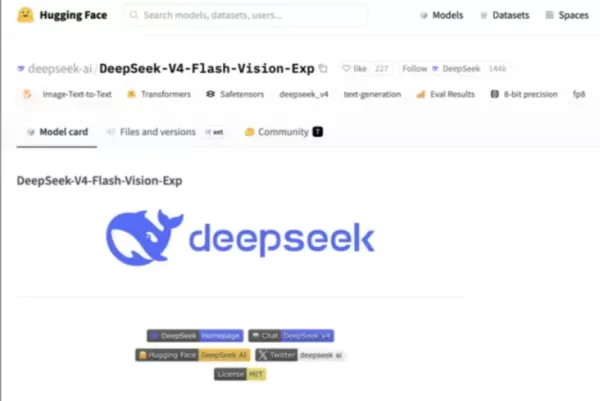
DeepSeek has released DeepSeek-V4-Flash-Vision-Exp on Hugging Face, marking the debut of the first experimental multimodal model in the V4 series under the MIT License. With 305B parameters and built on the V4-Flash-0731 foundation, this model integrates a visual encoder and Aligner into its core language architecture, enabling robust image comprehension through continuous training.
Targeting Multimodal Agents, Not Just Image Description
Unlike traditional multimodal models focused on visual question answering, DeepSeek has redefined the Vision version’s purpose: prioritizing multimodal agent capabilities. The official documentation highlights that agents can directly interpret visual inputs—such as web screenshots, software interfaces, and charts—and execute tasks by invoking tools. Essentially, this “eye” is designed for machine agents rather than human users.
The open-source package is comprehensive, featuring model weights, Tokenizer, Prompt Encoding reference implementations, and a minimal PyTorch inference setup. It covers essential modules including the visual encoder, Aligner, DFlash Attention, MoE, and Hyper-Connections. The community responded swiftly, with seven quantized versions already available on Hugging Face for llama.cpp, LM Studio, and Ollama.
Notable timeline details reveal a strategic rollout: the model first appeared on the DeepSeek API on August 21, accessible only via API without weight distribution. Developers could input text and images simultaneously, with image processing charged by token. Ten days later, weights were officially released, enabling local deployment and secondary development. This “API-first, then open-source” strategy underscores DeepSeek’s primary positioning as an API service provider.
Performance Near Claude Opus 4.8, with Measured Official Claims
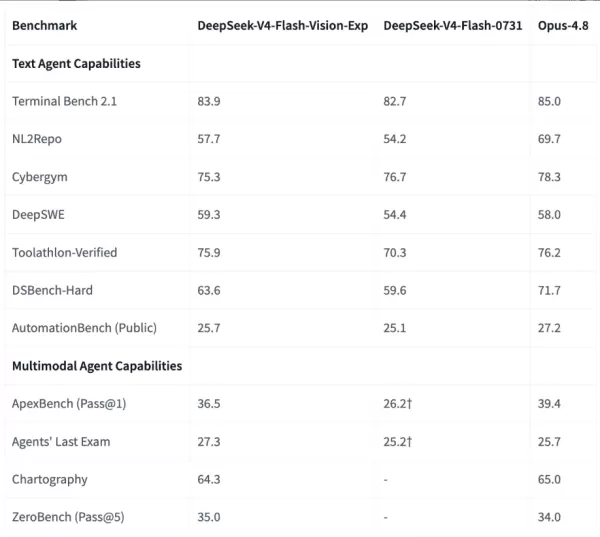
Benchmark results indicate that adding visual capabilities does not significantly compromise pure text agent performance: Terminal Bench 2.1 scores rose from 82.7 to 83.9, and DeepSWE improved from 54.4 to 59.3, surpassing Opus 4.8’s 58.0. Multimodal agent improvements are more pronounced: ApexBench Pass@1 reached 36.5, Agents' Last Exam scored 27.3 (exceeding Opus 4.8’s 25.7), and ZeroBench Pass@5 hit 35.0, outperforming the competitor’s 34.0.
However, DeepSeek avoids claiming “comprehensive superiority”: on the NL2Repo project, it scored 57.7, trailing Opus 4.8’s 69.7. The official statement remains measured, noting only that “multimodal agent capabilities are close to Claude Opus 4.8.” Recent updates show DeepSeek assembling a complete agent technology stack: the model handles reasoning and tool calls, Harness manages continuous task execution, and Vision enables agents to directly interpret computer visual information. This open-source release is a critical step in completing this ecosystem.
Related article
 US health agencies evaluate OpenAI and Anthropic AI models
Public health agencies nationwide are set to evaluate generative AI through a new initiative led by the Coalition for Health AI, in partnership with OpenAI, Anthropic, and Accenture.The Public Health Use Case and Learning Scaling Engine (PULSE) will
Alipay’s Touch and Pay to Transform 30 Million Offline Touchpoints Into an AI-Driven Business Network
Following the launch of a full-stack AI payment system and the AI-powered Alipay assistant "Abao," Alipay announced on July 8 that its "Touch and Pay" solution has undergone a comprehensive AI upgrade. The millions of "Touch and Pay" devices deployed
Tealium: Why RAG Quality Depends on Real-Time Data
Freddy Berlanti, Principal Product Manager of Applied AI at Tealium, explores retrieval-augmented generation (RAG). Image: Getty ImagesFreddy Berlanti, Principal Product Manager of Applied AI at Tealium, breaks down the critical divide between RAG sy
Related Special Topic Recommendations
writing
US health agencies evaluate OpenAI and Anthropic AI models
Public health agencies nationwide are set to evaluate generative AI through a new initiative led by the Coalition for Health AI, in partnership with OpenAI, Anthropic, and Accenture.The Public Health Use Case and Learning Scaling Engine (PULSE) will
Alipay’s Touch and Pay to Transform 30 Million Offline Touchpoints Into an AI-Driven Business Network
Following the launch of a full-stack AI payment system and the AI-powered Alipay assistant "Abao," Alipay announced on July 8 that its "Touch and Pay" solution has undergone a comprehensive AI upgrade. The millions of "Touch and Pay" devices deployed
Tealium: Why RAG Quality Depends on Real-Time Data
Freddy Berlanti, Principal Product Manager of Applied AI at Tealium, explores retrieval-augmented generation (RAG). Image: Getty ImagesFreddy Berlanti, Principal Product Manager of Applied AI at Tealium, breaks down the critical divide between RAG sy
Related Special Topic Recommendations
writing
 Best AI Editing Tools for Clear Business Writing
2026 Latest Best Top-rated AI Editing Tools for Clear Business Writing are here on XIX.AI! This curated list features powerful, game-changing solutions that help you boost writing efficiency significantly through real-world tests and rigorous rankings. You’ll find a free vs paid comparison to help you choose the perfect fit. Explore now and Unlock your AI edge!
 10 tools
 xix.ai
Animation Creation
Best AI Motion Cleanup Tools for Mocap Retargeting in Shorts, Ads, and Game Trailers
xix.ai
Animation Creation
Best AI Motion Cleanup Tools for Mocap Retargeting in Shorts, Ads, and Game Trailers
2026 Latest Best Top-rated AI Motion Cleanup Tools for Mocap Retargeting in Shorts, Ads, and Game Trailers! XIX.AI has curated a powerful game-changing collection featuring weekly updated rankings, free vs paid comparison, and real-world tests to help you find the must-try solution that boosts productivity and unlocks your creative edge. Explore now to discover your perfect tool for flawless motion edits.
9 tools
xix.ai
Comic Creation
Best AI Manga Background Generators for Serialized Stories
2026 Latest Best Top-rated AI Manga Background Generators for Serialized Stories! This curated list features powerful game-changing tools that help creators craft stunning visual content fast, boosting productivity significantly. Every option has undergone real-world tests to ensure top quality. Check out the free vs paid comparison and rankings to find your perfect fit. Explore now at XIX.AI to unlock your AI edge in manga creation.
9 tools
xix.ai
chatbot
Best AI Chat Companions: Hold Natural Talks with Long-Term Memory
2026 Latest Best AI Chat Companions Ranking features top-rated, powerful tools known for their ability to hold natural conversations and retain long-term memory. This curated list includes must-try options across free and paid tiers, backed by real-world tests and weekly updated rankings. XIX.AI stands out as a trusted choice in this elite collection. Explore now to discover your perfect AI chat companion and unlock your productivity edge today.
11 tools
xix.ai
Animation Creation
Best AI Animation Generators: Turn Ideas into Motion Clips Fast
2026 Latest Best Top-Rated AI Animation Generators! XIX.AI curates a powerful game-changing collection of must-try tools for turning creative ideas into high-quality motion clips swiftly. Each option has undergone rigorous real-world tests, featuring detailed free vs paid comparison and updated weekly rankings to help you find the perfect fit for boosting your animation productivity. Explore now to unlock your AI edge!
11 tools
xix.ai
Text-to-speech
Top Multilingual AI Voice Generators: Localize Audio at Scale
2026 Latest Top-Rated Best Multilingual AI Voice Generators for Large-Scale Audio Localization. This curated list features powerful, game-changing tools that deliver high-quality localized audio fast. Each option has undergone rigorous real-world tests to ensure reliability. Get a free vs paid comparison and discover the perfect fit for your projects. Explore now at XIX.AI to unlock your AI edge.
18 tools
xix.ai

 Comments (0)
0/500
Comments (0)
0/500
DeepSeek has released DeepSeek-V4-Flash-Vision-Exp on Hugging Face, marking the debut of the first experimental multimodal model in the V4 series under the MIT License. With 305B parameters and built on the V4-Flash-0731 foundation, this model integrates a visual encoder and Aligner into its core language architecture, enabling robust image comprehension through continuous training.
Targeting Multimodal Agents, Not Just Image Description
Unlike traditional multimodal models focused on visual question answering, DeepSeek has redefined the Vision version’s purpose: prioritizing multimodal agent capabilities. The official documentation highlights that agents can directly interpret visual inputs—such as web screenshots, software interfaces, and charts—and execute tasks by invoking tools. Essentially, this “eye” is designed for machine agents rather than human users.
The open-source package is comprehensive, featuring model weights, Tokenizer, Prompt Encoding reference implementations, and a minimal PyTorch inference setup. It covers essential modules including the visual encoder, Aligner, DFlash Attention, MoE, and Hyper-Connections. The community responded swiftly, with seven quantized versions already available on Hugging Face for llama.cpp, LM Studio, and Ollama.
Notable timeline details reveal a strategic rollout: the model first appeared on the DeepSeek API on August 21, accessible only via API without weight distribution. Developers could input text and images simultaneously, with image processing charged by token. Ten days later, weights were officially released, enabling local deployment and secondary development. This “API-first, then open-source” strategy underscores DeepSeek’s primary positioning as an API service provider.
Performance Near Claude Opus 4.8, with Measured Official Claims
Benchmark results indicate that adding visual capabilities does not significantly compromise pure text agent performance: Terminal Bench 2.1 scores rose from 82.7 to 83.9, and DeepSWE improved from 54.4 to 59.3, surpassing Opus 4.8’s 58.0. Multimodal agent improvements are more pronounced: ApexBench Pass@1 reached 36.5, Agents' Last Exam scored 27.3 (exceeding Opus 4.8’s 25.7), and ZeroBench Pass@5 hit 35.0, outperforming the competitor’s 34.0.
However, DeepSeek avoids claiming “comprehensive superiority”: on the NL2Repo project, it scored 57.7, trailing Opus 4.8’s 69.7. The official statement remains measured, noting only that “multimodal agent capabilities are close to Claude Opus 4.8.” Recent updates show DeepSeek assembling a complete agent technology stack: the model handles reasoning and tool calls, Harness manages continuous task execution, and Vision enables agents to directly interpret computer visual information. This open-source release is a critical step in completing this ecosystem.








 US health agencies evaluate OpenAI and Anthropic AI models
Public health agencies nationwide are set to evaluate generative AI through a new initiative led by the Coalition for Health AI, in partnership with OpenAI, Anthropic, and Accenture.The Public Health Use Case and Learning Scaling Engine (PULSE) will
US health agencies evaluate OpenAI and Anthropic AI models
Public health agencies nationwide are set to evaluate generative AI through a new initiative led by the Coalition for Health AI, in partnership with OpenAI, Anthropic, and Accenture.The Public Health Use Case and Learning Scaling Engine (PULSE) will
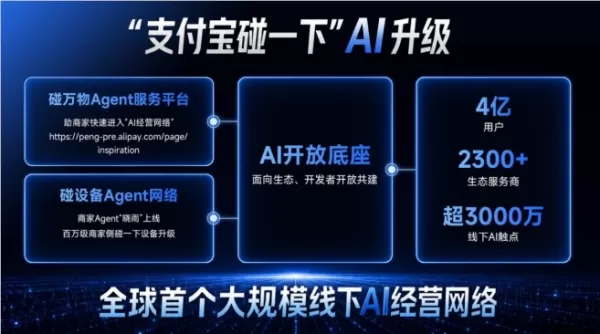 Alipay’s Touch and Pay to Transform 30 Million Offline Touchpoints Into an AI-Driven Business Network
Following the launch of a full-stack AI payment system and the AI-powered Alipay assistant "Abao," Alipay announced on July 8 that its "Touch and Pay" solution has undergone a comprehensive AI upgrade. The millions of "Touch and Pay" devices deployed
Alipay’s Touch and Pay to Transform 30 Million Offline Touchpoints Into an AI-Driven Business Network
Following the launch of a full-stack AI payment system and the AI-powered Alipay assistant "Abao," Alipay announced on July 8 that its "Touch and Pay" solution has undergone a comprehensive AI upgrade. The millions of "Touch and Pay" devices deployed
 Tealium: Why RAG Quality Depends on Real-Time Data
Freddy Berlanti, Principal Product Manager of Applied AI at Tealium, explores retrieval-augmented generation (RAG). Image: Getty ImagesFreddy Berlanti, Principal Product Manager of Applied AI at Tealium, breaks down the critical divide between RAG sy
Tealium: Why RAG Quality Depends on Real-Time Data
Freddy Berlanti, Principal Product Manager of Applied AI at Tealium, explores retrieval-augmented generation (RAG). Image: Getty ImagesFreddy Berlanti, Principal Product Manager of Applied AI at Tealium, breaks down the critical divide between RAG sy

2026 Latest Best Top-rated AI Editing Tools for Clear Business Writing are here on XIX.AI! This curated list features powerful, game-changing solutions that help you boost writing efficiency significantly through real-world tests and rigorous rankings. You’ll find a free vs paid comparison to help you choose the perfect fit. Explore now and Unlock your AI edge!
10 tools
xix.ai

2026 Latest Best Top-rated AI Motion Cleanup Tools for Mocap Retargeting in Shorts, Ads, and Game Trailers! XIX.AI has curated a powerful game-changing collection featuring weekly updated rankings, free vs paid comparison, and real-world tests to help you find the must-try solution that boosts productivity and unlocks your creative edge. Explore now to discover your perfect tool for flawless motion edits.
9 tools
xix.ai

2026 Latest Best Top-rated AI Manga Background Generators for Serialized Stories! This curated list features powerful game-changing tools that help creators craft stunning visual content fast, boosting productivity significantly. Every option has undergone real-world tests to ensure top quality. Check out the free vs paid comparison and rankings to find your perfect fit. Explore now at XIX.AI to unlock your AI edge in manga creation.
9 tools
xix.ai

2026 Latest Best AI Chat Companions Ranking features top-rated, powerful tools known for their ability to hold natural conversations and retain long-term memory. This curated list includes must-try options across free and paid tiers, backed by real-world tests and weekly updated rankings. XIX.AI stands out as a trusted choice in this elite collection. Explore now to discover your perfect AI chat companion and unlock your productivity edge today.
11 tools
xix.ai

2026 Latest Best Top-Rated AI Animation Generators! XIX.AI curates a powerful game-changing collection of must-try tools for turning creative ideas into high-quality motion clips swiftly. Each option has undergone rigorous real-world tests, featuring detailed free vs paid comparison and updated weekly rankings to help you find the perfect fit for boosting your animation productivity. Explore now to unlock your AI edge!
11 tools
xix.ai

2026 Latest Top-Rated Best Multilingual AI Voice Generators for Large-Scale Audio Localization. This curated list features powerful, game-changing tools that deliver high-quality localized audio fast. Each option has undergone rigorous real-world tests to ensure reliability. Get a free vs paid comparison and discover the perfect fit for your projects. Explore now at XIX.AI to unlock your AI edge.
18 tools
xix.ai












