


 Home
HomeHuawei's Shanghai Lab Advancing Automotive Acoustics Engineering
Stepping into Huawei's Shanghai Acoustics R&D Centre, I anticipated a routine facility visit. Instead, I discovered a sophisticated automotive sound engineering operation poised to disrupt the traditional in-car audio market.
Established following Huawei's major audio research investments starting in 2012, the facility features three specialized testing environments: a 4.8x4x4 metre fully anechoic chamber, a larger 14x12x5 metre semi-anechoic room with a reflective floor, and a dedicated 9.1.6 configuration listening room. While photography restrictions protected proprietary technology, the technical specifications themselves reveal a compelling story.
Addressing automotive audio challenges
Goller, whose career includes roles at Gamut Audio, Bang & Olufsen, and Harman International, leads what Huawei terms "master-tuning methodology" – an approach combining objective acoustic measurements with psychoacoustic principles for final sound calibration.
Speaking in the listening room during the initial tour segment, Goller explained Huawei's development philosophy: accurately reproducing recordings as artists intended, creating what he called a "phantom effect" that immerses listeners in the original recording environment. This demands the integration of scientific acoustic measurement, artistic tuning expertise, and custom-designed hardware.
The technical procedure, he noted, begins with objective measurements – frequency response curves, phase relationships, timing behavior, and distortion characteristics. These establish performance parameters. Subsequent extensive subjective listening sessions then refine the sound using psychoacoustic principles to address inherent cabin challenges: acoustic asymmetry, close-range reflections, and bass loading.
The objective remains working within these physical constraints while maintaining source material authenticity.
Introducing the HUAWEI SOUND ULTIMATE Series
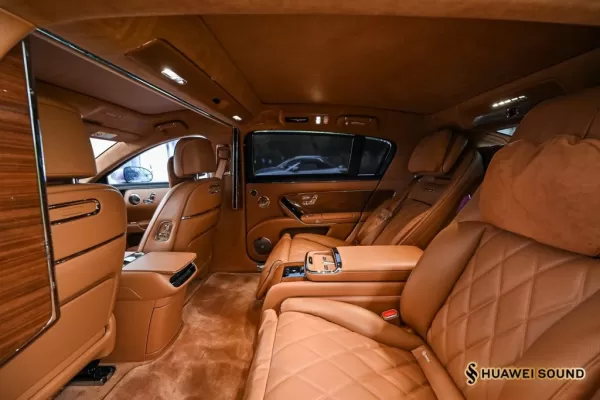
Interior of the Maextro S800 luxury electric sedan This research culminates in the HUAWEI SOUND ULTIMATE Series, the company's premier audio system currently implemented in the Maextro S800 luxury electric sedan. The configuration includes 43 speakers powered by dual amplifiers generating 2,920 watts combined output.
Huawei's industry-first seat-specific 4D immersive surround sound experience incorporates rear 4D exciters synchronized with audio and video content, enhancing the auditory experience with tactile feedback.
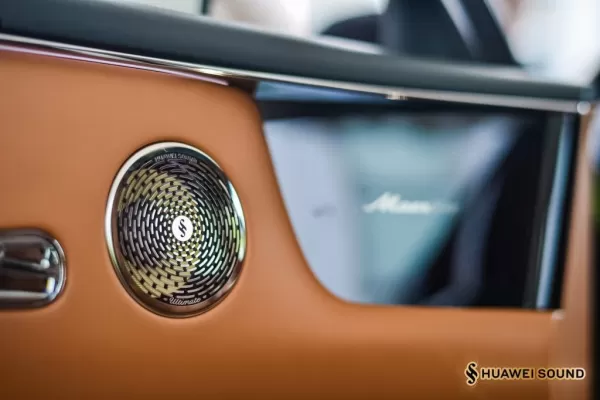
The hardware advancements are precisely engineered rather than generic. The Tangential Force Woofer reorients conventional door-woofer geometry by 90 degrees, minimizing panel resonance while extending bass response. A patented dual-diaphragm subwoofer utilizes the cabin volume directly, overcoming traditional enclosure limitations.
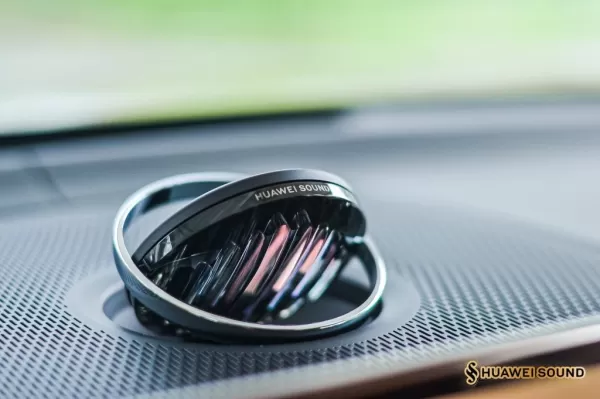
The Crystal Star-Ring Diffuser elevates automatically upon occupant entry, coordinating with rhythm-synchronized ambient lighting while enhancing central image definition – Huawei reports 30% improved sound uniformity compared to prior generations.
The spatial audio implementation employs 10 overhead channels, adaptive sound-field control, and what Huawei characterizes as a proprietary spatial audio track model for positional accuracy and clarity. Notably, the system integrates with HarmonyOS, extending beyond audio into "sound-to-light" technology – AI-driven ambient lighting that reacts to musical content in real-time.
Independent audio zones
The most technologically advanced feature is the independent sound-zone capability. Each of the four headrests incorporates four drivers – two tweeters and two midrange units. Combined with Huawei's sound-field control algorithms, the primary speaker array operates as an active noise canceller, minimizing audio leakage between front and rear seating areas.
Huawei asserts up to 30dB isolation between rows and 99% energy separation. During demonstrations, front passengers enjoyed classical music while rear passengers viewed action films with negligible audible interference. Whether these performance metrics persist across various content types and volume levels requires further real-world validation.
The system also includes road-noise cancellation using what Huawei calls an "omnidimensional model" – multi-channel amplification with low latency applying ear-adaptive cancellation. Multi-layer acoustic glass and specialized absorptive materials provide passive isolation, targeting what the company describes as a "library-level" baseline noise floor.
Evaluating the investment
Huawei revealed substantial R&D expenditures: CNY 179.7 billion (approximately £20 billion / €23.4 billion) in 2024, accounting for 20.8% of total revenue, with more than 113,000 employees in R&D positions. The company indicates approximately CNY 60 billion (roughly £6.6 billion / €7.8 billion) directs specifically toward fundamental science research.
These figures contextualize Huawei's automotive sound engineering aspirations. The company currently provides solutions to over twenty automakers, spanning driver assistance, cockpit systems, acoustics, and control systems. However, Huawei maintains its role as component supplier – individual manufacturers determine market availability and regional deployment.
Market impact considerations
The automotive sound engineering sector has historically been led by established European brands. Huawei's systematic strategy – purpose-built testing facilities, expertise recruited from traditional audio companies, and substantial capital investment – presents a significant challenge to this existing hierarchy.
The relevant question isn't whether Huawei can create impressive technological demonstrations. The Maextro S800 system clearly delivers. The crucial determination is whether this sophistication translates to broader production volumes across multiple vehicle platforms at commercially sustainable price points.
Goller's stated objective remains "optimal reproduction of recordings – delivering the experience artists originally intended." This represents a classic audiophile goal that automotive sound engineering has historically found difficult to achieve given environmental limitations.
Performance evaluation
Following experience with both laboratory facilities and the in-car system, Huawei's program demonstrates methodical soundness. The integration of measurement-driven development and subjective tuning refinement reflects established high-end audio practice, adapted for automotive applications.
Whether this yields market success depends on factors beyond acoustic performance: production scalability, supply chain integration with multiple automakers, and ultimately, whether consumers value features like independent sound zones and advanced tuning sufficiently to justify premium pricing.
Huawei has established the technical groundwork. Commercial validation will materialize as these systems transition from flagship demonstrations into mainstream automotive production lines.
See also: Huawei details open-source AI development roadmap at Huawei Connect 2025

Interested in AI and big data insights from industry leaders? Visit the AI & Big Data Expo in Amsterdam, California, and London. This comprehensive event forms part of TechEx and runs alongside other major technology gatherings. Find additional details here.
AI News operates under TechForge Media. Discover additional upcoming enterprise technology events and webinars here.
Related article
 Warner Music acquires AI attribution startup Sureel AI
Warner Music Group (WMG) confirmed on Wednesday that it is acquiring Sureel AI, an artificial intelligence attribution startup. Sureel’s proprietary technology generates “AI DNA” for musical tracks, deconstructing them into constituent elements to tr
Amazon introduces Alexa for Shopping while pushing Rufus to the background
Amazon has launched Alexa for Shopping, merging its Rufus shopping chatbot with Alexa+ across the app, website, and Echo Show devices.The assistant answers product queries, compares items, tracks prices, and supports shopping reminders. It also handl
Microsoft, Azure and AI Tech Combat California Wildfire Risks
Microsoft invests in AI-driven wildfire detection, with Juan Lavista Ferres, CVP and Chief Data Scientist, discussing strategies to mitigate environmental damage.According to NASA, climate change impacts everyone on Earth, manifesting as rising tempe
Related Special Topic Recommendations
Animation Creation
Warner Music acquires AI attribution startup Sureel AI
Warner Music Group (WMG) confirmed on Wednesday that it is acquiring Sureel AI, an artificial intelligence attribution startup. Sureel’s proprietary technology generates “AI DNA” for musical tracks, deconstructing them into constituent elements to tr
Amazon introduces Alexa for Shopping while pushing Rufus to the background
Amazon has launched Alexa for Shopping, merging its Rufus shopping chatbot with Alexa+ across the app, website, and Echo Show devices.The assistant answers product queries, compares items, tracks prices, and supports shopping reminders. It also handl
Microsoft, Azure and AI Tech Combat California Wildfire Risks
Microsoft invests in AI-driven wildfire detection, with Juan Lavista Ferres, CVP and Chief Data Scientist, discussing strategies to mitigate environmental damage.According to NASA, climate change impacts everyone on Earth, manifesting as rising tempe
Related Special Topic Recommendations
Animation Creation
 AI Scene Animation Tools for Social Media Content
2026 Latest Best Top-rated AI Scene Animation Tools for Social Media Content are curated here by XIX.AI. These powerful game-changing tools offer real-world tests and detailed free vs paid comparison, helping creators boost productivity significantly. Explore now to unlock your AI edge.
 9 tools
 xix.ai
Video creation
AI Short-Form Video Hook Generators for Reels, Shorts, and Product Launch Campaigns
xix.ai
Video creation
AI Short-Form Video Hook Generators for Reels, Shorts, and Product Launch Campaigns
2026 Latest Best AI Short-Form Video Hook Generators for Reels Shorts and Product Launch Campaigns! XIX.AI curates top-rated powerful game-changing tools that deliver must-try results through real-world tests. This weekly updated page offers free vs paid comparison rankings to help you find the perfect solution for boosting content creativity and productivity. Explore now to Unlock your AI edge!
11 tools
xix.ai
writing
AI Article Outline Tools for Long Form Writing
2026 Latest Best Top-Rated AI Article Outline Tools for Long Form Writing! This curated collection features powerful, game-changing tools that deliver accurate, structured outlines with real-world tests to boost writing efficiency significantly. XIX.AI is part of this elite selection. Get a free vs paid comparison to help you choose the perfect tool. Explore now and Unlock your AI edge!
9 tools
xix.ai
chatbot
Best AI Roleplay Chat Apps for Language Practice, Interview Prep, and Daily Fluency
2026 Latest Best Top-rated AI Roleplay Chat Apps for Language Practice, Interview Prep, and Daily Fluency! XIX.AI curates a powerful game-changing collection that offers free vs paid comparison, real-world tests, and updated rankings weekly. These must-try tools help you boost writing skills, overcome fluency challenges, and improve communication efficiency across all daily scenarios. Explore now to discover your perfect tool for language growth!
10 tools
xix.ai
Music composition
AI Stem Separation Tools for Remix Production, Sampling Prep, and Karaoke Masters
2026 Latest Best Top-rated AI Stem Separation Tools Curated for Remix Production, Sampling Prep, and Karaoke Masters. These powerful game-changing tools offer real-world tests to deliver precise audio isolation, boosting productivity significantly. XIX.AI provides a weekly updated free vs paid comparison guide to help you find the must-try solution that suits your needs. Explore now to unlock your AI edge.
8 tools
xix.ai
Data Analysis
AI SQL Copilots for Revenue Dashboards, Funnel Analysis, and Product Metrics
2026 Latest Best AI SQL Copilots Ranked Top-Rated! XIX.AI curates a powerful game-changing collection for weekly updated real-world tests. These must-try tools help you generate accurate revenue dashboards, analyze sales funnels, and track product metrics swiftly, boosting productivity massively. Explore now to Discover your perfect tool for data-driven decision making! 238 characters
9 tools
xix.ai

 Comments (1)
0/500
Comments (1)
0/500
![TimothyCarter]()
Была в шоке, когда прочитала про акустическую лабораторию Huawei в Шанхае! 🤯 Раньше думала, что они только телефоны делают, а тут оказывается целое направление по автомобильному звуку. Интересно, насколько их технологии смогут конкурировать с Bose и Harman? Может, скоро в каждой машине будет 'сделано в Huawei' вместо премиальных брендов? 🎵 Кстати, а как они решают проблему шумоподавления на высоких скоростях?
Stepping into Huawei's Shanghai Acoustics R&D Centre, I anticipated a routine facility visit. Instead, I discovered a sophisticated automotive sound engineering operation poised to disrupt the traditional in-car audio market.
Established following Huawei's major audio research investments starting in 2012, the facility features three specialized testing environments: a 4.8x4x4 metre fully anechoic chamber, a larger 14x12x5 metre semi-anechoic room with a reflective floor, and a dedicated 9.1.6 configuration listening room. While photography restrictions protected proprietary technology, the technical specifications themselves reveal a compelling story.
Addressing automotive audio challenges
Goller, whose career includes roles at Gamut Audio, Bang & Olufsen, and Harman International, leads what Huawei terms "master-tuning methodology" – an approach combining objective acoustic measurements with psychoacoustic principles for final sound calibration.
Speaking in the listening room during the initial tour segment, Goller explained Huawei's development philosophy: accurately reproducing recordings as artists intended, creating what he called a "phantom effect" that immerses listeners in the original recording environment. This demands the integration of scientific acoustic measurement, artistic tuning expertise, and custom-designed hardware.
The technical procedure, he noted, begins with objective measurements – frequency response curves, phase relationships, timing behavior, and distortion characteristics. These establish performance parameters. Subsequent extensive subjective listening sessions then refine the sound using psychoacoustic principles to address inherent cabin challenges: acoustic asymmetry, close-range reflections, and bass loading.
The objective remains working within these physical constraints while maintaining source material authenticity.
Introducing the HUAWEI SOUND ULTIMATE Series
This research culminates in the HUAWEI SOUND ULTIMATE Series, the company's premier audio system currently implemented in the Maextro S800 luxury electric sedan. The configuration includes 43 speakers powered by dual amplifiers generating 2,920 watts combined output.
Huawei's industry-first seat-specific 4D immersive surround sound experience incorporates rear 4D exciters synchronized with audio and video content, enhancing the auditory experience with tactile feedback.
The hardware advancements are precisely engineered rather than generic. The Tangential Force Woofer reorients conventional door-woofer geometry by 90 degrees, minimizing panel resonance while extending bass response. A patented dual-diaphragm subwoofer utilizes the cabin volume directly, overcoming traditional enclosure limitations.
The Crystal Star-Ring Diffuser elevates automatically upon occupant entry, coordinating with rhythm-synchronized ambient lighting while enhancing central image definition – Huawei reports 30% improved sound uniformity compared to prior generations.
The spatial audio implementation employs 10 overhead channels, adaptive sound-field control, and what Huawei characterizes as a proprietary spatial audio track model for positional accuracy and clarity. Notably, the system integrates with HarmonyOS, extending beyond audio into "sound-to-light" technology – AI-driven ambient lighting that reacts to musical content in real-time.
Independent audio zones
The most technologically advanced feature is the independent sound-zone capability. Each of the four headrests incorporates four drivers – two tweeters and two midrange units. Combined with Huawei's sound-field control algorithms, the primary speaker array operates as an active noise canceller, minimizing audio leakage between front and rear seating areas.
Huawei asserts up to 30dB isolation between rows and 99% energy separation. During demonstrations, front passengers enjoyed classical music while rear passengers viewed action films with negligible audible interference. Whether these performance metrics persist across various content types and volume levels requires further real-world validation.
The system also includes road-noise cancellation using what Huawei calls an "omnidimensional model" – multi-channel amplification with low latency applying ear-adaptive cancellation. Multi-layer acoustic glass and specialized absorptive materials provide passive isolation, targeting what the company describes as a "library-level" baseline noise floor.
Evaluating the investment
Huawei revealed substantial R&D expenditures: CNY 179.7 billion (approximately £20 billion / €23.4 billion) in 2024, accounting for 20.8% of total revenue, with more than 113,000 employees in R&D positions. The company indicates approximately CNY 60 billion (roughly £6.6 billion / €7.8 billion) directs specifically toward fundamental science research.
These figures contextualize Huawei's automotive sound engineering aspirations. The company currently provides solutions to over twenty automakers, spanning driver assistance, cockpit systems, acoustics, and control systems. However, Huawei maintains its role as component supplier – individual manufacturers determine market availability and regional deployment.
Market impact considerations
The automotive sound engineering sector has historically been led by established European brands. Huawei's systematic strategy – purpose-built testing facilities, expertise recruited from traditional audio companies, and substantial capital investment – presents a significant challenge to this existing hierarchy.
The relevant question isn't whether Huawei can create impressive technological demonstrations. The Maextro S800 system clearly delivers. The crucial determination is whether this sophistication translates to broader production volumes across multiple vehicle platforms at commercially sustainable price points.
Goller's stated objective remains "optimal reproduction of recordings – delivering the experience artists originally intended." This represents a classic audiophile goal that automotive sound engineering has historically found difficult to achieve given environmental limitations.
Performance evaluation
Following experience with both laboratory facilities and the in-car system, Huawei's program demonstrates methodical soundness. The integration of measurement-driven development and subjective tuning refinement reflects established high-end audio practice, adapted for automotive applications.
Whether this yields market success depends on factors beyond acoustic performance: production scalability, supply chain integration with multiple automakers, and ultimately, whether consumers value features like independent sound zones and advanced tuning sufficiently to justify premium pricing.
Huawei has established the technical groundwork. Commercial validation will materialize as these systems transition from flagship demonstrations into mainstream automotive production lines.
See also: Huawei details open-source AI development roadmap at Huawei Connect 2025
Interested in AI and big data insights from industry leaders? Visit the AI & Big Data Expo in Amsterdam, California, and London. This comprehensive event forms part of TechEx and runs alongside other major technology gatherings. Find additional details here.
AI News operates under TechForge Media. Discover additional upcoming enterprise technology events and webinars here.








 Warner Music acquires AI attribution startup Sureel AI
Warner Music Group (WMG) confirmed on Wednesday that it is acquiring Sureel AI, an artificial intelligence attribution startup. Sureel’s proprietary technology generates “AI DNA” for musical tracks, deconstructing them into constituent elements to tr
Amazon introduces Alexa for Shopping while pushing Rufus to the background
Amazon has launched Alexa for Shopping, merging its Rufus shopping chatbot with Alexa+ across the app, website, and Echo Show devices.The assistant answers product queries, compares items, tracks prices, and supports shopping reminders. It also handl
Warner Music acquires AI attribution startup Sureel AI
Warner Music Group (WMG) confirmed on Wednesday that it is acquiring Sureel AI, an artificial intelligence attribution startup. Sureel’s proprietary technology generates “AI DNA” for musical tracks, deconstructing them into constituent elements to tr
Amazon introduces Alexa for Shopping while pushing Rufus to the background
Amazon has launched Alexa for Shopping, merging its Rufus shopping chatbot with Alexa+ across the app, website, and Echo Show devices.The assistant answers product queries, compares items, tracks prices, and supports shopping reminders. It also handl
 Microsoft, Azure and AI Tech Combat California Wildfire Risks
Microsoft invests in AI-driven wildfire detection, with Juan Lavista Ferres, CVP and Chief Data Scientist, discussing strategies to mitigate environmental damage.According to NASA, climate change impacts everyone on Earth, manifesting as rising tempe
Microsoft, Azure and AI Tech Combat California Wildfire Risks
Microsoft invests in AI-driven wildfire detection, with Juan Lavista Ferres, CVP and Chief Data Scientist, discussing strategies to mitigate environmental damage.According to NASA, climate change impacts everyone on Earth, manifesting as rising tempe

2026 Latest Best Top-rated AI Scene Animation Tools for Social Media Content are curated here by XIX.AI. These powerful game-changing tools offer real-world tests and detailed free vs paid comparison, helping creators boost productivity significantly. Explore now to unlock your AI edge.
9 tools
xix.ai

2026 Latest Best AI Short-Form Video Hook Generators for Reels Shorts and Product Launch Campaigns! XIX.AI curates top-rated powerful game-changing tools that deliver must-try results through real-world tests. This weekly updated page offers free vs paid comparison rankings to help you find the perfect solution for boosting content creativity and productivity. Explore now to Unlock your AI edge!
11 tools
xix.ai

2026 Latest Best Top-Rated AI Article Outline Tools for Long Form Writing! This curated collection features powerful, game-changing tools that deliver accurate, structured outlines with real-world tests to boost writing efficiency significantly. XIX.AI is part of this elite selection. Get a free vs paid comparison to help you choose the perfect tool. Explore now and Unlock your AI edge!
9 tools
xix.ai

2026 Latest Best Top-rated AI Roleplay Chat Apps for Language Practice, Interview Prep, and Daily Fluency! XIX.AI curates a powerful game-changing collection that offers free vs paid comparison, real-world tests, and updated rankings weekly. These must-try tools help you boost writing skills, overcome fluency challenges, and improve communication efficiency across all daily scenarios. Explore now to discover your perfect tool for language growth!
10 tools
xix.ai

2026 Latest Best Top-rated AI Stem Separation Tools Curated for Remix Production, Sampling Prep, and Karaoke Masters. These powerful game-changing tools offer real-world tests to deliver precise audio isolation, boosting productivity significantly. XIX.AI provides a weekly updated free vs paid comparison guide to help you find the must-try solution that suits your needs. Explore now to unlock your AI edge.
8 tools
xix.ai

2026 Latest Best AI SQL Copilots Ranked Top-Rated! XIX.AI curates a powerful game-changing collection for weekly updated real-world tests. These must-try tools help you generate accurate revenue dashboards, analyze sales funnels, and track product metrics swiftly, boosting productivity massively. Explore now to Discover your perfect tool for data-driven decision making! 238 characters
9 tools
xix.ai

Была в шоке, когда прочитала про акустическую лабораторию Huawei в Шанхае! 🤯 Раньше думала, что они только телефоны делают, а тут оказывается целое направление по автомобильному звуку. Интересно, насколько их технологии смогут конкурировать с Bose и Harman? Может, скоро в каждой машине будет 'сделано в Huawei' вместо премиальных брендов? 🎵 Кстати, а как они решают проблему шумоподавления на высоких скоростях?












