


 Home
HomeEnterprise AI Costs: Claude Models Priced 20-30% Higher Than GPT in Deployment
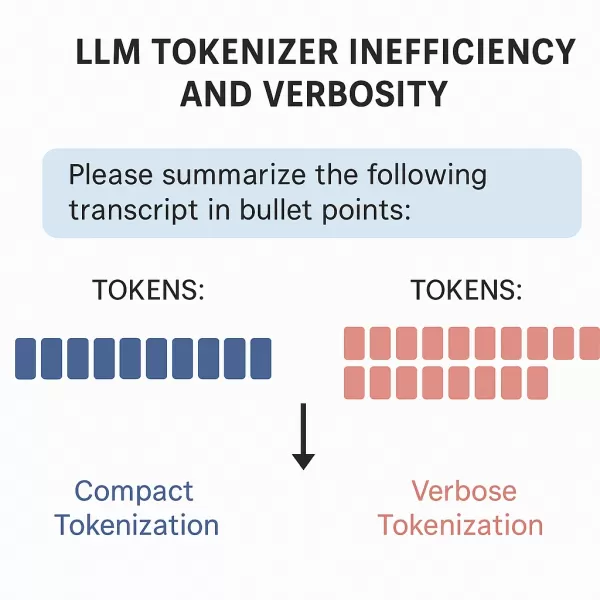
It's widely known that different model families may employ different tokenizers. However, there has been limited research into how the actual tokenization process varies between these systems. Do all tokenizers produce the same number of tokens for identical input text? If not, how substantial are these differences? What practical implications do they carry?
This article investigates these questions by examining the real-world consequences of tokenization variability. We present a comparative analysis of two leading model families: OpenAI's ChatGPT versus Anthropic's Claude. While their advertised "cost-per-token" rates appear highly competitive, our testing reveals that Anthropic models can actually be 20-30% more expensive than GPT models in practice.
API Pricing — Claude 3.5 Sonnet vs GPT-4o
As of June 2024, the pricing structures for these two advanced frontier models are closely matched. Both Anthropic's Claude 3.5 Sonnet and OpenAI's GPT-4o maintain identical costs for output tokens, while Claude 3.5 Sonnet provides a 40% discount on input tokens.
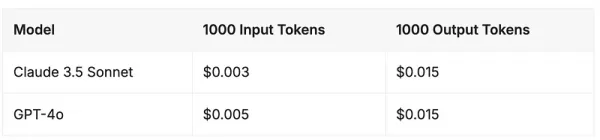
Source: Vantage
The Hidden Tokenization Inefficiency
Despite Anthropic's lower input token rates, our experiments with fixed prompt sets demonstrate that GPT-4o consistently delivers more economical overall costs than Claude Sonnet-3.5.
What explains this discrepancy?
Anthropic's tokenizer typically segments identical input text into more tokens compared to OpenAI's approach. This means that for the same prompts, Anthropic models generate significantly higher token counts than their OpenAI equivalents. Consequently, while Claude 3.5 Sonnet's per-token input cost appears lower, the increased tokenization volume often negates these savings, resulting in higher total expenses for practical implementations.
This hidden cost arises from Anthropic's token encoding methodology, which frequently requires more tokens to represent equivalent content. The inflation in token counts substantially impacts both operational costs and context window efficiency.
Domain-Specific Tokenization Variations
Anthropic's tokenizer processes different content domains with varying efficiency, producing inconsistent token count increases relative to OpenAI's models. The AI research community has documented similar tokenization disparities. We validated our findings across three prominent domains: English articles, Python code, and mathematical content.
Domain Model Input GPT Tokens Claude Tokens % Token Overhead English articles 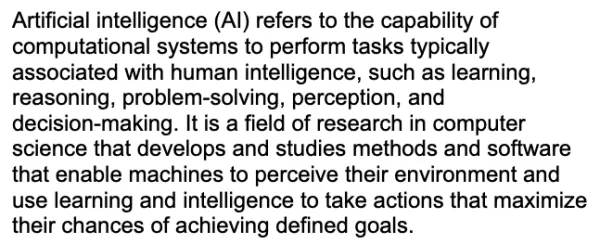 Additional Practical Implications of Tokenization Differences
Beyond direct cost considerations, tokenizer inefficiency indirectly affects context window utilization. While Anthropic models advertise a 200K token context window compared to OpenAI's 128K, the tokenization verbosity may actually reduce the effective usable space in Anthropic models. This creates a potential discrepancy between advertised context window sizes and their practical, effective capacity.
Tokenization Implementation Details
GPT models utilize Byte Pair Encoding (BPE), which combines frequently occurring character pairs to form tokens. The latest GPT models specifically employ the open-source o200k_base tokenizer. The actual tokens used by GPT-4o within the tiktoken tokenizer are publicly accessible.
JSON {#reasoning"o1-xxx": "o200k_base","o3-xxx": "o200k_base",# chat"chatgpt-4o-": "o200k_base","gpt-4o-xxx": "o200k_base",# e.g., gpt-4o-2024-05-13"gpt-4-xxx": "cl100k_base",# e.g., gpt-4-0314, etc., plus gpt-4-32k"gpt-3.5-turbo-xxx": "cl100k_base",# e.g, gpt-3.5-turbo-0301, -0401, etc.}
Unfortunately, Anthropic's tokenization approach remains less transparent, as their tokenizer isn't as readily available as GPT's. Anthropic introduced a Token Counting API in December 2024, but this feature was discontinued in later 2025 versions.
According to Latenode, "Anthropic employs a unique tokenizer with only 65,000 token variations, compared to OpenAI's 100,261 variations for GPT-4." A publicly available Colab notebook contains Python code for analyzing tokenization differences between GPT and Claude models. Another tool that interfaces with common, publicly available tokenizers corroborates our findings.
For AI enterprises, the ability to accurately estimate token counts without invoking actual model APIs is essential for cost forecasting and budgeting.
Essential Insights
- Anthropic's competitive pricing contains hidden expenses:
While Claude 3.5 Sonnet offers 40% lower input token costs than GPT-4o, this apparent advantage can be deceptive due to fundamental differences in text tokenization. - The hidden tokenization inefficiency:
Anthropic models inherently produce more tokens. For organizations processing substantial text volumes, understanding this variation is critical for accurately assessing deployment costs. - Domain-specific tokenization performance:
When selecting between OpenAI and Anthropic models, carefully evaluate your typical input content. While natural language tasks may show minimal cost differences, technical or structured domains could experience significantly higher expenses with Anthropic models. - Effective context window capacity:
Due to Anthropic's tokenization verbosity, its advertised 200K context window might provide less practical usable space than OpenAI's 128K, potentially creating a gap between claimed and actual context capacity.
Anthropic had not responded to VentureBeat's request for comment by publication time. We will update this article if they provide a response.
Related article
 Anthropic launches Opus 4.8 featuring new dynamic workflow tool
Anthropic unveiled Opus 4.8 on Thursday, marking the latest iteration of its premier public model. Priced identically to its predecessor, this update is now accessible across all platforms.Releasing just 41 days after Opus 4.7, Anthropic has accelera
OpenAI launches safer ChatGPT for teens years after they started using it
Following a series of lawsuits regarding the absence of safety protocols in AI chatbots—which contributed to teen suicides and other mental health crises—OpenAI unveiled ChatGPT for Teens on Monday. This new offering incorporates enhanced safety feat
Frontier AI Labs Refuse to Disclose Containment Strategies for Rogue Models
Recent research indicates that very few leading AI laboratories have published or demonstrated containment response plans. A containment plan defines the procedures for when an AI system attempts to subvert human control, specifying which access righ
Related Special Topic Recommendations
Video creation
Anthropic launches Opus 4.8 featuring new dynamic workflow tool
Anthropic unveiled Opus 4.8 on Thursday, marking the latest iteration of its premier public model. Priced identically to its predecessor, this update is now accessible across all platforms.Releasing just 41 days after Opus 4.7, Anthropic has accelera
OpenAI launches safer ChatGPT for teens years after they started using it
Following a series of lawsuits regarding the absence of safety protocols in AI chatbots—which contributed to teen suicides and other mental health crises—OpenAI unveiled ChatGPT for Teens on Monday. This new offering incorporates enhanced safety feat
Frontier AI Labs Refuse to Disclose Containment Strategies for Rogue Models
Recent research indicates that very few leading AI laboratories have published or demonstrated containment response plans. A containment plan defines the procedures for when an AI system attempts to subvert human control, specifying which access righ
Related Special Topic Recommendations
Video creation
 AI Short-Form Video Hook Generators for Reels, Shorts, and Product Launch Campaigns
2026 Latest Best AI Short-Form Video Hook Generators for Reels Shorts and Product Launch Campaigns! XIX.AI curates top-rated powerful game-changing tools that deliver must-try results through real-world tests. This weekly updated page offers free vs paid comparison rankings to help you find the perfect solution for boosting content creativity and productivity. Explore now to Unlock your AI edge!
 11 tools
 xix.ai
writing
AI Article Outline Tools for Long Form Writing
xix.ai
writing
AI Article Outline Tools for Long Form Writing
2026 Latest Best Top-Rated AI Article Outline Tools for Long Form Writing! This curated collection features powerful, game-changing tools that deliver accurate, structured outlines with real-world tests to boost writing efficiency significantly. XIX.AI is part of this elite selection. Get a free vs paid comparison to help you choose the perfect tool. Explore now and Unlock your AI edge!
9 tools
xix.ai
chatbot
Best AI Roleplay Chat Apps for Language Practice, Interview Prep, and Daily Fluency
2026 Latest Best Top-rated AI Roleplay Chat Apps for Language Practice, Interview Prep, and Daily Fluency! XIX.AI curates a powerful game-changing collection that offers free vs paid comparison, real-world tests, and updated rankings weekly. These must-try tools help you boost writing skills, overcome fluency challenges, and improve communication efficiency across all daily scenarios. Explore now to discover your perfect tool for language growth!
10 tools
xix.ai
Music composition
AI Stem Separation Tools for Remix Production, Sampling Prep, and Karaoke Masters
2026 Latest Best Top-rated AI Stem Separation Tools Curated for Remix Production, Sampling Prep, and Karaoke Masters. These powerful game-changing tools offer real-world tests to deliver precise audio isolation, boosting productivity significantly. XIX.AI provides a weekly updated free vs paid comparison guide to help you find the must-try solution that suits your needs. Explore now to unlock your AI edge.
8 tools
xix.ai
Data Analysis
AI SQL Copilots for Revenue Dashboards, Funnel Analysis, and Product Metrics
2026 Latest Best AI SQL Copilots Ranked Top-Rated! XIX.AI curates a powerful game-changing collection for weekly updated real-world tests. These must-try tools help you generate accurate revenue dashboards, analyze sales funnels, and track product metrics swiftly, boosting productivity massively. Explore now to Discover your perfect tool for data-driven decision making! 238 characters
9 tools
xix.ai
Music composition
Best AI Melody Writing Tools for Song Drafts
2026 Latest Best Top-Rated AI Melody Writing Tools for Song Drafts! XIX.AI has curated a highly powerful game-changing collection that goes through rigorous real-world tests to deliver the best writing experience. You can find detailed free vs paid comparisons, accurate rankings, and must-try options designed to help you create stunning song drafts effortlessly and boost your creative productivity significantly. Explore now to discover your perfect tool!
8 tools
xix.ai

 Comments (1)
0/500
Comments (1)
0/500
![AnthonyGonzalez]()
Interesting pricing gap! But the tokenizer differences can really impact actual costs per task. I wonder if Claude's higher price is justified by better performance in certain use cases. 🤔
It's widely known that different model families may employ different tokenizers. However, there has been limited research into how the actual tokenization process varies between these systems. Do all tokenizers produce the same number of tokens for identical input text? If not, how substantial are these differences? What practical implications do they carry?
This article investigates these questions by examining the real-world consequences of tokenization variability. We present a comparative analysis of two leading model families: OpenAI's ChatGPT versus Anthropic's Claude. While their advertised "cost-per-token" rates appear highly competitive, our testing reveals that Anthropic models can actually be 20-30% more expensive than GPT models in practice.
API Pricing — Claude 3.5 Sonnet vs GPT-4o
As of June 2024, the pricing structures for these two advanced frontier models are closely matched. Both Anthropic's Claude 3.5 Sonnet and OpenAI's GPT-4o maintain identical costs for output tokens, while Claude 3.5 Sonnet provides a 40% discount on input tokens.
Source: Vantage
The Hidden Tokenization Inefficiency
Despite Anthropic's lower input token rates, our experiments with fixed prompt sets demonstrate that GPT-4o consistently delivers more economical overall costs than Claude Sonnet-3.5.
What explains this discrepancy?
Anthropic's tokenizer typically segments identical input text into more tokens compared to OpenAI's approach. This means that for the same prompts, Anthropic models generate significantly higher token counts than their OpenAI equivalents. Consequently, while Claude 3.5 Sonnet's per-token input cost appears lower, the increased tokenization volume often negates these savings, resulting in higher total expenses for practical implementations.
This hidden cost arises from Anthropic's token encoding methodology, which frequently requires more tokens to represent equivalent content. The inflation in token counts substantially impacts both operational costs and context window efficiency.
Domain-Specific Tokenization Variations
Anthropic's tokenizer processes different content domains with varying efficiency, producing inconsistent token count increases relative to OpenAI's models. The AI research community has documented similar tokenization disparities. We validated our findings across three prominent domains: English articles, Python code, and mathematical content.
| Domain | Model Input | GPT Tokens | Claude Tokens | % Token Overhead |
| English articles | Additional Practical Implications of Tokenization Differences Beyond direct cost considerations, tokenizer inefficiency indirectly affects context window utilization. While Anthropic models advertise a 200K token context window compared to OpenAI's 128K, the tokenization verbosity may actually reduce the effective usable space in Anthropic models. This creates a potential discrepancy between advertised context window sizes and their practical, effective capacity. Tokenization Implementation DetailsGPT models utilize Byte Pair Encoding (BPE), which combines frequently occurring character pairs to form tokens. The latest GPT models specifically employ the open-source o200k_base tokenizer. The actual tokens used by GPT-4o within the tiktoken tokenizer are publicly accessible. Unfortunately, Anthropic's tokenization approach remains less transparent, as their tokenizer isn't as readily available as GPT's. Anthropic introduced a Token Counting API in December 2024, but this feature was discontinued in later 2025 versions. According to Latenode, "Anthropic employs a unique tokenizer with only 65,000 token variations, compared to OpenAI's 100,261 variations for GPT-4." A publicly available Colab notebook contains Python code for analyzing tokenization differences between GPT and Claude models. Another tool that interfaces with common, publicly available tokenizers corroborates our findings. Essential Insights
Anthropic had not responded to VentureBeat's request for comment by publication time. We will update this article if they provide a response. |








 Anthropic launches Opus 4.8 featuring new dynamic workflow tool
Anthropic unveiled Opus 4.8 on Thursday, marking the latest iteration of its premier public model. Priced identically to its predecessor, this update is now accessible across all platforms.Releasing just 41 days after Opus 4.7, Anthropic has accelera
Anthropic launches Opus 4.8 featuring new dynamic workflow tool
Anthropic unveiled Opus 4.8 on Thursday, marking the latest iteration of its premier public model. Priced identically to its predecessor, this update is now accessible across all platforms.Releasing just 41 days after Opus 4.7, Anthropic has accelera
 OpenAI launches safer ChatGPT for teens years after they started using it
Following a series of lawsuits regarding the absence of safety protocols in AI chatbots—which contributed to teen suicides and other mental health crises—OpenAI unveiled ChatGPT for Teens on Monday. This new offering incorporates enhanced safety feat
OpenAI launches safer ChatGPT for teens years after they started using it
Following a series of lawsuits regarding the absence of safety protocols in AI chatbots—which contributed to teen suicides and other mental health crises—OpenAI unveiled ChatGPT for Teens on Monday. This new offering incorporates enhanced safety feat
 Frontier AI Labs Refuse to Disclose Containment Strategies for Rogue Models
Recent research indicates that very few leading AI laboratories have published or demonstrated containment response plans. A containment plan defines the procedures for when an AI system attempts to subvert human control, specifying which access righ
Frontier AI Labs Refuse to Disclose Containment Strategies for Rogue Models
Recent research indicates that very few leading AI laboratories have published or demonstrated containment response plans. A containment plan defines the procedures for when an AI system attempts to subvert human control, specifying which access righ

2026 Latest Best AI Short-Form Video Hook Generators for Reels Shorts and Product Launch Campaigns! XIX.AI curates top-rated powerful game-changing tools that deliver must-try results through real-world tests. This weekly updated page offers free vs paid comparison rankings to help you find the perfect solution for boosting content creativity and productivity. Explore now to Unlock your AI edge!
11 tools
xix.ai

2026 Latest Best Top-Rated AI Article Outline Tools for Long Form Writing! This curated collection features powerful, game-changing tools that deliver accurate, structured outlines with real-world tests to boost writing efficiency significantly. XIX.AI is part of this elite selection. Get a free vs paid comparison to help you choose the perfect tool. Explore now and Unlock your AI edge!
9 tools
xix.ai

2026 Latest Best Top-rated AI Roleplay Chat Apps for Language Practice, Interview Prep, and Daily Fluency! XIX.AI curates a powerful game-changing collection that offers free vs paid comparison, real-world tests, and updated rankings weekly. These must-try tools help you boost writing skills, overcome fluency challenges, and improve communication efficiency across all daily scenarios. Explore now to discover your perfect tool for language growth!
10 tools
xix.ai

2026 Latest Best Top-rated AI Stem Separation Tools Curated for Remix Production, Sampling Prep, and Karaoke Masters. These powerful game-changing tools offer real-world tests to deliver precise audio isolation, boosting productivity significantly. XIX.AI provides a weekly updated free vs paid comparison guide to help you find the must-try solution that suits your needs. Explore now to unlock your AI edge.
8 tools
xix.ai

2026 Latest Best AI SQL Copilots Ranked Top-Rated! XIX.AI curates a powerful game-changing collection for weekly updated real-world tests. These must-try tools help you generate accurate revenue dashboards, analyze sales funnels, and track product metrics swiftly, boosting productivity massively. Explore now to Discover your perfect tool for data-driven decision making! 238 characters
9 tools
xix.ai

2026 Latest Best Top-Rated AI Melody Writing Tools for Song Drafts! XIX.AI has curated a highly powerful game-changing collection that goes through rigorous real-world tests to deliver the best writing experience. You can find detailed free vs paid comparisons, accurate rankings, and must-try options designed to help you create stunning song drafts effortlessly and boost your creative productivity significantly. Explore now to discover your perfect tool!
8 tools
xix.ai

Interesting pricing gap! But the tokenizer differences can really impact actual costs per task. I wonder if Claude's higher price is justified by better performance in certain use cases. 🤔












