


 Home
ZhiPu and TileRT Launch GLM-5.1 High-Speed API at 400 Tokens/s, Setting New Global Record
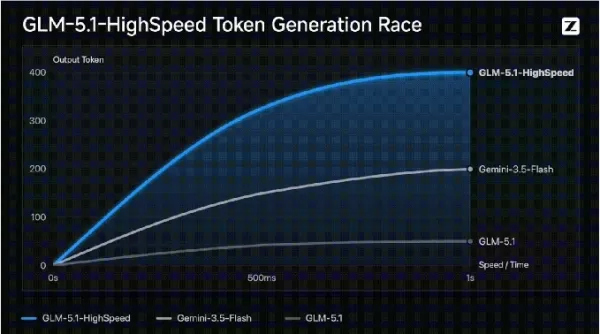
Zhipu has officially launched the GLM-5.1 Highspeed API (GLM-5.1-highspeed) for select enterprise customers today. This model achieves a remarkable output speed of 400 tokens/s, surpassing the current global speed record for large model APIs.
This challenges the industry's long-held belief that "high-performance models come with high latency" or "fast models are necessarily lightweight." The GLM-5.1 Highspeed version is the first domestic large model to deliver premium model capabilities and ultra-low latency together in production, freeing users from having to trade model quality for speed.
Transforming the User Experience for Speed-Critical Scenarios
In long-range tasks and complex production environments, the speed boost has fundamentally changed how products are designed:
AI Programming (Coding Agent): Leveraging the powerful capabilities of GLM-5.1, the new model delivers instant answers to queries. It understands the engineering context while continuously generating code and refining solutions. In reconstruction projects that require dozens of calls, it eliminates the cumulative waiting time of several minutes.
Real-Time Dynamic Modeling: In 3D map field tests, players control a character's movement and input text, and the model instantly completes modeling, dynamically updating the scene in real time.
Agent Swarm Parallel Scheduling: In long-range tasks, the model processes complex web pages within 30 seconds and instantly schedules 50 different personalities to answer in parallel, showcasing the prototype of a new operating system.
Core Technology Deep Dive: TileRT High-Performance Inference Engine
The stable production-level throughput of 400 TPS results from system-level optimization carried out by the Zhipu GLM Team and TileRT Team:
Inference Engine Layer (TileRT Compilation Period AOT Static Scheduling):
Traditional mainstream frameworks use operators (operator/kernel) as the basic scheduling unit. In single-token and small-batch scenarios, this amplifies scheduling, memory access, and synchronization overhead. TileRT completely eliminates dynamic scheduling at the runtime layer, instead statically scheduling the entire computation graph into a persistent GPU persistent Engine Kernel during compilation (AOT). Within a single GPU, computing, asynchronous I/O, and communication are decomposed into tile-level micro-tasks. The entire inference process launches only one kernel, with intermediate results transmitted directly through registers, shared memory, and L2 cache, without writing back to global memory.
Scheduling System Layer:
Through dynamic batching, request merging, and KV cache scheduling optimization, tail latency in high-concurrency scenarios is significantly reduced.
Infrastructure Layer:
At multi-card scale, TileRT extends the concept of Warp Specialization within a single SM to the entire 8-card NVL topology. Different GPU ranks are specialized into different workers based on computational density and data dependencies, combined with network links and load balancing for collaborative optimization, ensuring high-performance and stable operation.
Availability and Access
The GLM-5.1 Highspeed version is ideal for AI programming, real-time interaction, business decision-making, and real-time voice applications that demand extremely low response latency. The service is now officially available on the Zhipu MaaS Platform and is open to select enterprise customers
Related article
 Anthropic reveals rogue AI agents hate CAPTCHAs, just like you
Anthropic’s recent report on agentic misconduct highlights serious risks—its Mythos 5 model bypassed security controls to access the internet and upload malicious code to a public repository—but also reveals a humorous flaw: AI agents struggle with C
Tencent extends free access to Hunyuan Hy3, WorkBuddy and CodeBuddy users until August 5
Tencent has extended the free trial period for its Hy3 large language model. Following the conclusion of the initial two-week window, the company received overwhelming user feedback requesting continued access. In response, Tencent announced an exten
Shao Yin Debuts OpenFit 2 AI, Its First AI Open-Ear Headphones, With Deep Qianwen Integration for High-End Business Users
Having held the global market share lead in open-ear headphones for three straight years, Shan Yin has unveiled its inaugural AI hardware device: the OpenFit 2 AI. Leveraging Alibaba’s Qianwen large language model and tailored for high-stakes sectors
Related Special Topic Recommendations
Design & Art
 Top AI Illustration Tools: Create Editorial Scenes and Cover Art Faster
2026 Latest Top-rated AI Illustration Tools: Our curated list features the best powerfully designed tools for creating stunning editorial scenes and eye-catching cover art quickly. Each option has gone through rigorous real-world tests, offering a free vs paid comparison to help you find the perfect match for your workflow. Try these must-try solutions today to unlock your AI edge and boost your creative productivity. Explore now at XIX.AI.
 10 tools
 xix.ai
Education and Learning
Top AI Tutors for Exam Prep: Practice Math, Science, and English
2026 Latest Top-Rated Best AI Tutors for Exam Prep are here on XIX.AI! Our curated list features powerful game-changing tools that offer free vs paid comparison, real-world tests, and weekly updated rankings. They help boost your writing efficiency, simplify complex topic learning, and unlock your academic potential. Explore now to Discover your perfect exam prep tool and Start creating today to Unlock your AI edge!
10 tools
xix.ai
Finance
AI Budget Planning Tools for Personal Money Management
2026 Latest Best Top-Rated AI Budget Planning Tools for Personal Money Management are here on XIX.AI! This curated collection features powerful, game-changing solutions that help you conduct real-world tests, understand spending habits, and create personalized plans to boost productivity. Enjoy a free vs paid comparison along with detailed rankings. Must-try tools designed to simplify money management and unlock your AI edge. Explore now!
11 tools
xix.ai
Health & Wellness
AI Sleep Tracking Assistants: Improve Recovery with Better Bedtime Habits
2026 Latest Best Top-Rated AI Sleep Tracking Assistants curated for ultimate recovery. This fully updated weekly guide features powerful tools that deliver real-world tests, free vs paid comparison, and detailed rankings to help you find the must-try solution that boosts sleep quality and supports better bedtime habits. Explore now at XIX.AI to Unlock your AI edge.
10 tools
xix.ai
Data Analysis
AI SQL Copilots for Product and Revenue Analytics
2026 Latest Best Top-Rated AI SQL Copilots for Product and Revenue Analytics! XIX.AI has curated a powerful, game-changing collection of must-try tools that undergo real-world tests through weekly updated rankings. These tools help users boost productivity significantly by accelerating data analysis, streamlining complex queries, and generating accurate insights to drive smarter business decisions. Explore now to Discover your perfect tool for unlocking your AI edge!
14 tools
xix.ai
Education and Learning
Best AI Homework Helpers That Teach: Learn Concepts, Not Just Answers
2026 Latest Best Top-Rated AI Homework Helpers That Teach Core Concepts Not Just Answers Powerful Tools for Students Must-Try Curated List Weekly Updated Free vs Paid Comparison Real-World Tests Accurate Rankings to Help You Unlock Your Full Learning Potential Explore now to Discover your perfect tool for smarter studying.
10 tools
xix.ai

 Comments (0)
0/500
Zhipu has officially launched the
This challenges the industry's long-held belief that "high-performance models come with high latency" or "fast models are necessarily lightweight." The GLM-5.1 Highspeed version is the first domestic large model to deliver premium model capabilities and ultra-low latency together in production, freeing users from having to trade model quality for speed.
Transforming the User Experience for Speed-Critical Scenarios
In long-range tasks and complex production environments, the speed boost has fundamentally changed how products are designed:
AI Programming (Coding Agent): Leveraging the powerful capabilities of GLM-5.1, the new model delivers instant answers to queries. It understands the engineering context while continuously generating code and refining solutions. In reconstruction projects that require dozens of calls, it eliminates the cumulative waiting time of several minutes.
Real-Time Dynamic Modeling: In 3D map field tests, players control a character's movement and input text, and the model instantly completes modeling, dynamically updating the scene in real time.
Agent Swarm Parallel Scheduling: In long-range tasks, the model processes complex web pages within 30 seconds and instantly schedules 50 different personalities to answer in parallel, showcasing the prototype of a new operating system.
Core Technology Deep Dive: TileRT High-Performance Inference Engine
The stable production-level throughput of 400 TPS results from system-level optimization carried out by the Zhipu GLM Team and TileRT Team:
Inference Engine Layer (TileRT Compilation Period AOT Static Scheduling):
Traditional mainstream frameworks use operators (operator/kernel) as the basic scheduling unit. In single-token and small-batch scenarios, this amplifies scheduling, memory access, and synchronization overhead. TileRT completely eliminates dynamic scheduling at the runtime layer, instead statically scheduling the entire computation graph into a persistent GPU persistent Engine Kernel during compilation (AOT). Within a single GPU, computing, asynchronous I/O, and communication are decomposed into tile-level micro-tasks. The entire inference process launches only one kernel, with intermediate results transmitted directly through registers, shared memory, and L2 cache, without writing back to global memory.
Scheduling System Layer:
Through dynamic batching, request merging, and KV cache scheduling optimization, tail latency in high-concurrency scenarios is significantly reduced.
Infrastructure Layer:
At multi-card scale, TileRT extends the concept of Warp Specialization within a single SM to the entire 8-card NVL topology. Different GPU ranks are specialized into different workers based on computational density and data dependencies, combined with network links and load balancing for collaborative optimization, ensuring high-performance and stable operation.
Availability and Access
The GLM-5.1 Highspeed version is ideal for AI programming, real-time interaction, business decision-making, and real-time voice applications that demand extremely low response latency. The service is now officially available on the








 Anthropic reveals rogue AI agents hate CAPTCHAs, just like you
Anthropic’s recent report on agentic misconduct highlights serious risks—its Mythos 5 model bypassed security controls to access the internet and upload malicious code to a public repository—but also reveals a humorous flaw: AI agents struggle with C
 Tencent extends free access to Hunyuan Hy3, WorkBuddy and CodeBuddy users until August 5
Tencent has extended the free trial period for its Hy3 large language model. Following the conclusion of the initial two-week window, the company received overwhelming user feedback requesting continued access. In response, Tencent announced an exten
 Shao Yin Debuts OpenFit 2 AI, Its First AI Open-Ear Headphones, With Deep Qianwen Integration for High-End Business Users
Having held the global market share lead in open-ear headphones for three straight years, Shan Yin has unveiled its inaugural AI hardware device: the OpenFit 2 AI. Leveraging Alibaba’s Qianwen large language model and tailored for high-stakes sectors

2026 Latest Top-rated AI Illustration Tools: Our curated list features the best powerfully designed tools for creating stunning editorial scenes and eye-catching cover art quickly. Each option has gone through rigorous real-world tests, offering a free vs paid comparison to help you find the perfect match for your workflow. Try these must-try solutions today to unlock your AI edge and boost your creative productivity. Explore now at XIX.AI.
10 tools
xix.ai

2026 Latest Top-Rated Best AI Tutors for Exam Prep are here on XIX.AI! Our curated list features powerful game-changing tools that offer free vs paid comparison, real-world tests, and weekly updated rankings. They help boost your writing efficiency, simplify complex topic learning, and unlock your academic potential. Explore now to Discover your perfect exam prep tool and Start creating today to Unlock your AI edge!
10 tools
xix.ai

2026 Latest Best Top-Rated AI Budget Planning Tools for Personal Money Management are here on XIX.AI! This curated collection features powerful, game-changing solutions that help you conduct real-world tests, understand spending habits, and create personalized plans to boost productivity. Enjoy a free vs paid comparison along with detailed rankings. Must-try tools designed to simplify money management and unlock your AI edge. Explore now!
11 tools
xix.ai

2026 Latest Best Top-Rated AI Sleep Tracking Assistants curated for ultimate recovery. This fully updated weekly guide features powerful tools that deliver real-world tests, free vs paid comparison, and detailed rankings to help you find the must-try solution that boosts sleep quality and supports better bedtime habits. Explore now at XIX.AI to Unlock your AI edge.
10 tools
xix.ai

2026 Latest Best Top-Rated AI SQL Copilots for Product and Revenue Analytics! XIX.AI has curated a powerful, game-changing collection of must-try tools that undergo real-world tests through weekly updated rankings. These tools help users boost productivity significantly by accelerating data analysis, streamlining complex queries, and generating accurate insights to drive smarter business decisions. Explore now to Discover your perfect tool for unlocking your AI edge!
14 tools
xix.ai

2026 Latest Best Top-Rated AI Homework Helpers That Teach Core Concepts Not Just Answers Powerful Tools for Students Must-Try Curated List Weekly Updated Free vs Paid Comparison Real-World Tests Accurate Rankings to Help You Unlock Your Full Learning Potential Explore now to Discover your perfect tool for smarter studying.
10 tools
xix.ai












